conscious fashion

The Striped Tunic Sweater by Plantation

Reading Time: 2 minutes

Minimal, seasonless and timeless design from Japan


Going ahead with defining a capsule wardrobe, today we introduce: The Striped Tunic Sweater by Plantation1982.

Here, we are going to tell you more about the material and design which, at first, may look simple, yet each detail is deeply curated. Perhaps noticing details is something people are not used to anymore, though we know that some individuals have a special eye. But for those who don’t, we hope you’ll rediscover the pleasure of being more attentive, and maybe, more curious.

Discover The Striped Tunic Sweater


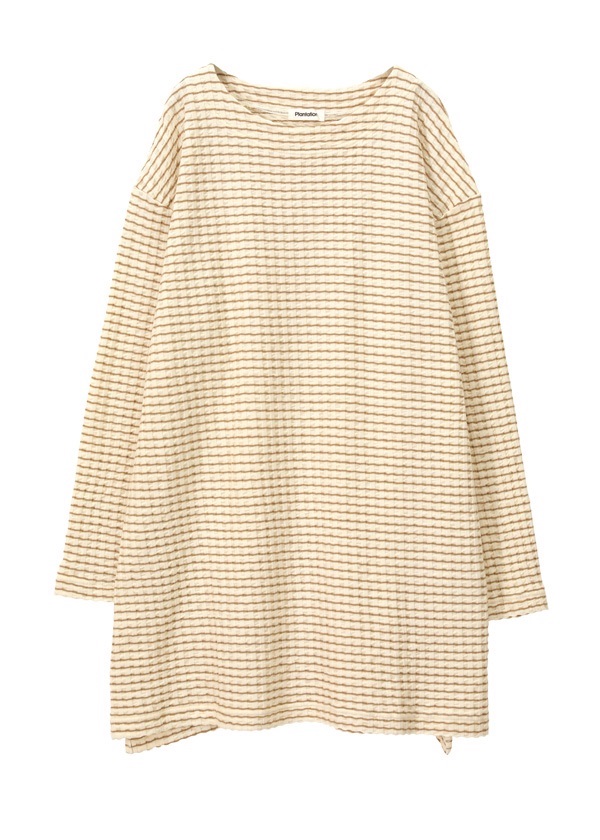
Made in Japan, this sweater is 100% cotton – with a soft hand. It’s easy to match, and its cosy silhouette adds an elegant touch even to casual outfits.
the-striped-tunic-sweater
The Striped Tunic Sweater
Plantation


The ripple structure is swollen, like a tube – replacing the usual rib working.
The boat neck is shallow in the vertical direction and wide in the horizontal. This design makes the neckline look beautiful.

In addition, the vertical texture of the fabric makes it difficult to pick up the lines of your body and underwear. As a result, this garment is very comfortable to wear.

The tunic sweater is ideal transitioning between seasons. But no worries, when the weather gets colder, it is easy to layer over it with a cardigan. Or a tank top or t-shirt underneath. Since the material surface is uneven, it will look great with many outfits.

The length is 168 cm, so it comfortably covers the hip line.

Now the colour: off-white. The base is off-white as a gentle cream. The stripes are mocha brown, giving an overall light and soft impression.

This product is washed to give it a unique texture. And, most importantly, you can wash it by hand at home (easy-care product).

Educating ourselves to be aware of what we buy. Taking more time to evaluate, appreciating details – is a worthy exercise.
The world is full of garbage, we don’t need more of it. Choose wisely!

The Striped Tunic Sweater by Plantation Read More »

Not For All – Arrogance Or Honesty?

Reading Time: 2 minutes

The point on exclusivity and unconventional work


When we say that our work is not for all, it shouldn’t be seen as a sign of arrogance. On the contrary, if you ponder a little on the true meaning, you will perceive that it denotes a genuine and realistic approach.

Can we truly please everyone? No, obviously, we cannot.
To illustrate, if you usually buy fast fashion, you would never check out our selection. If you like showing off logo-emblazoned garments, we are not for you. If you are a passive consumer, perhaps you will not interact with us.

Pleasing everyone is a naive goal, and though it’s impossible to accomplish, the downside of trying is that it generates a bazaar of elements. A fragmented and undefined proposal where everything is possible, but nothing stands out. Because there is no soul. No clarity. The truth is that you have to be honest to say that what you do is not for everyone.

Over about twenty-five years in the fashion field, we saw the rise and fall of the system. A fast-paced environment in which profit and marketing took over creativity. And ultimately, it led to the exploitation of people and the planet. This system now needs a new air, something more, beyond that glossy facade. Creative visions supported by a conscious approach.

We are a drop in the ocean, but we are trying to bring a different perspective, providing a deeper meaning to fashion, and rediscovering its true beauty. And therefore evolve to the next level.

Our selection and thoughts are for those who appreciate the value of unconventional work that falls outside an imposed system. We aim to interact with individuals who are not passive consumers but active thinkers. Those who want to be informed because they are not stuck in the past or constrained by pointless rules but constantly evolving.

Not for all–but it might be for you.

Not For All – Arrogance Or Honesty? Read More »

Awakening: Social and Ethical Consciousness

Reading Time: 2 minutes

Exploring the impact of modern issues on personal responsibility and collective action


Awakening means developing your consciousness – ethical and social – in order to become a better human.

Awakening is an intentional choice. Indeed, it is the act of opening our eyes to realise what happens inside and around us. Once we understand the reality, the damage we have caused to other people and the environment, awakening follows.

Therefore, we become aware that acting without considering the consequences – in other words, acting without a long-term ethical vision – is not a worthy choice.

Awakening requires our eyes to see, our brain to think and pay attention, freeing our conscience to emerge. For instance, we reach a higher level of consciousness by reading books, essays, or newsletters. Following thoughtful leaders. Interacting and sharing ideas in a community. Perhaps we could list other ways, but honestly, meditation is not our field of knowledge.

Ultimately, awakening is free.
So, you can pay someone to turn on the light for you, but then the process is yours, and no one can do it for you.

How does it all connect to fashion?
Believe us, it does. Fashion, as a reflection of our society, is part of a system based on exploitation. Part of the world is living at the expense of others and the planet.

The result of awakening is that we are no longer satisfied with this system. We cann’t take it as it is. So, we want to bring about change.

How do we do it?


We do it by offering you a thoughtful selection. By intentionally choosing fewer itemsonly what we really need. Unique pieces. By no longer conforming to fashion rules but instead being active agents of change. By infusing our own vision and values. More is not the answer. Rather, less but better with more ethical choices.

How do fashion brands do it?
Smaller production runs, higher quality, and shorter and adequately paid work chain. No sales, just real, balanced value. No modern slavery serving fast fashion.

How do you do it?
Consume less. Choose wisely.

Awakening: Social and Ethical Consciousness Read More »

Design Against Waste

Reading Time: 2 minutes

Innovative solutions for a sustainable future


Waste is a major issue in our culture–perhaps one of the biggest. It is undoubtedly a side effect of our lifestyle. Waste is the ignorant byproduct of our times, meaning the etymological non-understanding of what we leave behind.

In other words, it represents a blind and egoistic short-term vision. People simply don’t care. Their children will live in an open-air landfill, but that’s not their concern.

However, the problem is real, devastating, and we cannot ignore it anymore. There’s no way to sweep waste under the carpet or make it magically disappear.

Acknowledging the problem and the environmental cost it carries along, is the first step. But what is the solution?

Design is the answer.
An accurate design is at the core of solving the waste issue. Changing the way we conceive products is absolutely crucial. We need intentionally designed items in every single field and category–fashion, furniture, technology, and beyond.
Products made with eco, recycled materials taht can have multiple lives and eventually enter a circular pattern.
Items made to last. In other words, design against waste.

By the way, this was the standard in the past in terms of lifetime. Products were built to endure. Now, the life of a garment barely exceeds a couple of washes, and a mobile phone lasts less than a year.
Moreover, convenience culture played a significant role in exacerbating wasteful habits and proliferating a throwaway mentality. Buying a new item is cheaper than repairing it. So people throw things away and replace them—even if the new item lasts only a few months. And so, the never-ending cycle continues.

The point is that real designers make good designs. But fashion–like any other industry–is in the hands of people who are more attracted to marketing than design. So It’s unlikely that change will emerge from within the current system.

Unless a new generation of designers, aware of the issue and moved by it, steps forward to make a difference–to change for the better.
We remain optimistic!

Design Against Waste Read More »

Selection vs Quantity

Reading Time: 2 minutes

The power of thoughful choices


Carefully picking out the most suitable items is an interesting point: selection vs quantity. Talking about selection, especially when people are accustomed to a supermarket mentality, is not an easy task.

A while ago, a lady who used to come to our boutique asked to try on an item. When we said her size was sold-out, she replied:
“My size is sold out because you ordered only a few pieces.”

Also, she said it with an ironic grin on her lips, as she intended to belittle our work.

Accidentally and unbeknownst to her, she had hit the point: selecting a few pieces is not a demerit. On the contrary, we firmly believe it is a plus! It grants you uniqueness, which is far better than being the clone of many other people.

Selection vs quantity? We choose selection. In fact, we do this intentionally. To order a few pieces by choosing those of value, the special ones, is a deliberate act. We are at the opposite of the fast-fashion concept. Disposable goods have never been for us. Moreover, the idea of fashion as a supermarket makes us shudder.

A selection of meaningful garments #formodernhumans


Years ago, we were already on this path, and recent events have made this direction even clearer. Choosing an evolved style–and lifestyle–means we don’t need too many things, only the ones that truly make a difference.

We help you create your unique, distinctive individual style. We do it operating with respect for people and the planet. It’s a vision for a better world. It is not about quantity. Of course, it is not.

We cannot please everyone, and we do not appeal to a mass audience. But we can please people like us, a niche of like-minded individuals who share the same values.

It’s a selection of meaningful garments for modern humans.

Selection vs Quantity Read More »