climate change

Copernicus Climate Change Service: The European State of the Climate 2025

Reading Time: 7 minutes

From heatwaves to near-record ocean temperatures, Europe remains the fastest-warming continent


According to the latest European State of the Climate report (ESOTC 2025), published by Copernicus Climate Change Service and the World Meteorological Organisation, Europe remains the world’s fastest-warming continent.

The report, released on 29 April 2026, documents a year marked by record heatwaves, near-record ocean temperatures, destructive wildfires, shrinking glaciers, and mounting pressure on biodiversity. More than 95% of Europe experienced above-average temperatures in 2025.

Globally, 2025 ranked as the third-warmest year ever recorded, with planetary warming now reaching approximately 1.4°C above pre-industrial levels. If emissions continue at their current pace, the Paris Agreement’s 1.5°C threshold could be exceeded before the end of this decade.

Across Europe, the signs of climate change are no longer isolated events but interconnected realities reshaping ecosystems, economies, and daily life.

Copernicus Climate: Europe in 2025

Temperature: Almost the entire continent saw above‑average temperatures. Several northern European countries logged their warmest or second‑warmest year.

Heatwaves: Europe endured its second most-severe heatwave on record; sub‑Arctic Fennoscandia saw its longest.

Wildfires: Record burnt area and fire emissions, led by August fires on the Iberian Peninsula.

Oceans: Highest annual sea surface temperature on record, with 86% of the region experiencing at least “strong” marine heatwave conditions.

Glaciers & snow: Net mass loss across all European glacier regions. Snow cover extent and mass both third lowest on record.

Floods/storms: Strong regional contrasts. Storms and flooding hit some areas, but overall less widespread than in recent years.

Energy: Renewables supplied 46.4% of Europe’s electricity. Solar power set a new contribution record (12.5%).
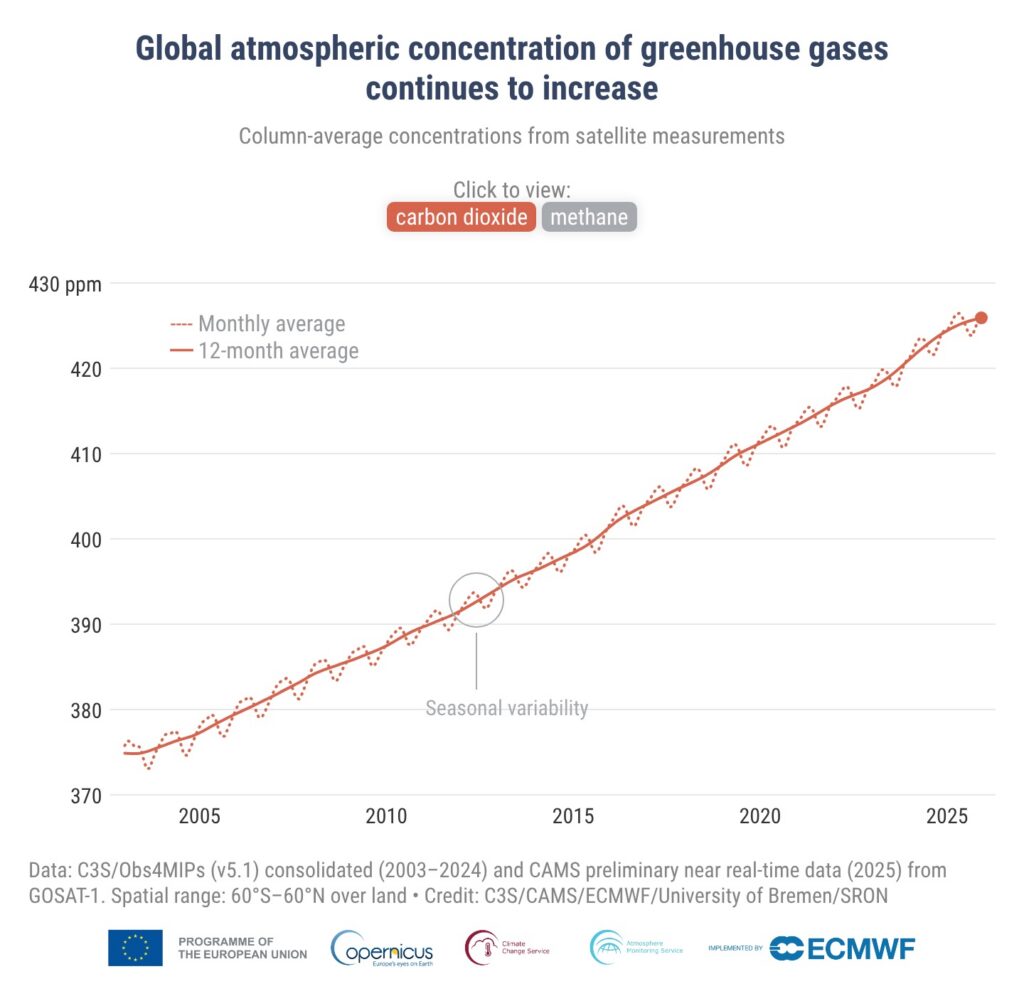
Copernicus Climate Change Service: line graph showing rising global atmospheric CO₂ and methane concentrations from 2020 to 2025.

Temperature across Europe’s land and seas


According to the Copernicus Climate report, Europe is warming more than twice as fast as the global average — and 2025 brought that into sharp focus. On land, almost the entire continent (at least 95%) saw above-average annual temperatures, with Europe suffering its second most severe heatwave on record. At sea, the picture was equally alarming: the annual sea surface temperature for the European ocean region reached an all-time high, and a record 86% of the region experienced at least “strong” marine heatwave conditions.

Hydrological conditions in 2025


In 2025, much of northwestern to eastern Europe was drier than average, with annual precipitation totals 10–40% below normal. This led to record-low soil moisture in some areas and below-average river flow in 70% of Europe’s rivers. In contrast, southwestern and parts of northeastern Europe saw above-average precipitation, soil moisture, and river flow. These patterns also influenced sunshine, cloud cover, and climate-driven renewable power potential.

The contrasts aligned with prevailing atmospheric circulation. High pressure brought drier, sunnier conditions to northwestern, central, and eastern Europe, while low pressure over the North Atlantic shifted storm tracks further south toward southwestern Europe.

Across the Iberian Peninsula, spring brought above-average rainfall, followed by summer heatwaves. This shift created abundant dried vegetation that fueled large wildfires.

Key messages

  • Soil moisture: 2025 ranked as one of the three driest years for soil moisture across Europe since 1992. In May, 35% of Europe experienced “extreme” agricultural drought.
  • Precipitation (northwest/central Europe): 2025 ranked among the ten driest years in 47 years for this region — a sharp contrast to the exceptionally wet conditions of 2023 and 2024.
  • River flooding: Despite several significant flood events, total flooded extent was the second lowest since 1992 and far smaller than the widespread flooding seen in 2023 and 2024.
  • Extreme precipitation: The share of Europe’s land area affected by extreme precipitation was below average, notably smaller than in several recent years — especially for the most extreme events.
  • Wildfire emissions: Annual wildfire emissions reached record highs in Spain (where contrasting hydrological conditions fueled large fires), as well as in Cyprus, the United Kingdom, the Netherlands, and Germany.

Long heatwave in sub-Arctic Fennoscandia


In July 2025, sub-Arctic Fennoscandia experienced its longest and most severe heatwave on record, lasting 21 days from 12 July to 1 August. Temperatures near and within the Arctic Circle reached 30°C.

The region typically sees up to two “strong” heat stress days per year, but in 2025 some areas endured almost two weeks at this level. The combination of dry conditions and high temperatures produced “moderate” to “severe” drought during the heatwave, along with up to two weeks of elevated fire danger.

The heatwave coincided with a marine heatwave in the Norwegian Sea, as well as parts of the North Sea and the Baltic Sea.

Cold environments in a warming climate


From the Alps to the Arctic, Europe’s ice and snow cover is shrinking. The area experiencing winter days with freezing temperatures is also declining.

Snow cover: In 2025, end-of-season snow cover extent and mass were the third lowest in the 42-year record. In March alone, the snow-covered area was roughly 1.32 million km² below average — an area equivalent to France, Italy, Germany, Switzerland, and Austria combined.

Glaciers: European glaciers recorded a net mass loss in 2025, with the most negative balances observed in Iceland.

Greenland: The Greenland Ice Sheet lost approximately 139 gigatonnes (Gt) of ice in 2025, equivalent to about 1.5 times the total ice stored in all European Alpine glaciers.

Climate policy and action: biodiversity


Biodiversity — the variety of life on Earth — is essential for a sustainable future, yet climate change is a major driver of its decline.

Healthy ecosystems provide clean air and water, fertile soils, and pollination, all of which underpin food security, livelihoods, and human health. Biodiversity also helps regulate the climate and buffers against extreme weather events.

Recognising this link, European policy frameworks have increasingly integrated climate and biodiversity. The EU Biodiversity Strategy for 2030 aims to protect and restore nature. By the end of 2025, approximately half of the Strategy’s recommended actions were either in place or fully completed, with most of the remainder already underway.

Climate’s impact on biodiversity


Marine heatwaves have shifted from occasional to annual events, driving mass mortality, species shifts, and ecosystem disruption. From 2023 to 2025, the entire Mediterranean Sea experienced at least “strong” marine heatwave conditions each year.

Posidonia oceanica seagrass — covering ~19,000 km² of Europe’s coasts — is highly sensitive to heat. Thermal stress has driven a 34% decline in its meadows over 50 years. Yet conservation efforts over the past decade have stabilised some areas, boosting species richness, restoring fish nurseries, and enhancing carbon storage and coastal protection.

Peatland wildfires: Europe has lost more peatland proportionally than any other region. Remaining sites like Deurnsche Peel and Mariapeel (Netherlands) are vital. Dried-out peat ignites easily — in April 2020, a 710-hectare fire burned for four days and smouldered for two months. Such fires kill amphibians, ground-nesting birds, and Sphagnum mosses, degrading habitats. Solutions include green firebreaks, ecological corridors, buffer zones, and native reforestation.

Copernicus Climate: trends in climate indicators


The latest Copernicus Climate data shows a clear pattern: the planet is warming, oceans are absorbing more heat, ice is disappearing, and sea levels are rising. Europe and the Mediterranean are warming significantly faster than the global average.

Rising temperatures (since pre-industrial, 1850–1900)

  • Global: +1.4°C
  • Europe: +2.4°C
  • WMO Region VI (Europe): +2.6°C
  • Arctic: +3.2°C

Oceans under pressure

Sea surface temperatures since the 1980s:

  • Global oceans: +0.6°C
  • Europe: +1.1°C
  • Mediterranean Sea: +1.4°C

Ocean heat content (upper 2000 m) has risen steadily since 1993.

Sea level rise (1999–2025)

  • Global: +3.7 mm per year
  • Europe: +2–4 mm per year

Greenhouse gases (annual increase since 2020)

  • CO₂: +2.6 ppm
  • CH₄: +11.6 ppb

Ice loss accelerating

  • Arctic sea ice (September): -33% since the 1980s
  • Antarctic sea ice (February): -20%

Ice loss since the 1970s:

  • Greenland: -5,747 Gt
  • Antarctica: -4,876 Gt
  • Global glaciers: -9,580 Gt

These indicators confirm that climate change is not a distant threat — it is an ongoing transformation already reshaping ecosystems, coastlines, and weather patterns worldwide.

Final thoughts


Reading the Copernicus 2025 Climate report (download it here), one might be tempted to highlight the positives. Renewables at 46%. Solar at a record 12.5%. Half of biodiversity actions completed.

Do not be fooled.

As climate scientist Kevin Anderson has long argued, every metric points the wrong way. Global temperature: up. Ocean heat: up. Sea levels: up. Ice loss: accelerating. Europe’s warming rate: twice the global average. The 1.5°C Paris threshold: set to be breached by the end of this decade — a decade earlier than predicted.

This is not progress. This is managed decline dressed up as hope.

Leaders knew the science. They had the tools. They chose delay. Most importantly, they chose fossil fuels. In doing so, they chose their own political timelines over the planet’s physical timelines. That is not a failure of capability. It is a failure of will — and of conscience.

The report does not show that we are on the right track. It shows that we are running off track, and those at the controls have intentionally refused to brake.

Copernicus Climate Change Service: The European State of the Climate 2025 Read More »

Milano Cortina Olympics: snow needs cold, not crude

Reading Time: 4 minutes

The uncomfortable truth behind “sustainable” and “neutral” Winter Olympics


There is a lot of excitement in the air for Milano Cortina Olympics. In fact, the Games are set to showcase sport, landscape, and international cooperation. We are told to celebrate fashion, food, culture, and people.

In reality, it risks becoming yet another glossy exercise in greenwashing. And not only that. The Games also reveal a deeper, more disturbing contradiction: selective ethics, selective exclusions, selective silence.

Winter sports need snow, not fossil fuels


Winter sports depend on snow, ice, and stable temperatures. Yet the Milano Cortina Winter Olympics are sponsored by Eni, one of Italy’s largest oil and gas companies—an industry that directly fuels the climate crisis threatening the very existence of winter itself.

This contradiction is not accidental. It is strategic.

As Greenpeace Italia recently stated:

“Winter sports need snow, not polluting companies.”

Milano Cortina Olympics: when sponsorship becomes image laundering


Sponsorships like these are not neutral acts of support. They are tools of reputation laundering, designed to associate fossil fuel corporations with values such as resilience, excellence, and sustainability, while diverting attention from the environmental damage caused by their core business.

Eni’s presence at the Olympics does not reduce emissions.
It does not protect glaciers.
It does not safeguard mountain ecosystems.

What it does is offer a powerful stage to rewrite a narrative.

The climate crisis is not an abstract backdrop


The climate emergency is already reshaping winter sports:

  • artificial snow replacing natural snowfall
  • shortened seasons and shrinking glaciers
  • increasing environmental pressure on fragile alpine territories

Allowing companies that actively contribute to global warming to sponsor the Winter Olympics means ignoring this reality—or worse, normalising it.

As Greenpeace puts it:

“Those who fuel the climate crisis, threatening the survival of ice and snow on which the Winter Games depend, cannot be sponsors of the Games.”

This is not radicalism. It is coherence.

The IOC’s responsibility


The International Olympic Committee often speaks the language of sustainability. But language without action remains branding.

If the Olympic movement genuinely wants to protect the future of winter sports, it must take a clear stance and end sponsorships from oil and gas companies—just as tobacco sponsorships were once banned from sport for ethical reasons.

Some industries are simply incompatible with certain values.
Fossil fuels and the Winter Olympics are one of those cases.

A double standard dressed as neutrality


Russia is out. Israel is in.

The official justification for excluding Russia from the Olympic Games was the violation of international law and the incompatibility of war with Olympic values. Yet the same principles seem to dissolve when it comes to Israel, despite the scale of destruction and civilian deaths in Palestine far exceeding many past conflicts that have led to sanctions.

This selective morality undermines any claim of neutrality. When sport chooses silence in the face of certain atrocities and outrage in others, it stops being a space of peace and becomes a mirror of geopolitical hypocrisy.

The discomfort was impossible to fully contain. During the opening ceremony, J.D. Vance was met with loud boos from the audience—an unplanned rupture in the performance of neutrality. Even as cameras attempted to manage the narrative, the reaction exposed a growing gap between institutional silence and public conscience.

Israel’s parade was embarrassing. 
Just as embarrassing was the attempt to erase Ghali through selective camera framing—an evident effort to censor his words and silence his pro-Palestinian stance.

Is it really still unclear that Israel is committing genocide, as widely documented by human rights observers?

Ghali, Rodari, and the words that should never be censored


Ghali recited Reminder, a poem by Gianni Rodari:

“There are things to do every day:
wash, study, play,
and set the table at midday.

There are things to do at night:
close your eyes, sleep,
have dreams for dreaming,
ears for hearing.

There are things never to do,
neither by day nor by night,
neither by sea nor by shore:
for example, WAR.”

Words simple enough for a child. Apparently too dangerous for a stage.

What kind of future are we celebrating?


The Olympic principles are excellence, respect, and friendship. They aim to unite people through sport, promoting peace, solidarity, and inclusion.

And yet, this is what Ghali later wrote on Instagram:

“Peace? Harmony? Humanity?
I did not feel any of this last night, but I felt it through your messages.
People are what truly matter, and in a time of so much hatred, please do not play their game. Respond as we would want the world to be.
‘There are things that must never be done.’”
Ghali

Beyond the beautiful façade


We can celebrate Italianness at Milano Cortina Olympics. We can take pride in the landscape, culture, fashion, food, and athletes and everything else. But this could also be an opportunity to rethink how major events relate to territory, climate, and responsibility.

Instead, it risks becoming another case study in how sustainability is used as a decorative word—applied after the damage is done. A study in beautiful façades.

Snow is not a metaphor.
Ice is not a logo.
The climate crisis cannot be sponsored away.

And humanity does not come in Series A and Series B.

If they sold you the Winter Olympics as ethical and sustainable, this is greenwashing.

Milano Cortina Olympics: snow needs cold, not crude Read More »

COP30 in Belém: climate promises vs fossil fuel politics

Reading Time: 4 minutes

With 1,600 lobbyists in attendance—outnumbering most nations—the summit’s goals of finance and justice face a critical test


As the second week of the COP30 climate summit begins in Belém, Brazil—in the heart of the Amazon—the stakes are becoming sharper and harder to ignore. The world faces a profound contradiction: the need for urgent, radical action to address record-breaking temperatures collides with the overwhelming presence of the very industry driving the crisis. The initial discussions have set the stage, but the most difficult negotiations now begin.

Against this backdrop of unprecedented lobbyist attendance, delegates are confronting an immense and politically charged agenda. In short, six critical issues will determine if COP30 delivers real change or just repeats empty promises.

The six defining issues of COP30


1. Preventing runaway warming: the 1.5°C lifeline.
The data are stark: current national pledges put the world on track for a catastrophic 2.3–2.5°C of warming. In fact, overshooting the 1.5°C target is now almost certain. The task in Belém is to pressure major emitters into steeper, faster emissions cuts, aiming to make the overshoot as small and as brief as possible. Yet this effort is inevitably complicated by the presence of 1,600 fossil fuel lobbyists. Indeed, their influence risks diluting ambition behind closed doors.

2. Funding climate adaptation: paying for survival.
Developing nations are demanding solutions to the enormous financial gap facing communities already suffering climate-fuelled storms, droughts, and rising seas. COP30 is the deadline for agreeing on a new global finance goal for adaptation. But success means ensuring vulnerable countries can build real resilience. An urgent necessity that sits uneasily alongside the fact that fossil fuel lobbyists outnumber every country delegation except Brazil’s.

3. Unlocking trillion-dollar finance: from pledges to projects.
The central challenge remains converting grand climate finance commitments into actual, accessible flows. A proposed roadmap aims to mobilise $1.3 trillion each year by 2035 for developing countries. Negotiators will now focus on reforming global financial systems, so public funds can leverage private investment. But these over “real money” happen alongside the significant influence of petrostates. Azerbaijan, the UAE, and Egypt—all fossil fuel major producers—hosted the last three summits.

For a deeper look at this dynamic, read our previous analysis: Is it time to give up on the COPs?

4. Scaling creative solutions: beacons of hope.
Despite the political tension, COP30 is also a launchpad for concrete initiatives. Highlights include the Beat the Heat programme for sustainable cooling, the Food Waste Breakthrough to cut methane emissions, and the Tropical Forest Forever Facility, designed to pay countries for preserving forests. These examples offer a glimpse of what coordinated climate action could achieve, if matched by political will.

5. Ensuring a just transition: the Belém action mechanism.
The shift to a green economy must be equitable. In fact major expected outcome is the Belém Action Mechanism for Just Transition, a framework intended to support workers and communities dependent on high-carbon industries through job creation, training, and structural support. This commitment to justice is essential in a process where powerful economic actors dominate.

6. Reigniting the Paris spirit in a “decade of delivery.”
Nearly a decade after the hope of the 2015 Paris Agreement, COP30 aims to recapture that momentum and mark the start of a true “decade of delivery”. The goal is to finally translate lofty pledges into action. Yet that ambition is being tested by the sheer scale of industry involvement, with recent investigations intensifying long-standing concerns about the summit’s integrity.

Final thoughts: a summit at a crossroads


In conclusion, the message from Belém is clear, yet profoundly conflicted. As the second week opens, the technical challenges of emissions cuts, finance, and adaptation are firmly on the table.

However, the real battle for this summit’s outcome will be fought not over the official agenda, but over the unspoken power dynamics in the negotiating rooms. With one in every 25 participants representing the fossil fuel industry—and those delegates outnumbering the combined representation of the ten most climate-vulnerable nations—the question is no longer merely what will be decided, but who is truly deciding it.

Ultimately, the world is watching to see whether COP30 can overcome this contradiction and accelerate genuine action, or whether the so-called “decade of delivery” will once again be co-opted by the forces of delay.

COP30 in Belém: climate promises vs fossil fuel politics Read More »

Ujoh SS26: Elegance in the Anthropocene

Reading Time: 3 minutes

At Paris Fashion Week, Ujoh showcases a wardrobe for a feverish planet


For its SS26 presentation at Paris Fashion Week, Ujoh reimagined elegance for a world grown warmer.

The Japanese summer has become unforgiving. A climatic reality that now grips cities from Paris to Milan to New York. As the air grows thick and the heat intensifies, the very notion of getting dressed can feel like a burden. Yet Ujoh resists this surrender, proposing instead a summer uniform that is light, ingenious, and elegant. A way to maintain one’s style even as the climate becomes more extreme.

A marine inspiration runs throughout the collection. Sailor collars gain structure, fastenings recall a plastron, and trousers open like sails. The house’s signature layering evolves into a study in breathability, while between skirts and trousers, new hybrid forms emerge from a design process that allows unexpected volumes to blossom.

Ujoh SS26 at Paris Fashion Week


The fabrics embody the essence of summer. Ujoh’s tailoring becomes lighter, realised in airy gabardine, fluid poplin, and cotton and linen blended with rayon to preserve a graceful drape. Mesh and technical textiles are strategically incorporated to create zones of ventilation. Every detail serves daily life. Pieces are easy to care for, practical, and perfectly suited to the pace of urban Japan, without ever yielding to mere informality.

Each piece stands strong on its own by design, yet together they compose the unique harmony that defines Ujoh. A shirt unfolds into a boat neckline; a mesh top is re-conceived as a polo; a scarf-cap reinvents the accessory as a modular object.

The sea returns as a recurring motif. A net-dress reimagines a fishing net as delicate lace, while embroideries sketch the outlines of tropical leaves. Stripes evoke the classic seaside elegance of Italian lidos and retro swimwear. Against the skin, silver jewellery—cuffs, bangles, rings—captures the shimmer of water, echoing the simple, soothing joys of summer.

The collection’s palette remains rooted in the urban landscape: a sober trilogy of black, white, and beige that is radically Japanese and unbroken by the heat. Within this framework, Ujoh inscribes a singular note: a distinctive blue, poised between a lilac-grey and a deep navy, which serves as the signature hue for the collection.

Final thoughts


What emerges from this sober palette and thoughtful construction is nothing less than a blueprint for elegance in the Anthropocene. This collection rejects the false choice between style and practicality. Instead, Ujoh SS26 sketches a summer that is both resilient and joyful, where lightness means not surrender but vitality. Clothing that breathes, adapts, and elevates the everyday. True to its DNA, the house offers a silhouette that is fully dressed, deeply elegant, and universally relevant for the world we now inhabit.

Ujoh SS26: Elegance in the Anthropocene Read More »

Earth Overshoot Day: the day humanity exhausts Earth’s annual natural resources 

Reading Time: 4 minutes

Can we change course? Can humans live in balance with nature?


July 24th marks Earth Overshoot Day—the date when humanity’s demand for ecological resources exceeds what Earth can regenerate in a year. From this point on, we’re drawing down nature’s capital—robbing future generations to maintain the present.

This symbolic threshold arrives earlier each year, highlighting our deepening ecological debt. In the 1970s, Overshoot Day fell in December. Today, it comes in late July. Wealthier nations overshoot at alarming rates: the U.S. consumes resources as if it had five Earths; Italy’s ecological footprint is 2.9 times what its ecosystems can replenish.

The path back: five levers for change


According to the  Global Footprint Network, solutions exist to move the date—and they hinge on systemic changes, not small tweaks. The organisation promotes five key strategies, encapsulated in the campaign #MoveTheDate:

  1. Energy transition: Replacing fossil fuels with renewables could shift Overshoot Day by 93 days.
  2. Circular economies: Reducing waste and redesigning production systems to close material loops. 
  3. Food system overhaul: Cutting global meat consumption by 50% could push the date back 17 days. 
  4. Green cities: Rethinking mobility, housing, and infrastructure to reduce urban footprints.
  5. Policy shifts: Implementing binding treaties to protect forests, oceans, and carbon sinks. 

The good news? If we manage to push back Overshoot Day by just five days per year, we could return to living within Earth’s means by 2050.

Rupert Read on reversing ecological overshoot


But is it still possible?
Rupert Read, environmental philosopher and former spokesperson for Extinction Rebellion, is sceptical of techno-optimistic solutions. He aligns with the “deep adaptation” movement, which argues that ecological collapse is now likely—and that instead of relying solely on mitigation, we must prepare for radical societal transformation.

From Read’s perspective:

  • “Too little, too late” – Even drastic emissions cuts may not suffice, as we may have already triggered tipping points like permafrost thaw and Amazon dieback.
  • Growth paradox – Infinite economic growth is incompatible with planetary boundaries.
  • False hope risk – Frameworks like #MoveTheDate may underestimate the slow pace of actual system change, especially given the inertia of CO₂ in the atmosphere.

In short, Read contends that overshoot isn’t just a policy failure—it’s the symptom of a deeper crisis: a civilisation fundamentally at odds with ecology.

Read’s alternative: Transformative adaptation


Read’s vision focuses on resilience, degrowth, and radical localisation. He argues that rather than saving an unsustainable system, we need to build a new one—one grounded in ecological humility.

Key pillars of this approach include:

  • Degrowth – Shifting from GDP obsession to prioritising human well-being and scaling back consumption to within planetary limits.
  • Co-liberation – Challenging the exploitative logics of capitalism and colonialism that view nature as disposable.
  • Radical localism – Empowering communities to grow food, restore ecosystems, and reclaim agency—starting now, without waiting for governments to act.

In an essay co-authored with Caroline Lucas, Read urges a ground-up approach to adaptation:

“Begin, in other words, not with an abstraction but with direct experience, and with quality of life. Climate action can become popular when people understand its benefits in the terms of their own communities, and their own lives. For the climate movement, this means shifting adaptation and resilience-building from the margins to the centre of our strategic message. This is about more local, nature-friendly food-growing that people can have a stake in: for instance, through planting fruiting tree and bush varieties that are able to cope with higher summer temperatures.”

They call for climate popularism—a politics that is local, collaborative, and hopeful:

“Despite stereotypes about voters who can only be won over by a politics of fury, research shows that an ‘exhausted majority’ is tiring of endless aggression and division. They seek something they can positively believe in, a programme that is local, collaborative and respectful. A depolarising wave of action that mobilises communities’ instinctive protective instincts could really be… popular. And that is climate popularism.”

The verdict: Possible, but not probable


Technically, reversing ecological overshoot is still possible—if humanity moves at wartime speed. But politically, Read believes it is improbable without unprecedented global mobilisation and a reimagining of what progress means.

Earth Overshoot Day: The bottom line


Earth Overshoot Day is a warning. Yes, we could move the date back five days a year and restore ecological balance by 2050. But Read’s work reminds us: this will take more than innovation. It demands a cultural, political, and moral reckoning.

The choice before us is not simply between green tech and collapse. It’s between:

  • Clinging to a broken system, or
  • Building one that recognises humanity as part of, not separate from, the natural world.

In the end, the future belongs to those who stop pretending.


🌍 Want to explore how marketing manipulates ecological narratives?
Read This is Greenwashing — a practical guide to recognising the gap between sustainability claims and reality, written for modern humans seeking clarity and action.

Grab your copy from your favourite digital store through this link: https://books2read.com/u/bpgxOX

Spot the lies. Demand better.

Earth Overshoot Day: the day humanity exhausts Earth’s annual natural resources  Read More »