From heatwaves to near-record ocean temperatures, Europe remains the fastest-warming continent
According to the latest European State of the Climate report (ESOTC 2025), published by Copernicus Climate Change Service and the World Meteorological Organisation, Europe remains the world’s fastest-warming continent.
The report, released on 29 April 2026, documents a year marked by record heatwaves, near-record ocean temperatures, destructive wildfires, shrinking glaciers, and mounting pressure on biodiversity. More than 95% of Europe experienced above-average temperatures in 2025.
Globally, 2025 ranked as the third-warmest year ever recorded, with planetary warming now reaching approximately 1.4°C above pre-industrial levels. If emissions continue at their current pace, the Paris Agreement’s 1.5°C threshold could be exceeded before the end of this decade.
Across Europe, the signs of climate change are no longer isolated events but interconnected realities reshaping ecosystems, economies, and daily life.
Copernicus Climate: Europe in 2025
Temperature: Almost the entire continent saw above‑average temperatures. Several northern European countries logged their warmest or second‑warmest year.
Heatwaves: Europe endured its second most-severe heatwave on record; sub‑Arctic Fennoscandia saw its longest.
Wildfires: Record burnt area and fire emissions, led by August fires on the Iberian Peninsula.
Oceans: Highest annual sea surface temperature on record, with 86% of the region experiencing at least “strong” marine heatwave conditions.
Glaciers & snow: Net mass loss across all European glacier regions. Snow cover extent and mass both third lowest on record.
Floods/storms: Strong regional contrasts. Storms and flooding hit some areas, but overall less widespread than in recent years.
Energy: Renewables supplied 46.4% of Europe’s electricity. Solar power set a new contribution record (12.5%).
Temperature across Europe’s land and seas
According to the Copernicus Climate report, Europe is warming more than twice as fast as the global average — and 2025 brought that into sharp focus. On land, almost the entire continent (at least 95%) saw above-average annual temperatures, with Europe suffering its second most severe heatwave on record. At sea, the picture was equally alarming: the annual sea surface temperature for the European ocean region reached an all-time high, and a record 86% of the region experienced at least “strong” marine heatwave conditions.
Hydrological conditions in 2025
In 2025, much of northwestern to eastern Europe was drier than average, with annual precipitation totals 10–40% below normal. This led to record-low soil moisture in some areas and below-average river flow in 70% of Europe’s rivers. In contrast, southwestern and parts of northeastern Europe saw above-average precipitation, soil moisture, and river flow. These patterns also influenced sunshine, cloud cover, and climate-driven renewable power potential.
The contrasts aligned with prevailing atmospheric circulation. High pressure brought drier, sunnier conditions to northwestern, central, and eastern Europe, while low pressure over the North Atlantic shifted storm tracks further south toward southwestern Europe.
Across the Iberian Peninsula, spring brought above-average rainfall, followed by summer heatwaves. This shift created abundant dried vegetation that fueled large wildfires.
Key messages
- Soil moisture: 2025 ranked as one of the three driest years for soil moisture across Europe since 1992. In May, 35% of Europe experienced “extreme” agricultural drought.
- Precipitation (northwest/central Europe): 2025 ranked among the ten driest years in 47 years for this region — a sharp contrast to the exceptionally wet conditions of 2023 and 2024.
- River flooding: Despite several significant flood events, total flooded extent was the second lowest since 1992 and far smaller than the widespread flooding seen in 2023 and 2024.
- Extreme precipitation: The share of Europe’s land area affected by extreme precipitation was below average, notably smaller than in several recent years — especially for the most extreme events.
- Wildfire emissions: Annual wildfire emissions reached record highs in Spain (where contrasting hydrological conditions fueled large fires), as well as in Cyprus, the United Kingdom, the Netherlands, and Germany.
Long heatwave in sub-Arctic Fennoscandia
In July 2025, sub-Arctic Fennoscandia experienced its longest and most severe heatwave on record, lasting 21 days from 12 July to 1 August. Temperatures near and within the Arctic Circle reached 30°C.
The region typically sees up to two “strong” heat stress days per year, but in 2025 some areas endured almost two weeks at this level. The combination of dry conditions and high temperatures produced “moderate” to “severe” drought during the heatwave, along with up to two weeks of elevated fire danger.
The heatwave coincided with a marine heatwave in the Norwegian Sea, as well as parts of the North Sea and the Baltic Sea.
Cold environments in a warming climate
From the Alps to the Arctic, Europe’s ice and snow cover is shrinking. The area experiencing winter days with freezing temperatures is also declining.
Snow cover: In 2025, end-of-season snow cover extent and mass were the third lowest in the 42-year record. In March alone, the snow-covered area was roughly 1.32 million km² below average — an area equivalent to France, Italy, Germany, Switzerland, and Austria combined.
Glaciers: European glaciers recorded a net mass loss in 2025, with the most negative balances observed in Iceland.
Greenland: The Greenland Ice Sheet lost approximately 139 gigatonnes (Gt) of ice in 2025, equivalent to about 1.5 times the total ice stored in all European Alpine glaciers.
Climate policy and action: biodiversity
Biodiversity — the variety of life on Earth — is essential for a sustainable future, yet climate change is a major driver of its decline.
Healthy ecosystems provide clean air and water, fertile soils, and pollination, all of which underpin food security, livelihoods, and human health. Biodiversity also helps regulate the climate and buffers against extreme weather events.
Recognising this link, European policy frameworks have increasingly integrated climate and biodiversity. The EU Biodiversity Strategy for 2030 aims to protect and restore nature. By the end of 2025, approximately half of the Strategy’s recommended actions were either in place or fully completed, with most of the remainder already underway.
Climate’s impact on biodiversity
Marine heatwaves have shifted from occasional to annual events, driving mass mortality, species shifts, and ecosystem disruption. From 2023 to 2025, the entire Mediterranean Sea experienced at least “strong” marine heatwave conditions each year.
Posidonia oceanica seagrass — covering ~19,000 km² of Europe’s coasts — is highly sensitive to heat. Thermal stress has driven a 34% decline in its meadows over 50 years. Yet conservation efforts over the past decade have stabilised some areas, boosting species richness, restoring fish nurseries, and enhancing carbon storage and coastal protection.
Peatland wildfires: Europe has lost more peatland proportionally than any other region. Remaining sites like Deurnsche Peel and Mariapeel (Netherlands) are vital. Dried-out peat ignites easily — in April 2020, a 710-hectare fire burned for four days and smouldered for two months. Such fires kill amphibians, ground-nesting birds, and Sphagnum mosses, degrading habitats. Solutions include green firebreaks, ecological corridors, buffer zones, and native reforestation.
Copernicus Climate: trends in climate indicators
The latest Copernicus Climate data shows a clear pattern: the planet is warming, oceans are absorbing more heat, ice is disappearing, and sea levels are rising. Europe and the Mediterranean are warming significantly faster than the global average.
Rising temperatures (since pre-industrial, 1850–1900)
- Global: +1.4°C
- Europe: +2.4°C
- WMO Region VI (Europe): +2.6°C
- Arctic: +3.2°C
Oceans under pressure
Sea surface temperatures since the 1980s:
- Global oceans: +0.6°C
- Europe: +1.1°C
- Mediterranean Sea: +1.4°C
Ocean heat content (upper 2000 m) has risen steadily since 1993.
Sea level rise (1999–2025)
- Global: +3.7 mm per year
- Europe: +2–4 mm per year
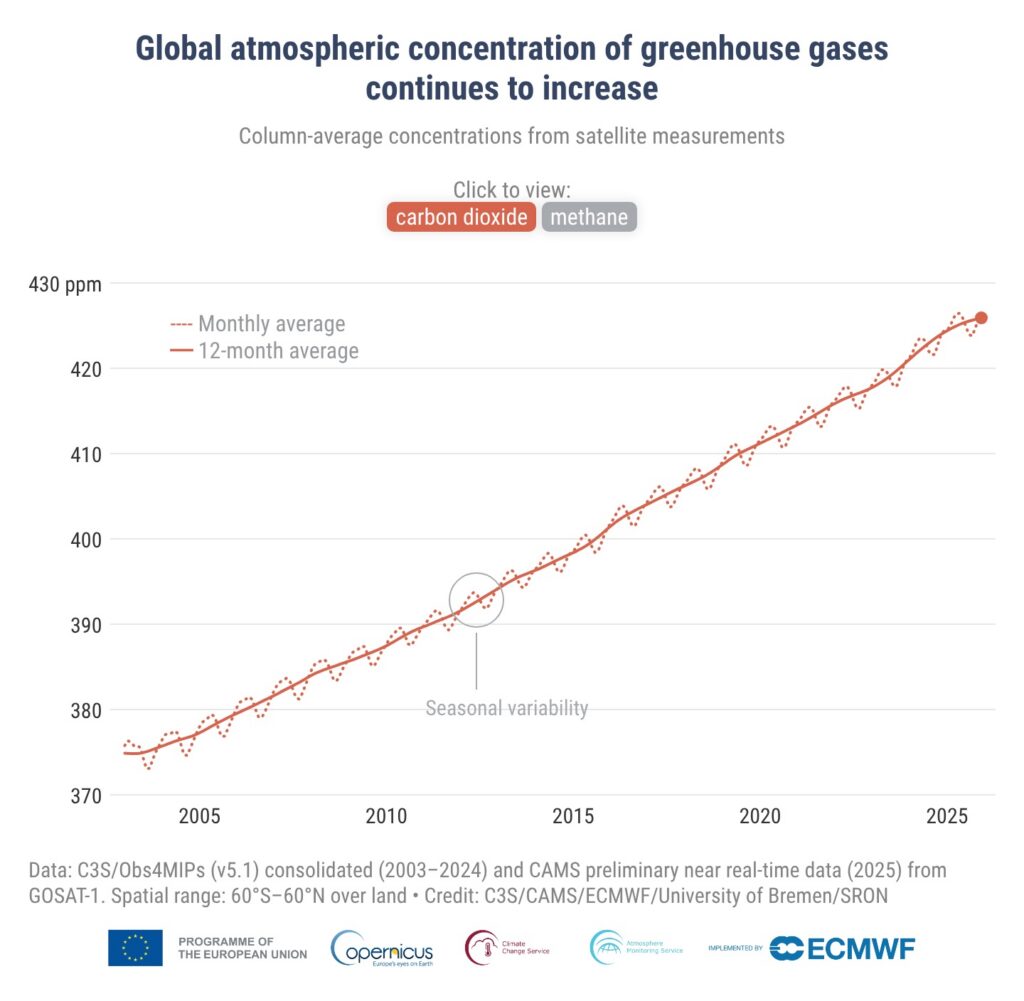
Greenhouse gases (annual increase since 2020)
- CO₂: +2.6 ppm
- CH₄: +11.6 ppb
Ice loss accelerating
- Arctic sea ice (September): -33% since the 1980s
- Antarctic sea ice (February): -20%
Ice loss since the 1970s:
- Greenland: -5,747 Gt
- Antarctica: -4,876 Gt
- Global glaciers: -9,580 Gt
These indicators confirm that climate change is not a distant threat — it is an ongoing transformation already reshaping ecosystems, coastlines, and weather patterns worldwide.
Final thoughts
Reading the Copernicus 2025 Climate report (download it here), one might be tempted to highlight the positives. Renewables at 46%. Solar at a record 12.5%. Half of biodiversity actions completed.
Do not be fooled.
As climate scientist Kevin Anderson has long argued, every metric points the wrong way. Global temperature: up. Ocean heat: up. Sea levels: up. Ice loss: accelerating. Europe’s warming rate: twice the global average. The 1.5°C Paris threshold: set to be breached by the end of this decade — a decade earlier than predicted.
This is not progress. This is managed decline dressed up as hope.
Leaders knew the science. They had the tools. They chose delay. Most importantly, they chose fossil fuels. In doing so, they chose their own political timelines over the planet’s physical timelines. That is not a failure of capability. It is a failure of will — and of conscience.
The report does not show that we are on the right track. It shows that we are running off track, and those at the controls have intentionally refused to brake.