Ecological debt: how we live beyond our means — using in just 123 days the resources meant to last a year
Overshoot Day in Italy fell on May 3 this year. Three days earlier than in 2025, when it occurred on May 6. From that day onward, Italy has been symbolically living on credit from the planet, having exhausted the water, energy, and natural resources that the Earth can regenerate in a full year.
An ecological debt that places Italy broadly in line with other European countries, though still lagging behind those with later Overshoot Days.
France reached its Overshoot Day earlier, on April 24. Germany (May 10), the United Kingdom (May 22), and Spain (June 4) follow — reflecting a comparatively greater ability to balance consumption with regeneration. Luxembourg, however, reached its Overshoot Day as early as February, while Qatar’s falls on February 4.
Globally, in the early 1970s, Overshoot Day fell in late December (December 25 in 1971). By 1990, it had already moved to mid-October.
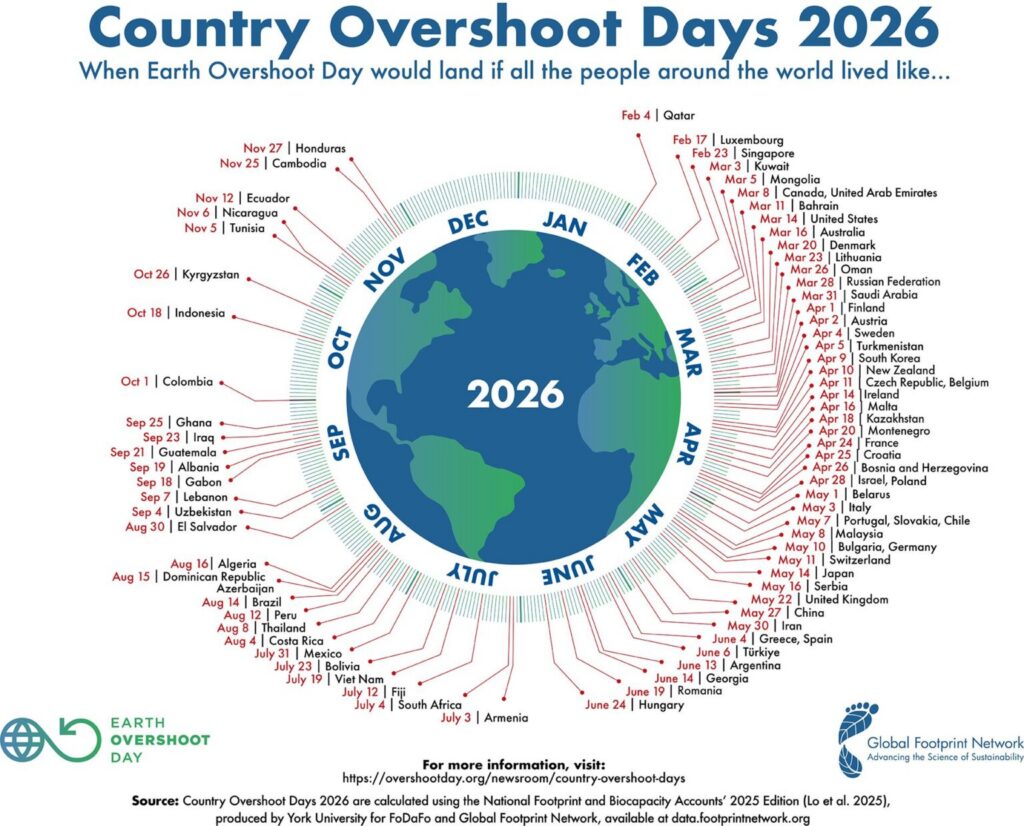
Entering the phase of overexploitation
The data is compiled by the Global Footprint Network, an international research organisation that measures countries’ ecological footprints by comparing their natural resource consumption with the planet’s capacity to regenerate them.
For Italy, this means that in just over four months, the country has consumed what the Earth can regenerate in an entire year. From that point forward, demand exceeds supply — and the deficit accumulates.
This imbalance is not abstract. It materialises as environmental degradation, biodiversity loss, waste accumulation, greenhouse gas build-up, and land consumption.
The impact of our lifestyles
The numbers speak clearly: if every person on Earth adopted our consumption patterns, we would need about 2.7 planets to stay in balance.
This imbalance is not accidental — it is structural. It reflects production and consumption systems built on continuous growth, where demand routinely exceeds actual needs and efficiency gains are often offset by increased use.
This concern is echoed at the highest institutional levels:
“Much of the ‘natural’ capital upon which so much of human wellbeing and economic activity depends — water, land, the air and atmosphere, biodiversity and marine resources — continues its seemingly inexorable decline. The cost of inaction and the price humanity will eventually pay is likely to dwarf the cost of swift and decisive action now.”
— Achim Steiner, former UNEP Executive Director
Move the date later in the year
The goal is simple: move the date later in the year.
But doing so requires more than a checklist of good intentions — it demands a shift in how systems are designed and how value is defined.
It means transitioning from linear to circular models, where waste is reduced at the source rather than managed downstream.
It means rethinking energy, food, and mobility systems so that efficiency is not just technological, but cultural.
And it means designing cities that reduce the need for consumption, not just optimise it.
And it also means confronting everyday habits — from what we buy to how we eat — recognising that individual choices, while limited on their own, become powerful when aligned with systemic change.
Even small shifts, when scaled, can move the date forward by days. Structural transformation can move it by months.
Final thoughts
Italy’s Overshoot Day is not meant to be observed — it is meant to be reversed.
Yet none of this is possible without acknowledging a harder truth: moving the date means moving our habits.
Italy exhausted its annual budget in 123 days — not by accident, but by design.
The same systems that built prosperity now threaten to undermine it.
But systems are not fixed. They can be redesigned.
The choice is ours: continue consuming as if tomorrow will never come, or recognise that every day moved later is a day earned back for future generations.
Overshoot Day in Italy arrived three days earlier this year.
Next year, it could arrive later.
In essence, we need to ask: what kind of world do we want?