Climate change: the warning was clear; the will was not
Summer heatwave used to mean lightweight clothes, long evenings, open windows. Summer was our favourite season — until it turned into something unrecognisable. We cling to the memory of what it was, even as we dread what it is becoming. The heat isn’t just weather anymore. It’s evidence. Cities are hells of fire, the air is unbreathable.
According to the WHO, the heatwave in Europe caused 1,300 deaths, with Germany hitting a record 41.7 °C.
A scorching heatwave in Europe is not a surprise. It is a confirmation — of every report that was read, every projection that was modelled, and every choice to put money first while the thermometer ran higher. A failure of political will — by leaders who repeatedly chose short-term economic interests over long-term climate action.
To the leaders who signed the Paris Agreement, who stood before cameras and promised to keep 1.5°C alive:
Recently, the Copernicus Climate Change Service released its European State of the Climate 2025 report. You should read it not as a scientific update, but as an indictment.
Europe is the fastest-warming continent on Earth. 2025 saw its second-most severe heatwave, record-high sea surface temperatures, and unprecedented wildfires. The Arctic is warming more than twice as fast as the global average. Greenland is losing ice at rates you were warned about forty years ago.
And where are we on the metrics that matter? Not moving in the right direction.
You celebrate renewables reaching 46.4% of electricity generation. It is genuine progress, but not enough. Markets, technological advances, and public demand have accelerated the transition, often despite hesitant political leadership. At the same time, governments continue to subsidise fossil fuels, approve new extraction projects, and postpone difficult decisions.
The scientists told you. The activists begged you. The youth marched. And you nodded, smiled, and did next to nothing.
The 2025 data is not an anomaly. It is the predictable outcome of your intentional inaction.
Do not ask us to celebrate half-measures. Do not ask us to call stagnation “progress.” The only honest conclusion is this: you knew, you had the power to act, and you chose not to. You leave the burden entirely on the people.
This summer, the headlines are telling us about another heatwave, another broken record, other tragedies. Europe is under the blaze.Widening inequalities. Workers who collapsed. Lives lost.
And as this summer heatwave burns, the silence of inaction is louder than the fire.
Why one of the world’s most uncompromising climate scientists says our leaders have chosen to fail, and what we can actually do about it
Net zero is a scam. Kevin Anderson goes straight for the truth about climate change. There are plenty of climate scientists who soften the message. They talk about “pathways,” “transitions,” and “cautious optimism.” Kevin Anderson is not one of them.
Professor of Energy and Climate Change, working across the universities of Manchester, Uppsala in Sweden, and Bergen in Norway, he is one of the world’s leading climate scientists.
We refer to him and mention him from time to time. But here’s why we trust him more than almost anyone else: he is brutally direct and honest.
On the Rob Cooper podcast, shared also on Climate Uncensored (source of this post), Anderson laid out the situation in plain language. Here’s what he said.
The 3 numbers you need to understand climate change (straight from Anderson)
1. Temperatures are not small changes. We signed up to stop warming at 1.5°C or 2°C above pre-industrial levels. Those numbers sound tiny. We need to understand they are massive changes to our climate, they happen on a global scale.
2. Carbon budgets are just fossil fuel budgets. If we are not to exceed those temperatures, we know how much carbon dioxide we can put into the atmosphere. Those come from fossil fuels. We know exactly how many billion tons of CO₂ we can still emit. That tells us exactly how many fossil fuels we can burn – and therefore, how much time we have left.
3. The time frame is already broken. For 1.5°C: zero emissions by the early 2030s. That’s five years from now. For 2°C: zero emissions by 2045–2050. We have more leeway. This will happen only if we bring emissions down. But we’re not following the pathway to 1.5°C. We never were. Emissions are still rising.
We’re not going to achieve the 1.5°C target.
“Our leaders have chosen to fail on climate change; this is nothing new. Every single metric on climate change is pointing in the wrong direction.”
What “progress” actually looks like (spoiler: this isn’t it)
Every year, we add more renewables. Every year, we also add more fossil fuels. The climate does not care about renewables. It cares about the fossil fuel phase-out.
Anderson argues that, to stay within 1.5°C, we need 7–8% emissions cuts every single year, starting yesterday. Even then, he notes, avoiding major tipping points would require an element of luck.
We will move in the right direction when more renewables mean, at the same time, less fossil fuels. 2°C is not safe. We are not in a good place.
Lots of academics point to China as if it is progress. But it is not. Carbon dioxide builds up every year. So every year we fail to reduce emissions, the following year gets harder. The reductions we see in China are far from sufficient to deliver. Next year, the problem will be more challenging than this year.
“If the problem gets harder every single year, I don’t call that progress. Progress is only when you deliver what you need to. Let’s not put that as it is in line with our progress. It is not at all. Until we eliminate fossil fuels and the emissions from them, until we reduce the emissions from agriculture, temperatures will just keep going up. Reducing emissions doesn’t mean temperatures stay stable or go down; it means temperatures rise less quickly.”
Temperatures vs impacts
“We shouldn’t only talk about temperatures, we should talk about impacts because impacts are what impact people.”
1.5°, 2°, what are those? If the impacts come in five years, we’ll not have time to defend ourselves. If it happens in ten, we’ll have more time. But some of the impacts occur faster than we thought. That’s a real issue. Infrastructures were created for a specific climate; changing them is highly costly and time-consuming. But we have to do it.
People think we’re in a new normal. But we’re not, because one day will be new and the next one new again. Temperatures will only start to normalise when we stop emitting fossil fuels. Until that point, the climate will just keep changing.
The lie at the heart: net zero is a scam
The scientists are doing a fantastic job. The oil and gas industries know what is happening. Those at the top of these industries deliberately undermined the climate issue.
There is no climate science as such, he points out. It’s only physics and chemistry that explain the world around us.
Mitigation is about what we do to reduce emissions. There, says Anderson, we have increasingly been overoptimistic, which has started to lie. We have been telling untruths for at least two decades on climate change. And that’s because the analysis that we do doesn’t fit with a particular political framing of the world.
And every year we fail to deliver on climate change, the level of the lies increases. Some say we can’t take away hope or instil fear.
But our job is to say it how it is. There is a global delusion around this. And it goes much deeper than that. If you want to get funding, economic growth, and net-zero 2050, it has to fit a political agenda.
Policymakers put pressure on the chain, on journalists and so on, so the whole system is delusional. People should use common sense. And just do the maths.
Many academics believe in their own delusion, so it is easier to make other people believe in this. We need to start with a sense of integrity.
On climate change, we desperately need new ways of thinking; people of my age have totally failed. We need new perspectives.
Climate change is colonial (and no, we’re not all in this together)
For Anderson, climate change is not only a scientific issue. It is also a question of historical responsibility and global justice. This is one of Anderson’s most uncomfortable – and most important – points.
The UK, US and wealthy nations built their prosperity on slavery, stolen minerals and cheap labour. Now they’re doing the same with the carbon budget.
Today, we are still embedded in the legacy of colonial history. We can’t do anything about the past, but we should at least recognise it. And what we shouldn’t do is perpetuate it. There is a responsibility: our prosperity has been built on the backs of others.
Now, in the UK, people have more per capita carbon budget we can burn compared to other poor countries. There is a disproportionate share.
“We took their labour as slaves, we stole their minerals, and now we’re stealing their carbon budget.”
The UK (all wealthy nations) is perpetuating colonialism. We need to question that. Here’s the connection with climate change.
The second part is that we’re not all in this together. There are people locked in their conditions; there’s nothing they can do.
Poor countries cannot afford to cut further. There are people who need to have higher carbon emissions. The richest 1% of emitters globally produce twice the emissions of the bottom half of humanity combined.
“We need to switch from production to the rich to production for the public infrastructure. We need to move the skills to do good things for society. At the moment, we have private luxury for a minority (a big minority), and public squander for everyone else.”
He is also critical of the “cost-of-living crisis” framing.
“There’s no cost-of-living crisis, it happens for those who benefit from it.”
For high-emitting, high-income households, responding to climate change would mean paying more. So they pretend we’re all in this together. Because they want to put the cost on the average household.
“It’s easy to point to the billionaires, as soon as they go to Mars the better, but it’s actually us as well. If this discussion is not heard, it’s because we are in the group of disproportionate use.”
What actually gives Kevin Anderson hope?
Not techno-optimism. Not net-zero pledges.
Hope, for him, lives in action – specifically, in honest, humble dialogue.
People talking at a bar. Schoolkids discussing worthwhile things. Communities deciding what a good life looks like, not just an efficient economy. Humility, if something is wrong, admit it and go on. He mentions Greta Thunberg explicitly: people of his generation have failed, he says. New perspectives are desperately needed.
“Don’t expect experts to solve this. Change comes bottom-up. Talk with integrity. Leave yourself open to views that feel uncomfortable.”
10 words on a billboard? He said no words.
Impactful images. Local meaning. Tailor the issue to the place and identity.
“Most people are good. Play to shared values, not fear.”
We don’t have to fall into the individualistic model, fighting and competing with each other; we need to value our community. Temperature and metrics are very helpful. To get people on board, we have to go from global to local and see what impacts locally.
What you can actually do (from Anderson’s closing advice)
If net zero is a scam, what can we actually do?
Don’t look for heroes in high places. Policymakers, most academics, and the media are trapped in the same delusion.
Use common sense. And do the maths yourself. The numbers don’t lie.
Have honest conversations. Ask: What is a good world? What is a good life? What is a good community?
Realise you might be the agent of change. Not a politician. Not a celebrity. You, talking to people around you.
A final thought
Net zero is a scam, Kevin Anderson argues. The system is not broken. It is working exactly as designed – for the minority who emit the most.
Change starts when the rest of us stop asking for permission and start talking honestly about what kind of world we actually want.
—
Want to hear it directly? Here is the interview with Kevin Anderson on Climate Uncensored, or on the Rob Cooper podcast.
LVMH-owned Italian leather maker lobbied to weaken EU anti-deforestation law while importing hides linked to forest destruction, NGO says
Greenwashing has become so pervasive that the connection between LVMH and deforestation rarely springs to mind when thinking of the luxury giant. But a new investigation by environmental NGO Global Witness suggests it should. The findings, shared exclusively with POLITICO, reveal fresh links between LVMH’s supply chain and forest destruction in South America. They also raise uncomfortable questions about who really pays the price for luxury leather.
LVMH and deforestation: The Global Witness investigation
Global Witness has uncovered evidence that Nuti Ivo — an Italian tannery group owned by LVMH — imported hides from Paraguay through suppliers allegedly tied to large-scale deforestation in the Gran Chaco forest, one of South America’s most threatened ecosystems.
The timing is critical. The EU’s anti-deforestation regulation (EUDR), approved in 2023, is designed to keep products linked to recently cleared land out of European markets. Beef, cocoa, soy, palm oil, and cattle-related products are all covered. But parts of the leather industry are now lobbying for leather to be excluded from the regulation. Their argument is that leather is only a byproduct of the meat industry and therefore should not be considered a driver of deforestation.
One of the most vocal advocates in this debate has been Fabrizio Nuti, CEO of Nuti Ivo and president of Italy’s tannery association. During discussions in the European Parliament, Nuti argued that stricter traceability requirements could become impossible for the sector to manage, especially regarding imports from South America.
Traceability gaps and deforestation links
Yet according to Global Witness, companies connected to Nuti Ivo sourced hides from Paraguayan suppliers linked to over 100,000 hectares of deforestation. Including land claimed by Indigenous communities. Trade records show that in 2025 alone, the Nuti Ivo Group imported thousands of tons of leather from Paraguay. Moreover, traceability remains alarmingly thin: the group can track only part of its hides back to individual slaughterhouses, leaving significant blind spots within the supply chain.
LVMH responded by stating that it is committed to ending deforestation across its operations and supply chains by 2025. The group also said it has never lobbied to weaken the EU deforestation regulation. After being confronted with trade data showing imports from Paraguay, the company described the quantities as “very small” and linked them to contracts that predated its acquisition of Nuti Ivo in 2023. LVMH added that discussions were underway to phase out those remaining agreements.
But environmental organisations disagree with attempts to exempt leather from the EUDR. In a joint letter to the European Commission, groups including Human Rights Watch and ClientEarth argued that excluding leather would undermine the logic of the law: if meat from cattle raised on deforested land is banned, they say, the animal’s skin should not be treated as an innocent byproduct.
Source: POLITICO, reporting on an investigation by NGO Global Witness (published April 27, 2026)
From green certifications to greenwashing: a familiar pattern
This is not an isolated case. In This is Greenwashing, when we tried to find sustainable options to print, we realised how tricky the situation is. Specifically, we acknowledged a global scandal of green labels: companies accused or convicted of environmental crimes continued to obtain and trade under “green” certifications.
“Over a 25-year period (1998–2023), at least 347 companies received sustainability certifications despite being publicly accused of illegal logging, deforestation, or fraudulent environmental practices” (ICIJ, Deforestation Inc., 2023).
In our eBook, we explore how sustainability language can sometimes coexist with business practices that tell a very different story. Especially in industries where supply chains are long, fragmented, and difficult to monitor.
The luxury industry has long sold itself on an idea of perfection. Flawless products, pristine images, and increasingly, unassailable sustainability pledges. But the case of LVMH and deforestation reveals a less polished reality. One where legal loopholes, opaque supply chains, and quiet lobbying efforts can undermine even the most well-intentioned green laws.
If leather is truly a byproduct, then it inherits the environmental cost of the meat it accompanies — not a free pass. The EUDR exists precisely to close that kind of accounting trick. Exempting leather wouldn’t just weaken the regulation; it would signal that luxury, once again, plays by different rules.
For LVMH, the path forward is clear but not easy. Promises to end deforestation by 2025 mean little if supply chains in 2025 are still tied to Paraguay’s disappearing Gran Chaco. The industry needs less lobbying and more traceability. Fewer claims of “very small” quantities and a full accounting of every hide.
Because in the end, green laws don’t fail in Brussels. They fail in the gap between a CEO’s testimony and a forest on fire. And that gap is where luxury must finally choose a side.
From heatwaves to near-record ocean temperatures, Europe remains the fastest-warming continent
According to the latest European State of the Climate report (ESOTC 2025), published by Copernicus Climate Change Service and the World Meteorological Organisation, Europe remains the world’s fastest-warming continent.
The report, released on 29 April 2026, documents a year marked by record heatwaves, near-record ocean temperatures, destructive wildfires, shrinking glaciers, and mounting pressure on biodiversity. More than 95% of Europe experienced above-average temperatures in 2025.
Globally, 2025 ranked as the third-warmest year ever recorded, with planetary warming now reaching approximately 1.4°C above pre-industrial levels. If emissions continue at their current pace, the Paris Agreement’s 1.5°C threshold could be exceeded before the end of this decade.
Across Europe, the signs of climate change are no longer isolated events but interconnected realities reshaping ecosystems, economies, and daily life.
Copernicus Climate: Europe in 2025
Temperature: Almost the entire continent saw above‑average temperatures. Several northern European countries logged their warmest or second‑warmest year.
Heatwaves: Europe endured its second most-severe heatwave on record; sub‑Arctic Fennoscandia saw its longest.
Wildfires: Record burnt area and fire emissions, led by August fires on the Iberian Peninsula.
Oceans: Highest annual sea surface temperature on record, with 86% of the region experiencing at least “strong” marine heatwave conditions.
Glaciers & snow: Net mass loss across all European glacier regions. Snow cover extent and mass both third lowest on record.
Floods/storms: Strong regional contrasts. Storms and flooding hit some areas, but overall less widespread than in recent years.
Energy: Renewables supplied 46.4% of Europe’s electricity. Solar power set a new contribution record (12.5%).
Temperature across Europe’s land and seas
According to the Copernicus Climate report, Europe is warming more than twice as fast as the global average — and 2025 brought that into sharp focus. On land, almost the entire continent (at least 95%) saw above-average annual temperatures, with Europe suffering its second most severe heatwave on record. At sea, the picture was equally alarming: the annual sea surface temperature for the European ocean region reached an all-time high, and a record 86% of the region experienced at least “strong” marine heatwave conditions.
Hydrological conditions in 2025
In 2025, much of northwestern to eastern Europe was drier than average, with annual precipitation totals 10–40% below normal. This led to record-low soil moisture in some areas and below-average river flow in 70% of Europe’s rivers. In contrast, southwestern and parts of northeastern Europe saw above-average precipitation, soil moisture, and river flow. These patterns also influenced sunshine, cloud cover, and climate-driven renewable power potential.
The contrasts aligned with prevailing atmospheric circulation. High pressure brought drier, sunnier conditions to northwestern, central, and eastern Europe, while low pressure over the North Atlantic shifted storm tracks further south toward southwestern Europe.
Across the Iberian Peninsula, spring brought above-average rainfall, followed by summer heatwaves. This shift created abundant dried vegetation that fueled large wildfires.
Key messages
Soil moisture: 2025 ranked as one of the three driest years for soil moisture across Europe since 1992. In May, 35% of Europe experienced “extreme” agricultural drought.
Precipitation (northwest/central Europe): 2025 ranked among the ten driest years in 47 years for this region — a sharp contrast to the exceptionally wet conditions of 2023 and 2024.
River flooding: Despite several significant flood events, total flooded extent was the second lowest since 1992 and far smaller than the widespread flooding seen in 2023 and 2024.
Extreme precipitation: The share of Europe’s land area affected by extreme precipitation was below average, notably smaller than in several recent years — especially for the most extreme events.
Wildfire emissions: Annual wildfire emissions reached record highs in Spain (where contrasting hydrological conditions fueled large fires), as well as in Cyprus, the United Kingdom, the Netherlands, and Germany.
Long heatwave in sub-Arctic Fennoscandia
In July 2025, sub-Arctic Fennoscandia experienced its longest and most severe heatwave on record, lasting 21 days from 12 July to 1 August. Temperatures near and within the Arctic Circle reached 30°C.
The region typically sees up to two “strong” heat stress days per year, but in 2025 some areas endured almost two weeks at this level. The combination of dry conditions and high temperatures produced “moderate” to “severe” drought during the heatwave, along with up to two weeks of elevated fire danger.
The heatwave coincided with a marine heatwave in the Norwegian Sea, as well as parts of the North Sea and the Baltic Sea.
Cold environments in a warming climate
From the Alps to the Arctic, Europe’s ice and snow cover is shrinking. The area experiencing winter days with freezing temperatures is also declining.
Snow cover: In 2025, end-of-season snow cover extent and mass were the third lowest in the 42-year record. In March alone, the snow-covered area was roughly 1.32 million km² below average — an area equivalent to France, Italy, Germany, Switzerland, and Austria combined.
Glaciers: European glaciers recorded a net mass loss in 2025, with the most negative balances observed in Iceland.
Greenland: The Greenland Ice Sheet lost approximately 139 gigatonnes (Gt) of ice in 2025, equivalent to about 1.5 times the total ice stored in all European Alpine glaciers.
Climate policy and action: biodiversity
Biodiversity — the variety of life on Earth — is essential for a sustainable future, yet climate change is a major driver of its decline.
Healthy ecosystems provide clean air and water, fertile soils, and pollination, all of which underpin food security, livelihoods, and human health. Biodiversity also helps regulate the climate and buffers against extreme weather events.
Recognising this link, European policy frameworks have increasingly integrated climate and biodiversity. The EU Biodiversity Strategy for 2030 aims to protect and restore nature. By the end of 2025, approximately half of the Strategy’s recommended actions were either in place or fully completed, with most of the remainder already underway.
Climate’s impact on biodiversity
Marine heatwaves have shifted from occasional to annual events, driving mass mortality, species shifts, and ecosystem disruption. From 2023 to 2025, the entire Mediterranean Sea experienced at least “strong” marine heatwave conditions each year.
Posidonia oceanica seagrass — covering ~19,000 km² of Europe’s coasts — is highly sensitive to heat. Thermal stress has driven a 34% decline in its meadows over 50 years. Yet conservation efforts over the past decade have stabilised some areas, boosting species richness, restoring fish nurseries, and enhancing carbon storage and coastal protection.
Peatland wildfires: Europe has lost more peatland proportionally than any other region. Remaining sites like Deurnsche Peel and Mariapeel (Netherlands) are vital. Dried-out peat ignites easily — in April 2020, a 710-hectare fire burned for four days and smouldered for two months. Such fires kill amphibians, ground-nesting birds, and Sphagnum mosses, degrading habitats. Solutions include green firebreaks, ecological corridors, buffer zones, and native reforestation.
Copernicus Climate: trends in climate indicators
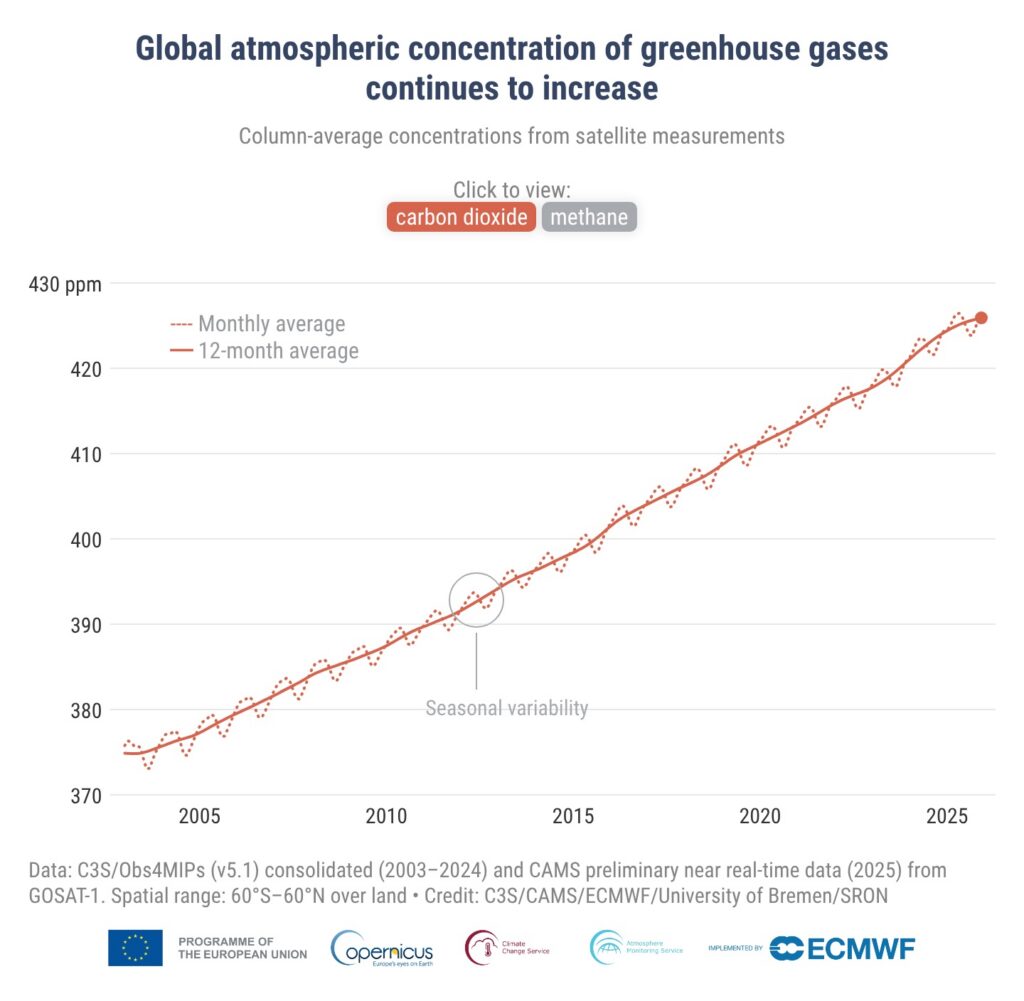
The latest Copernicus Climate data shows a clear pattern: the planet is warming, oceans are absorbing more heat, ice is disappearing, and sea levels are rising. Europe and the Mediterranean are warming significantly faster than the global average.
Ocean heat content (upper 2000 m) has risen steadily since 1993.
Sea level rise (1999–2025)
Global: +3.7 mm per year
Europe: +2–4 mm per year
Greenhouse gases (annual increase since 2020)
CO₂: +2.6 ppm
CH₄: +11.6 ppb
Ice loss accelerating
Arctic sea ice (September): -33% since the 1980s
Antarctic sea ice (February): -20%
Ice loss since the 1970s:
Greenland: -5,747 Gt
Antarctica: -4,876 Gt
Global glaciers: -9,580 Gt
These indicators confirm that climate change is not a distant threat — it is an ongoing transformation already reshaping ecosystems, coastlines, and weather patterns worldwide.
Final thoughts
Reading the Copernicus 2025 Climate report (download it here), one might be tempted to highlight the positives. Renewables at 46%. Solar at a record 12.5%. Half of biodiversity actions completed.
Do not be fooled.
As climate scientist Kevin Anderson has long argued, every metric points the wrong way. Global temperature: up. Ocean heat: up. Sea levels: up. Ice loss: accelerating. Europe’s warming rate: twice the global average. The 1.5°C Paris threshold: set to be breached by the end of this decade — a decade earlier than predicted.
This is not progress. This is managed decline dressed up as hope.
Leaders knew the science. They had the tools. They chose delay. Most importantly, they chose fossil fuels. In doing so, they chose their own political timelines over the planet’s physical timelines. That is not a failure of capability. It is a failure of will — and of conscience.
The report does not show that we are on the right track. It shows that we are running off track, and those at the controls have intentionally refused to brake.
The uncomfortable truth behind “sustainable” and “neutral” Winter Olympics
There is a lot of excitement in the air for Milano Cortina Olympics. In fact, the Games are set to showcase sport, landscape, and international cooperation. We are told to celebrate fashion, food, culture, and people.
In reality, it risks becoming yet another glossy exercise in greenwashing. And not only that. The Games also reveal a deeper, more disturbing contradiction: selective ethics, selective exclusions, selective silence.
Winter sports need snow, not fossil fuels
Winter sports depend on snow, ice, and stable temperatures. Yet the Milano Cortina Winter Olympics are sponsored by Eni, one of Italy’s largest oil and gas companies—an industry that directly fuels the climate crisis threatening the very existence of winter itself.
This contradiction is not accidental. It is strategic.
“Winter sports need snow, not polluting companies.”
Milano Cortina Olympics: when sponsorship becomes image laundering
Sponsorships like these are not neutral acts of support. They are tools of reputation laundering, designed to associate fossil fuel corporations with values such as resilience, excellence, and sustainability, while diverting attention from the environmental damage caused by their core business.
Eni’s presence at the Olympics does not reduce emissions. It does not protect glaciers. It does not safeguard mountain ecosystems.
What it does is offer a powerful stage to rewrite a narrative.
The climate crisis is not an abstract backdrop
The climate emergency is already reshaping winter sports:
artificial snow replacing natural snowfall
shortened seasons and shrinking glaciers
increasing environmental pressure on fragile alpine territories
Allowing companies that actively contribute to global warming to sponsor the Winter Olympics means ignoring this reality—or worse, normalising it.
As Greenpeace puts it:
“Those who fuel the climate crisis, threatening the survival of ice and snow on which the Winter Games depend, cannot be sponsors of the Games.”
This is not radicalism. It is coherence.
The IOC’s responsibility
The International Olympic Committee often speaks the language of sustainability. But language without action remains branding.
If the Olympic movement genuinely wants to protect the future of winter sports, it must take a clear stance and end sponsorships from oil and gas companies—just as tobacco sponsorships were once banned from sport for ethical reasons.
Some industries are simply incompatible with certain values. Fossil fuels and the Winter Olympics are one of those cases.
A double standard dressed as neutrality
Russia is out. Israel is in.
The official justification for excluding Russia from the Olympic Games was the violation of international law and the incompatibility of war with Olympic values. Yet the same principles seem to dissolve when it comes to Israel, despite the scale of destruction and civilian deaths in Palestine far exceeding many past conflicts that have led to sanctions.
This selective morality undermines any claim of neutrality. When sport chooses silence in the face of certain atrocities and outrage in others, it stops being a space of peace and becomes a mirror of geopolitical hypocrisy.
The discomfort was impossible to fully contain. During the opening ceremony, J.D. Vance was met with loud boos from the audience—an unplanned rupture in the performance of neutrality. Even as cameras attempted to manage the narrative, the reaction exposed a growing gap between institutional silence and public conscience.
Israel’s parade was embarrassing. Just as embarrassing was the attempt to erase Ghali through selective camera framing—an evident effort to censor his words and silence his pro-Palestinian stance.
Is it really still unclear that Israel is committing genocide, as widely documented by human rights observers?
Ghali, Rodari, and the words that should never be censored
Ghali recited Reminder, a poem by Gianni Rodari:
“There are things to do every day: wash, study, play, and set the table at midday.
There are things to do at night: close your eyes, sleep, have dreams for dreaming, ears for hearing.
There are things never to do, neither by day nor by night, neither by sea nor by shore: for example, WAR.”
Words simple enough for a child. Apparently too dangerous for a stage.
What kind of future are we celebrating?
The Olympic principles are excellence, respect, and friendship. They aim to unite people through sport, promoting peace, solidarity, and inclusion.
And yet, this is what Ghali later wrote on Instagram:
“Peace? Harmony? Humanity? I did not feel any of this last night, but I felt it through your messages. People are what truly matter, and in a time of so much hatred, please do not play their game. Respond as we would want the world to be. ‘There are things that must never be done.’” Ghali
Beyond the beautiful façade
We can celebrate Italianness at Milano Cortina Olympics. We can take pride in the landscape, culture, fashion, food, and athletes and everything else. But this could also be an opportunity to rethink how major events relate to territory, climate, and responsibility.
Instead, it risks becoming another case study in how sustainability is used as a decorative word—applied after the damage is done. A study in beautiful façades.
Snow is not a metaphor. Ice is not a logo. The climate crisis cannot be sponsored away.
And humanity does not come in Series A and Series B.
If they sold you the Winter Olympics as ethical and sustainable,this is greenwashing.