greenwashing

Fashion Crimes: Dirty Cotton

Reading Time: 3 minutes

Earthsight Ong linking european giants to illegal activities in Brazil


According to the British NGO Earthsight, the cotton used by textile giants H&M and Zara to produce their clothes is dirty cotton.

Specifically, the NGO alleges that the two European brands are complicit in large-scale illegal deforestation activities in Brazil, including land grabbing, human rights abuses, corruption, and violent land conflicts. But this revelation is particularly alarming as it implicates Better Cotton, a certified sustainable cotton label. If you heard us say certifications worth zero, here’s the proof.

Fashion Crimes: The report on dirty cotton


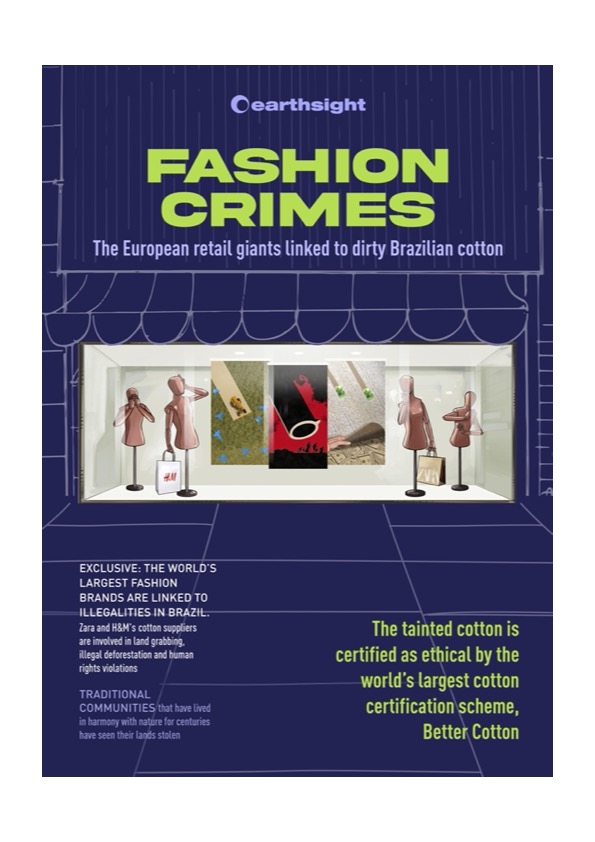
Using satellite imagery, court decisions, product shipping records, and undercover investigations, Earthsight has compiled a report titled ‘Fashion Crimes.’ The result is a damning portrait! Cotton certified as ethical by the world’s largest certification system, Better Cotton, is found to be contaminated by numerous environmental offences. Also, this cotton is exported to various Asian manufacturers, producing approximately 250 million clothing items and household articles annually for H&M, Zara, and their sister brands’ global stores.

Fashion Crimes: dirty cotton - Report cover
Fashion Crimes: Dirty Cotton – read the full report here

The NGO has tracked the journey of 816,000 tons of cotton from two of Brazil’s largest agroindustrial companies, Horita Group and Slc Agrícola, in Western Bahia. Traditional communities lived in harmony with nature. But greedy agricultural companies serving global cotton markets attacked them and robbed their lands. The Brazilian families who own these lands have a lengthy history of legal proceedings, convictions for corruption, and multimillion-dollar fines for illegal deforestation.

Some of these illicit activities take place in the Cerrado region, a savanna renowned for its rich fauna and flora, constituting the second most important biome in Brazil. The Cerrado, which hosts 5% of the world’s species, saw a 43% increase in vegetation destruction in 2023. The clearing of Cerrado trees for agriculture generates carbon equivalent to the emissions of 50 million cars each year.

Environmental protection is a key issue for the European Union, which has included the new European Deforestation Regulation (Eudr) in the Green Deal. A program against climate change that encourages the consumption of certified raw materials and imposes restrictions on the importation of those produced in deforested regions.

“Earthsight’s year-long investigation reveals that corporations and consumers in Europe and North America are driving this destruction in a new way. Not by what they eat – but what they wear.”

Better Cotton: certifications & greenwashing


In conclusion, the NGO points the finger at Better Cotton, the world’s largest ‘ethical’ cotton certification system, with the raw material exposed as dirty cotton. Therefore, contaminated by various environmental offences. “BC has been repeatedly accused of greenwashing and criticised for failing to allow for full traceability of supply chains.”

Therefore, can we trust sustainable labels? No, of course not! Left alone, labels and certifications mean nothing. In fact, they are frequently used to mislead people. So, they are just greenwashing. Moreover, selling more green products is a strategy to support the overproduction model. So, it won’t solve any issue. (Download “The sustainability basics” checklist here).

Even though brands like Zara and H&M might use sustainable materials, the massive quantities they produce would nullify the sustainable effort. Why isn’t this clear? The solution is plain: we must produce and consume less. It’s the only viable strategy in the face of such devastation.
Consumers play a crucial role in perpetuating these harmful practices, often unknowingly. By reducing our consumption and demanding accountability from brands, we can make a real difference in protecting the environment and promoting sustainability.

While uncovering dirty cotton practices is crucial, it’s imperative to recognize that consuming less is fundamental for sustainability. Consume less: this is the action we must take now!

Fashion Crimes: Dirty Cotton Read More »

Identity and Ethics

Reading Time: 3 minutes

Peering behind the veil of the fashion industry


When it comes to identity, the spotlight often shifts away from ethics. That seems especially evident during the Milano Fashion Week.

The recent emphasis on rediscovering lost brand identities amid transitions between creative directors is appreciable. Instead of merely chasing trends and pushing boundaries to the point of absurdity, there’s a noticeable return to celebrating heritage and the unique DNA of fashion houses. However, amidst this shift, one can’t help but question the credibility of companies that have previously indulged in such superficial games.

The discrepancy between image and reality at MFW


The day before the conclusion of Milan Fashion Week, a revealing program titled “Indovina chi viene a cena” (Guess Who’s Coming to Dinner) aired on Rai3 (you can watch it here). The journalist Sabrina Giannini and her colleague shed light on the stark reality behind sustainability claims in the fashion industry. It became evident that the more brands flaunt their sustainable slogans, the less sustainable their practices proved to be. Sustainability is 90% greenwashing! This disillusionment extends beyond just material choices and production processes. In fact, it delves into the exploitation of cheap labour through outsourcing. A practice that starkly contrasts with the Italian craftsmanship ethos.

Fashion industry, identity and ethics


While these issues aren’t new to those who follow fashion’s undercurrents, the program highlighted some uncomfortable truths. Particularly striking was the response of the influencers when questioned about their awareness of designers’ materials and sustainable practices. Their dismissive reactions have underscored a glaring disconnection between the industry’s rhetoric and its actual impact. Specifically, these girls giggled or ran away, having no means to participate in a more than necessary discussion. By the way, does the fashion industry need these kinds of people? Really? Is this what the fashion industry is about?

Furthermore, Sabrina Giannini attempted to engage with designers and fashion houses on these pressing matters. What response did they get? Silence and indifference. Despite sustainability being touted as a pivotal theme in fashion, the lack of willingness from brands to engage in open dialogue is concerning. Indeed, it raises questions about the industry’s true commitment to ethical principles beyond mere lip service.

If the aim was to reveal the stark misalignment between the industry’s professed values and its actions, then the brands, with their silence, have succeeded!

Ethics, respect for work, workers’ rights, impact on the planet. All fall under the sustainability hat. But the fashion industry is not interested in that. Dear designers, refusing to open your doors, you have succeeded in unveiling your true faces.

Ultimately, Milano Fashion Week was all about identities. But clearly, no one cares about ethics!

Identity and Ethics Read More »

The Greenwashing Effect

Reading Time: 2 minutes

& where sustainability can grow


Today, we read on Modem about Camera Nazionale della Moda Italiana’s presence at COP28, and the greenwashing effect starts itching. By the way, the entire conference sparked a considerable sense of discomfort.

Indeed, the recent presence of the fashion world at COP28 in Dubai raised eyebrows and questions about the authenticity of the messages from mainstream fashion entities. Likewise, the event “Climate Change is not Cool: A Sustainability Message from the Fashion World” by Camera Nazionale della Moda Italiana.

COP28 & the fashion industry


While it’s promising to witness fashion institutions addressing sustainability on global platforms, there’s a deep concern about greenwashing. True sustainability isn’t a marketing tactic; it’s a fundamental shift in values, production methods, and consumer behaviour. Which we failed to witness so far. When mainstream brands adopt sustainability as a buzzword without genuine commitment, they dilute the essence of real change.

The authentic roots of sustainability


A genuine, sustainable culture in fashion starts as a counter-culture, born from grassroots movements, independent designers and shops, and community-driven initiatives. It’s radical, disruptive, and not easily co-opted by corporate agendas. These movements champion transparency, good quality, ethical production, and circular economies. 

The power of the counterculture


History has shown that meaningful change often originates from the fringes, where unconventional ideas take root. These movements challenge the status quo, paving the way for a new fashion narrative that prioritises craftsmanship, durability, ethical practices, and a deeper understanding of the environmental impact.

Shifting perspectives and empowering choices


As consumers, we hold significant power in shaping the fashion industry. Embracing a more sustainable mindset involves supporting independent, ethical brands, vintage and secondhand fashion, and demanding transparency from big corporations. It’s about making informed choices that align with our values and contribute positively to a more sustainable future.

The fact that fashion entities participate in events like COP28 can create a false impression of sustainability – the greenwashing effect, indeed. However, real change happens through the efforts of communities, alternative movements, designers and shops that prioritise quality – less, much less but better – not overconsumption. 

Eventually, we must remember that we vote with our wallets; that’s how we shape the world we want. And that’s how we attest our commitment to sustainability.

The Greenwashing Effect Read More »

Small Parts To Preserve the Environment

Reading Time: 2 minutes

Are fashion brands really doing enough?


According to some news, top luxury fashion brands and other popular ones do their small parts to preserve the environment. And, following their reasoning, these “small parts” are enough to make a big difference. But is it true?

Fashion industry & climate change


It is proven that human actions have caused climate change. Also, we know that fashion is a big polluting industry which discards tons of waste everywhere. So, we wonder, what are they trying to say with these pieces of news? How do these messages translate into facts? Are they really making a positive impact?

For instance, in the context of brands doing their small part for a lower-impact fashion industry, a newsletter said that Dior launched a pair of recyclable sneakers. So, they say, the brand is doing its part for climate change. But, for a juggernaut, is this single move enough to preserve our planet?

In today’s world, it’s a common concern whether the sustainability efforts made by corporations are genuine or just a form of greenwashing. Some argue that any small step taken towards sustainability can bring about a positive change. But that could probably work decades ago. At this moment, the situation has gotten so much worse that this news seems ridiculous.

In the face of a climate emergency, forget small steps–we need radical change!

Marketing: the realm of greenwashing


In fact, we agree with those who believe such efforts are simply a PR tactic without any significant systemic change. These news are part of fashion marketing plans, which should be labelled as greenwashing.

Corporations or brands of any size set up their marketing plans and release that kind of information, which has no basis. Magazines, fashion journalists or influencers get paid to share the great news. Hey, it’s business in the end! Who cares if it’s misleading?
The point is that most people take that kind of news for granted. So, whoever shares them is complicit in promoting greenwashing.

Now, please tell us, do you think brands make a big difference by doing their small parts to preserve the environment? Do you really believe it?

Comment here below or WhatsApp directly from here!

Small Parts To Preserve the Environment Read More »

Secondhand And Fashion Resale

Reading Time: 2 minutes

Circularity or marketing trick?


Driven by the popularity of secondhand, the fashion resale market is growing strongly, not only for luxury brands but mass-market brands, too.

“The explosion of cheap, mass-market brands over the last two decades has meant the secondhand market is now awash with polyester party dresses and synthetic sweaters.” via Business Of Fashion.

As a matter of fact, “I’m searching for a little something” – is still the NR 1 customers’ request. In other words, it means a low-priced, easy-to-purchase, easy-to-get-rid-of piece of clothing. Though we don’t sell that product, we often hear that request. That’s what people want! Sadly, the attractive price for clothes is now a burden we all pay. In fact, clothes end up in landfills, where trillions of “little things” are towering, polluting lands and seas. So, you may wonder, was it really so convenient?

Since our wardrobes are packed with clothing, reselling is a way to clean them out. Of course, donating, too, helps.

Secondhand and fashion resale: pros and cons


From the perspective of circularity, reselling represents a valuable opportunity. First, it prevents clothes from ending up in the garbage bin, giving them a longer life. Second, it makes luxury brands accessible.

But, in the case of fast fashion, there’s a big issue with reselling: mass-market brands use circularity to greenwash. Indeed, the fact that fast-fashion brands push people to resell their clothing is a marketing trick. They do it to sell more fast-fashion items. Reselling fast fashion to purchase more fast fashion is pure madness. Instead of limiting the problem, brands make it bigger by feeding the system.

Secondhand and fashion resale make sense for quality products, as clothing made to last deserves a second life, though brands should control production anyway. But it is dangerous with fast fashion. In fact, we’d better avoid producing new garbage at all, which would be the ultimate solution to fashion waste.

How do you make a positive impact? Don’t buy fast fashion. Buy less, far much less, buy better!

Secondhand And Fashion Resale Read More »