greenwashing

B Corp and ultra-fast fashion: A contradiction of our time?

Reading Time: 2 minutes

What does it really mean when a disposable fashion brand earns a sustainability seal?


What happens when B Corp meets ultra-fast fashion?
When BusinessWire announces“Princess Polly Becomes a Certified B Corporation™”, and BOF frames it as “the US-Australian Shein competitor earning socially responsible recognition,” we’re forced to ask: Is this progress — or just polished greenwashing?

BOF’s headline says it all: “Can an Ultra-Fast Fashion Brand Be ‘Sustainable’?”
Spoiler: it’s a rhetorical question. At least, we hope so.

What is a B Corp?
“A B Corp certification signifies that a company meets certain standards of social and environmental responsibility, but it doesn’t address all aspects of operations and practices.” —This is Greenwashing

B Corp certification and ultra-fast fashion: A Stamp of approval or a smokescreen?


Princess Polly’s Co-CEO, Eirin Bryett, celebrates the certification as proof of their “commitment to purpose-driven practices.”
But let’s be real: can a brand built on overproduction, hyper-consumption, and disposable trends genuinely “embed sustainability into every part of its business”?

After finishing This Is Greenwashing, we almost shelved it, thinking the market was saturated with truth-tellers. Turns out, the greenwashing playbook is still going strong.

The B Corp blind spot: Overproduction


In our book, This is Greenwashing, we called out B Corp’s limitations:

“B Corp certification evaluates various aspects of a company’s operations, including its environmental impact. However, overproduction may not be explicitly addressed, emphasising instead the use of sustainable materials, ethical labour practices, and other criteria.”

Fast fashion’s entire model relies on planned obsolescence — yet B Corp rewards brands for ticking boxes (recycled packaging! carbon offsets!) while sidestepping the root problem: overproduction. And ultra-fast fashion takes it to an even more extreme level.

B Corp and ultra-fast fashion – Final thoughts


We don’t doubt Princess Polly’s intentions. But good intentions don’t change business models.
When a brand profits from overproduction, it isn’t sustainable.
When a brand profits from convincing shoppers to buy more, faster — then slaps on a sustainability badge — it’s not progress. It’s PR.

So, what happens when B Corp meets ultra-fast fashion?
Simple: it’s greenwashing in a purpose-washed package.
Worse yet, the very notion that ultra-fast fashion could be labelled ‘sustainable’ is absurd.

In short, this is greenwashing.


P.S. Tired of being misled?
Read This is Greenwashing — awareness is power.

📘Get your e-book here, from your favourite digital store:  https://books2read.com/u/bpgxOX

Spot the lies. Demand better.

B Corp and ultra-fast fashion: A contradiction of our time? Read More »

This is Greenwashing: Seeing clearly in a world of green fog

Reading Time: 2 minutes

A guide to protecting yourself from false sustainability claims: Spot the lies, demand better


In a world of green fog, we’re surrounded by claims like “eco-friendly,” “carbon neutral,” and “sustainable.”
Sound familiar?

These buzzwords are everywhere, but how many of them are actually true?

Have you ever felt uneasy after buying a product labelled sustainable or eco? You’re not alone.
If you’ve ever felt misled by so-called green marketing, so have we. 
After years of watching brands twist language to appear greener than they are, we decided to write something clear, honest, and useful.

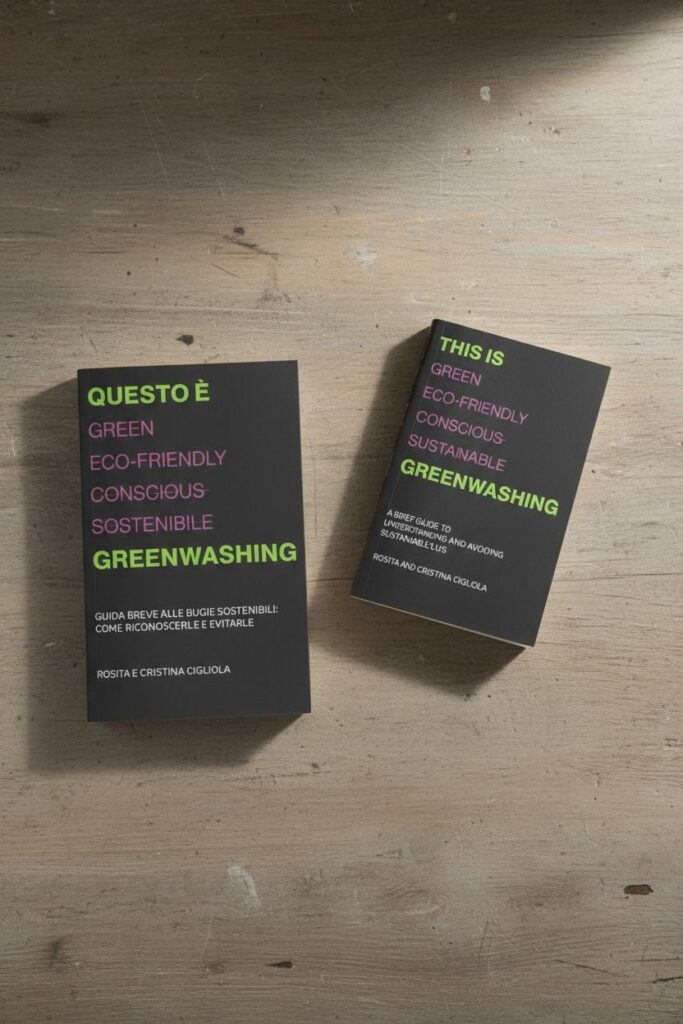
Seeing clearly in a world of green fog: Book cover of This is Greenwashing by Rosita and Cristina Cigliola. The design features bold, minimalist typography with green, pink, and white tones on a black background, highlighting themes of sustainability and deception. 'This is' appears in green; the words 'green', 'eco-friendly', 'conscious', and 'sustainable' are in pink but crossed out; and 'greenwashing' is in green. The subtitle and authors’ names are in white, standing out against the dark base.
This is Greenwashing: our e-book is out now!

Why this book exists


This Is Greenwashing isn’t a textbook.
It’s a guide born from frustration — and from a deep desire to empower.

“The most environmentally sustainable product is the one that never gets made.”

We’re Rosita and Cristina Cigliola, sisters with nearly 30 years in the fashion industry. We’ve seen greenwashing up close — how it misleads consumers and delays real change.

In recent years, especially after the pandemic, we’ve watched companies slap vague eco-labels on products while businesses carried on as usual. Greenwashing keeps consumers confused, compliant, and complicit in a broken system.

This e-book reveals the tactics behind the buzzwords. It helps you recognise what’s real and what’s not. You’ll learn how to decode vague claims, ask the right questions, and stop being manipulated by marketing.
Because when regulation fails, awareness becomes our strongest line of defence.

The bottom line: In a world of green fog, awareness is power


We wrote This Is Greenwashing to:

✔ Expose the tricks brands use to manipulate you
✔ Decode the jargon so you can spot lies at a glance
✔ Give you practical tools to make informed choices—no PhD required

In a world of green fog, knowledge is crucial. Awareness is power.
The more you know, the harder it is for companies to fool you.
And right now—with regulators stepping back and failing to protect us—we need that power more than ever.

📘 Get your e-book here — at your favourite digital store:  https://books2read.com/u/bpgxOX

📣 And if it helps, please leave a review — it truly means a lot.

“This is greenwashing’s greatest crime: distracting us with false solutions as the planet burns.”

Spot the lies. Demand better.

P.S. Share this with someone who’s ever asked: “But is this actually sustainable?”  🌍

🇮🇹 Versione italiana in arrivo — stay tuned!

This is Greenwashing: Seeing clearly in a world of green fog Read More »

Italy blocks EU’s Green Claims Directive, stalling anti-greenwashing regulation

Reading Time: 3 minutes

The demise of the directive and what it means for Europe’s fight against greenwashing


The regulatory landscape is growing increasingly opaque as European policymakers retreat from anti-greenwashing regulation. Most notably, they have blocked the proposed Green Claims Directive—a central piece of legislation aimed at tackling greenwashing.

The European Commission recently announced its intention to withdraw the proposal, citing opposition from several Member States and mounting pressure from right-wing groups in the European Parliament. Italy played a decisive role in this setback by pulling its support, effectively torpedoing the final trilogue negotiations—an essential step in EU lawmaking. The move has drawn criticism from environmental organisations and consumer advocacy groups alike.

Anti-greenwashing regulation: What the directive aimed to do


At its core, the Green Claims Directive aimed to curb misleading environmental claims made by companies. The goal was to bring greater honesty and clarity to sustainability communications and product labelling across the EU. Key measures included:

  • Transparency and verifiability: Authorities would require companies to provide concrete, verifiable evidence to back up environmental claims.
  • Ban on vague language: Terms such as “eco-friendly”, “sustainable”, or “carbon neutral” would no longer be permitted unless backed by robust data.
  • Clearer labelling: Environmental labels would need to be comprehensible, standardised, and meaningful to consumers.
  • Stronger consumer protection: The directive aimed to shield consumers from unfair and deceptive marketing practices related to sustainability.

Italy’s role and the reasons behind the withdrawal


The Italian government, under Giorgia Meloni, openly opposed the directive. The stated rationale was to reduce bureaucratic burdens and additional costs for businesses—especially small and medium-sized enterprises, which account for a significant share of the EU economy.
However, critics argue this reflects a broader political alignment with efforts to dilute environmental regulations. Some even suggest that Commission President Ursula von der Leyen coordinated the decision, raising further doubts about the EU’s commitment to its own Green Deal ambitions.

The fallout: Consequences and concerns


The withdrawal of the directive has far-reaching implications:

  • Cancellation of the trilogue: The final negotiation round between EU institutions was scrapped.
  • Public backlash: Environmental groups and consumer associations expressed deep disappointment, calling it a significant regression.
  • Regulatory vacuum: Without a clear legal framework, companies may continue to engage in greenwashing with minimal accountability.

Anti-greenwashing regulation – Final thoughts


In essence, rejecting the Green Claims Directive marks a troubling pause in Europe’s push for transparent and honest environmental communication. In fact, it casts doubt on the political will to challenge deceptive sustainability claims and to protect consumers from being misled.

For a continent that once positioned itself as a global leader in green policy, the retreat of anti-greenwashing regulation sends a worrying message.

What do you think? Is this a political misstep or a deeper shift away from sustainability commitments?
Leave a comment below (you’ll need to register first). Or DM @suite123 WhatsApp | e.mail

Italy blocks EU’s Green Claims Directive, stalling anti-greenwashing regulation Read More »

Being a Sustainability Critic: What does it really mean?

Reading Time: 2 minutes

Challenging greenwashing and holding brands accountable


Today, we want to explore the concept of being a sustainability critic: taking a critical approach to sustainability. What does it really mean?  Is being a sustainability critic about disregarding sustainability altogether? Or is it about caring so much that we refuse to be deceived by corporations and their marketing strategies?

Sustainability is often positioned as a key solution to climate change. However, can we really talk about solutions? Climate change is already a harsh, irreversible reality. As Rupert Read puts it, our only choice is to adapt to a world of climate extremes.

The point of being a sustainability critic


Being a sustainability critic means looking beyond surface-level claims and greenwashing to assess the real impact of brands, policies, and movements. It’s about:

1. Questioning corporate narratives
2. Exposing contradictions
3. Holding companies accountable for their environmental and social claims

A sustainability critic doesn’t just applaud “eco-friendly” initiatives. Instead, they ask: Is this truly sustainable, or just another marketing ploy? This attitude demands curiosity, scepticism, and a commitment to transparency.

Sustainability vs. corporate reality


Yesterday morning, we came across this news from The Business of Fashion:

“Patagonia, Nike and others have tried but failed to eliminate labour exploitation at key Taiwanese suppliers.”

“Brands like Patagonia, Nike and Lululemon have been working for years to address the exploitation of migrant workers at key fabric suppliers in Taiwan. Despite some progress, the issue has persisted.”

But isn’t Patagonia the brand that truly cares about sustainability? At least, that’s what they claim. Yet, time and again, the gap between corporate promises and actual practices is enormous. In fact, their actions simply do not match their words.

The truth about sustainable fashion


This is exactly why we need sustainability critics. It’s about cutting through corporate rhetoric, challenging greenwashing, and demanding real ethical standards.

The truth is simple:

There is no sustainability in overproduction.

There is no sustainability in exploited labour.

And for brands that continue to push their sustainable lies, there’s only one response: this is greenwashing.

Final thoughts


In conclusion, being a sustainability critic — or taking a critical approach to sustainability — is essential to avoiding deception by brands and corporations. In fact, if we want genuine sustainability in fashion, we must move beyond empty promises and hold brands accountable. It’s time to rethink the way we consume and demand radical transparency.

And you? Do you consider yourself a sustainability critic? Share your thoughts in the comments!

Being a Sustainability Critic: What does it really mean? Read More »

Milano Design Week, Fashion & Greenwashing

Reading Time: 3 minutes

Exploring tangible contrasts and ethical dilemmas in contemporary events


As the Milano Design Week concluded, we reflected on tangible distinctions with Fashion Week and delved into the pros and cons of the greenwashing effect evident in contemporary events.

The Milano Design Week is an annual event which serves as a platform for showcasing furniture, objects, creativity and ideas. This season’s theme, “Materia Natura” (matter nature), set the stage for contemplating the importance of environmental sustainability in the creative and design process. Also, running in parallel with the official “Salone del Mobile,” the Fuorisalone has experienced significant growth. As a result, every corner of the city boasted its own installations and events.

Blessed with beautiful sunny days, we immersed ourselves in numerous installations, many intertwined with fashion brands, just without the please-look-at-me foolishness. But a couple of reflections began to crystallise in our minds.

Milano Design Week, Fashion & Greenwashing
Milano Design Week – “Il mare dove non si tocca” by Antonio Marras

Milano Design Week & Greenwashing


The cons:
1 – The emphasis on sustainability often appeared to be mere greenwashing, given the excessive expenditure of money and resources without tangible environmental benefits. On the contrary, waste seemed clear.
2 – Some (fashion) brands participated simply to secure a spot on the list rather than with genuine needs. Indeed, this sentiment was palpable when the quality of the installation was just a way to invite people to stop by. Even among those who collaborated on a co-marketing initiative, the focus seemed to be just the marketing strategy.

Milano Design Week vs Fashion Week


The pros:
1 – In contrast to Milano Fashion Week, Design Week is more inclusive and open to anyone. And the atmosphere is way more enjoyable.
2 – The staff responsible for welcoming attendees and ensuring security exhibit a notably kinder attitude. Since Ro is a wheelchair user, we received acts of kindness during Design Week that we were not accustomed to compared to our experiences during Fashion Week.
3 – No fashion carnival, meaning no subjects begging for attention.

suite123 staff- Milano Design Week – “Il mare dove non si tocca” by Antonio Marras


However, we loved “Il mare dove non si tocca” (In the deep sea) by Antonio Marras. Upon entering the enchanting NonostanteMarras space, we encountered a temporary bar in the inner courtyard. Unfortunately, the arrangement of plants and tables left little room for a wheelchair to pass through. Witnessing our attempt, Antonio Marras jumped up and asked people to clear a path for us. Moreover, he kindly offered assistance if we wished to explore the basement area, where he showed his ceramics and a marvellous marine set-up for the restaurant area in collaboration with the Rana family. Also, we met the beautiful Antonella Rana, Global Image and Communication Director of Pastificio Rana.
Antonio Marras’ caring attitude surprised us. Such unconventional behaviour for the fashion industry standards!

The Milano Design Week concluded amidst fusions with fashion and a deluge of greenwashing. Specifically, design wins over fashion for accessibility and courtesy, but sustainability sounds too much like greenwashing. In contrast, let’s shape events where creativity harmonizes with sustainability, inspiring and innovating without compromising our planet.

Milano Design Week, Fashion & Greenwashing Read More »