fast fashion

Enslaving Workers: Has Anything Changed?

Reading Time: 2 minutes

Examining the reality of modern exploitation and its impact on labour


It seems clear that our economic system is based on enslaving workers. That’s how it thrives—by keeping labor cheap and maximizing profit at the expense of human dignity. While the system flourishes, workers are left behind, their rights undermined, and their well-being compromised. This cycle perpetuates inequality and exploitation, making true progress seem elusive.

Here we quote an excerpt of Li Edelkoort’s talk from the Voices stage–via Business of Fashion. Edelkoort is one of the most respected trend forecasters. This talk is from 2015, definitely not something new.  So, why it’s worth sharing again? Because nothing has changed over time!

Li Edelkoort on enslaving workers and cheap deals


Low prices are enslaving workers and destroying cultural value. This is what Li Edelkoort said:

“The manufacturing of clothes has gone through a rapid and sordid restructuring process, which has seen production leave the western world to profit from and exploit low-income countries,” said Edelkoort. “How can a product that needs to be sown, grown, harvested, combed, spun, knitted, cut and stitched, finished, printed, labelled, packaged and transported cost a couple of Euros?” she asked, comparing fashion’s supply chain to slavery.

“On the hunt for cheaper deals, volume companies, but also some luxury brands, have trusted the making of their wages to underpaid workers living in dire conditions,” she continued. “What’s more, these prices imply the clothes are to be thrown away, discarded like a condom before being loved and savoured, teaching young consumers that fashion has no value. We should make legislation to have minimum prices.”

Has anything changed so far? 


Now, the question is: Has anything really changed? The answer is no. That’s precisely why it’s important to revisit this issue.

No one planned to find solutions. Brands and governments will never do it! A spontaneous act of understanding is not part of their plans. But the pandemic has contributed to exacerbating the situation. Many people lost their job, and the working conditions are even worse now.

Seven years after Edelkoort’s assertion, we are still just talking. And talking about change when nothing ever changes is frustrating. We value words, but without action, real change will never happen.

So we signed the “Good clothes fair pay” petition, which demands a living wage for the people who make our clothes. They need 1 million EU citizen signatures. 

Let’s help them!

Enslaving Workers: Has Anything Changed? Read More »
The Coherence Gap

Reading Time: 2 minutes

The clash between sustainability and fast fashion’s growth


Our society has a problem with consistency, revealing a glaring coherence gap. Indeed one point seems quite clear: what people say is not consistent with what they do. It’s like coherence is a fault, or it’s not necessary. So you are allowed to say something and then do the opposite without being held accountable.

Consistency and sustainability


Magazines these days released the news that Shein, the fast-fashion giant, is raising funds at 100 billion USD value.
Considering that their price range is around 10 – 20 euros, two things are certain. First, the materials have zero quality. Second, their production chains raise serious doubts. If 15 euros is the price of one dress, how much are workers getting paid to make that garment?
Quality can be something one could renounce, but an ethical production chain is the foundation of a healthy society. And therefore, crucial in any discussion, even about sustainability.

Yet no questions arise in those who buy Shein. In fact, in a moment when communication and marketing are all about sustainability, the fast-fashion giant is growing enormously. And there is similar news too. Recently Primark opened in Milano, and people were packed in line to get in.

Overcoming the coherence gap


People talk about sustainability and maybe show up at ‘Friday’s for Future’, but they buy fast fashion. Why?
Everyone, adults and teenagers, say something, but they do the opposite. This lack of consistency reveals that sustainability is just a marketing trend. It is a popular topic, something people like to discuss to show they are up-to-date, but they don’t really care.

In fact, if they were consistent, they wouldn’t buy fast fashion at all! And the case of low budgets is just an excuse to avoid the change since the business model is profitable for corporations and “convenient” for short-sighted masses. Vintage items are accessible to anyone, and nothing is more sustainable.

So, here’s the way to overcome the coherence gap: let actions follow thoughts. In the same direction, of course!

The Coherence Gap Read More »

The Island In The Desert

Reading Time: 2 minutes

Have you ever wondered where our textile waste ends up?


Talking about the cost of fast fashion and the madness of disposable items can be upsetting and frustrating. No one wants to listen.

We could define it as a hidden cost, assuming people do not see it directly. Except that there’s nothing hidden anymore. And so, we call it the true cost because it happens before our eyes. Although, people refuse to see it intentionally.

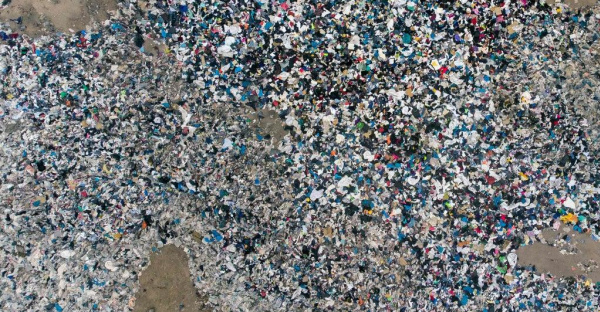
To illustrate the abnormity, perhaps a visual image helps awaken the conscience more than words.

Atacama desert in Chile - fast fashion leftovers
Atacama desert in Chile – fast fashion leftovers

Here, in front of your eyes, is the Atacama desert in Chile, the driest desert in the world. And that is an island of discarded clothing, including Christmas sweaters and ski boots, piling up in the desert. Horribly revealing the cost of fast fashion.

Chile is a hub for secondhand and unsold clothing coming from all over the world. USA, Europe and Asia. Approximately 59,000 tons of garments arrive there every year. Clothing merchants buy part of it, but the majority, about 39,000 tons, end up in rubbish dumps in the desert.

That happens because those garments contain chemicals and are not biodegradable, therefore not accepted in the municipal landfill.

The cost of fast fashion


We wonder what’s going to happen over time. Do you still feel ok with fast fashion and disposable goods?

On Monday, we posted about the need to shift our consumption habits. After reading this, the sense of urgency becomes imperative. It doesn’t need any further explanation.

Educating ourselves towards thoughtful consumption habits is fundamental. If brands don’t produce items made to last, we don’t buy from them!
Stop overconsumption. Stop purchasing disposable items. That is how we bring our contribution.

We know that expecting a change from brands is an illusion, yet it’s just a way to exclude ourselves from the game. If we pretend we do not play an active role, we hide our responsibilities.

On the contrary, we have to educate ourselves in order to become conscious and make intentional choices.

Break the loop. Take action now!

The Island In The Desert Read More »

Details Make The Difference

Reading Time: 2 minutes

Understanding quality fashion versus mass production


Although it is easy to copy high-fashion items, the difference between designer pieces and fast fashion is tangible.

With fast fashion, you get low-quality materials and poor construction, not to mention labour exploitation. Those elements change the final result completely.

By the way, it is well-known that people don’t see details.

Designer collaborations with fast-fashion chains are a way to make money by reaching a broader audience, which otherwise wouldn’t approach the brand. But what’s left of the original design? Does anyone notice that there is nothing of the original designs in those garments?

We still remember the first collaboration Karl Lagerfeld did with H&M. There was a lot of hype, so we decided to try. We bought many pieces, also some lingerie-style reminiscent of Chanel. Whenever we had the occasion, we tried on one or the other, but there was always something wrong. Pull one side, pull the other, no way to make the top, or the dress, seem decent.
The fit was terrible, stitchings and materials too. We ended up wearing some of those pieces as pyjamas.

Since we bought many items, the total amount was not small. Rethinking of it in terms of worth, did it make sense? Wasn’t it better to buy only one valuable piece, which we could wear for years? Rather than wasting money on several pieces we never wore?

Designer vs fast fashion


Indeed, that is the trick: reproducing a similar shape doesn’t mean tailoring the same construction. It doesn’t imply the same stitching ability and, definitely, not the same materials.

The quality of materials, together with the knowledge in crafting, are what make a piece of clothing look beautiful. And only expert hands can shape the proper fitting.

Change those ingredients, take out the sartorial touch, and instead of a Chanel imitation, you get a rag. Instead of an oversized dress, you get a garbage bag.

Yes, details make a huge difference.

Details Make The Difference Read More »

The Expiry Date: Fashion Or Mortadella?

Reading Time: 2 minutes

How communication strategies are undermining the fashion industry


Fashion communication – verbal, written and visual – has contributed to undermining the industry. In a world where fast fashion has become synonym of luxury and other similar absurdities, we always feel the need to define what we say. Somehow, we need to restore the meaning in this state of general confusion.

Hysterical mass production has led us to a broken industry incapable of selling the tons of items it produces. In fact, to manage the surplus, products are incinerated, making room for the next manifestation of this insanity.

So, why do niche brands or even high-end designers adopt these practices? Why do they feel compelled to hard-discount merchandise just a few months after its delivery to the stores, devaluing both their products and their brand identity?

“This item is new now, but it’s going to be old in three months or less.” There is no consistency in that.

A devaluing communication


The shallow language to attract consumers focuses not on value but on discounts or influencers:

PRE-SALE! – SALE! – Heavy discounts! – Black Friday! -60% -70%

Who offers less?!

“Today, with the influencers bad taste is everywhere.” – said Mr Valentino to “Il Messaggero”.

Herein lies a significant mistake in the communication and in the messaging of our industry.

When will fashion operators understand we are conceiving, producing, selling and communicating products born out of creativity? The moment we rediscover the value of that process, we’ll acknowledge the mistakes we’ve made.

Treating those products like milk or mortadella, as if they have a fast expiration date, is not a brilliant idea.

We love mortadella, and we also believe it holds more value than the majority of fashion products currently in stores. However, we think the true value of the entire creative process needs to be rediscovered and protected in the making and communication of fashion. It should be seen as something meaningful, timeless, not something to discard as quickly as possible.

What can we do to change?


Brands must produce less, taking extreme care of the entire process.
Heavy discounts should be eliminated, as they are not a healthy, long-term strategy.
People should consume less but better.

Let fast fashion serve its purpose for what is cheap, for people who chose not to see. At the same time, let’s protect and celebrate the timeless value of creativity, quality, and craftsmanship using the right language to support this mission..

The Expiry Date: Fashion Or Mortadella? Read More »