contemporary culture

Why we keep looking back: lasting ideas in a time of endless content

Reading Time: 3 minutes

Editorial reflection — ideas worth revisiting when everyone is chasing what’s new


A year moves fast, but lasting ideas don’t. We live amid new headlines, new trends, new urgency — but not everything worth saying belongs only to the moment it’s written.

Actually, we’re flooded by new content. Yet content is a funny word. It’s mostly related to people oversharing what they buy, eat, travel, and so on—call it content. In fact, content often means: show your overconsumption habits to the world.

As we move further into 2025, we’re pausing to look back at stories that haven’t aged. Not because they were “timely,” but because they were timeless.
In a society — and a digital world — obsessed with the next thing, we’ve always valued depth over speed, understanding over reaction, and clarity over noise.

What follows is a curated return to ideas that still speak, question, and clarify. Not a retrospective, but a reaffirmation: some thoughts don’t expire.

Lasting ideas worth revisiting


Below is a curated selection of posts that continue to resonate. Each one offers insight into the mechanisms, contradictions, and possibilities in fashion and beyond.

• Breaking free from the social media trap
We explored the possibility of escaping algorithmic feeds and finding better ways to connect.

Breaking free from the social media trap: Instagram Algorithms and TikTok’s future

• Preserving the Brain at Fondazione Prada
Two posts examining how brands exist within culture, through the lens of art, neuroscience, and cognitive reserve.

The lexicon of neurodegenerative diseases

Dialogue with art – aesthetic experience, cognitive reserve, and social interaction

• Holding brands accountable
A critical look at greenwashing and the role of the sustainability critic.

Being a sustainability critic: what does it really mean?

• Microplastics on human health
A three-part series from a dedicated event.

1: Understanding the problem

2: Health risks and scientific findings

3: Impact in fashion

• Indiscriminate discounts
A deeper exploration of how perpetual sales have compromised the market’s value.

Indiscriminate discounts — A practice that has spiralled out of control

• The myth of cheap luxury
Exploring why “cheap luxury” doesn’t exist and the social media scams that promote it.

The myth of cheap luxury and why it doesn’t exist

• Stories behind the collections
An analysis of the tension between idealism and reality in contemporary fashion narratives. Exploring the idea of one piece, one story.

The stories behind SS25: Tension between idealism and reality

• The reality of manufacturing: luxury sweatshops
Investigating the supply chain and the conscious disconnect of consumers.

Luxury sweatshops: the ugly truth behind the fashion industry — and why consumers look away

Final thoughts


Looking back isn’t about nostalgia — it’s about continuity. It is how we identify lasting ideas—the narratives that carry their weight beyond the moment.

In the rush to produce, publish, and promote, we can forget that the most valuable ideas are often those that last: the ones that explain, question, and clarify again and again.
This selection is a reminder that depth has its own timeline. Some stories keep working long after they’re written.

We invite you to wander further into our archive — there’s always more to uncover — and join our newsletter (signup is in the sidebar on desktop, at the bottom of the page on mobile, or here) for reflections that move at a different pace.

A note to our readers: since February 2025, all our posts are available in both English and Italian. To switch language, click the flag icon in the site menu on desktop, or tap the menu icon (three lines on the right) on mobile to access the language selector.

Why we keep looking back: lasting ideas in a time of endless content Read More »

Christmas 2025: seeking light in deepening shadows

Reading Time: 2 minutes

Holding space for peace when the world is holding its breath


Seasonal greetings arrive again, wishing us a Merry Christmas 2025. They speak of joy, magic, and gratitude. Yet for many, these words echo against hunger, displacement, or the constant sound of artillery. The world feels increasingly unstable, and war has become part of our daily language.

So the question lingers: where do we look for light when the shadows stretch so long? And what does it mean to celebrate when celebration can feel fragile, even out of place?

This year, the distance between the festive image and global reality feels especially wide. Gaza continues to endure unspeakable devastation and starvation. The war in Ukraine grinds on, with renewed violence in recent days. Sudan, too, is sinking into catastrophe, forcing millions into hunger and exile. These are not distant tragedies; they are humanitarian failures unfolding in real time.

A girl wearing powder pink shorts, a red oversized wool sweater, and green elf-style long socks cuddles a white bear in a snowy background with a few trees, among which are one Palestinian and one Ukrainian flag. Santa Claus stands, sending light towards the flags. Wishing a Merry Christmas 2025.
Merry Christmas 2025


In such a landscape, the core questions of Christmas — peace, hope, goodwill — risk sounding naive. Yet perhaps they are not sentimental at all, but quietly radical.

Not as slogans. Not as forced cheer. But as choices.

Perhaps the light we seek is not found in denial or forced joy, but in attention. In the decision to pause, to stay present with what is painful, and to refuse indifference. To hold sorrow and still choose empathy. To recognise that caring, today, is an active choice.

This Christmas, holding space can be an act of resistance in itself. A pause. A listening. A willingness to remain human in the face of what dehumanises.

To support humanitarian workers, to advocate, to bear witness — these are small gestures measured against vast suffering, yet they matter. They are how peace survives not as a wish, but as a practice.

In solidarity, in sorrow, and in stubborn hope,

Merry Christmas 2025

Christmas 2025: seeking light in deepening shadows Read More »

Editorial reflection on what still matters: against the rush of new content

Reading Time: 3 minutes

Looking back, reading forward: why some stories are still worth our attention


Since we’re approaching the end of the year, today’s post is an editorial reflection on what we’ve written so far and why it still feels relevant.

In an era dominated by mass content creation—often fast, repetitive, and empty—we have tried to remain attentive to what happens around us, making sense of events, news, and shifts rather than simply reacting to them. Over time, our work has focused on observation, context, and responsibility, choosing depth over immediacy.

Alongside this, we have consistently worked to clarify what greenwashing is, how to recognise it, and how it differs from genuine sustainability. This effort took a more structured form in our eBook, This Is Greenwashing. In reality, our critical approach to sustainability has always been part of our wider editorial lens, shaping how we read fashion, culture, and systems of production.

Because of this, many of our previous posts remain relevant. They were not written for the moment, but for understanding. Today, we circle back to some of them—pieces that still speak clearly, ask necessary questions, and deserve to be read again.

Editorial reflection: looking back, reading forward


Below is a curated selection of posts that continue to resonate. Each one offers insight into the mechanisms, contradictions, and possibilities of the contemporary fashion landscape.

• We are proud to give voice to designer Consti Gao, co-founder of JAMPROOF. This post is crucial to understanding what it means to build a brand in the contemporary landscape.

Sisyphus’ seventh season — emerging fashion brands in today’s landscape

• This post explores the logic behind labour exploitation and why it signals something deeper—a pattern that connects the fashion industry to any other field.

13 more brands under investigation in Milan for labour exploitation

• A story of slow fashion from Japan, where mud-dyeing becomes a language of time, care, and human connection to the earth.

Clay dye processing: the colour of the earth

• Greenwashing is what, most of the time, hides behind the language of sustainability. This piece helps build the tools to see more clearly.

Greenwashing: The system is designed to fail. It’s time to see clearly

• Is secondhand truly an effective solution, or is it being absorbed by the same logic of overconsumption it was meant to counter?

Secondhand fashion and overconsumption: Is thrifting the new fast fashion?

• Here, we analyse why—despite extremely expensive fashion schools—what the industry increasingly rewards is not skill, but visibility and hype.

Fashion is no longer a job for fashion designers

We invite you to read—or reread—these pieces slowly, without urgency, allowing space for reflection rather than consumption. And perhaps even discover other posts you might have missed.

Final thoughts


This editorial reflection is not about looking back with nostalgia, but about recognising continuity. It’s about understanding what endures and what can guide us forward. Some questions don’t expire, and some texts don’t either. In a digital space driven by constant output, choosing to reread is also a form of responsibility.

Take your time to explore our archive — there’s more to discover — and subscribe to our newsletter to receive reflections, stories, and insights throughout the year.

Editorial reflection on what still matters: against the rush of new content Read More »

Cloud Dancer: Pantone’s most controversial colour yet

Reading Time: 5 minutes

Why Pantone’s 2026 Colour of the Year is sparking global debate — and what we’re projecting onto it


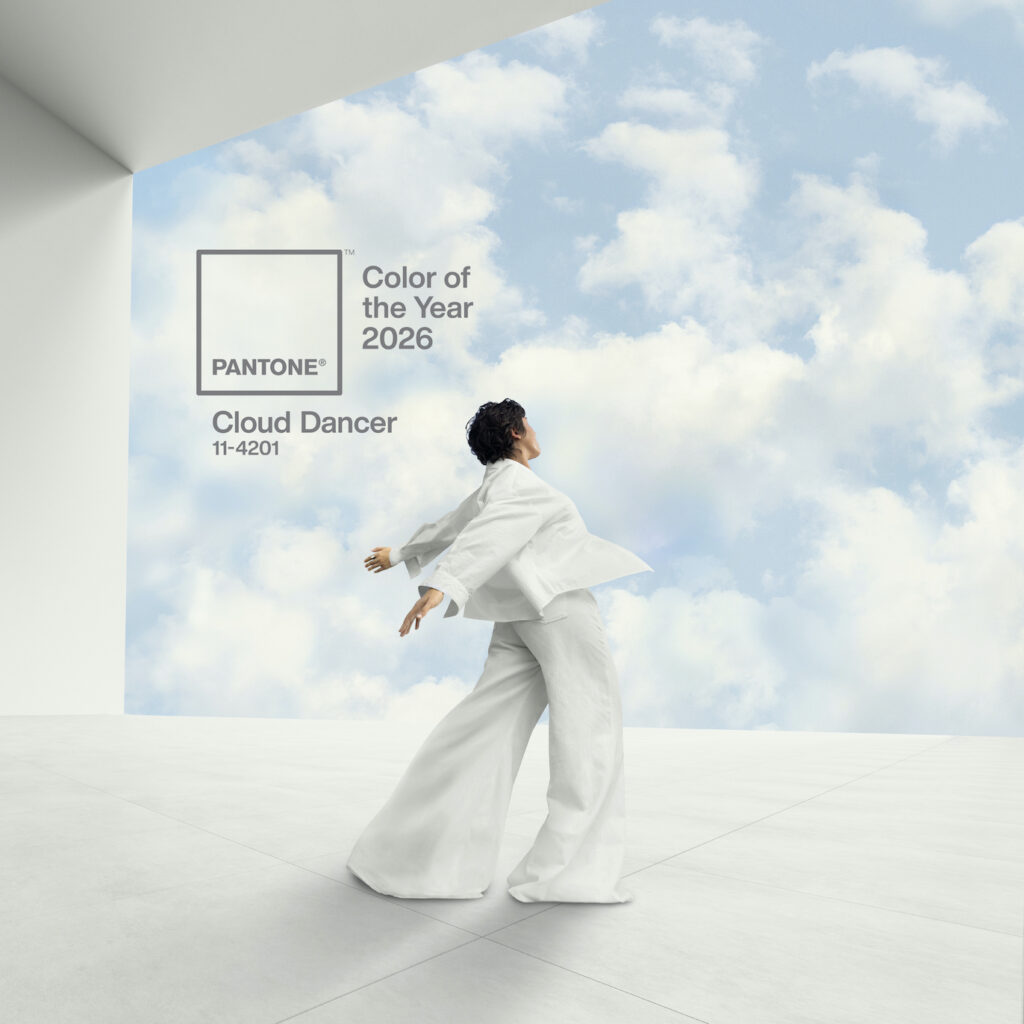
Cloud Dancer, Pantone’s soft white chosen as the 2026 Colour of the Year, is perhaps the most controversial selection in the brand’s history. Critics have dismissed it as boring, tone-deaf, or racially insensitive — a stark contrast to Pantone’s stated message of peace and new beginnings. As the first white shade chosen in 26 years, it has sparked accusations of “rage bait” and drawn unsettling cultural parallels.

Yet for us — having opened an all-white boutique in 2006 —  this hue resonates deeply. It feels like home—a colour that never overpowered but elevated. 

So, let’s take a closer look.

A conceptual image introducing Pantone's 2026 Color of the Year, Cloud Dancer. A woman in a flowing garments of a tranquil shade moves gracefully. She is posed as if dancing or floating effortlessly between wispy clouds and a smooth, reflective white floor. The overall scene evokes a feeling of lightness, calm, and ethereal movement.

Pantone: Cloud Dancer


Pantone has selected PANTONE 11-4201 Cloud Dancer, a serene, billowy white, as its 2026 Colour of the Year. Described as an ethereal hue, it symbolises a calming influence and a desire for a fresh start, encouraging quiet reflection and creativity.

The colour represents a conscious step away from relentless demands, promoting rest, focus, and an aspiration for peace and unity. Pantone will also spotlight artists throughout the year to create their own interpretations of the colour.

From the official release:

“At this time of transformation, when we are reimagining our future and our place in the world, PANTONE 11-4201 Cloud Dancer is a discrete white hue offering a promise of clarity,” says Leatrice Eiseman, Executive Director of the Pantone Color Institute. “The cacophony that surrounds us has become overwhelming, making it harder to hear the voices of our inner selves. A conscious statement of simplification, Cloud Dancer enhances our focus, providing release from the distraction of external influences.”

“We are living in a transitional time where people are seeking truth, possibility, and a new way of living,” added Laurie Pressman, Vice President of the Pantone Color Institute. “PANTONE 11-4201 Cloud Dancer is an airy white hue that exemplifies our search for balance between our digital future and our primal need for human connection—a liminal space that is a launchpad for creative expression—as individuals and communities are experimenting beyond traditional boundaries, opening the door to increased imagination and innovation.”

Cloud Dancer: applications of the colour of the year 2026


Far from being a “non-colour”, Pantone positions Cloud Dancer as a foundational and highly functional shade. Its key roles are to:

  • Act as a structural colour that scaffolds and harmonises the wider spectrum.
  • Provide adaptability, creating both serene monochrome looks and striking contrasts.
  • Bring an airy lightness to any product or environment.

Cloud Dancer in apparel


In fashion, Cloud Dancer serves multiple purposes:

  • A wardrobe anchor: it is the perfect, understated base for monochromatic dressing, from classic shirts and jeans to activewear and suiting.
  • A textural statement: the colour evokes billowy softness through spongy, puffy silhouettes, oversized padding, and rounded, cocooning shapes. It is realised in textures like:
    • Down- or foam-filled cloths
    • Fluffy furs and plush wools
  • An airy counterpoint: its vapour-like quality also lends itself to diaphanous chiffons and fluid jerseys, creating floaty, versatile pieces.
  • The ultimate support: it mixes effortlessly with all other colours, providing a sophisticated contrast that lets brighter hues stand out.

Cloud Dancer in fashion accessories & footwear


For accessories, Cloud Dancer introduces modernity and quiet elegance:

  • Universal compatibility: it mixes effortlessly with every colour palette, adding sophistication without overpowering an ensemble.
  • Dual textural impact:
    • In soft accessories like chunky knits and natural fibres, it offers comforting, conforming textures.
    • In structured pieces like fine jewellery, eyewear, belts, handbags, and footwear, it provides an understated, modern sophistication.

The controversy


The choice of Cloud Dancer has generated significant debate for several key reasons:

  • An unexpected letdown: after a series of bold, vibrant selections, many felt a neutral white was a surprisingly passive and uninspiring choice.
  • Perceived insensitivity: some critics viewed the promotion of a white hue as tone-deaf, given the current global discourse on racial justice.
  • A “non-colour”: public reaction was swift, with the shade widely described online as “bleak,” “dystopian,” and a signal of creative or economic recession.
  • Seen as provocation: some commentators suggested the selection was deliberate “rage bait”—a controversial move designed to generate publicity through outrage.

Pantone’s defence


In contrast, Pantone frames Cloud Dancer as a purposeful and meaningful response to the current moment. The Pantone Colour Institute describes it as a “billowy, balanced white” intended to symbolise calm, clarity, and a blank slate.

Laurie Pressman, Vice President of the Pantone Color Institute, elaborated:

“Similar to a blank canvas, Cloud Dancer signifies our desire for a fresh start. Peeling away layers of outmoded thinking, we open the door to new approaches. An airy white hue, Cloud Dancer opens space for creativity and allows bold ideas to emerge.”

A different perspective


This defence raises a compelling counterpoint to the accusations of creative bankruptcy. We would argue the opposite: how can a blank canvas represent a lack of creativity? It is, after all, the foundational starting point for every painter—the very space where bold ideas are born, and innovation begins.

Final thoughts


Ultimately, Cloud Dancer stands as one of Pantone’s most polarising choices, not just for its departure from vibrant tradition, but for its profound and perhaps unintended resonance with contemporary social currents.

A colour, after all, is a mirror. One sees in it what one brings: culture, context, and personal sensibility. While another neutral — black — might have felt more attuned to the current global climate, it lacks the essential quality of hope.

And in the end, isn’t that what we’re all looking for? Not a colour that reflects the weight of the now, but one that makes space for what comes next.

Cloud Dancer: Pantone’s most controversial colour yet Read More »

Frankenstein, misquoted: Guillermo del Toro, patriarchy strikes at the end

Reading Time: 4 minutes

Mary Shelley: when the genius of a woman is still rewritten by men


I watched Guillermo del Toro’s Frankenstein, and what comes to mind is: misquoted. As well-made as the film is, I’m left with a strong sense of disappointment.

To understand why, let’s go back to the origin.
The birth of Frankenstein dates back to the summer of 1816, a cold and dark summer marked by volcanic ash. At Villa Diodati in Switzerland, Lord Byron challenged Polidori, Percy Shelley, and the eighteen-year-old Mary Shelley to write a ghost story. Byron soon abandoned his tale, but Mary, after a sleepless night and discussions about electricity and galvanism, had a vision: a man bent over an inanimate creature that stirred to life with a jolt. From that image came a novel that would redefine Gothic literature, horror, and science fiction, exploring ethics, creation, and fears of technological progress.

Gothic scene: An antique copy of Frankenstein by Mary Shelley rests on a weathered wooden desk, alongside a candelabra, an old leather-bound book, an ornate key, parchment sheets, and an inkwell with nib. A deep bordeaux curtain drapes to the side, framing a large, atmospheric window in the background.
“Frankenstein” by Mary Shelley — special edition, a gift from author Rima Jbara.
Frankenstein: Guillermo Del Toro’s adaptation

You read a book and take from it what you want. If you’re an artist or a director, you tell the story in your own way; art must be free to express itself. In fact, films almost never reproduce the plot of the books they draw inspiration from. Spoiler: books are always better than the films. It couldn’t be any different for Guillermo del Toro and his version of Frankenstein. The actors are excellent, their performances flawless. The set design, costumes, and music are all beautifully crafted.
The first part of the film is his own embroidery on the story: there are connections, but the real tale is something else entirely. It becomes more truthful when the creature’s narration begins. Certainly, one strength of the film is that it makes clear—even to those who have never opened the book—that Frankenstein is the name of the creator, not the creature. And above all, that the real monster is not the creature but the one who made it.
At the end, a quotation appears. As I read it, I miss the author’s name.
Beautiful, I think. I don’t recall reading it in the book. Indeed, it’s not there.

“The heart will break and yet brokenly live on.”  
Lord Byron, Childe Harold’s Pilgrimage

To sum up, the director makes a film based on a story written by Mary Shelley, and decides to close the film with a quote by Lord Byron! WTF!

Mary Shelley’s legacy

Mary Shelley didn’t just invent a genre; she wrote pages of extraordinary emotional power. Her words were enough. I understand that it’s an artistic choice, of course. And precisely because it is, it carries weight: every deliberate gesture says something.

Mary Shelley initially hid her identity as the author of Frankenstein. The novel was published anonymously in 1818. As a result, the public attributed it to Mary’s husband, the poet Percy Shelley, because of his literary fame. At the time, a young woman could not possibly have written something so radical and complex. Mary waited five years before reclaiming her name: she published the second edition under her own name in 1823. A deliberate act—she was asserting her authorship and resisting the scepticism surrounding female creativity.

Patriarchy at play

Today, you, director, draw inspiration from a woman who, at eighteen, wrote a masterpiece that continues to inspire readers, writers, musicians, and filmmakers… and what do you do? You end your film with a quote by Lord Byron? As if Mary Shelley hadn’t written countless lines that left a mark. As if Mary Shelley had ever needed a man to legitimise her. Seriously?

In other words, women today no longer have to publish anonymously, but legitimacy—oh—that still comes from men. I can’t wrap my head around it. Quoting Byron at the end shifts the focus from her to him. It’s a symbolic gesture, but symbols matter. Male appropriation of female genius — as a norm? Unintentional? Interpretations are open.

This mechanism is nothing new—and it’s certainly not gone. If this isn’t patriarchal culture…

I find myself wanting to apologise to you, Mary Shelley.

Sincerely,
Rosita

Frankenstein, misquoted: Guillermo del Toro, patriarchy strikes at the end Read More »