contemporary culture

Violence against women: a cultural problem

Reading Time: 3 minutes

With regressive attitudes growing amongst the young, how do we build a future of prevention?


Yesterday, 25th November, marked the International Day for the Elimination of Violence against Women, established by the UN in 1999. However, reflection and action cannot be confined to a single day.

Tragically, not a day passes without news of a femicide. And if not explicitly, then there are reports of online violence, manipulation, oppression, and the absence of equal opportunities. In other words, there are constant attempts to silence and diminish the female figure.

It is a sobering thought that this violence was only formally recognised as a violation of human rights in 1993, with the adoption of the Declaration on the Elimination of Violence against Women (DEVAW) by the UN General Assembly. This was further reinforced by the Vienna World Conference on Human Rights, which also acknowledged it as a human rights violation.

Right. Formally recognised only in 1993…

Violence against women: data and context


The data on femicides are not just ‘crime news,’ but the last, tragic link in a chain. According to Istat, over 31% of women in Italy have experienced some form of physical or sexual violence in their lifetime (from the age of 16). Furthermore, the European Parliament states that one in three women in the EU has experienced physical violence, sexual violence, or threats as an adult.

United Nations data indicate that one woman or girl is killed every 10 minutes by an intimate partner or family member.

Femicide is the culmination of violence that often began much earlier. We need to talk about it to recognise the signs long before it is too late.

As Laura Bates, founder of the Everyday Sexism Project, insightfully notes:

“For the first time in history, repeated studies are suggesting that the most misogynistic, outdated, regressive attitudes towards women and girls are now the most common amongst the youngest.”

Dismantling stereotypes: the “I didn’t expect that.”


How many times have we heard “but he was a good guy”? It is time to dismantle this dangerous cliché. The “monster” does not exist; what exists is the “normal” man who does not accept rejection and who considers a woman his property. Violence lies there, in pathological jealousy, in control, in stalking. We must learn to recognise these red flags, because there is no such thing as a “violent look”.

A focus on prevention: what can we actually do?


Beyond indignation, we need prevention. Prevention means sexual and emotional education in schools, to teach respect and how to manage emotions. It means supporting anti-violence centres, which save lives every day. It means, for each of us, not looking the other way when we hear a worrying argument from a neighbour. Violence is fought with culture.

Yet, in Italy, the government appears to disagree with this approach. Indeed, Minister Roccella has stated that there is no data to prove that sexual and emotional education in schools helps to prevent violence.

Final thoughts: violence against women is a cultural problem


Before we conclude, we also want to suggest reading a powerful testimony written by one of our friends—a heartbreaking story of abuse that sheds light on the real, everyday consequences of this cultural problem. (Find it here.)

As we reflect on the International Day for the Elimination of Violence against Women, we must be clear that the problem is systemic. Women start from a disadvantaged position, as we are still considered a possession of men—whether husbands, partners, or family members. We are still considered less than men.

The subordination or perceived inferiority of women is the oldest prejudice in human history.

Violence against women is a cultural problem. And fighting it requires an everyday commitment—especially in a society facing cultural regression.

Violence against women: a cultural problem Read More »
Critique and contemporary language: subjectivity vs shared understanding

Reading Time: 5 minutes

How words shift meaning across culture, fashion, and society


As we prepare to absorb the inspiration from Milano Fashion Week, we find ourselves reflecting on critique and contemporary language. Should words remain confined to a subjective sphere? Or do they also carry a broader, shared dimension? The issue is crucial for achieving mutual understanding — especially in these divisive times.

Critique in fashion and contemporary culture


Critique is the process of analysis, evaluation, and judgment. It involves questioning assumptions, examining evidence, and applying standards (aesthetic, ethical, logical, etc.).
Words like critique — in fashion or elsewhere — naturally exist in tension between subjectivity and shared understanding.

Subjective meaning

Each individual, culture, or professional field can bring nuances to the term. In fashion, for instance, critique might mean a thoughtful aesthetic evaluation, a cultural commentary, or even a business review. For a designer, it could feel like judgment; for a scholar, it’s analysis; for a writer, it’s content.

Shared understanding

At the same time, communication requires a common ground. Without at least a baseline agreement (e.g., that critique is an evaluation beyond mere description), the word loses clarity. A global fashion discourse — spanning Milan, Paris, Tokyo, Lagos, and New York — requires a shared definition so that ideas can circulate meaningfully across borders.

Language: a living ecosystem


In practice, in fashion as in society at large, language works like a living ecosystem:

  • Words are never static; they evolve with cultural shifts. For example, “queer” once carried a negative, derogatory meaning. Over time, with cultural and social change, it has been reclaimed as a term of identity and empowerment within LGBTQ+ communities.
  • Critique in the 1980s fashion press does not mean quite the same thing as critique in today’s Instagram reels. In the 80s and 90s, it often referred to structured reviews by authoritative voices (Suzy Menkes, Cathy Horyn, etc.), published in newspapers or magazines and capable of shaping designers’ reputations. Today, critique is fragmented: it can be a 15-second TikTok reaction, an academic essay on cultural appropriation, or a consumer’s Instagram caption. Authority has decentralised, and critique has stretched from elite judgment to everyday commentary. And even the journalists’ commentary seems bland.
  • Globalisation pushes towards a shared vocabulary, but context (regional, professional, generational) keeps recharging words with subjective layers. The word “sustainable,” for example, has entered the global lexicon, particularly in fashion and lifestyle. Yet its meaning shifts: for policymakers, it refers to measurable impact and regulations; for brands, it often becomes a marketing narrative; for consumers, it can range from “eco-friendly” to simply “durable.” The same word is globally shared yet continuously recharged with subjective layers.

Language & social media

These evolving meanings don’t just change language in theory — they directly reshape how critique functions in practice, especially on social media, where fashion discourse now largely unfolds. On these platforms, language is both personal and public, amplifying the tension between subjective expression and shared understanding.

As Paola Bonacini, Associate Professor in Geometry at the University of Catania, noted: “Social media is a mirror of that small portion of reality, or falsehood, that we intentionally show the world.” This insight frames the current culture with precision.

The role of critique in fashion


In fashion, the tension between subjective and shared meaning plays out vividly: critique has shifted from the authoritative voices of established critics to the fragmented, instant reactions of digital platforms. In today’s “Like” economy, feedback is quantified in likes, shares, and sales. Dissent is rarely articulated; it appears instead as silence — a lack of engagement. There is little room for nuanced, critical argument in comment sections dominated by “OMG!” or “I hate this.”

Here, the collapse of critique illustrates the danger of losing both subjectivity and shared understanding: individual voices are reduced to emojis, while no collective definition of critique holds sway.

Brands are terrified of alienating any customer segment. Taking a strong, dissenting stance — for example, a political or environmental position that might prove controversial — is seen as bad for business. It feels safer to be bland. The industry thrives on collaborations – designer × fast fashion, brand × celebrity, brand × brand. The ethos is mutual celebration and commercial synergy, not critical examination. To critique one is to critique all, so silence prevails.

Fashion has not only lost its identity but also its sense of critique. One style, one pattern, one mindset. No space for dissent.

Critical dissent is dissent that is reasoned, articulated, and backed by evidence and analysis. It is the most effective and respected form because it offers an alternative perspective rather than mere rejection. Without critical dissent — reasoned arguments proposing alternatives — there is no force to challenge the status quo.

Final thoughts


In conclusion, the meaning of words is never fixed; it adapts to changing cultural contexts. Yet in contemporary language, both dimensions are necessary: subjectivity and shared understanding. Subjective meaning keeps a word alive, adaptable, and open to reinterpretation, while shared understanding anchors dialogue and provides common ground.

Fashion is more than a showcase of trends; it is a stage where the health of critique — subjective expression and shared discourse — is tested. Without strong critics or designers willing to dissent from the commercial formula, the fashion system has no reason to change. It simply perpetuates the same profitable, safe patterns — which, by the way, no longer work.

As Milano Fashion Week approaches, we should reflect on critique not just as subjective opinion or shared vocabulary, but as the force that keeps fashion — and language itself — alive.


The meaning of words and the role of critique are ever-evolving. What are your thoughts? Do you agree that fashion has lost its capacity for critical dissent?

We want to hear from you: 💬 Comment below (registration is quick and easy), send us an email, or message us on WhatsApp. Your perspective is a vital part of this discussion.

Critique and contemporary language: subjectivity vs shared understanding Read More »

 Sinner is the winner: “Today, I saw an Italian winning Wimbledon,” Panatta said

Reading Time: 2 minutes

In a flattened world, minimal style, quiet strength, and kindness still shine


Allow us a little Italian pride today: Jannik Sinner has become the first Italian man to win Wimbledon. As Adriano Panatta said, “Today, I saw an Italian winning Wimbledon.”

Beyond the tennis, Wimbledon remains a stage where elegance reigns—more haute couture than street style. Thankfully, it’s not the circus we often witness during fashion weeks. Yes—there’s still room for elegance. Unbelievable!

And that brings us to Sinner’s style—which is our perspective. But it’s something deeper than fashion’s recent fascination with tennis. Today, fashion brands compete to secure tennis players as brand ambassadors.

Jannik Sinner is the kind of young man you don’t often see these days: clean, understated, refreshingly simple. No gimmicks, no excess, no tattoos. But what truly stands out is his kindness and humility—his respectful nature, both on and off the court. From culture to manners to image—which are all deeply interconnected—he represents a rare breed. A species, one might say, on the verge of extinction.

That’s what we admire: the courage to be different. The courage to be oneself.
In a flattened world, minimal style, quiet strength, and kindness still shine.

So, thank you, Jannik Sinner.
First, for giving Italy something to celebrate beyond football, football, and yet more football—a world that doesn’t always reflect the best of us.
Thank you for the emotions you spark, and for your willingness to learn from your mistakes—because that, too, is a life lesson.
And thank you for yesterday’s historic win.
But most of all, thank you for being a role model for younger generations.

You show us that elegance can live outside the mainstream.
That it can come from simply being true to yourself—even if that means defying expectations.
That values matter.
That kindness wins.

 Sinner is the winner: “Today, I saw an Italian winning Wimbledon,” Panatta said Read More »

Bruce Springsteen: A rocker’s stand against Trumpism

Reading Time: 3 minutes

From the San Siro stage, a defiant cry against Trumpism and authoritarianism


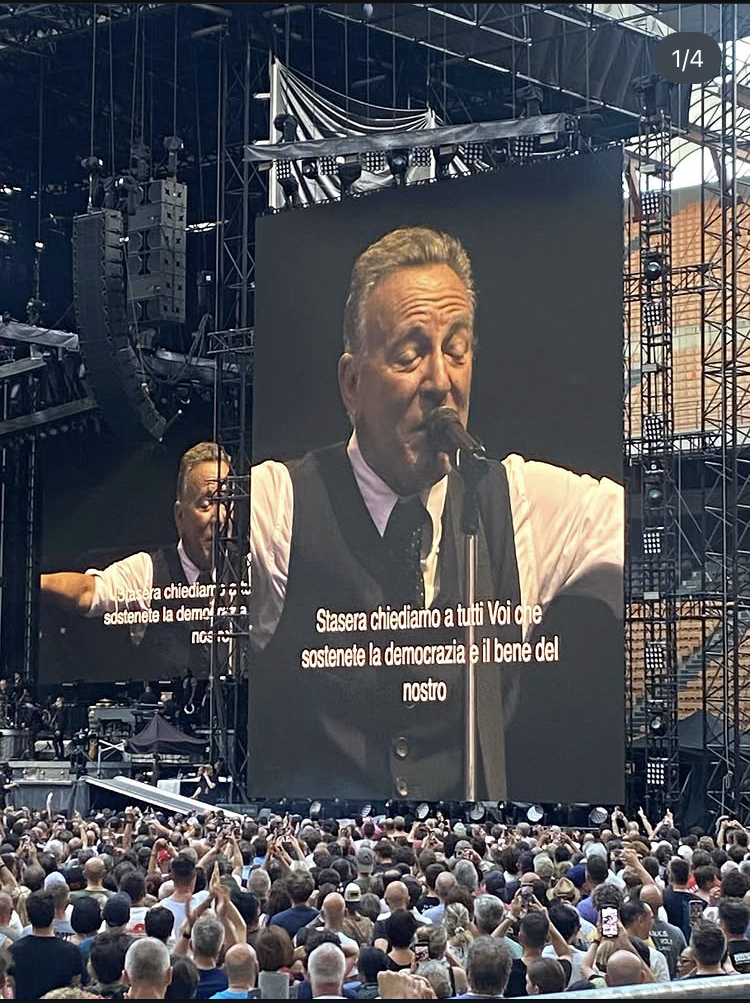
30 June: Among the highlights of our summer, the Bruce Springsteen concert in Milano stands out as one of the most powerful—for the music, his hoarse, unmistakable voice, the legendary E Street Band, and the worldview it delivered. It was a celebration of rock and all its rebellious, soulful energy—channelled in defence of democracy.

A Land of Hope and Dreams is, in fact, a political tour—a heartfelt defence of the American values being eroded by Trumpism.

From the San Siro stage, Bruce Springsteen delivered not just a performance but a manifesto. A clear, unwavering act of resistance against authoritarianism and the toxic legacy of Trump. Dressed in a quietly sharp, impeccable style—a statement of elegance and restraint—he stood for the America he’s sung about for fifty years. An America that seems lost. Actually, an America we barely recognise.

“The America I’ve sung about for nearly 50 years is real despite all its flaws: it’s an incredible country with incredible people.”

“There are problems in every home, so thank you for listening to mine.”

Image of the Bruce Springsteen concert in Milano. The Boss wears a white shirt, dark tie and vest. Subtitles in italian make every word clear.

Bruce Springsteen in Milano: Music as a rallying cry for democracy


In essence, Springsteen’s message was clear. Italian subtitles on screen translate his speech. His bold words—an unfiltered indictment:

“The America I love is in the hands of a corrupt, treacherous, and incompetent administration. Tonight, we ask you to stand up for democracy, to raise your voice against authoritarianism, and to let freedom ring.
Right now, things are happening that are altering the true nature of democracy in our countries, and they are too important to ignore: the abuses of a president and a dishonest government.
In America, my home, people who exercise their freedom of speech and voice their dissent are being persecuted. This is happening right now.
The richest men find satisfaction in abandoning the world’s poorest children to disease and death. In my country, they are sadistically enjoying the pain inflicted on honest American workers.
They are betraying our strongest allies and siding with dictators, against those who fight for freedom. They are defunding American universities that refuse to bow to their ideological demands. And they are abducting American residents off the streets without due process, deporting them to detention centres and foreign prisons.
But I have hope that we will survive this too.”

Springsteen holds nothing back. He steps into the front row, gifts his harmonica to the crowd, embraces the audience, and lets the fans embrace him in return. Also, he thanks the fans for listening—then closes with these words:

“I have hope because I believe in the profound truth voiced by the great American writer James Baldwin: ‘Not everything that is faced can be changed, but nothing can be changed until it is faced.’ In this world, there may not be as much humanity as we wish existed—but there is enough.”

Final thoughts


Springsteen didn’t just make the San Siro crowd sing, dance, and sweat—especially with his grand finale: Born in the U.S.A., Born to Run, Dancing in the Dark. He didn’t just give us a night of rock anthems—he gave us a call to arms. He left us with something even more powerful: a defiant cry, a musical and moral stand against Trumpism and authoritarianism.

In an era of rising authoritarianism, his defiance was a reminder: the fight for democracy isn’t just political—it’s cultural. And it’s ours to wage.

These values resonate more deeply than the divisive forces shaping today’s world.

Bruce Springsteen: A rocker’s stand against Trumpism Read More »

Fashion as protest: How John Lennon still inspires quiet resistance

Reading Time: 2 minutes

Seeking cross-cultural dialogue as USA bombs Iran


On June 17—just days before the U.S. bombed Iran—we shared a John Lennon quote on the suite123 Instagram account:

“Our society is run by insane people for insane objectives. I think we’re being run by maniacs for maniacal ends and I think I’m liable to be put away as insane for expressing that. That’s what’s insane about it.”

The Spring/Summer 25 GoodNeighbors Shirts collection led us back to his legacy. Inspired by Lennon’s 1977 days in Karuizawa. Lazy, sun-drenched moments with family—this resort wear blends effortless elegance with relaxed summer ease.

We never expected this collection to resonate so powerfully with the present. Just as we never expected—or would ever wish for—the horrific violence unfolding through the U.S.’s continued support of Israel’s destructive policies. A calculated move to divert attention from Gaza, where over 60,000 lives have been erased while the world watches. Americans voted for this president despite clear signs of instability.  Now the world must reckon with the consequences.

Revisiting John Lennon means rediscovering music, style, and his unwavering voice against war—messages that still burn urgently today.

The GoodNeighbors SS25 collection was born from a simple truth: the peace we seek in the world starts with the peace we cultivate in our own lives. A reminder that harmony isn’t just something we shout about. Peace isn’t just a slogan; it’show we move through the world.

Final thoughts


In the end, it’s clear. John Lennon’s quiet rebellion lives on, bridging cultures through music, fashion, and the courage to imagine something better.

What makes this timeless is simple: We still live in a world where, as Lennon said, “Our society is run by insane people for insane objectives.”

But here’s the truth they ignore: Humans are better. Cultures do connect. 

And every act of resistance—in fashion, music, or daily life—proves that we refuse to let maniacs define our future.

Connection. Meaningful research. Inclusion. A different language—this is how we resist. 
🖤 Add your voice below—we’relistening. (Register first to join the dialogue.) Or DM @suite123 | WhatsApp | e.mail

Fashion as protest: How John Lennon still inspires quiet resistance Read More »