contemporary culture

Cézanne and Renoir: Art, Beauty, Self-Improvement, and Friendship

Reading Time: 3 minutes

Revealing the importance of nature through art


On the occasion of the visit of our beloved Irish friend, we had the opportunity to visit the Renoir and Cézanne exhibition at Palazzo Reale.

Palazzo Reale pays tribute to the legacy of Paul Cézanne and Pierre Auguste Renoir, masters who contributed decisively to the birth of Impressionism, which celebrated its 150th anniversary on April 15, 2024.

So, the exhibition explores their influence on subsequent artistic movements. A journey through their most iconic paintings, from portraits to landscapes, still lifes, and bathers. Also, the exhibition ends with a section documenting how decisive the impact and influence of the two artists were on the subsequent generation of artists by comparing two Cézanne and Renoir works with two Pablo Picasso paintings.

Since our Irish friend Pauline is a painter and art teacher, she provided insights on colours and shapes, perspective and depth. Our pathway through the rooms of Palazzo Reale has been a full immersion in absolute beauty. We had the chance to discover more about Cézanne and Renoir, their different painting techniques, their life struggles, and their friendship. Indeed, their diverse traits joined them like a magnet, offering complementarity to each other. A deep connection, a shelter they couldn’t renounce. Also, despite their health issues, they remained passionate about creating art.

Cézanne and Renoir exhibition at Palazzo Reale, Milano
A reconstruction of Renoir’s studio

Some of Cézanne and Renoir memorable quotes


But the experience was so rich and profound that it’s difficult to summarise in just a few takeaways. So, we share some memorable quotes we found in the rooms:

“Art touches emotions. If it needs to be explained, it is not art.” Pierre-Auguste Renoir

“If my canvas is imbued with an undefined cosmic spirituality that moves me and makes me better, it will also move others, touching a part of their sensitivity of which they may be unaware.” Paul Cézanne

“A state of grace comes from contemplating God’s most beautiful creation: the human body. Suffering passes, beauty remains. I am perfectly happy.” Pierre-August Renoir

“Progress can only be made through nature; the eye is educated in relation to this.” Paul Cézanne

Exploring the paintings of Cézanne and Renoir has been such a meaningful experience. A lesson on art, beauty, self-improvement, and friendship. However, the importance of nature emerges through their art. Nature teaches through its form, which the artist interprets with an increasingly personal vision. Ultimately, nature is an open space to observe and contemplate the world. A space for observation, refuge, departure, and return. Therefore, a space to preserve.

Cézanne and Renoir: Art, Beauty, Self-Improvement, and Friendship Read More »
Milano Design Week, Fashion & Greenwashing

Reading Time: 3 minutes

Exploring tangible contrasts and ethical dilemmas in contemporary events


As the Milano Design Week concluded, we reflected on tangible distinctions with Fashion Week and delved into the pros and cons of the greenwashing effect evident in contemporary events.

The Milano Design Week is an annual event which serves as a platform for showcasing furniture, objects, creativity and ideas. This season’s theme, “Materia Natura” (matter nature), set the stage for contemplating the importance of environmental sustainability in the creative and design process. Also, running in parallel with the official “Salone del Mobile,” the Fuorisalone has experienced significant growth. As a result, every corner of the city boasted its own installations and events.

Blessed with beautiful sunny days, we immersed ourselves in numerous installations, many intertwined with fashion brands, just without the please-look-at-me foolishness. But a couple of reflections began to crystallise in our minds.

Milano Design Week, Fashion & Greenwashing
Milano Design Week – “Il mare dove non si tocca” by Antonio Marras

Milano Design Week & Greenwashing


The cons:
1 – The emphasis on sustainability often appeared to be mere greenwashing, given the excessive expenditure of money and resources without tangible environmental benefits. On the contrary, waste seemed clear.
2 – Some (fashion) brands participated simply to secure a spot on the list rather than with genuine needs. Indeed, this sentiment was palpable when the quality of the installation was just a way to invite people to stop by. Even among those who collaborated on a co-marketing initiative, the focus seemed to be just the marketing strategy.

Milano Design Week vs Fashion Week


The pros:
1 – In contrast to Milano Fashion Week, Design Week is more inclusive and open to anyone. And the atmosphere is way more enjoyable.
2 – The staff responsible for welcoming attendees and ensuring security exhibit a notably kinder attitude. Since Ro is a wheelchair user, we received acts of kindness during Design Week that we were not accustomed to compared to our experiences during Fashion Week.
3 – No fashion carnival, meaning no subjects begging for attention.

suite123 staff- Milano Design Week – “Il mare dove non si tocca” by Antonio Marras


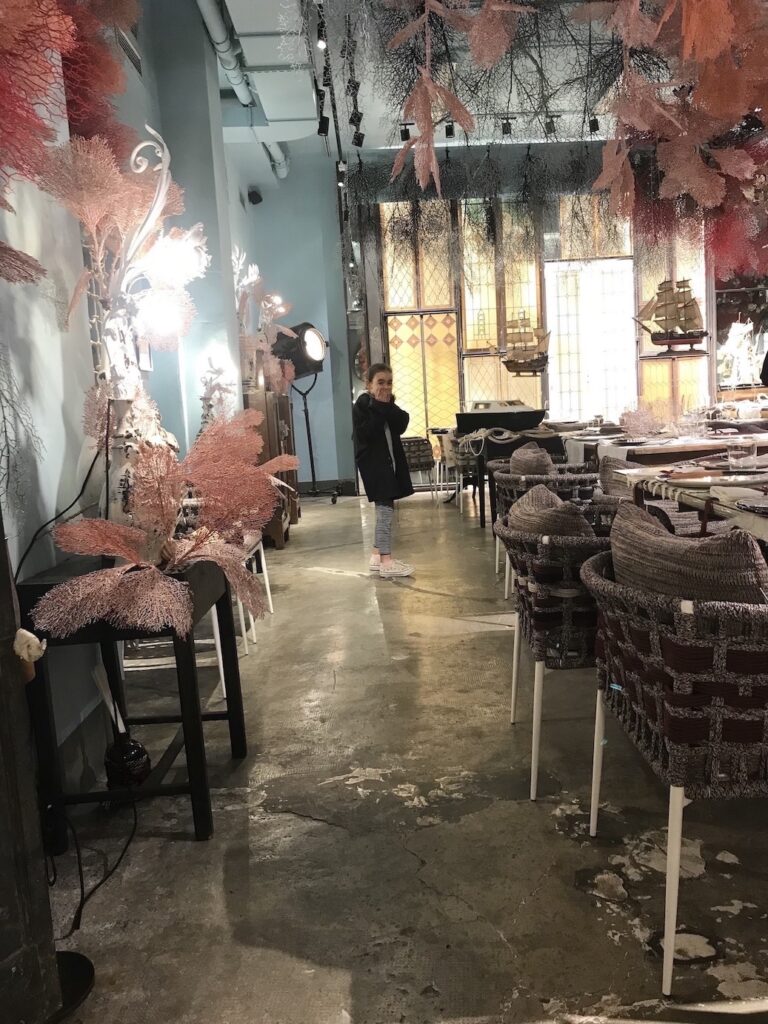
However, we loved “Il mare dove non si tocca” (In the deep sea) by Antonio Marras. Upon entering the enchanting NonostanteMarras space, we encountered a temporary bar in the inner courtyard. Unfortunately, the arrangement of plants and tables left little room for a wheelchair to pass through. Witnessing our attempt, Antonio Marras jumped up and asked people to clear a path for us. Moreover, he kindly offered assistance if we wished to explore the basement area, where he showed his ceramics and a marvellous marine set-up for the restaurant area in collaboration with the Rana family. Also, we met the beautiful Antonella Rana, Global Image and Communication Director of Pastificio Rana.
Antonio Marras’ caring attitude surprised us. Such unconventional behaviour for the fashion industry standards!

The Milano Design Week concluded amidst fusions with fashion and a deluge of greenwashing. Specifically, design wins over fashion for accessibility and courtesy, but sustainability sounds too much like greenwashing. In contrast, let’s shape events where creativity harmonizes with sustainability, inspiring and innovating without compromising our planet.

Milano Design Week, Fashion & Greenwashing Read More »

The Algorithm Dictatorship

Reading Time: 3 minutes

Exploring challenges for niche fashion within totalitarian thought


The algorithm dictatorship, sculpting the fashion industry with utmost precision, has created a perfect regime where every click, swipe, and trend is meticulously curated. Yet, beneath this facade of efficiency, the danger of totalitarian thinking looms large.

In the ever-evolving landscape of fashion, where trends shift like sand dunes in the wind, algorithms emerge as a formidable force, reshaping the industry in unprecedented ways. In recent years, algorithms have become the silent puppeteers pulling the strings behind our screens. They curate our social media feeds, tailor our online shopping experiences, and even influence the designs we’re presented with.
According to Business of Fashion, ‘algorithms are increasingly driving what consumers see, like, buy, and wear, and not always for the best.’

While on the surface, this might seem like a convenient way to streamline decision-making and personalise experiences, the reality is far more complex. In fact, it’s never been easier to manipulate the masses. Like never before, people have the same faces, the same clothes, and the same accessories. Ultimately, the same conformist, homogeneous mass thought.

Niche fashion & the algorithm dictatorship


People like us, independent minds passionate about niche fashion, can see the danger of the algorithm dictatorship. Niche fashion thrives on creativity, individuality, and unconventional styles. Therefore, it finds itself at odds with the algorithms. But in a world where algorithms prioritise mass appeal and mainstream trends, the space for niche fashion to flourish is shrinking.

However, the issue goes beyond mere visibility. It strikes at the heart of diversity and innovation within the fashion industry. Algorithms, by their very nature, favour the familiar over the unfamiliar, the safe over the daring. While algorithms excel at processing large quantities of data, they may overlook or undervalue items or trends with lower levels of engagement or popularity. In essence, algorithms prioritise the visibility and promotion of items associated with larger numbers, potentially overshadowing niche or less prevalent offerings. This means that emerging designers and niche labels, already operating on the fringes of the industry, struggle to compete for attention against established brands.

Specifically, algorithms contribute to the homogenisation of fashion, stifling creativity and diminishing the sense of discovery and excitement intrinsic to niche fashion. The possibility of stumbling upon a unique piece that speaks to your soul is gone. Instead, we’re fed a constant stream of cookie-cutter styles tailored to fit within the narrow confines of algorithmic preference.

Alternative sources #formodernhumans


To resist this contemporary totalitarian regime, the first step is to understand that algorithms control what we see. Second, seek out alternative sources of inspiration. This could involve following independent fashion designers on social media, exploring niche fashion blogs and publications, or shopping at small independent boutiques. Also, choosing alternative social media like the Fediverse. Therefore, prioritize platforms which offer diverse perspectives.

In conclusion, the algorithm dictatorship has created a totalitarian regime that manipulates people’s preferences in the fashion industry. And, more generally, in our lives. But amidst the stifling conformity, a rebellion brews: a call for passionate individuals to preserve the essence of niche fashion. A call for individuals to reclaim their autonomy.

The Algorithm Dictatorship Read More »

Ron Mueck at Triennale Milano

Reading Time: 2 minutes

Hyper realism & reflections on contemporary atrocities


Yesterday, our journey led us to experience Ron Mueck at Triennale Milano: his first solo exhibition, in collaboration with the ‘Fondation Cartier pour l’art contemporain.’

Unfortunately, we missed the inaugural event. So, looking for something interesting beyond our never-ending festive family meals, we headed straight to Triennale. This experience gave us a chance to reflect on the atrocities of our time. Indeed, it served as a poignant metaphor for Christmas 2023. While the world celebrates, Palestine, under bombing attacks, is teetering on the edge of extinction.

Art installations possess a unique force: they provoke contemplation, stirring emotions even more amid silence. In fact, this art exhibition was an evocative call to reflect on our present-day existence. Most importantly, the inhumanity prevailing within it.

Ron Mueck: hyper-realistic sculptures at Triennale Milano


The exhibit comprised six sculptures, each a vivid narrative in its own right. ‘Mass’ (2017) a towering assemblage of a hundred oversized human skulls. ‘In Bed’ (2005) depicts an immense woman seemingly fraught with anxiety. ‘Woman with Sticks’ (2009), a middle-aged woman bent backwards, struggling to hold a bundle of sticks twice her size. ‘This Little Piggy’ (2023) a composition capturing subjects engaged in the slaughtering of a pig, a yet unfinished creation emblematic of the artist’s evolving style. ‘En Garde’ (2023), three colossal dogs in varied poses, and ‘Baby’ (2023), a tiny newborn suspended on the wall.

Ron Mueck
‘Mass’ by Ron Mueck

Art: a mirror that reflects humanity


These sculptures, diverse in size and form, possess an evocative power, stirring deep empathy. Mueck’s meticulous craftsmanship, evident in the intricate details and nuanced use of colour, rendered these works hyper-realistic. They were undeniably captivating yet also unsettling, compelling us to confront our perceptions of reality.

Walking among the installations provided an immersive experience, both physical and visual, that touched us profoundly. Of all the sculptures, ‘Mass’ left the most haunting impression.

Contemplating ‘Mass’ by Ron Mueck at Triennale Milano felt like a metaphor for the atrocities of our era: stark imagery that mirrors the dissonance of this year’s Christmas.
While Christmas traditionally embodies sentiments of love, peace, and generosity, the atmosphere of Christmas 2023 felt incredibly strange and somewhat hypocritical. Celebrating the nativity seems pointless when the very birthplace has been ravaged. And over 7,000 children have been killed.

Among such devastation, what does the world truly celebrate? Merry what?

Ron Mueck at Triennale Milano Read More »

Global Turmoil and Traditions

Reading Time: 2 minutes

Christmas 2023: we are furious!


Amidst global turmoil, embracing traditions entails focusing on our core values. Unfortunately, hypocrisy feels heavy these days.

Christmas once symbolised profound meaning. However, over time, it has devolved into a season of excess: the most wasteful time of the year. A season marked by overconsumption and wastefulness. Yet, lately, the festive spirit feels different. In fact, this year, the sadness of the stark realities of the world around us overshadows it.

Heart-wrenching accounts of the war in Gaza and the conflict in Ukraine fill the news, each report detailing lives lost and families shattered. The weight of these events hangs over the holiday season, dimming joy and merriment.

If, at large, promoting the show of opulence in the fashion industry feels hollow, in the face of such tragedies becomes totally pointless. Indeed, we find it out of place. So, expect no such things from us.

James Elder: “I’m furious” speech


But we want to share the voice of James Elder – UNICEF Global Spokesperson. As his “I’m furious,” speech resonates with many.

via Middle East Eye

“I’m furious that those with power shrug at the humanitarian nightmares unleashed on a million children. I’m furious that children who are recovering from amputations in hospitals are then killed in those hospitals. I’m furious that there are more children hiding as we speak somewhere, who will no doubt be hit and have amputations in the coming days. I’m furious that of all the senseless attacks, the only admittance of dumb is the use of dumb bombs. I’m furious that disease is as well-armed as the warring parties, but it gets absolutely no attention.
And I’m furious that Christmas is likely to bring increased savagery and attacks as the world is distracted with its own, you know, love and goodwill. I’m furious that now we’re at 5.000, 6.000, 7.000 children killed, and they’re becoming statistics and not stories. I’m furious at the hypocrisy crushing empathy, and yeah, to a degree, I’m furious at myself for not being able to do more.”

It is a cry for humanity, urging immediate steps toward peace and protection for the most vulnerable. In fact, we need decisive action to end the senseless suffering and destruction that have turned the affected areas into a living nightmare. 

Amidst this global turmoil, embracing traditions feels hypocritical. So, our Merry Christmas wishes are a call to action for peace: let’s not bury pain in Gaza beneath our Christmas lights.

Global Turmoil and Traditions Read More »