Genderless, artisanal slow fashion for modern humans — care for the planet, style for the people
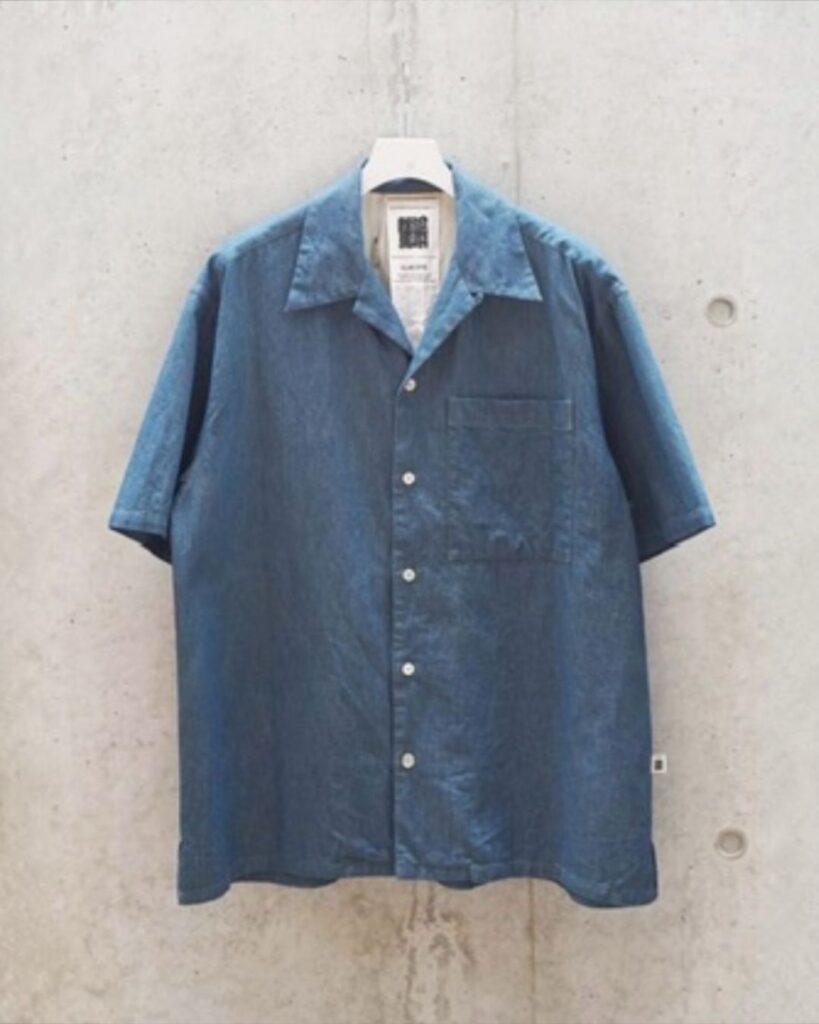
This is The Clay Indigo Short Sleeve Shirt by GoodNeighbors Shirts. In a system that produces tonnes of disposable clothing, we curate: one piece, one story. A radical view for ethical and aesthetic resistance — meaningful garments, an expression of good design. Slow fashion — made to last, made by hand.
The Clay Indigo Short Sleeve arrives with quiet distinction. It sits with ease — relaxed yet refined, tailored yet effortless. 100% cotton denim against the skin. The design features a distinctive clay-indigo hue — a colour born from the earth itself, not from synthetic vats. The wide open collar with its small loop invites versatile styling. A single chest patch pocket holds the day’s essentials. Two side slits and a back yoke with two pleats — plus a single loop — allow the fabric to move with you, not against you. The front closes with sustainable Takase shell buttons — repurposed from the food industry — each one carrying the subtle iridescence of the sea, a small act of waste reduction.
It honours the creativity of meaningful design: a shirt coloured through traditional clay-dyeing techniques, creating a depth and character no synthetic process can replicate. A garment that holds memory — of water, of place, of craftsmanship — yet feels entirely of the moment. Honest, understated, and made to be lived in.
Clay indigo. Earth after rain, riverbeds at dusk, pottery worn by time. The iron-rich clay of Fujioka City — Aoki’s birthplace — sinks into each fibre, leaving a soft texture and a mottled gradient only nature could create. Every piece distinct. Each a landscape.
Natural dye, tailored comfort — genderless slow fashion for modern humans
The design: Relaxed-fit short-sleeved tailored shirt. 100% cotton denim. Distinctive clay-indigo colour — naturally dyed with red clay from Gunma. Wide-open collar with a small loop for versatile styling. Single front chest patch pocket. Two side slits. Back yoke with two pleats and a single loop for ease of movement. Sustainable Takase shell buttons — repurposed from the food industry. Fine stitching details: 90/20 stitch count. Made in Japan.
The make: Made in Japan — by GoodNeighbors Shirts, a small artisanal brand revered for its textile expertise and natural-dyeing techniques. This denotes more than origin — it signifies integrity: a genuine commitment to craftsmanship and style. Every stitch reflects skill and purpose, ensuring a garment that stands apart. Each piece is hand-dyed by designer Akira Aoki using traditional mud-dyeing techniques. The iron-rich clay from his homeland naturally penetrates the fibres. No chemicals are used. Both soil and water are returned to nature after use. Every detail, from the shell buttons to the final pleat, is curated with care. Produced in limited runs.
The Clay Indigo Short Sleeve Shirt: earth-born colour with a story to tell
The Clay Indigo Short Sleeve Shirt offers a rare balance of character and versatility. Open, buttoned, or with a scarf through the loop — it’s yours to shape. From morning coffee to evening aperitivo, from studio to street, it simply works.
How to style:
For the studio: worn loose over a simple tank or fine-gauge tee. The open collar traces the line of the collarbone — understated, unhurried. The clay-indigo holds the light like dried river earth. Roll the sleeves once or twice. Let the hem fall where it falls. A shirt that doesn’t rush.
For the city: paired with tailored trousers or crisp denim. Button it — or leave it open like a second skin. Loop a scarf through the collar for a whisper of colour. The clay speaks of tradition; the cut speaks of today. Walk like you know where you’re going.
For the weekend: styled open over a white tank, tucked into wide pants that sway. The side slits grant freedom. The back pleats make space for the long lunch, the lingering conversation. The pocket holds a phone, a metro card, a pressed flower. The cotton remembers the clay it came from.
For the modern humans who curate, not consume — whose wardrobe is a library of dog-eared favourites, each piece a chapter in their story.
🌟 The Clay Indigo Short Sleeve – GoodNeighbors Shirts
Limited quantities. Like a river stone — smooth, distinctive, shaped by time and tide. Designed for daily wear. For personal style. For life.
Available by appointment for private shopping in Milano or worldwide — from screen to doorstep.
P.S. Ask us why the collar loop changes everything. Or how earth, water, and fabric become a philosophy, not just a process. We are here for the conversations, not just the transactions.
Genderless, artisanal slow fashion for modern humans — made with intention, worn with style
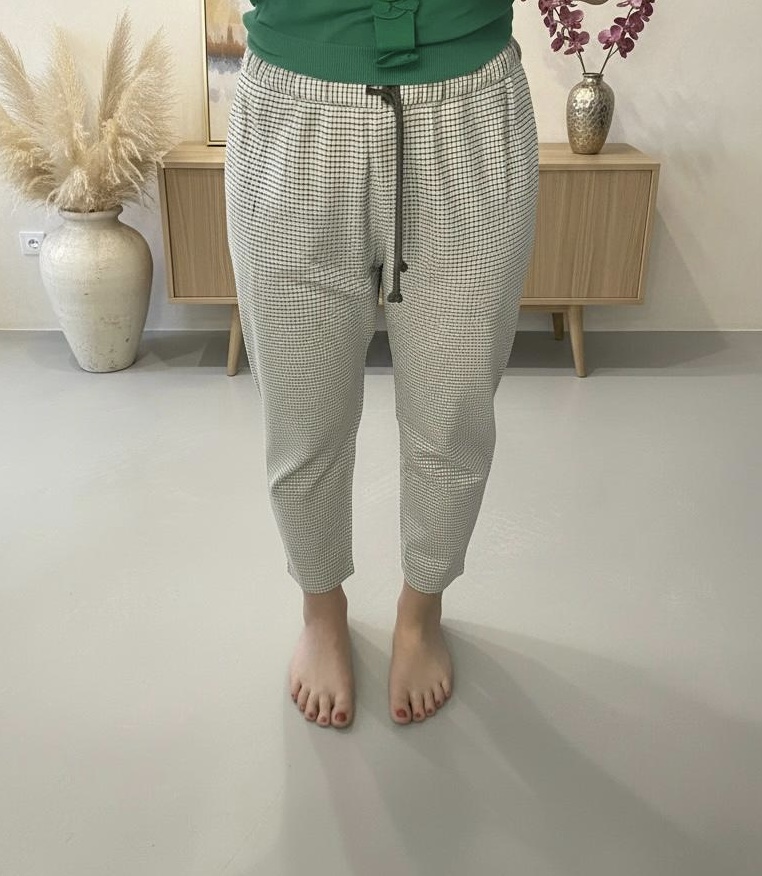
This is The Check Trousers by GoodNeighbors Shirts. In a system that produces tonnes of disposable clothing, we curate: one piece, one story. A radical view for ethical and aesthetic resistance — meaningful garments, an expression of good design. Slow fashion — made to last, made by hand.
The Check Trousers arrive with understated confidence. They sit with style — relaxed yet refined, tailored yet easy. 100% cotton against the leg. The design features a distinctive burgundy-and-dark-green check on a clean white base — a pattern that recalls vintage clubhouse floors and modern city grids. The print is woven, not printed; the colours sink into the fibre with quiet permanence. The elasticated waistband and adjustable drawstring offer a personalised fit — an invitation to move freely. Two practical side slit pockets complete the piece — an invitation to live hands-free.
It honours the creativity of meaningful design: structure — of a classic check, reimagined for modern ease. Of a trouser that stands up to the day but bends with the body. And comfort — the only guide that could produce something this effortless, this honest.
Burgundy and dark green, on white. A burgundy that belongs to aged leather and autumn vineyards. A green that belongs to forest shadows and the patina of old brass. A white that is not a blank slate, but a canvas — bright, crisp, alive.
Genderless, artisanal trousers for modern humans
The design: Straight-leg cotton trousers. 100% cotton. Distinctive burgundy-and-dark-green check print on clean white base. Elasticated waistband with adjustable drawstring. Two side slit pockets. Comfortable fit. Made in Japan.
The make: Made in Japan — by GoodNeighbors Shirts, a small artisanal brand revered for its textile expertise and natural-dyeing techniques. This denotes more than origin — it signifies integrity: a genuine commitment to craftsmanship and style. Every stitch — from precise construction to sustainable production — reflects skill and purpose, ensuring a garment that stands apart. Every detail, from the woven check to the final drawstring knot, is curated with care. Each piece is produced in limited runs.
The Check Trousers: stylish vintage-inspired pattern that moves with you
The Check Trousers offer something unique: comfort that adapts, style that stands out. Designed for movement and for rest. From morning coffee to evening aperitivo, from studio to street, they simply work.
How to style:
For the studio: worn with a crisp Oxford shirt or a fine-gauge sweater. Add a blazer, depending on the weather. The check adds a graphic element without shouting. Let the hem brush the top of a loafer. A uniform that remembers slow days.
For the city: paired with a simple white tee or a slouchy knit. The burgundy-and-green check nods to tradition, but the drawstring waist says now. Rolled cuffs, relaxed stance. Walk with purpose.
For the weekend: styled with a denim shirt knotted at the waist. The elastic waistline forgives the second coffee and the third pastry. The side pockets hold keys, a phone, a folded poem. The cotton breathes.
For the modern humans who curate, not consume — whose wardrobe is a library of dog-eared favourites, each piece a chapter in their story.
🌟 The Check Trousers – GoodNeighbors Shirts Limited quantities. Like a hand-drawn trait — subtle, singular, unrepeatable style. Designed for daily wear. For personal style. For life.
Available by appointment for private shopping in Milano or worldwide — from screen to doorstep.
P.S. Ask us why the drawstring changes everything. Or how design, comfort, and fabric become a philosophy, not just a process. We are here for the conversations, not just the transactions.
Why one of the world’s most uncompromising climate scientists says our leaders have chosen to fail, and what we can actually do about it
Net zero is a scam. Kevin Anderson goes straight for the truth about climate change. There are plenty of climate scientists who soften the message. They talk about “pathways,” “transitions,” and “cautious optimism.” Kevin Anderson is not one of them.
Professor of Energy and Climate Change, working across the universities of Manchester, Uppsala in Sweden, and Bergen in Norway, he is one of the world’s leading climate scientists.
We refer to him and mention him from time to time. But here’s why we trust him more than almost anyone else: he is brutally direct and honest.
On the Rob Cooper podcast, shared also on Climate Uncensored (source of this post), Anderson laid out the situation in plain language. Here’s what he said.
The 3 numbers you need to understand climate change (straight from Anderson)
1. Temperatures are not small changes. We signed up to stop warming at 1.5°C or 2°C above pre-industrial levels. Those numbers sound tiny. We need to understand they are massive changes to our climate, they happen on a global scale.
2. Carbon budgets are just fossil fuel budgets. If we are not to exceed those temperatures, we know how much carbon dioxide we can put into the atmosphere. Those come from fossil fuels. We know exactly how many billion tons of CO₂ we can still emit. That tells us exactly how many fossil fuels we can burn – and therefore, how much time we have left.
3. The time frame is already broken. For 1.5°C: zero emissions by the early 2030s. That’s five years from now. For 2°C: zero emissions by 2045–2050. We have more leeway. This will happen only if we bring emissions down. But we’re not following the pathway to 1.5°C. We never were. Emissions are still rising.
We’re not going to achieve the 1.5°C target.
“Our leaders have chosen to fail on climate change; this is nothing new. Every single metric on climate change is pointing in the wrong direction.”
What “progress” actually looks like (spoiler: this isn’t it)
Every year, we add more renewables. Every year, we also add more fossil fuels. The climate does not care about renewables. It cares about the fossil fuel phase-out.
Anderson argues that, to stay within 1.5°C, we need 7–8% emissions cuts every single year, starting yesterday. Even then, he notes, avoiding major tipping points would require an element of luck.
We will move in the right direction when more renewables mean, at the same time, less fossil fuels. 2°C is not safe. We are not in a good place.
Lots of academics point to China as if it is progress. But it is not. Carbon dioxide builds up every year. So every year we fail to reduce emissions, the following year gets harder. The reductions we see in China are far from sufficient to deliver. Next year, the problem will be more challenging than this year.
“If the problem gets harder every single year, I don’t call that progress. Progress is only when you deliver what you need to. Let’s not put that as it is in line with our progress. It is not at all. Until we eliminate fossil fuels and the emissions from them, until we reduce the emissions from agriculture, temperatures will just keep going up. Reducing emissions doesn’t mean temperatures stay stable or go down; it means temperatures rise less quickly.”
Temperatures vs impacts
“We shouldn’t only talk about temperatures, we should talk about impacts because impacts are what impact people.”
1.5°, 2°, what are those? If the impacts come in five years, we’ll not have time to defend ourselves. If it happens in ten, we’ll have more time. But some of the impacts occur faster than we thought. That’s a real issue. Infrastructures were created for a specific climate; changing them is highly costly and time-consuming. But we have to do it.
People think we’re in a new normal. But we’re not, because one day will be new and the next one new again. Temperatures will only start to normalise when we stop emitting fossil fuels. Until that point, the climate will just keep changing.
The lie at the heart: net zero is a scam
The scientists are doing a fantastic job. The oil and gas industries know what is happening. Those at the top of these industries deliberately undermined the climate issue.
There is no climate science as such, he points out. It’s only physics and chemistry that explain the world around us.
Mitigation is about what we do to reduce emissions. There, says Anderson, we have increasingly been overoptimistic, which has started to lie. We have been telling untruths for at least two decades on climate change. And that’s because the analysis that we do doesn’t fit with a particular political framing of the world.
And every year we fail to deliver on climate change, the level of the lies increases. Some say we can’t take away hope or instil fear.
But our job is to say it how it is. There is a global delusion around this. And it goes much deeper than that. If you want to get funding, economic growth, and net-zero 2050, it has to fit a political agenda.
Policymakers put pressure on the chain, on journalists and so on, so the whole system is delusional. People should use common sense. And just do the maths.
Many academics believe in their own delusion, so it is easier to make other people believe in this. We need to start with a sense of integrity.
On climate change, we desperately need new ways of thinking; people of my age have totally failed. We need new perspectives.
Climate change is colonial (and no, we’re not all in this together)
For Anderson, climate change is not only a scientific issue. It is also a question of historical responsibility and global justice. This is one of Anderson’s most uncomfortable – and most important – points.
The UK, US and wealthy nations built their prosperity on slavery, stolen minerals and cheap labour. Now they’re doing the same with the carbon budget.
Today, we are still embedded in the legacy of colonial history. We can’t do anything about the past, but we should at least recognise it. And what we shouldn’t do is perpetuate it. There is a responsibility: our prosperity has been built on the backs of others.
Now, in the UK, people have more per capita carbon budget we can burn compared to other poor countries. There is a disproportionate share.
“We took their labour as slaves, we stole their minerals, and now we’re stealing their carbon budget.”
The UK (all wealthy nations) is perpetuating colonialism. We need to question that. Here’s the connection with climate change.
The second part is that we’re not all in this together. There are people locked in their conditions; there’s nothing they can do.
Poor countries cannot afford to cut further. There are people who need to have higher carbon emissions. The richest 1% of emitters globally produce twice the emissions of the bottom half of humanity combined.
“We need to switch from production to the rich to production for the public infrastructure. We need to move the skills to do good things for society. At the moment, we have private luxury for a minority (a big minority), and public squander for everyone else.”
He is also critical of the “cost-of-living crisis” framing.
“There’s no cost-of-living crisis, it happens for those who benefit from it.”
For high-emitting, high-income households, responding to climate change would mean paying more. So they pretend we’re all in this together. Because they want to put the cost on the average household.
“It’s easy to point to the billionaires, as soon as they go to Mars the better, but it’s actually us as well. If this discussion is not heard, it’s because we are in the group of disproportionate use.”
What actually gives Kevin Anderson hope?
Not techno-optimism. Not net-zero pledges.
Hope, for him, lives in action – specifically, in honest, humble dialogue.
People talking at a bar. Schoolkids discussing worthwhile things. Communities deciding what a good life looks like, not just an efficient economy. Humility, if something is wrong, admit it and go on. He mentions Greta Thunberg explicitly: people of his generation have failed, he says. New perspectives are desperately needed.
“Don’t expect experts to solve this. Change comes bottom-up. Talk with integrity. Leave yourself open to views that feel uncomfortable.”
10 words on a billboard? He said no words.
Impactful images. Local meaning. Tailor the issue to the place and identity.
“Most people are good. Play to shared values, not fear.”
We don’t have to fall into the individualistic model, fighting and competing with each other; we need to value our community. Temperature and metrics are very helpful. To get people on board, we have to go from global to local and see what impacts locally.
What you can actually do (from Anderson’s closing advice)
If net zero is a scam, what can we actually do?
Don’t look for heroes in high places. Policymakers, most academics, and the media are trapped in the same delusion.
Use common sense. And do the maths yourself. The numbers don’t lie.
Have honest conversations. Ask: What is a good world? What is a good life? What is a good community?
Realise you might be the agent of change. Not a politician. Not a celebrity. You, talking to people around you.
A final thought
Net zero is a scam, Kevin Anderson argues. The system is not broken. It is working exactly as designed – for the minority who emit the most.
Change starts when the rest of us stop asking for permission and start talking honestly about what kind of world we actually want.
—
Want to hear it directly? Here is the interview with Kevin Anderson on Climate Uncensored, or on the Rob Cooper podcast.
When institutions turn to social media virality to promote environmental awareness
On June 5, to celebrate World Environment Day, the UN Environment Programme suggested the following:
“Film a short, repeatable dance, post it on social media, and challenge your network. Join the #NowForClimate dance challenge.”
That’s a direct quote from a UNEP newsletter. It’s not a joke. (UNEP’s “Your May Briefing: What to know ahead of World Environment Day, latest on buildings and construction, and more” newsletter, May 25, 2026).
It’s hard to see what dancing has to do with slowing climate change — other than chasing social media virality, that is. Perhaps the UNEP believes people need hope to engage with climate change, which can otherwise feel like a distant, scientific, or political issue that doesn’t invite real personal involvement.
So let’s set aside the dance challenge and unpack the solutions the UNEP actually names as “reasons for hope.”
World Environment Day – the report
According to scientists, the Earth is on track to exceed a critical global warming threshold within the next ten years, pushing the planet closer to a full-scale climate disaster.
But there’s a silver lining.
A recent UNEP report highlights that several low-carbon innovations — such as renewable energy — are nearing their own tipping points, where they could rapidly become the norm. These shifts might help humanity move beyond fossil fuels in certain sectors and significantly cut the greenhouse gas emissions fueling climate change.
The report, titled Cheaper. Cleaner. Unstoppable. Clean technologies that are delivering for the Climate, notes that these tipping points are not a sure thing. They depend on consistent and long-term policies, financial backing, and public buy-in to reach their full potential. Still, their growing momentum offers hope to those on the front lines of the climate fight — because once advancements hit a critical threshold, they can begin to fuel themselves.
UNEP and the five areas to watch
As mentioned in the new UNEP report, five sectors show promising signs of progress:
1. Renewable energy – Now the cheapest option in most places. Solar power costs less than new coal or gas plants, driving over $450 billion in global energy investment in 2024. Renewables have supplied more than 75% of new power capacity since 2020, with solar and wind leading the charge.
2. Electric vehicles (EVs) – accounting for more than a quarter of global new car sales in 2025, up from less than 3% in 2019. Norway, China, and Ethiopia (where EVs make up 60% of new sales) are leading the way. Electric buses, delivery vans, and two- or three-wheelers are also expanding rapidly in low- and middle-income countries, bringing cleaner air, lower fuel costs, and reduced oil dependence.
3. Smarter buildings – A “passive-first” design using shade, insulation, and reflective materials can lower indoor temperatures by up to 9°C, reducing or eliminating the need for air conditioning. Combined with green spaces, this could cut urban emissions by 25% while improving health and air quality.
4. Heat pumps – These energy-efficient systems heat and cool buildings using far less energy than conventional methods. Already popular in Northern Europe, they are critical for fast-growing cities in Africa, Asia, and the Middle East, where cooling demand is set to soar.
5. Cutting food waste – Food waste accounts for up to 10% of global emissions. Cities like Bangkok, Rio de Janeiro, and Yokohama are piloting financial incentives, awareness campaigns, and food redistribution programs that could be scaled worldwide. When paired with greater food awareness, more advanced tracking systems, and technologies that link extra food to buyers, these efforts could meaningfully cut food waste and create more sustainable food systems.
Final thoughts
So for World Environment Day, the UN Environment Programme invited people and activists to share a dance on social media. But is this really the strategy we need?
We understand marketing. We understand the need for public engagement. But has any viral dance challenge ever deepened someone’s commitment to climate action? Or did it just grow a few follower counts?
The UNEP’s “reasons for hope” deserve a harder look — the kind climate scientist Kevin Anderson urges. He warns against “hopium“: the belief that tech breakthroughs alone will save us, without hard changes to lifestyles and economic structures.
Yes, renewable energy, electric vehicles, heat pumps, and better buildings are all part of the solution. But the UNEP report still encourages readers to place significant hope in the possibility of technological tipping points. That framing conveniently avoids the harder truths. Here’s what it leaves out:
1. Technology is not a substitute for demand reduction. Renewables are growing, but so is overall energy use.
2. These tipping points depend on political will that is currently absent. Good policies and funding remain the exception, not the rule.
3. Hope without honesty is dangerous. Climate scientists and institutions have a duty to tell the public how bad things really are — not to soften the message with silver linings. The UNEP admits we’ll likely pass 1.5°C this decade — that would be catastrophic. Listing a few optimistic trends does not erase that reality.
The UNEP means well. But meaning well is not the same as leading well. And turning climate action into a viral trend risks reducing the greatest challenge humanity has ever faced to little more than entertainment.
So skip the dance. Let’s talk about what we need to stop doing — not just what we can keep doing, slightly cleaner. Real climate action is not only about cleaner technologies. It is about consumption, growth, and the activities we may need to reduce or abandon altogether.
A step towards ending animal abuse or another non-binding guideline?
Camera Nazionale della Moda Italiana (CNMI) has recently published new guidelines banning animal fur. Is it a crucial step toward eradicating animal abuse? Could be. But the guidelines are voluntary.
Animal fur: the new guidelines
Camera Moda released new regulations on animal fur. Starting from the next edition, September 2026, brands are invited to avoid presenting garments and accessories made from animal fur during Milano Fashion Week shows.
Notice the wording: invited, not required. This is no hard ban. No fines, no disqualification, no exclusion from the official calendar. Creative and entrepreneurial autonomy? Fully intact.
Voluntary by design, but why?
At first glance, a “voluntary ban” sounds like an oxymoron. If it’s voluntary, can we call it a ban at all?
Yet context matters. CNMI’s move doesn’t emerge from nowhere. It builds on a sustainability path the association started back in 2012, and it reflects a concrete legislative fact: Italy banned fur farming as of 2022. You can’t raise animals for fur on Italian soil anymore. Imported fur, however, remains perfectly legal.
So the guidelines sit in a strange in-between space. They echo the law’s spirit without enforcing it. They push toward ethical fashion without punishing those who resist.
Let’s not forget: animal fur is not a necessity. It never was — at least not in any modern context. In 2026, with exceptional faux fur, recycled materials, and innovative textiles on the market, using real fur is an aesthetic choice, not a functional one.
Italy no longer allows animals to be farmed for fur. That’s the law. CNMI’s guidelines simply ask: if we don’t raise them here, why should we showcase them here?
What changes, really?
For many major luxury brands, nothing changes. Gucci, Prada, Armani, Valentino, Versace — they all went fur-free years ago, often ahead of any industry guideline. For them, this is validation, not transformation.
For those still using fur, the message is softer: keep your autonomy, but know the runway is no longer neutral ground. Showing fur in September 2026 won’t get a brand kicked out of Fashion Week. But it might get you noticed — and not in a good way.
That’s the real lever here: reputation. In an industry built on image, reputational pressure can sometimes move faster than legislation. CNMI is betting that fashion houses care more about public perception than about sanctions.
A step or a trick?
Let’s be honest. A genuine ban would require oversight, enforcement, consequences. This has none of that. From a purely legal standpoint, it’s barely more than a strongly worded suggestion.
But here’s where it gets familiar.
If you’ve been following Italian fashion politics lately, you’ve seen this movie before. The voluntary nature of the fur guidelines echoes something much darker: the attempt to make labour exploitation voluntary too.
Remember Article 30 of the Small and Medium Enterprises Bill? Approved by the Senate, debated in the Chamber of Deputies, it tried to exempt major fashion brands from liability for crimes committed along their production chains. Human rights abuses. Wage theft. Caporalato — the gangmaster system that reduces workers to modern slaves.
Widely described as a legal shield for luxury brands, the amendment was eventually withdrawn following protests by trade unions, workers, and the Clean Clothes Campaign. It will now return to the Senate.
But the logic behind it never left: let brands decide for themselves whether to be responsible.
Final thoughts
In conclusion, what does the Camera Moda animal fur ban mean? Is this a definitive victory against animal abuse? No. Absolute bans are still rare, and voluntary guidelines won’t stop every brand.
The fur guidelines say: we invite you to be ethical, but no pressure. Article 30 said: we invite you to monitor your supply chain, but if you don’t, don’t worry — you won’t be liable.
Same melody. Different verse.
No sanctions for fur. No liability for labour. In both cases, the system protects the brand, not the victim — whether that victim is an animal or a worker.
CNMI’s fur guidelines are not bad. They move the needle, however slightly. But they also reinforce a dangerous logic: the idea that the fashion industry should regulate itself voluntarily.
But if the fashion industry can be trusted to self-regulate on animal welfare, why not on human welfare?
Because we’ve already seen the answer. When given the chance to self-regulate on labour, major brands lobbied for a law that said: don’t hold us accountable.