fashion waste

The Island In The Desert

Reading Time: 2 minutes

Have you ever wondered where our textile waste ends up?


Talking about the cost of fast fashion and the madness of disposable items can be upsetting and frustrating. No one wants to listen.

We could define it as a hidden cost, assuming people do not see it directly. Except that there’s nothing hidden anymore. And so, we call it the true cost because it happens before our eyes. Although, people refuse to see it intentionally.

To illustrate the abnormity, perhaps a visual image helps awaken the conscience more than words.
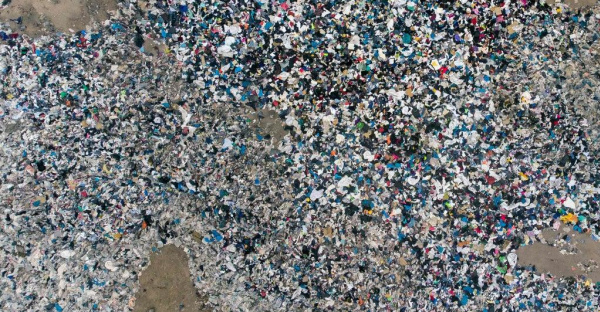
Atacama desert in Chile - fast fashion leftovers
Atacama desert in Chile – fast fashion leftovers

Here, in front of your eyes, is the Atacama desert in Chile, the driest desert in the world. And that is an island of discarded clothing, including Christmas sweaters and ski boots, piling up in the desert. Horribly revealing the cost of fast fashion.

Chile is a hub for secondhand and unsold clothing coming from all over the world. USA, Europe and Asia. Approximately 59,000 tons of garments arrive there every year. Clothing merchants buy part of it, but the majority, about 39,000 tons, end up in rubbish dumps in the desert.

That happens because those garments contain chemicals and are not biodegradable, therefore not accepted in the municipal landfill.

The cost of fast fashion


We wonder what’s going to happen over time. Do you still feel ok with fast fashion and disposable goods?

On Monday, we posted about the need to shift our consumption habits. After reading this, the sense of urgency becomes imperative. It doesn’t need any further explanation.

Educating ourselves towards thoughtful consumption habits is fundamental. If brands don’t produce items made to last, we don’t buy from them!
Stop overconsumption. Stop purchasing disposable items. That is how we bring our contribution.

We know that expecting a change from brands is an illusion, yet it’s just a way to exclude ourselves from the game. If we pretend we do not play an active role, we hide our responsibilities.

On the contrary, we have to educate ourselves in order to become conscious and make intentional choices.

Break the loop. Take action now!

The Island In The Desert Read More »

Waste, And Why We Waste

Reading Time: 2 minutes

Understanding the impact of overconsumption and the quest for sustainability


“Waste isn’t waste until we waste it.”

Will I Am


This quote deeply resonates with us, not only because of the heightened awareness recent events have brought. But also because we have always been committed to reducing waste as much as possible.
Writing on the backside of printed sheets, avoiding plastic coffee cups, refilling our water bottles, and limiting the quantity of paper used for packaging are just a few of the steps we’ve taken to minimize the waste we produce. Perhaps now, we approach this issue with even more urgency, as the environmental damage we’ve caused is becoming increasingly visible.

The waste culture


But, digging deeper, where does our wastefulness come from? When did we start wasting so much?

Waste is the ignorant byproduct of an over-consumerist society. From the 1950s, little by little, overconsumption has been promoted as an ideal lifestyle, infiltrating our habits and shaping our culture—while completely disregarding the consequences. “Consume like there’s no tomorrow” is the motto. And, if we go on like this, there will be no tomorrow!

The fact that masses can be easily manipulated is quite scary. The fact that offered a sense of comfort, we avoid thinking altogether, is even more troubling.

By the way, along our journey, we’ve come to acknowledge our mistakes. With open eyes, we are committed to changing for the better.

Whether fashion waste or any other kind, consciousness manifets on many levels and layers.
First and foremost, stop wasting food! Then, whenever you grow tired of something, explore other options before throwing it away.

Even in the case of fashion, please don’t throw away clothes you don’t want anymore.


There are ways to reduce fashion waste:

. choose quality, it lasts longer.
. wash in lower temperatures, so clothes will not get damaged.
. repair when possible.
. donate to charity.
. some shops collect items to recycle.
. resell if you want, there are many resell platforms.

We have options available, so how much waste is up to us.

Waste, And Why We Waste Read More »