fashion waste

Unsold stock destruction: EU ban now in force. Why are legislators tackling the outcome instead of the cause?

Reading Time: 4 minutes

Fashion still has one problem legislators chose not to solve: overproduction


The EU ban on unsold stock destruction has now come into force.

Under the Ecodesign for Sustainable Products Regulation (ESPR), large companies are no longer allowed to destroy unsold clothing, clothing accessories and footwear. The measure aims to reduce textile waste and encourage more circular ways of managing excess inventory.

Instead of destroying unsold products, companies are encouraged to improve stock management and explore alternatives such as resale, donations, remanufacturing and reuse.

The ban applies to large companies from 19 July 2026, while medium-sized companies will have to comply from 2030. Destruction remains possible only in specific, justified circumstances, including safety risks, irreparable product damage and counterfeit goods.

Related post: Destruction of unsold textiles: a historic ban… with many loopholes

There is no doubt that preventing perfectly usable garments from being destroyed is a positive step. Every year, between 4% and 9% of unsold textiles in Europe are destroyed before ever being worn, generating millions of tonnes of unnecessary CO₂ emissions.
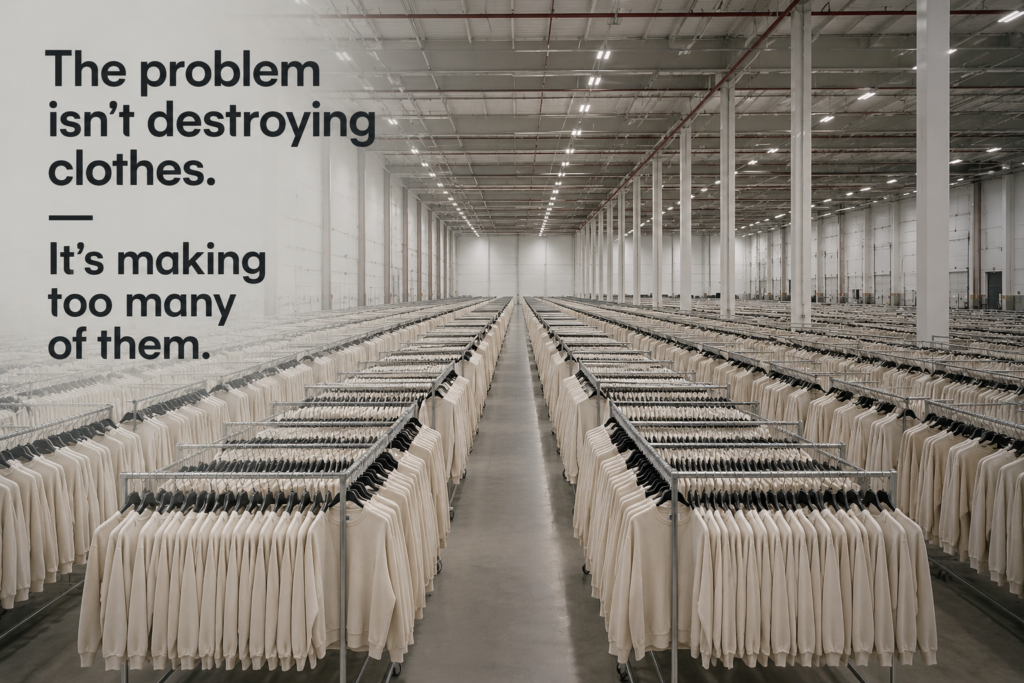
Warehouse filled with identical garments illustrating the problem of unsold stock destruction.


Unsold stock destruction: treating the symptom


The regulation addresses what happens after clothes remain unsold.

It does not address the question that comes before everything else:

Why are so many garments being produced that they become waste in the first place?

Overproduction remains fashion’s structural problem.

Brands continue to manufacture collections at a pace that exceeds real demand. The result is predictable: discounting, returns, excess inventory and, ultimately, disposal.

Better inventory management can reduce some waste, but it does not challenge the production model itself. As long as brands continue to rely on high volumes and constant product turnover, unsold stock will remain an inevitable consequence.

The problem is amplified by online retail, where high return rates create another layer of excess stock. Returned garments may be difficult or too costly to inspect, repair and resell, pushing companies towards disposal or lower-value solutions.

This is why the issue is not only what happens to unwanted garments at the end of their journey. It is also how many garments enter the market in the first place — and whether the fashion system is designed around genuine demand or around continuous growth.

If too many garments continue to be produced, banning their destruction changes what happens at the end of the process, but not the business model that creates the surplus.

The risk of shifting the problem


The regulation also includes exemptions, allowing destruction in justified cases such as safety concerns, damaged products or counterfeit goods.

It also requires companies to disclose the volumes of unsold goods they discard, improving transparency.

These are important safeguards, but they do not eliminate every risk.

Unsold products can still be exported, downcycled into low-value materials or redirected into opaque secondary markets. Preventing destruction is easier than preventing waste from simply changing form.

Final thoughts


The ban on unsold stock destruction is an important environmental measure. Destroying perfectly usable clothing has long been one of the fashion industry’s most indefensible practices, and banning it is long overdue.

Yet the regulation addresses what happens after overproduction has already occurred. It manages the surplus, but not the system that creates it.

The fashion industry’s environmental crisis does not begin with burning garments or disposing of unsold stock. It begins much earlier, with a business model that rewards ever-increasing production volumes, encourages rapid product turnover, and ultimately generates more clothing than the market can absorb.

In this context, the ban treats one of the industry’s most visible symptoms rather than its underlying cause. It may achieve exactly what it was designed to do, but what it was designed to do is too limited to tackle fashion’s structural environmental problem.

A truly sustainable fashion policy would also ask a more fundamental question: how much clothing do we actually need? That is where concepts such as sufficiency and degrowth become relevant — not because they advocate stopping the production of clothing, but because they challenge the assumption that producing more is always compatible with sustainability.

Until overproduction becomes part of the political conversation, Europe will continue making fashion less wasteful without necessarily making it sustainable. 

Unsold stock destruction: EU ban now in force. Why are legislators tackling the outcome instead of the cause? Read More »

Destruction of unsold textiles: a historic ban… with many loopholes

Reading Time: 3 minutes

A turning point against waste: rules, exemptions, and the challenges for truly circular fashion


The European Union has put an end to one of the most controversial practices in the fashion world: the systematic destruction of unsold textiles. From 19 July 2026, large companies will be prohibited from destroying unsold clothing, accessories, and footwear. This provision will be extended to medium-sized companies from 2030 onwards.

This decision, implemented through the Ecodesign for Sustainable Products Regulation (ESPR), aims to break an unsustainable paradox: in Europe, between 4% and 9% of textile products are destroyed each year before ever being worn, generating 5.6 million tonnes of CO₂ emissions — an impact equivalent to that of the entire country of Sweden.

In this context, the measure takes on central importance. It aligns with the EU’s strategy to combat waste, reduce pollution, and accelerate the transition towards a fully circular economy. The intent is clear: to redirect unsold goods towards alternative virtuous channels, such as discounted resale, donations, material regeneration, or creative reuse.

Exemptions: the loopholes to monitor


The Commission has provided for exceptions to the ban, which are necessary but potentially ambiguous. Destruction of unsold textiles will still be permitted for:

  • Reasons of safety, hygiene, or public health.
  • Irreparable product damage.
  • Technical inadequacy for recycling or reuse.
  • Violation of intellectual property rights.
  • Situations where destruction is deemed the option with the lowest environmental impact.

In parallel, from February 2027, the obligation to declare disposed unsold garments via a standardised communication format will come into force, aimed at ensuring transparency.

However, it is precisely here that the greatest risks lie. Definitions such as “technical inadequacy” or “lowest environmental impact” are elastic and subject to interpretation. Without extremely clear guidelines and a rigorous control system, they could become loopholes to circumvent the spirit of the law. The danger is that the problem could simply be exported, with garments shipped outside the EU to be disposed of where rules are less stringent, thereby fuelling the phenomenon of waste colonialism.

Textile industry: a sector truly “at the forefront”?


The Commissioner for the Environment, Jessika Roswall, described the textile sector as “at the forefront of the transition towards sustainability,” while acknowledging that the data “demonstrates the need to act.”

This statement appears to be in strong tension with reality:

  1. The waste figures cited by the Commission itself depict a backward sector, symbolic of the “take-make-dispose” model.
  2. The very need for legislation highlights the failure of self-regulation. A sector truly at the forefront would not need a ban to stop such a wasteful practice.
  3. The real pioneers (circular brands, reuse models) remain a niche compared to the dominance of fast fashion and mass-market “luxury.”

The declaration is more of a political act—aimed at involving the industry rather than criminalising it—than a factual description.

The real challenge begins now


This ban is a fundamental step, but its effectiveness is not guaranteed. It will depend on three crucial factors:

  1. Stringent guidelines that minimise the ambiguity of the exemptions.
  2. A robust and uniform system of controls and sanctions across Europe.
  3. A definition of “destruction” broad enough to also cover disposal disguised as poor-quality recycling.

Final reflections

In conclusion, the regulation on the destruction of unsold textiles is a fundamental step forward that changes the regulatory paradigm.

The EU has charted a course towards a more circular and responsible textile and fashion industry. But the battle against waste will be won (or lost) in the details of implementation, in the vigilance of the authorities, and in the capacity to close every potential loophole.

Companies are now called upon to genuinely reinvent how they manage the value of products and materials, rather than merely finding new ways to circumvent the disposal problem.

Destruction of unsold textiles: a historic ban… with many loopholes Read More »

African organisations accuse UNEP’s Textile Circularity Project of unreliable data and a tainted process

Reading Time: 3 minutes

African coaltion warns that proposed global guidelines, built on flawed foundations, threaten millions of livelihoods and the future of textile reuse


A coalition of African organisations, supported by experts from Europe, Asia, and America, has sent a formal letter to the UN Environment Programme (UNEP). The letter raises concerns about the reliability of the data underpinning UNEP’s projects for global textile circularity and protests against the credibility granted to entities described as “beholden” to fast fashion giants.

The open letter directly challenges UNEP’s Circularity and Trade of Used Textiles project. This project aims to create global guidelines distinguishing reusable second-hand clothing from waste. The signatories, representing the livelihoods of millions in the sorting, repair, and resale trades, argue that the entire effort is compromised from its foundation. (Fashion Magazine).

African organisations: the letter of accusation


Their core accusations are threefold:

  1. Unreliable data:
    The project relies on unverified figures, such as the frequently cited claim that 95% of textile waste is reusable. A figure that contradicts established industry knowledge and lacks transparent collection methods.
  2. A tainted process: 
    The coalition describes the consultations as rushed and exclusionary, sidelining the very experts who understand the complex realities of the trade.
  3. Corporate influence: 
    In Ghana, an NGO funded by the ultra-fast fashion industry led the research. The very entities whose overproduction is the root of the waste crisis — creating an unacceptable conflict of interest.

“What we have observed does not match the objectivity expected from a UN programme,” said Jeffren Boakye Abrokwah, President of the Ghanaian Used Clothing Dealers Association. “In Ghana, UNEP’s research partner is an NGO that already runs a waste campaign. It is funded by the fast fashion industry. This compromises the neutrality of the data.”

However, this sentiment found an international echo. Alan Wheeler, Director General of the UK’s Textile Recycling Association, stated, “UNEP’s willingness to adopt unverified conclusions contradicts its stated commitment to impartiality and undermines public trust.”

But this dispute erupts as the second-hand clothing market faces unprecedented strain. New, low-quality garments flood African markets. While in Europe, collectors are on strike and countries like Sweden are authorising the destruction of unsold clothing. Against this backdrop, the call for credible and impartial solutions has never been more urgent.

Final thoughts


In conclusion, the core conflict is no longer just about data or methodology. It is about who gets to define circularity. The African organisations’ letter exposes a disturbing reality. In essence, the industry itself may shape a UN process meant to regulate the fashion industry’s waste.

So this is not merely a failure of process; it is a hijacking of the solution. Letting fast-fashion entities set the rules, the UNEP project legitimises greenwashing and undermines the circular economy it aims to protect. In other words, the system is not simply being poorly designed. It is being designed to fail, preserving a linear model of overproduction and waste under the guise of sustainability.

The credibility of global environmental governance now hangs in the balance.

African organisations accuse UNEP’s Textile Circularity Project of unreliable data and a tainted process Read More »

EU adopts new rules targeting textile and food waste

Reading Time: 3 minutes

The move tackles the millions of tonnes of waste generated each year in the EU, aiming to create a more circular economy


In a major step towards a circular economy, the European Parliament has officially adopted new rules to tackle the millions of tonnes of waste generated by the textile and food industries.

The legislation, which received its final green light yesterday, takes direct aim at a massive environmental problem. Every year, the EU generates a staggering 60 million tonnes of food waste (equivalent to 132 kg per person) and 12.6 million tonnes of textile waste. Clothing and footwear alone account for 5.2 million tonnes of waste. The equivalent of 12 kg of waste per person every year. Currently, less than 1% of all textiles worldwide are recycled into new products.

Textile and food waste: key measures


Key measures of the new law include:

Food waste

EU member states must meet binding 2030 target to reduce food waste by 10% in processing/manufacturing and by 30% per capita in retail, food service, and households. They must also facilitate the donation of unsold food safe for human consumption.

Textile waste

“Polluter pays” for fashion. All producers selling textiles in the EU must cover the costs of managing their waste through new Extended Producer Responsibility (EPR) schemes, a system designed to make brands financially accountable for the entire lifecycle of their products. This means:

  • Who it affects: All producers (brands, retailers, importers) who make textiles available on the EU market. Rgardless of their size or whether they are based inside or outside the EU. This explicitly includes e-commerce sellers.
  • Financial obligation: Producers will be financially responsible for the full net costs of the collection, sorting, transport, preparation for re-use, and recycling of their end-of-life products.
  • Timeline: Member states have 30 months from the directive’s entry into force to establish these EPR schemes. Micro-enterprises are granted an additional year to comply.
  • Product scope: Broad coverage including clothing, accessories, headwear, footwear, blankets, bed and kitchen linen, and curtains.
  • Targeting fast fashion: Member states can modulate EPR fees based on the sustainability of products (e.g., durability, recyclability). Crucially, they are encouraged to use this tool to address the environmental impact of ultra-fast and fast fashion business models, making them pay more for their disproportionate waste.

This framework fundamentally shifts the financial and operational burden of textile waste from municipalities and taxpayers onto the producers. So it creates a powerful economic incentive for the industry to design longer-lasting, more recyclable clothing and to support circular business models. Notably, the legislation also empowers countries to target ultra-fast fashion by adjusting financial contributions to make these practices less profitable.

The law will be formally signed and published. EU nations then have 20 months to transpose these groundbreaking rules into their national legislation, setting the stage for a more sustainable future.

Potential challenges and criticisms: The fast fashion loophole


Burden on SMEs, micro-enterprises, and compliance costs.
Micro-enterprises get an extra year to comply. But the costs of setting up monitoring, reporting, and paying into EPR schemes can be disproportionately high for small designers and brands compared to giant corporations.

Focus on end-of-life vs design: recycling vs. reducing.
The legislation heavily focuses on managing waste after it is created. And so: collecting, sorting, recycling. While crucial, this doesn’t directly force a radical reduction in production volume—the root cause of the problem. The fast fashion business model, based on ever-faster turnover, can continue as long as producers pay the recycling fee. The fee must be high enough to truly incentivize designing durable, repairable, and recyclable clothing from the outset.

Final thoughts


The EU’s new waste law is strong in intent, ambitious, and necessary. But the weak spots are primarily in the execution:

  • The use of non-binding language for critical issues like fast fashion.
  • The historic difficulty of harmonizing enforcement across 27 different countries.
  • The economic and practical challenges of building a circular economy from the ground up.

The success of this directive won’t be judged by its passage, but by how these challenges are navigated by the European Commission and member states over the next decade. 

It’s a powerful first step, but the journey ahead is complex.

EU adopts new rules targeting textile and food waste Read More »

Netflix: Buy Now! The Shopping Conspiracy – Why you should watch

Reading Time: 4 minutes

Corporate tricks that encourage overconsumption and why accountability matters


The latest Netflix documentary on sustainability, Buy Now! The Shopping Conspiracy, released on November 20th this year, is a must-watch for anyone who shops—anywhere.

12,000, 25,000, 36,000, and 1.3 million. What do these numbers represent? They are the staggering quantities of items produced annually by Gap, H&M, Zara, and Shein, respectively.

Intrigued by how we, as consumers, are persuaded to buy more than we need, I decided to watch it. The trailer promised a compelling exploration of this phenomenon.

Netflix, Buy Now!: Corporate manipulation exposed


Have you ever wondered where all those products go—the ones we discard without a second thought? This so-called “away” isn’t some magical place. It’s real, and it’s devastating.

This is where away is:


Netflix’s Buy Now! The Shopping Conspiracy takes an instructional approach to unravel the system behind overconsumption. The documentary is structured around five shocking directives: sell more, waste more, lie more, hide more, and control more.
Throughout these segments, former insiders from Amazon, Apple, Unilever, and Adidas reveal how companies manipulate us. Eric Liedtke, former Adidas Brand President, explains it bluntly: “You don’t need a new piece of clothing; you need a compelling reason to buy it.”

Netflix Buy Now! The Shopping Conspiracy – Official trailer


Have you noticed that the colour of Sprite bottles is no longer green but clear plastic? Even these subtle changes have a sinister purpose. Coca-Cola made the change to hide the environmental impact of their products. In fact, when the bottles were green they were easily identifiable in landfills.

But the manipulation doesn’t stop at marketing. It extends to how products are designed, determining their lifespan and whether they can be repaired. These calculated decisions ensure a cycle of relentless consumption, benefiting corporations at the expense of people and the planet.

The impact of product design and consumer behaviour


In today’s world, items are no longer built to last, they have short lifespans. Phones get replaced every three years, and clothing falls apart after a few washes so people replace it every month, if not weekly.

There are some things my family has had for more than ten years that have lasted the test of time, from our Christmas tree my parents bought more than twenty years ago to the dining table they have that has been repurposed into a desk. These pieces were built to last, unlike many products today. Take my computer, for instance. In the six years I’ve owned it, I’ve had to replace the battery. But, the battery is glued inside the device, requiring the replacement of an entire panel.

This isn’t an accident. Kyle Wiens, CEO of iFixit, says Apple censors information so that consumers find it harder to repair devices, making them more likely to buy a new one.
A prime example of this approach is wireless earphones. They are designed with batteries precisely placed and glued into the devices, making replacements nearly impossible. The result? Consumers are left with no choice but to discard and replace them when the battery dies—further fuelling the cycle of waste.

The design flaws and deliberate barriers to repairability aren’t going unnoticed. Recent efforts, such as New York’s legislation on the right to repair electronic products and the EU’s new environmental regulations, demonstrate a growing awareness of the issue. While some companies are taking steps toward sustainability, these efforts remain insufficient to counteract the immense damage already done.

Conclusion: Netflix Buy Now! No novelty, but worth watching


It may not be a groundbreaking concept, but the Netflix documentary Buy Now! effectively exposes corporate manipulation. Hopefully, it will reach a broader audience.

While corporations and governments bear the greatest responsibility for systemic change, as individuals we hold significant power too. We can demand accountability from companies, advocate for action through our local representatives and most importantly, make mindful choices in our daily lives. This means buying less, prioritising true quality garments that are made to last and exploring vintage or second-hand options whenever possible.

Before making your next purchase, ask yourself: Do I really need that new fast-fashion dress?

Every decision we make has the power to challenge the status quo and contribute to a more sustainable future.


✍️ Post written by Sorcha Gorman, a scholar from Melbourne / Australia, studying Public Relations at Università Cattolica in Milan. Currently interning with suite123.

Netflix: Buy Now! The Shopping Conspiracy – Why you should watch Read More »