fashion industry

The Upscale Drive

Reading Time: 2 minutes

Revising the (over)production model


Ending the diffusion lines is one of the strategies recently adopted by fashion maisons. Why this change of direction? And is it the start of a new business model?

What is a diffusion line?

The diffusion lines, also named second lines, are ready-to-wear collections whose name is similar or somehow recalls the designer’s name. The inspiration and design of these clothing and accessory lines come from the maison archive. But they get simplified in terms of patterns, working, and materials to offer the spirit of the brand at a lower price. More affordable, or relatively so. However, much lower compared to the main lines.

Main lines dominate the high-end market segment, which means they are expensive. However, if brands remained solely in this high-end segment, they would miss out on the majority of the market.

So, driven by greed and speed, brands launched diffusion lines as an opportunity to expand the business and maximise profits. Specifically, diffusion lines were conceived and produced for the mass market.

Apart from some trailblazers like Armani, whose Emporio line was born in 1980, many diffusion lines started spreading in the 90s and mushroomed during 2000. For decades brands focused on evergrowing, ever-expanding, overproducing, and heavy discounting policies. So they triggered a vicious cycle that led to an oversaturated market deprived of value.
Now, things are changing. Some fashion maisons are stepping back, embarking on a new—or not so new—path.

The new strategy: quitting diffusion lines


Recently, Valentino announced the discontinuation of its Red Valentino line starting in 2024—a diffusion line launched in 2003—to shift its focus more toward couture. Likewise, Chloè is to phase out its See by Chloé line over the next three years, addressed as a – “natural and necessary evolution for the long term.”

So, in the short term, brands have maximised profit through secondary lines. But, in the long run, this strategy has compromised the market and their own image.

Now the market is almost dead, and this forced them to change their path.
If fashion maisons want to stay relevant in an oversaturated market, they need to do some cleaning. Ending the diffusion lines will allow brands a more focused business model.

Though we do not expect they will stop overproducing, we are curious to see what they will do next!
The Upscale Drive Read More »

The New Categorising

Reading Time: 2 minutes

A human need, or an empty extremisation?


The new trend of categorising—or the need to assign labels that define where specific groups should fit—is growing rapidly. Terms like genderless, sustainable, recycled, upcycled, and inclusive are some of the most popular labels in fashion today. Yet, while we see these pretty, or not really so, boxes clearly labelled, they often feel too artificial, fake.

Categorising: a marketing byproduct


Why are brands so obsessed with labelling their work? And, in parallel, why do people need these labels? To identify themselves? or to be represented?

Jean-Paul Gaultier created the majority of the fashion topics that are trending now. Yet, during the ’80s and ’90s, there were no labels to claim in the fashion world. It was, instead, a celebration of freedom—both from the designer’s perspective and for those who wore his creations.
Fast forward to 2022, and the obsession with labelling has exploded. Genderless and sustainable are among the most popular, with nearly every brand now claiming to be genderless. Similarly, terms like recycled and upcycled have surged to the forefront. Clearly, it’s a trend.

Coming from a family of seamstresses, disassembling a pair of trousers to make a skirt or transforming a shirt into a blouse was part of our daily routine—essentially, the essence of upcycling and recycling. Moreover, in our boutique, we always offered men’s items to women and women’s items to men, but we never felt the need to categorise them. This, in many ways, embodies the true spirit of genderless fashion, inclusion, and diversity.

Even though about five years ago, we started focusing more on genderless or recycled as valuable concepts, now brands overuse them. Indeed these leabel became so mainstream that they are abused or intentionally misleading, as in the case of sustainability.

We are not happy to be classified. So we wonder, what happened recently? What does the new categorising mean?

We believe that the less meaning we find in brands and their products, the more they rely on labels to make their offerings easier to market.

The supply far exceeds the number of people in the world who can actually purchase these products—the demand. To reach the masses, brands have lowered the bar. And the more they lower the bar, the less value they offer. This is where the need for aggressive marketing and labelling comes into play.

In conclusion, labelling is an attempt to legitimise and promote an otherwise hollow system. Rather than focusing on what truly matters—the substance—they rely on labels to create a facade of value.

The New Categorising Read More »

The Challenge of Selling Sustainability To the Youth

Reading Time: 3 minutes

Identity or Identical: discovering your own style


Throughout many generations, there has always been the chapter of one’s young adult life when the opportunity of freedom and finding themselves is made available.
A topic within the discovery of oneself is figuring out your preferred style of clothing. Although this topic has always been apparent, it has flourished more than ever in recent years since more styles from the past have resurfaced and more alternative designs are being discovered.

Today’s youth are born into a society where they have effortless access to every clothing style imaginable. Indeed, they are given more flexibility upon various purchases because of discounted stores, and thanks to fast fashion, shelves are constantly reloaded with new trends.
They rely on mass production and endless options in order to discover the type of person they want to be in society. They use fashion as a method of showing the world who they are. And how they want to be portrayed.

Youth and sustainability: mixed messages


A strong message of environmentalism, as well as activism for unjust labour and mass waste in the fashion industry, have been shoved in the faces of many young adults. They are the future. So they should be informed because inevitably, they will have to be the ones to fix it.
But how are young people supposed to comprehend the immense troubles of mass production when that is the tool used for constructing their individuality?

Ethical production, made-to-order business strategies, and high-end thrifting apps seem to be one solution to mass waste. But how are the youth expected to contribute to the solution when they are supporting the problem in order to find themselves?

Sustainably identical or identity through corruption


Will sustainability among the youth insinuate an ideal of cloning or constricting youth creativity? There have been many new sustainable brands on the rise recently. So access to creativity and options is not the problem. The problem is general access due to price.

A brand is not truly sustainable unless the price is high. Profits go towards ethically paying for all processes of production, distribution, and finding high-quality environmentally friendly materials. Which are expensive. So does that place a cement barrier between the youth and sustainable living?

How do we expect the new generation to contribute to the solution? When rationally, they are one of the biggest components of the problem.

We inform them, we educate them, and we make them aware. Rather than remaining the problem, they can be one of the biggest solutions.
Since Generation Z and Millenials are what makes up one of the biggest factors in overconsumption, waste, and over-production. Convincing them to halt their current mindset would tear down the entire system.

You can’t continue the unhealthy cycle if there is no one left to buy into the lies.


✍️ A piece written by Gavriel Ewart. An American girl studying fashion and communication at Cattolica university in Milan and interning for suite123

The Challenge of Selling Sustainability To the Youth Read More »

Paris Fashion Week 22

Reading Time: 3 minutes

Fashion as a means of protest: how the industry can channel rebellion


Paris Fashion Week 22 has concluded, and even there, the heartbeats felt in the past weren’t beating that much. The atmosphere felt cooler, more restrained. Designing a collection during the pandemic for brands that have to grind a lot of money wasn’t the ideal ground. Furthermore, staging shows during a time of war wiped out fashion relevance.

For sure, the war in Ukraine made us wonder what’s the sense in what we do.

Fall/Winter 22 pret-a-porter


The purpose was to use every single voice, runway, or platform to protest. Even though we have to keep up with our work, we cannot stay silent in front of Ukraine’s tragedy. And so, we really appreciated all the designers who took a stand and raised their voices in support of Ukraine.

As in Milano, the ’90s were leading in Paris too: the white tank top, the slip dress, transparencies, crop-tops were everywhere. Also, Balenciagitis infected all designers in Paris too. In short, it was all about big shoulders.

Paris Fashion Week 22: some random tiny notes


Dior: a futuristic approach mixed with the past generated a far-fetched confusion.

Saint Laurant: this time is yes! Anthony Vaccarello made a very elegant collection respecting the maison’s heritage. The final tuxedos outfits were gorgeous!

Dries Van Noten: the video presentation looked like a commercial to launch his cosmetic line. Time to monetize!

Balmain: Olivier Rousteing is a good designer, but the show was too futuristic. Armours can protect you from haters but will never give you the elegance of a blazer.

Chloé: you can cook without salt, but the food has no taste. We saw some of the classics remixed with well-known marketing trends. However, the collection was insipid, and the beauty created by Natacha Ramsey-Levi vanished.

Uma Wang: a modern and beautiful collection shown through an impactful video.

Issey Miyake: one of the best digital presentations, “sow it and let it grow”, was the message. Indeed, the video was the story of growth and re-birth, which showed the cycle of nature through clothing.

Yohji Yamamoto: can you renovate while being faithful to your style? Only a master like him can do it, and his work is like poetry for fashion. The way he tailored denim was unique.

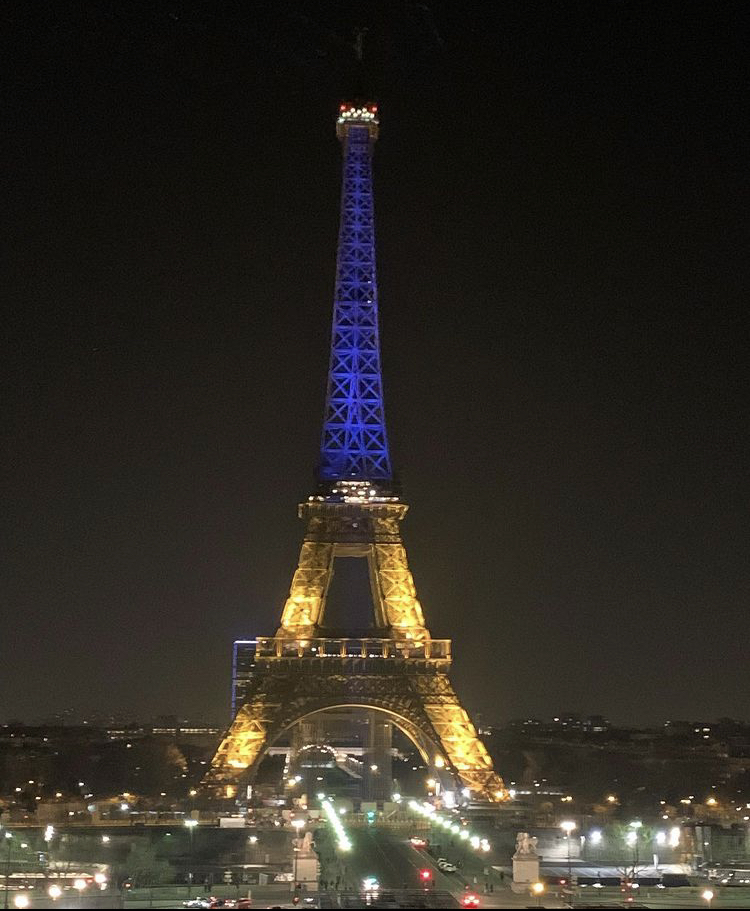
Image of Paris - tour Eiffel in support of Ukraine during Paris fashion Week 22


Boyarovskaya: impactful and chilling video. The Belarusian and Ukrainian duo sends a heartbreaking message.

Ann Demeulemeester: still white sneakers, for real? And weren’t all models wearing the same outfit again this season?

Balenciaga: Gvasalia’s background voice was chilling. His obsession for the East-European refugee outfits was clear so far, but his misshapen imagery never felt so real and angsty.

Valentino: PP Piccioli’s words, before the show, were everything: “we see you, we feel you”. A whole collection in PP Pink and some black. The message was strong, but the choice limited the beauty we used to see at Valentino shows. And the pre-show seemed like a commercial for Spiderman.

Vuitton: Ghesquière too got Balenciagitis! But we loved the tie outfits.

Chanel: a very wearable and balanced tweed story. No headshots.

Miu Miu: from preppy to biker style, call them winter outfits if you live in California! Panties peaking through the waistline recalled the first Dolce&Gabbana. Ok for the coats, jackets and column dresses. The rest, too mini, too cropped.

Paris Fashion Week 22: final thoughts


Unfortunately, the return of the runways signalled the re-awakening of the collateral circus. However, let’s debunk a myth:
Who said video presentations aren’t a valuable means to introduce a collection? Don’t say it again, please.

And above all, one point emerged: activism through fashion is a thoughtful way to bring back a sense of purpose in our work.

#STANDWITHUKRAINE

Paris Fashion Week 22 Read More »