fashion industry

Designer or image maker: who actually makes fashion now?

Reading Time: 3 minutes

The industry traded designers for pure spectacle. The market noticed.


Designer or image maker: fashion spent a decade pretending that was a false choice. The market made it real:  growth slowed in Europe; luxury sales in China remain deeply depressed.

These days, watching shows from New York to Milan to Paris, we can’t help but wonder: has fashion become pure entertainment? And if so, does the industry still need designers, or just image makers? 

The industry has always been partly entertainment. Now it is almost nothing but spectacle. Impressive runway shows, campaigns, and viral moments now matter more than the clothes themselves. The industry doesn’t want designers for their design skills anymore. It wants people who can create an image around fashion.

Designer or image maker. The distinction matters.

A designer’s job is to design clothes: to understand proportion, construction, fabric, silhouette, technique and how all those things come together on a body. An image maker’s job is different. It is to create desire, attention and a world people want to look at — and, ideally, belong to.

The fashion industry has increasingly rewarded the second.

It wants creative directors who can generate images, buzz, and viral moments. Creative directors are expected to build worlds. Celebrities bring their audiences with them. Influencers become the campaign. The clothes are almost secondary to the universe built around them.

Attention is the scarcest resource, and image makers are very good at attracting it.

For a while, this worked. 

But where does the spectacle end and the clothes begin to speak? 

Because when the show ends, that is what we are interested in: clothes. Not their social-media representation. Not the celebrity wearing them. And not the campaign. The garments themselves — the things we can actually wear, and want to wear.

And perhaps this is where fashion has lost something important: the ability to recognise value in design.

A beautifully designed garment does not necessarily produce a viral moment. Its value can be quiet. It can live in the cut, the fabric, the construction, the proportion, the way it moves on the body. It requires looking. Sometimes it requires knowledge.

Spectacle requires none of that.

It tells us what to look at.

And when an industry becomes increasingly dependent on attention, what can be seen easily starts to matter more than what requires understanding.

That question used to be philosophical. Now it is economic.

Luxury brands have spent years raising prices in the name of exclusivity, with runway shows growing bigger than ever. Yet demand has cooled. Perhaps consumers haven’t stopped wanting luxury. Perhaps they are becoming more selective about where luxury feels real. They grew less willing to pay luxury prices for products whose value they no longer recognise.

Because luxury hasn’t disappeared.

People still spend on exceptional experiences, craftsmanship, jewellery, hospitality, travel and objects that feel genuinely valuable.

The customers didn’t leave luxury. They left fashion’s version of it.

And that should worry fashion. What does the spectacle say when consumer desire falls? What happens when the attention machine keeps growing, but people become less willing to buy what they see? Ultimately, what’s the point of these huge shows, and who are they for?

Because an image can create desire. It can create excitement, status and conversation. In the short run. But an image cannot replace the thing itself. And that is where fashion’s spectacle collides with the market: consumers want less and less of what is selling. Quality has plummeted; exclusivity and scarcity, once the industry’s selling points, now read as artificial. 

Fashion doesn’t need fewer designers. It needs to remember why it needed them in the first place.

Image makers can create attention.
Designers create the reason to look.

Fashion needs image. It just can’t survive on image alone.

Designer or image maker: who actually makes fashion now? Read More »
Vogue World Milan and the spectacle of “Made in Italy”

Reading Time: 4 minutes

The lost meaning of Italian elegance and craftsmanship


Vogue World Milan is all over social media, but not for the reason one might expect. Rather than embodying class and sophistication, it generated enough grotesque memes to last for years. Some viewers even described it as a “plastic surgery expo.” Even Miuccia Prada appeared to have something to say without saying a word. So, spectacle yes, but not exactly in a flattering sense.

However, some people commented, “It was so Italian” — which left us astonished. What was so Italian about it? Just Milano and those sitting in the front row. Certainly not what Vogue claimed. In fact, it seemed closer to the Met Gala idea of fashion spectacle than to any distinct Italian vision.

Created by Anna Wintour in 2022 for philanthropic purposes, Vogue World is an international event less a fashion show than a highly produced spectacle that brings together designers, models, celebrities, performers, and technology. This Milan edition took place in Galleria Vittorio Emanuele II, bringing together Italian craftsmanship, fashion, performance, and technology.

Staged on September 22nd, the event was in collaboration with the Milan Municipality, Teatro alla Scala and its Academy. More than 500 guests were seated along the four arms of the Galleria. The front row was historic and exceptional: many of the biggest names in Made in Italy were there — Miuccia Prada, Raf Simons, Donatella Versace, Pierpaolo Piccioli, Domenico Dolce, Stefano Gabbana, and more. The event raised €2.65 million for the Biblioteca di Quarto Oggiaro redevelopment and expansion.

According to the official programme, Vogue claimed to move through “The Artisanal Revolution,” “The Industrial Revolution,” “Made in Italy,” “The Age of Intelligence,” and “The Imagination Revolution.” Vogue specifically said the event was intended to address the value of craftsmanship in the age of AI.

But was Vogue World Milan really so? 

Elegance, craftsmanship, Italianness — these didn’t seem to be the main values. Elegance, in particular, seemed a lost concept. 

There is an interesting contradiction at the heart of the evening. Vogue explicitly presented the event as a celebration of “Made in Italy,” craftsmanship and the human touch in the age of AI, while sponsors including OpenAI and Meta supported the event. The very forces the spectacle claimed to examine were footing the bill.

So, Vogue World Milan claimed to celebrate “Made in Italy” and craftsmanship. Yet the spectacle seemed to undermine both. Most importantly, what does it mean to celebrate “Made in Italy” when the people and production system that actually make it possible are increasingly under pressure? 

For an event ostensibly celebrating human craftsmanship and “the human touch,” Vogue World Milan’s defining moment was four robots waving at the crowd. A fitting confession that fashion would rather borrow Silicon Valley’s hype than trust its own hands. The irony runs deep: Vogue World was billed as a tribute to Italian artisanal tradition, yet the segment everyone talked about featured Unitree humanoid robots wearing nothing at all, doing little more than waving and mimicking a lasso motion.

Il Fatto Quotidiano called the staging “extremely didactic.” A wooden model of the Duomo, tailors in white coats, then the Industrial Revolution, then the irruption of technology, all seasoned with ostentatious luxury and so much show-off that it left doubts about the event’s true meaning: a mere and self-referential celebration of fashion as the status quo.

On her Instagram, Frida Giannini highlighted the disconnection between the rhetoric of Italian craftsmanship, elegance and “Made in Italy”, and the extravagance of the event itself. She wrote:

“Tacky and ridiculous… Nonsense. Nonhumor. Nonelegance. Only an embarrassing circus. For Milano and Italy… With Open AI and robots??? Please, a bit of consistency. And dignity. So sad.”

She was having fun, she swore — but only because she could see all the details of those creepy faces having fun. The point stands: the inconsistency between the rhetoric and reality wasn’t a detail. It was the whole show.

While Italian craftsmanship was being celebrated as a marketing slogan, a few kilometres away the Made in Italy supply chain was enduring one of its most dramatic moments. The figures released by Milan’s CGIL paint a stark picture: in just three years, Milan’s fashion system has lost a quarter of its exports (−23.3%), sliding from over €3 billion to under €2.3 billion. Artisan businesses are shuttering (−19.7% in clothing, −17% in leather). And hours of temporary layoff schemes (cassa integrazione) soared in the second quarter of 2026. (source: Il Fatto Quotidiano)

The hands that actually make Made in Italy possible went unmentioned.

Is this Italian? Is this Italian elegance? Or is it simply a spectacular representation of what fashion has become — a circus of its own making?

Find the response in Miuccia Prada’s eyes.

Vogue World Milan and the spectacle of “Made in Italy” Read More »

When “sustainable” isn’t the whole story: rethinking wool

Reading Time: 4 minutes

The wool protest at New York Fashion Week raises an uncomfortable question: can a material be sustainable if animal welfare is not part of the equation?


Rethinking wool starts with admitting that “sustainable” doesn’t tell the whole story.

Wool is natural, renewable and often presented as a responsible alternative to synthetics. But what happens when we look beyond the fibre to the animal it comes from?

The closer we look at fashion’s sustainability claims, the more complicated they become. A material can have environmental advantages and still raise serious ethical questions. “Better for the planet” and “ethical for animals” aren’t necessarily the same thing.

That tension came into sharp focus during New York Fashion Week this month, when PETA protesters disrupted the COS show on 13 September to protest the use of wool and alleged mistreatment of sheep. The confrontation escalated when Steven Kolb, then president and CEO of the Council of Fashion Designers of America, physically restrained protesters. He subsequently resigned.

But beyond the disruption, the protest raised a question that deserves more attention than a few minutes of fashion-week drama:

Can we call a material sustainable if the way it is produced raises questions about animal welfare?

What do we actually mean by sustainable wool?


Wool is a natural, renewable protein fibre — sheep grow a new fleece each year — and it biodegrades under the right conditions, rather than persisting as plastic microfibres. Its durability, temperature regulation and odour resistance can also mean less frequent washing and longer use. Wool garments can be repaired, resold or recycled, although what happens at the end of a garment’s life depends on the garment and the system available to recover it.

Yet none of these characteristics tells us how the sheep were treated.

COS (owned by H&M Group) says its virgin wool is sourced from farms certified under the Responsible Wool Standard (RWS), developed to address animal welfare, land management, and social requirements. Textile Exchange, which owns and manages the standard, describes animal welfare as a fundamental requirement. 

But what does a certification actually tell us — and what does it leave out?


We explored this topic in our eBook, This is Greenwashing. As with certified paper, RWS certification is designed to verify specific practices against a defined set of criteria. But certification has limits. Animal welfare standards are not the same thing as animal rights. People can reasonably believe that properly regulated sheep farming meets a meaningful animal-welfare standard while still disagreeing about what that standard should include.

Fashion loves categories. Natural. Synthetic. Sustainable. Circular. Responsible.

Labels make complicated systems easier to understand — and easier to sell. But sustainability isn’t a material category. It is a question of how something is produced, by whom, under what conditions, with what consequences, and for how long it remains in use.

Wool doesn’t become sustainable simply because it is natural. Nor can the sustainability of a synthetic fibre be judged solely by the fact that its raw material is fossil-derived. That does not diminish the well-established role of fossil fuels in driving climate change. But the sustainability of a finished product depends on its full lifecycle, not just whether its raw material is natural or fossil-derived.

The reality is messier.

So should we stop buying wool?


There isn’t a single answer.

Someone concerned primarily with fossil-fuel dependence may see wool differently from someone whose first concern is animal welfare. Someone buying a wool coat they expect to wear for twenty years is making a different choice from someone replacing polyester jumpers every winter.

But these aren’t separate conversations. If we’re serious about responsible fashion, we have to consider all of them: how a garment affects people, the planet and animals, and how long it remains in use. Prioritising one doesn’t automatically cancel out the others.

The material is only one part of the equation.

Perhaps the more useful question isn’t “Is wool sustainable?”
Rather, it is: “What exactly do we mean when we call this wool sustainable?”

Rethinking wool doesn’t necessarily mean rejecting it. It means resisting the temptation to stop at the label. Natural doesn’t mean harmless. Renewable doesn’t mean ethical. Certified doesn’t mean beyond question. And “sustainable” — perhaps the most overused word in fashion — doesn’t tell us nearly enough on its own.

The more responsible approach may simply be to ask better questions.

When “sustainable” isn’t the whole story: rethinking wool Read More »

Sustainability didn’t fall out of fashion. It was never really in fashion.

Reading Time: 5 minutes

What fashion’s retreat from sustainability, as the climate crisis becomes more urgent, says about the industry’s business model


A personal perspective by Rosita Cigliola

Yesterday it was sustainable. Today it is AI-powered. Tomorrow it will be something else.
The Financial Times has just asked what happened to sustainability in fashion. After years of ambitious commitments, brands are quietly retreating from targets, scaling back initiatives and putting profitability at the centre of the conversation.

The obvious explanation is that sustainability failed. 

But I think something else happened. Sustainability didn’t fall out of fashion. It was never really in fashion. At least, not in the way the word suggested.

During the pandemic, when factories closed, shops emptied, and fashion had the opportunity to look at itself in the mirror, sustainability became one of the industry’s favourite words. Brands and experts announced commitments (for instance, Rewiring Fashion). Collections became conscious—even fast fashion. Businesses became responsible. Materials and packaging became eco-friendly. Circularity was everywhere.

The language was reassuring. 

The problem was that the business model remained awfully familiar.
Fashion still needed to sell more clothes.
And more clothes.
And more clothes.

In fact, this was the uncomfortable contradiction at the heart of the sustainability conversation: an industry built around growth, overproduction and overconsumption was trying to present itself as increasingly sustainable without even questioning the pattern itself.

In This is Greenwashing, we argued this was no accident. Sustainability had become a marketing language – a collection of attractive but often vague words that allowed brands to communicate environmental responsibility. A responsibility that didn’t necessarily require demonstrating systemic change. The industry didn’t need to lie outright. It simply needed to choose its words with care.

Conscious.
Responsible.
Eco.
Green.

Words that sounded like progress. But words that required considerably less evidence than the impression they created. That impression was enough.

Now persistent economic volatility continues to affect the markets, and something revealing is happening.
When sustainability was fashionable, brands could afford to talk about it. But when it became too expensive, too complicated or commercially inconvenient as other costs increased, those commitments became less urgent.
That tells us something important. Especially now, when extreme weather is no longer an abstract warning for a distant future but a reality unfolding all around us. 


The climate crisis did not become less urgent. Sustainability became less convenient.

The problem wasn’t a lack of good intentions. They were in abundance. The incentives were wrong. And sustainability was turned into a marketing strategy to reach those incentives.

The underlying problem is that the rules and rewards of fashion have not fundamentally changed. 
Producing and selling more generates more revenue. Companies are rewarded for sales growth and profit. Investors expect financial returns. Sustainability can cost more and reduce margins. But voluntary environmental targets often have no consequences if they are missed. 
And perhaps that is why I am less surprised by the retreat than some people seem to be. 

What surprises me more, though it shouldn’t, is how quickly the industry has found another story. AI. 

AI is now everywhere in fashion. 

AI for demand forecasting.
AI for product development.
AI for personalised shopping.
AI-generated models.
AI-generated campaigns.
AI for supply-chain management.
AI for sustainability reporting. 
AI to reduce waste.
AI to make fashion more efficient.

Efficient, not sustainable.  

Sustainability seems to disappear beneath yet another change in marketing labels.

Some of these applications may be useful. AI can help brands analyse enormous quantities of information, identify inefficiencies and improve forecasting. The technology itself is not the point, although its massive freshwater and energy consumption raise serious sustainability questions. The problem is what happens when technology becomes a marketing adjective. Because we have seen this movie before. Replace sustainability with AI-powered and ask the same questions.
What exactly does it mean?
Where is it being used?
What has actually changed?
What problem does it solve?
What evidence do we have?
And – most importantly – does it change the business model, or does it simply make the existing business model faster?

That last question matters enormously in fashion. If AI allows a company to predict demand better and therefore produce fewer unwanted garments, wonderful. If it allows a company to generate thousands of new designs faster, create more marketing content and accelerate production of more things nobody needs, then efficiency has not necessarily made fashion more sustainable. It may simply have made overproduction more efficient.

This is where the sustainability conversation went wrong.

We became fascinated by the solution before asking whether we were solving the right problem. We celebrated recycled polyester without asking how many polyester garments we actually needed. We celebrated resale platforms without understanding the impact on the environment – or that they were pushing overconsumption further. We celebrated circularity without asking how much clothing was entering the system. In essence, we celebrated innovation without asking whether innovation was reducing consumption or simply making it easier.

Now AI arrives with the same seductive promise: technology will fix the mess. Perhaps it will fix some of it — the business problems, not the environmental ones. But technology cannot decide what fashion should produce. Which, on a deeper level, also means what world we do want.
People do. 
Companies do.
Consumers do.
And ultimately, the business model does.

There is also a delicious irony here.

We spent years telling consumers to look for the green label. Now we may tell them to look for the AI label. And if history is any guide (even this seems quite dubious lately), we should be careful. Because once a word becomes valuable enough to sell something, marketing will learn how to use it. 

This does not mean that sustainability was meaningless. Nor does it mean that every brand that made environmental commitments was acting cynically. There are designers, manufacturers, and brands doing serious work. And there are consumers who genuinely want fashion to have less impact. But meaningful change was never going to come from vocabulary alone. 

A more sustainable fashion industry cannot be created by changing the adjectives attached to the same products, the same volumes and the same incentives. That is the uncomfortable part. And perhaps the most useful conclusion we can draw from sustainability’s disappearance is not that fashion has abandoned the environment. It is that we should finally stop confusing talking about change with changing the system. 

Because if sustainability disappears when climate change gets brutally real, it was not a business principle. 

It was a trend. 

Sustainability didn’t fall out of fashion. It was never really in fashion. Read More »

Unsold stock destruction: EU ban now in force. Why are legislators tackling the outcome instead of the cause?

Reading Time: 4 minutes

Fashion still has one problem legislators chose not to solve: overproduction


The EU ban on unsold stock destruction has now come into force.

Under the Ecodesign for Sustainable Products Regulation (ESPR), large companies are no longer allowed to destroy unsold clothing, clothing accessories and footwear. The measure aims to reduce textile waste and encourage more circular ways of managing excess inventory.

Instead of destroying unsold products, companies are encouraged to improve stock management and explore alternatives such as resale, donations, remanufacturing and reuse.

The ban applies to large companies from 19 July 2026, while medium-sized companies will have to comply from 2030. Destruction remains possible only in specific, justified circumstances, including safety risks, irreparable product damage and counterfeit goods.

Related post: Destruction of unsold textiles: a historic ban… with many loopholes

There is no doubt that preventing perfectly usable garments from being destroyed is a positive step. Every year, between 4% and 9% of unsold textiles in Europe are destroyed before ever being worn, generating millions of tonnes of unnecessary CO₂ emissions.

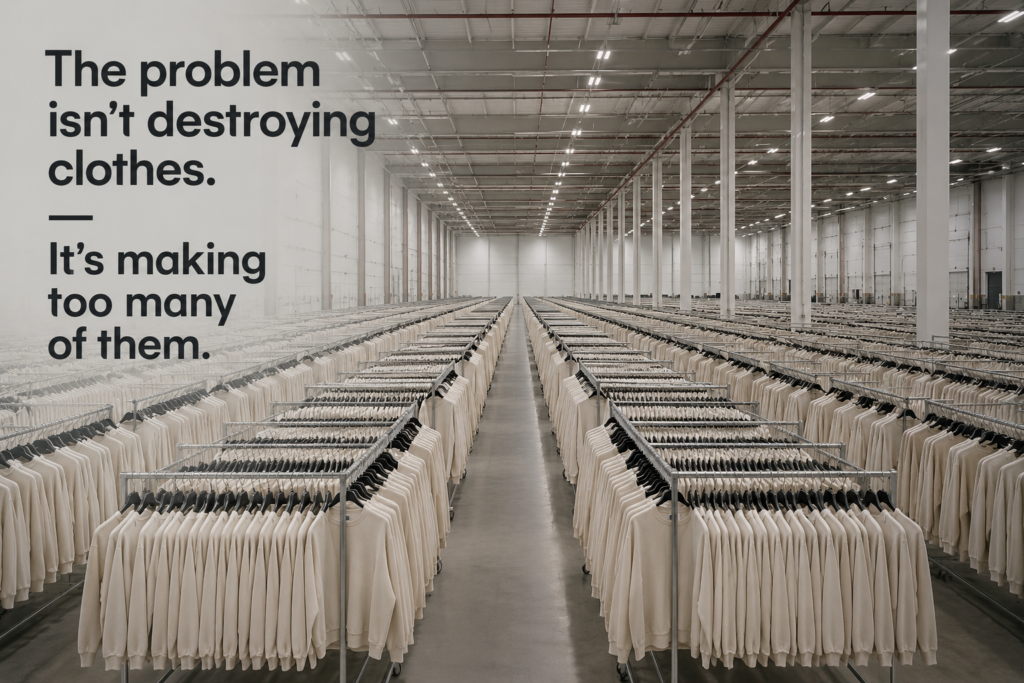
Warehouse filled with identical garments illustrating the problem of unsold stock destruction.


Unsold stock destruction: treating the symptom


The regulation addresses what happens after clothes remain unsold.

It does not address the question that comes before everything else:

Why are so many garments being produced that they become waste in the first place?

Overproduction remains fashion’s structural problem.

Brands continue to manufacture collections at a pace that exceeds real demand. The result is predictable: discounting, returns, excess inventory and, ultimately, disposal.

Better inventory management can reduce some waste, but it does not challenge the production model itself. As long as brands continue to rely on high volumes and constant product turnover, unsold stock will remain an inevitable consequence.

The problem is amplified by online retail, where high return rates create another layer of excess stock. Returned garments may be difficult or too costly to inspect, repair and resell, pushing companies towards disposal or lower-value solutions.

This is why the issue is not only what happens to unwanted garments at the end of their journey. It is also how many garments enter the market in the first place — and whether the fashion system is designed around genuine demand or around continuous growth.

If too many garments continue to be produced, banning their destruction changes what happens at the end of the process, but not the business model that creates the surplus.

The risk of shifting the problem


The regulation also includes exemptions, allowing destruction in justified cases such as safety concerns, damaged products or counterfeit goods.

It also requires companies to disclose the volumes of unsold goods they discard, improving transparency.

These are important safeguards, but they do not eliminate every risk.

Unsold products can still be exported, downcycled into low-value materials or redirected into opaque secondary markets. Preventing destruction is easier than preventing waste from simply changing form.

Final thoughts


The ban on unsold stock destruction is an important environmental measure. Destroying perfectly usable clothing has long been one of the fashion industry’s most indefensible practices, and banning it is long overdue.

Yet the regulation addresses what happens after overproduction has already occurred. It manages the surplus, but not the system that creates it.

The fashion industry’s environmental crisis does not begin with burning garments or disposing of unsold stock. It begins much earlier, with a business model that rewards ever-increasing production volumes, encourages rapid product turnover, and ultimately generates more clothing than the market can absorb.

In this context, the ban treats one of the industry’s most visible symptoms rather than its underlying cause. It may achieve exactly what it was designed to do, but what it was designed to do is too limited to tackle fashion’s structural environmental problem.

A truly sustainable fashion policy would also ask a more fundamental question: how much clothing do we actually need? That is where concepts such as sufficiency and degrowth become relevant — not because they advocate stopping the production of clothing, but because they challenge the assumption that producing more is always compatible with sustainability.

Until overproduction becomes part of the political conversation, Europe will continue making fashion less wasteful without necessarily making it sustainable. 

Unsold stock destruction: EU ban now in force. Why are legislators tackling the outcome instead of the cause? Read More »