fashion industry

British Fashion Council pivots: June LFW moves to Paris as brands seek global spotlight

Reading Time: 3 minutes

London steps back, Paris steps up: The BFC’s gamble to relocate brands reveals fashion’s widening power gap


The British Fashion Council (BFC) pivots: it will skip June’s London Fashion Week, opting instead to showcase menswear designers in Paris during the French capital’s event. The move, framed as a ‘strategic evolution,’ underscores the growing pressure on cities beyond Paris to justify standalone runways in an era of instability, where buyers and media increasingly prioritize fewer, high-impact events.

While the BFC emphasizes the benefits—including a dedicated London Show Rooms (LSR) space in Paris for emerging designers—critics warn that ceding the June calendar risks eroding London’s reputation as a cradle of innovation. The decision reflects broader shifts: the rise of co-ed collections, budget pressures, and the gravitational pull of Paris, where even British talent now flocks for visibility.

The Paris effect


“Brexit stole the show from London Fashion Week—and gifted it to Paris,” titled Politico recently. The prophecy now rings louder. Paris Fashion Week, already a magnet for global designers, offers what London struggles to guarantee: buyer density, prestige, and a direct path to commercial success.

In fact, there has always been a creative dialogue between Paris and London. But after Covid and Brexit, keeping this dialogue alive became more challenging, said Serge Carreira from the Fédération de la Haute Couture et de la Mode. “London is a scene of revelations, where one puts down creative roots, whereas Paris is a destination once the brand is established, to reach a more global audience,” declared Carreira to CNN. “This dynamic isn’t new but Paris as a next step in a British designer’s career might feel like a more amplified move.” 

The emerging designer trade-off


The BFC’s LSR initiative in Paris grants emerging designers valuable buyer access—but at what cost? London’s identity as a cradle of avant-garde experimentation is increasingly sidelined. With PFW boasting over 100 shows across nine days, and London’s calendar shrinking, the capital risks becoming a feeder system rather than a rival.

Yet signs of rebellion stir. Off-calendar British brands like Corteiz may point to a new generation that rejects the spectacle of traditional runway shows. Instead, they favour creative drops, limited-run capsules, and collaborations—questioning the fashion system itself.

This hints at an alternative future: another avant-garde is emerging, one that rejects the old system entirely.

Alternative futures


Some of the most compelling moments during London Fashion Week came not from the main stage, but from smaller, off-schedule presentations. These intimate settings—less about commercial splash, more about authentic expression—felt both innovative and grounded.

Perhaps that’s the real shift worth watching. In an age of climate anxiety and economic instability, the next generation of designers may no longer aspire to put on hyper-expensive shows filled with endless outfits. Instead, they might choose meaningful connections, slower processes, and sustainability-first design.

British Fashion Council pivots: A warning for New York?


London’s struggle mirrors NYC’s: both risk becoming satellites to Paris and Milan. If even British talent—nurtured by institutions like Central Saint Martins—flees homegrown runways, what hope remains for cities without that legacy?

Final thoughts: Business over romance


The British Fashion Council pivots. The decision to relocate June’s LFW to Paris is a business-first gamble, a bet on survival prioritising global reach over tradition. Therefore, an attempt to stay relevant in a market that increasingly rewards consolidation. The shift highlights fashion’s uneven power balance, with Paris solidifying its dominance. 

But as Paris tightens its grip, London faces an existential question: Can it remain a creative capital in a system that increasingly prioritises commerce over risk-taking?

It’s a surrender to Paris’ dominance, yes, but also a referendum on whether creativity alone can sustain a fashion capital today.

The answer may lie off-calendar—in intimate presentations, climate-conscious design, and disruptors—brands unafraid to break the mould. 

Ultimately, fashion’s future cannot be just more Paris. Fashion’s future belongs to those brave enough to imagine something else entirely.

British Fashion Council pivots: June LFW moves to Paris as brands seek global spotlight Read More »

Trump slaps 20% tariffs on EU imports: Is Europe the parasite in his trade war?

Reading Time: 2 minutes

The long-feared tariffs are here: who really pays the price?


The hammer has finally fallen: Donald Trump slaps 20% tariffs on European imports, branding the EU ‘friends who stole money from us.’

“The European Union, our friends, have stolen money from us,” declared Donald Trump last night, unveiling punitive tariffs of up to 20% on European goods (Politico). 

Ah, grazie mille, Donald—here we were, believing we were allies, only to learn we’re just a gang of pickpockets in Prada shoes.

Trump slaps 20% tariffs – The math of misery


Who Pays? You do. All of us.

Consumers—yes, even Americans—will see prices rise. Analysts warn of across-the-board hikes, from Italian leather to Vietnamese sneakers.

But the damage won’t stop at checkout counters. Exporters will bleed market share. Workers—from Milan’s textile mills to Ohio’s factories—will face slashed contracts and hiring freezes. Inflation, already biting, will get new teeth.

This isn’t protectionism—it’s collective punishment dressed up as policy.

Within hours, European markets nosedived—predictably. But the real spectacle was Nike, Adidas and Puma plunging 10%, their Vietnamese and Chinese supply chains now in the crosshairs. 

Nothing screams “patriotic revival” quite like sabotaging the very offshoring model US corporations pioneered.

The perfect storm: fashion industry’s worst-case scenario


The European Union had braced for this blow, but the fashion sector still gasped. Textiles, clothing, accessories: all now face a tariff war they can’t afford. This is an industry already on its knees, battered by inflation, supply chain chaos, and the whims of geopolitics. Now, add Trump’s Trade Tantrum to the list.

In fact, Italy’s textile and fashion sector braces for inevitable collateral damage.

The bigger question


As Trump slaps 20% new tariffs like punitive badges of honour, we’re left to ask: what’s the vision here? What’s the endgame? A world where commerce is treated as conquest, where long-standing allies are recast as economic villains, and where the true villains—according to this logic—aren’t the billionaires monetising division, but the artisans stitching handbags? Spare us.

Europe’s fashion industry isn’t “stealing”; it’s competing. Trump’s tariffs won’t magically resurrect American manufacturing; they’ll just subsidise its race to the bottom. The ‘Made in USA’ tag still relies on poverty wages and migrant exploitation—but sure, let’s pretend Europe is the problem.

This isn’t protectionism—it’s economic masochism with a flag pin on its lapel.

Trump slaps 20% tariffs on EU imports: Is Europe the parasite in his trade war? Read More »

Marc Le Bihan FW25/26: Consistency and repetition in a chaotic world

Reading Time: 4 minutes

Why a steady vision defies the ever-changing fashion industry


In a fashion industry grappling with a crisis of identity, Marc Le Bihan FW25/26 collection—spanning both prêt-à-porter and couture—offers a steady foothold. One of exceptional beauty. His unwavering commitment to consistency and repetition stands as a testament to values that are increasingly rare in today’s frenetic landscape. In a world of flux, Marc Le Bihan’s work is a quiet rebellion, a reminder that timelessness can still exist.

The fashion world is no stranger to upheaval. Creative directors hop from one maison to another, prioritising their own ego over the heritage and DNA of the brands they helm. The result? A homogenised sea of sameness, stripped of individuality and meaning. This relentless churn of leadership only amplifies the instability of an already fragile industry. It begs the question: in an era defined by permacrisis, is this cycle of paranoid instability truly what we need? Or does it merely perpetuate chaos?

We believe the answer comes from Marc Le Bihan.

Marc Le Bihan FW25/26 artisanal fashion: Rarities for the rare


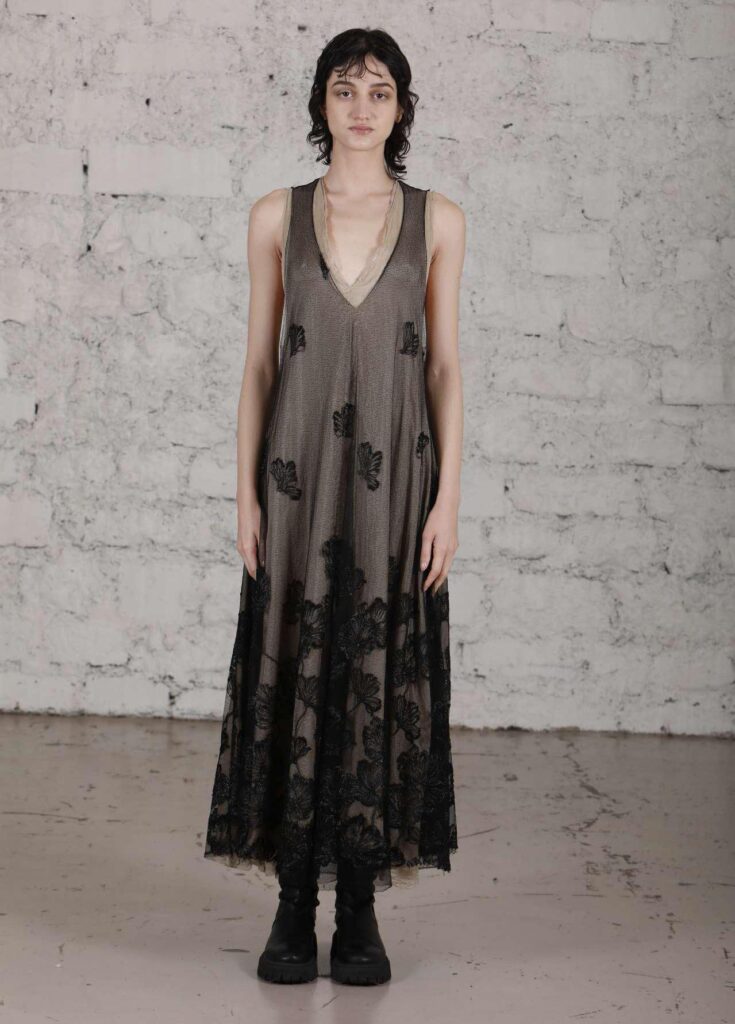
When we received Marc Le Bihan’s lookbooks and line sheets, we were struck—once again—by the beauty and distinctiveness of his vision. Each piece, meticulously crafted, tells a story of continuity. The collection features impalpable fabrics such as pongé silk and tulle—staples that elevate the ethereal quality of his designs. The dolcezza fabric, a luxuriously soft cotton blend, adds a tactile dimension, while jacquard and more structured textures provide contrast and depth.

Image of Marc Le Bihan FW25 couture line: profile pose of a short-haired brunette model wearing a black dress with white lace flowers and a black vest covered with silk; hands with natural mani on the hips.
Marc Le Bihan couture


The colour palette is equally considered, moving from pearl and taupe to steel, black, and vibrant shades of red. As the colour card notes, all products are hand-dyed, meaning slight irregularities and subtle tonal variations may occur. This artisanal touch not only underscores the uniqueness of each garment but also reinforces the philosophy of timelessness and individuality that defines Le Bihan’s exacting tailoring.

Season after season, he builds his collections like a wardrobe—one timeless garment at a time. This approach is not just gratifying; it’s revolutionary. In a world obsessed with the next big trend, Marc Le Bihan’s radical design is a pledge: when you invest in his creations, they will never fall out of fashion.

Marc Le Bihan ready-to-wear


We encourage you to revisit our interview with Marc Le Bihan, as his words remain as relevant today as they were when first spoken:

“My idea is to keep a garment for ten years in the wardrobe, then take it out and still want to wear it because it’s timeless. Mine is a work in progress. If a shirt is good, it’s good forever.”

Final thoughts


While many brands chase the ephemeral allure of trends, Marc Le Bihan offers something far more profound: comfort in consistency. His designs are not just garments of exceptional beauty; they are anchors in a turbulent sea. He is a beacon of stability, a rare figure in an industry that has, for the most part, lost its way.

Yet, Le Bihan’s consistency is an exception, not the rule. In a world of excess and instability, his work stands as a rarity—a testament to the enduring power of a steady vision. As Nietzsche once said, “Everything rare for the rare.” To wear Marc Le Bihan is to embody this ethos. It is to declare that you are not common, that you value the enduring over the fleeting.

In a chaotic world, Marc Le Bihan FW25/26 is more than fashion—it’s a philosophy for modern humans. And in an industry crying out for direction, it’s a philosophy worth celebrating.


📲 Claim your piece of Marc Le Bihan’s rare elegance—contact us via WhatsApp or email.

Marc Le Bihan FW25/26: Consistency and repetition in a chaotic world Read More »

Demna at Gucci: How identity crumbles in fashion’s musical chairs game

Reading Time: 2 minutes

Innovation or overload: Is fashion’s new path inspiring or alienating?


The latest shuffle of creative directors—most notably, the appointment of Demna at Gucci—lays bare the fragility of identity in fashion’s relentless game of musical chairs. Just as we begin to acclimatise to one creative vision at the helm of a heritage brand, the winds change once again. But let’s be honest: is this truly innovation, or is it simply overload?

Put another way, is fashion’s frenetic, feverish delirium with designer reshuffles inspiring—or is it alienating its audience?

Recall what we wrote about Milan Fashion Week and, later, Paris Fashion Week. We celebrated the return to brand identity, the renewed focus on timelessness and heritage. We dared to hope for stability. And yet, less than a week later, identity seems to have been tossed out the window.

The Identity Collapse: Demna at Gucci


Just as we were beginning to appreciate a more identitarian Gucci—hoping for a true luxury revival—Kering announced the appointment of Demna Gvasalia as the brand’s new creative director. It’s as if Kering learned nothing from the chaos left in Alessandro Michele’s take—or the polarising fallout of Demna’s own tenure at Balenciaga. Was that really the vision Balenciaga needed? Transforming a maison synonymous with elegance and refinement into a dystopian, post-apocalyptic, East-European flea market aesthetic? To sell what—logoed baseball caps? Now, will the same happen to Gucci? A brand on the verge of death seems to receive its final blow.

The market’s reaction was swift: following the announcement, Kering’s shares plummeted by over 12%. Meanwhile, an Instagram poll by The Business of Fashion revealed that 64% of respondents believe Demna is the wrong choice for Gucci.

Final thoughts


In the end, just as we began to appreciate fashion’s renewed focus on identity, it took mere days for the industry to unravel it all. Identity crumbles under the weight of sensational headlines and the incessant reshuffling of creative directors—a cycle that, in the long run, is exhausting. Demna’s appointment at Gucci is just one example. In the coming days, we’re likely to see more luxury brands playing this same game of musical chairs. Jonathan Anderson, for instance, has just left Loewe—but headed where? For conglomerates, consistency seems to be the least of their concerns. This cycle of constant change has become the new normal in the fashion industry—a chronic disease affecting all luxury brands in pursuit of profit and overgrowth.

This is a game that leads to a devastating collapse of identity. What feels like innovation is, in reality, overload. What should inspire instead alienates. And as the industry spins faster and faster, one can’t help but wonder: who, exactly, is this for?

Demna at Gucci: How identity crumbles in fashion’s musical chairs game Read More »

Seasonless garments: The art of dressing beyond the calendar

Reading Time: 3 minutes

A guide to building a wardrobe that works year-round


Seasonless dressing offers a smarter, more sustainable approach to fashion, championing garments that transcend seasonal limitations while remaining relevant and versatile year-round.

Yet, for many, the concept remains elusive. Fashion is often perceived as a seasonal affair, dictated by shifting trends and ever-changing collections. The constant demand for newness still dominates. So, items carried forward over time are not understood or appreciated. But true style isn’t about keeping up with fleeting trends—it’s about adaptability, longevity, and building a wardrobe that works effortlessly in any season.

It’s no secret that sustainability has vanished from corporate agendas. But climate change is a reality, making mindful consumption more urgent than ever. That’s why, at suite123 Milano, we remain committed to our values, advocating for fashion that respects both people and the planet—because the true cost of style should never be our future.

What does ‘seasonless’ really mean?


Seasonless garments are timeless, versatile pieces designed to be worn all year round. They are not confined to a specific trend or weather condition but instead adapt seamlessly through functionality, layering, and styling.

Think of them as the backbone of your wardrobe—reliable, adaptable, and always in style. A well-cut mannish shirt or a silk dress, for instance, transitions effortlessly from summer, worn with sandals, to winter, layered with tights and boots.

The practical magic of seasonless garments


Beyond aesthetics, seasonless dressing offers tangible benefits:

  • Cost-effective: Investing in timeless pieces reduces the need for constant new purchases, ultimately saving money and cutting down waste.
  • Space-saving: A curated wardrobe of versatile items means less clutter and a stronger focus on what truly matters.
  • Effortless styling: Thoughtfully designed pieces mix and match with ease, making getting dressed easier and more intuitive.

A deeper emotional connection: A style that grows with you


Seasonless garments are more than just clothes—they are companions that evolve with you. They tell a story of intentionality and thoughtful selection, reflecting a lifestyle that values quality over quantity. By choosing seasonless pieces, you are not merely dressing for the present moment; you are curating a wardrobe that stands the test of time. A wardrobe for life that tells the story of you.

How to embrace seasonless dressing


Building a seasonless wardrobe is simpler than it seems. Here’s how:

  • Prioritise fabrics: Choose natural, breathable materials like cotton, linen, wool, and silk, which regulate temperature and adapt to different climates.
  • Embrace versatile colours: Choose shades that complement each other, allowing for effortless mixing and matching.
  • Master layering: A single piece can be styled for multiple seasons—for instance, a lightweight blazer worn over a summer dress in spring or paired with a turtleneck in winter. Specifically, layering means adding or removing pieces depending on the weather or your own perception of it.
  • Use accessories wisely: Scarves, belts, and jewellery can refresh the look of seasonless staples, adding variety without excess.

The bigger picture: Seasonless garments are a sustainable choice


Above all, seasonless dressing is a quiet rebellion against fast fashion. Here’s why it matters:

  • Investing in garments that last beyond a single season reduces environmental impact.
  • It challenges the relentless cycle of overconsumption, encouraging a slower, more intentional approach to fashion.
  • It is not just a passing trend but a movement towards a more mindful, sustainable future.

Conclusion: Seasonless garments – A call to action


With sustainability fading from corporate agendas, the power to drive change lies with you. We invite you to rethink your approach to fashion—not as a seasonal cycle of consumption, but as a mindful, personal, and sustainable practice.

Seasonless garments are a smart, stylish, and responsible choice—one that aligns with your values and enhances your lifestyle. After all, true style isn’t about keeping up with seasons; it’s about building a wardrobe that works for you, all year round.

Ready to take the first step?
📲 Get in touch via email or WhatsApp to explore our curated selection of seasonless pieces. We’re here to help you make the shift.

Seasonless garments: The art of dressing beyond the calendar Read More »