sustainability

Climate action and the new materiality: when climate risk becomes a profit crisis

Reading Time: 4 minutes

Why climate risk is no longer a sustainability issue, but a financial one


What makes companies truly sensitive to climate action?

Profit.

Not moral pressure.
Not awareness campaigns.
And not even public outrage.

Profit.

And this is precisely why the new report, The Cost of Inaction, by Apparel Impact Institute (AII), feels different. It does not appeal to conscience. It speaks the only language that boardrooms consistently understand: financial survival.

The new materiality: from responsibility to financial necessity


For years, the fashion industry has discussed climate targets, net-zero pathways, decarbonisation roadmaps. The vocabulary has been refined. The pledges have multiplied—and with them, so has greenwashing.

But awareness without structural action changes very little. (We explored the knowledge gap here).

This report shifts the narrative. Climate risk is translated into numbers. And the numbers are not symbolic.

  • Operating margins could shrink by up to 34% by 2030
  • Losses could reach 67% by 2040
  • Under a net-zero transition scenario, the $1.77 trillion fashion industry could lose up to 70% of its value by 2040

This is no longer about “doing better.”
It is about remaining economically viable.

The three pressures that will reshape fashion


The report identifies three main financial risks:

  1. Rising carbon pricing
  2. Increasing raw material costs
  3. Higher and more volatile energy prices

The message is clear: delaying the energy transition increases exposure. Conventional operators heavily dependent on fossil fuels and coal will face multiplying costs.

Climate volatility is not a future scenario.
It is a cost driver already embedded in supply chains.

The most interesting part: action pays


The report is not apocalyptic. It is pragmatic.

It shows that early investments — particularly in supplier decarbonisation — create resilience and protect margins.

Incremental improvements such as: 

  • Energy efficiency
  • Heat recovery systems
  • Electrification
  • Renewable energy adoption

can deliver meaningful short-term relief while building long-term competitiveness. The report advises CFOs to view these not as costs, but as capital allocations that stabilise the Cost of Goods Sold (COGS) and protect EBIT—a framing that transforms a sustainability expense into a margin-defence strategy.

Companies that de-risk their supply chains and decouple profitability from climate-sensitive inputs could face four to five times less exposure by 2040.

This is not activism.
This is financial strategy.

CFOs at the centre


One of the most revealing aspects of the report is who it addresses: chief financial officers and finance teams.

Climate strategy is no longer confined to sustainability departments. It now belongs in capital allocation, risk modelling, and governance discussions.

Kristina Elinder Liljas of AII describes the report as putting a “price tag” on delayed net-zero transition. And that phrase matters. Because once a risk is priced, it can no longer be ignored.

Even industry leaders — such as H&M Group — acknowledge that awareness without decisive action will not deliver science-based targets—a notable admission from a company emblematic of the fast-fashion business model.

However, when it comes to sustainability and climate change, fast fashion reveals a striking paradox. The overproduction model remains untouched — as if it were neutral, inevitable. Yet choosing not to change is itself a powerful act of choice. The fast-fashion perspective is not just limited; it is inherently flawed. The core issue is that maintaining an unchanged overproduction business model is not a viable option; it is the very barrier preventing real progress.

Climate action: collaboration is not optional


The report emphasises co-financing and collective investment. Supply chains are interconnected ecosystems. One actor alone cannot stabilise the system.

Lewis Perkins, CEO of AII, highlights that maintaining business stability in a climate-disrupted world requires industry-wide cooperation, channelled through initiatives like AII’s own Fashion Climate Fund, which pools brand capital to de-risk and accelerate supplier-level investments.

This is perhaps the uncomfortable truth: resilience is a collective effort.

Beyond fashion


Although focused on apparel, the message extends far beyond fashion.

Any industry that postpones climate mitigation is not protecting its profit. It is accumulating risk.

The cost of inaction is not abstract.
It is measurable.
And it compounds.

A final reflection


For years, we have framed sustainability as an ethical evolution. Perhaps we were speaking the wrong language. Ethics, it seems, has become unfashionable.

If profit is what finally moves companies, then maybe this is the real turning point: climate action is no longer about virtue.

It is about survival.

And when survival becomes the question, hesitation becomes the most expensive choice of all.

But a final irony remains: the very brands whose business depends on relentless overproduction are now positioned as architects of the solution. Can those who built the problem truly deliver the cure — or will profit and habit always win?

Climate action and the new materiality: when climate risk becomes a profit crisis Read More »
Destruction of unsold textiles: a historic ban… with many loopholes

Reading Time: 3 minutes

A turning point against waste: rules, exemptions, and the challenges for truly circular fashion


The European Union has put an end to one of the most controversial practices in the fashion world: the systematic destruction of unsold textiles. From 19 July 2026, large companies will be prohibited from destroying unsold clothing, accessories, and footwear. This provision will be extended to medium-sized companies from 2030 onwards.

This decision, implemented through the Ecodesign for Sustainable Products Regulation (ESPR), aims to break an unsustainable paradox: in Europe, between 4% and 9% of textile products are destroyed each year before ever being worn, generating 5.6 million tonnes of CO₂ emissions — an impact equivalent to that of the entire country of Sweden.

In this context, the measure takes on central importance. It aligns with the EU’s strategy to combat waste, reduce pollution, and accelerate the transition towards a fully circular economy. The intent is clear: to redirect unsold goods towards alternative virtuous channels, such as discounted resale, donations, material regeneration, or creative reuse.

Exemptions: the loopholes to monitor


The Commission has provided for exceptions to the ban, which are necessary but potentially ambiguous. Destruction of unsold textiles will still be permitted for:

  • Reasons of safety, hygiene, or public health.
  • Irreparable product damage.
  • Technical inadequacy for recycling or reuse.
  • Violation of intellectual property rights.
  • Situations where destruction is deemed the option with the lowest environmental impact.

In parallel, from February 2027, the obligation to declare disposed unsold garments via a standardised communication format will come into force, aimed at ensuring transparency.

However, it is precisely here that the greatest risks lie. Definitions such as “technical inadequacy” or “lowest environmental impact” are elastic and subject to interpretation. Without extremely clear guidelines and a rigorous control system, they could become loopholes to circumvent the spirit of the law. The danger is that the problem could simply be exported, with garments shipped outside the EU to be disposed of where rules are less stringent, thereby fuelling the phenomenon of waste colonialism.

Textile industry: a sector truly “at the forefront”?


The Commissioner for the Environment, Jessika Roswall, described the textile sector as “at the forefront of the transition towards sustainability,” while acknowledging that the data “demonstrates the need to act.”

This statement appears to be in strong tension with reality:

  1. The waste figures cited by the Commission itself depict a backward sector, symbolic of the “take-make-dispose” model.
  2. The very need for legislation highlights the failure of self-regulation. A sector truly at the forefront would not need a ban to stop such a wasteful practice.
  3. The real pioneers (circular brands, reuse models) remain a niche compared to the dominance of fast fashion and mass-market “luxury.”

The declaration is more of a political act—aimed at involving the industry rather than criminalising it—than a factual description.

The real challenge begins now


This ban is a fundamental step, but its effectiveness is not guaranteed. It will depend on three crucial factors:

  1. Stringent guidelines that minimise the ambiguity of the exemptions.
  2. A robust and uniform system of controls and sanctions across Europe.
  3. A definition of “destruction” broad enough to also cover disposal disguised as poor-quality recycling.

Final reflections

In conclusion, the regulation on the destruction of unsold textiles is a fundamental step forward that changes the regulatory paradigm.

The EU has charted a course towards a more circular and responsible textile and fashion industry. But the battle against waste will be won (or lost) in the details of implementation, in the vigilance of the authorities, and in the capacity to close every potential loophole.

Companies are now called upon to genuinely reinvent how they manage the value of products and materials, rather than merely finding new ways to circumvent the disposal problem.

Destruction of unsold textiles: a historic ban… with many loopholes Read More »

Milano Cortina Olympics: snow needs cold, not crude

Reading Time: 4 minutes

The uncomfortable truth behind “sustainable” and “neutral” Winter Olympics


There is a lot of excitement in the air for Milano Cortina Olympics. In fact, the Games are set to showcase sport, landscape, and international cooperation. We are told to celebrate fashion, food, culture, and people.

In reality, it risks becoming yet another glossy exercise in greenwashing. And not only that. The Games also reveal a deeper, more disturbing contradiction: selective ethics, selective exclusions, selective silence.

Winter sports need snow, not fossil fuels


Winter sports depend on snow, ice, and stable temperatures. Yet the Milano Cortina Winter Olympics are sponsored by Eni, one of Italy’s largest oil and gas companies—an industry that directly fuels the climate crisis threatening the very existence of winter itself.

This contradiction is not accidental. It is strategic.

As Greenpeace Italia recently stated:

Winter sports need snow, not polluting companies.”

Milano Cortina Olympics: when sponsorship becomes image laundering


Sponsorships like these are not neutral acts of support. They are tools of reputation laundering, designed to associate fossil fuel corporations with values such as resilience, excellence, and sustainability, while diverting attention from the environmental damage caused by their core business.

Eni’s presence at the Olympics does not reduce emissions.
It does not protect glaciers.
It does not safeguard mountain ecosystems.

What it does is offer a powerful stage to rewrite a narrative.

The climate crisis is not an abstract backdrop


The climate emergency is already reshaping winter sports:

  • artificial snow replacing natural snowfall
  • shortened seasons and shrinking glaciers
  • increasing environmental pressure on fragile alpine territories

Allowing companies that actively contribute to global warming to sponsor the Winter Olympics means ignoring this reality—or worse, normalising it.

As Greenpeace puts it:

“Those who fuel the climate crisis, threatening the survival of ice and snow on which the Winter Games depend, cannot be sponsors of the Games.”

This is not radicalism. It is coherence.

The IOC’s responsibility


The International Olympic Committee often speaks the language of sustainability. But language without action remains branding.

If the Olympic movement genuinely wants to protect the future of winter sports, it must take a clear stance and end sponsorships from oil and gas companies—just as tobacco sponsorships were once banned from sport for ethical reasons.

Some industries are simply incompatible with certain values.
Fossil fuels and the Winter Olympics are one of those cases.

A double standard dressed as neutrality


Russia is out. Israel is in.

The official justification for excluding Russia from the Olympic Games was the violation of international law and the incompatibility of war with Olympic values. Yet the same principles seem to dissolve when it comes to Israel, despite the scale of destruction and civilian deaths in Palestine far exceeding many past conflicts that have led to sanctions.

This selective morality undermines any claim of neutrality. When sport chooses silence in the face of certain atrocities and outrage in others, it stops being a space of peace and becomes a mirror of geopolitical hypocrisy.

The discomfort was impossible to fully contain. During the opening ceremony, J.D. Vance was met with loud boos from the audience—an unplanned rupture in the performance of neutrality. Even as cameras attempted to manage the narrative, the reaction exposed a growing gap between institutional silence and public conscience.

Israel’s parade was embarrassing. 
Just as embarrassing was the attempt to erase Ghali through selective camera framing—an evident effort to censor his words and silence his pro-Palestinian stance.

Is it really still unclear that Israel is committing genocide, as widely documented by human rights observers?

Ghali, Rodari, and the words that should never be censored


Ghali recited Reminder, a poem by Gianni Rodari:

“There are things to do every day:
wash, study, play,
and set the table at midday.

There are things to do at night:
close your eyes, sleep,
have dreams for dreaming,
ears for hearing.

There are things never to do,
neither by day nor by night,
neither by sea nor by shore:
for example, WAR.”

Words simple enough for a child. Apparently too dangerous for a stage.

What kind of future are we celebrating?


The Olympic principles are excellence, respect, and friendship. They aim to unite people through sport, promoting peace, solidarity, and inclusion.

And yet, this is what Ghali later wrote on Instagram:

“Peace? Harmony? Humanity?
I did not feel any of this last night, but I felt it through your messages.
People are what truly matter, and in a time of so much hatred, please do not play their game. Respond as we would want the world to be.
‘There are things that must never be done.’”
Ghali

Beyond the beautiful façade


We can celebrate Italianness at Milano Cortina Olympics. We can take pride in the landscape, culture, fashion, food, and athletes and everything else. But this could also be an opportunity to rethink how major events relate to territory, climate, and responsibility.

Instead, it risks becoming another case study in how sustainability is used as a decorative word—applied after the damage is done. A study in beautiful façades.

Snow is not a metaphor.
Ice is not a logo.
The climate crisis cannot be sponsored away.

And humanity does not come in Series A and Series B.

If they sold you the Winter Olympics as ethical and sustainable, this is greenwashing.

Milano Cortina Olympics: snow needs cold, not crude Read More »

The luxury dilemma: what does it mean “to do our work properly” in a broken system?

Reading Time: 5 minutes

FW26 Men’s Fashion Week: unpacking Miuccia Prada’s statement on sustainability


Men’s Fashion Week Fall/Winter 2026/27 has just wrapped up in Milan, bringing the luxury dilemma sharply into focus. Beyond the collections themselves, one statement in particular stood out — a widely shared comment by Miuccia Prada on sustainability.

In a season marked by uncertainty, many brands sought reassurance either in the past through nostalgia or in bold contemporary provocations, while reaffirming tailoring and colour as anchors of meaning. Following a runway show explicitly reflecting on the present moment, Miuccia Prada and co-designer Raf Simons spoke to the press. Sustainability inevitably entered the conversation.

Abstract image of an unrecognisable garment blurred in the background, overlaid with a barcode reading “OVERPRODUCTION”, symbolising the luxury dilemma at the heart of the fashion system.

Luxury fashion and sustainability: pragmatism versus idealism


Miuccia Prada reiterated her long-standing commitment to doing her work conscientiously and striving for excellence. She stated:

“I’m trying to get on with my work and do it properly. If we truly wanted to be sustainable, we’d have to stop everything: no cars, no clothes, no consumption at all. We must be honest and do our work to the best of our ability, bringing creativity, quality, and awareness to it.”

It is a compelling, deliberately provocative statement — one that exposes the tension between idealism and pragmatism in sustainability discourse.

A titan of the luxury fashion industry and a figure known for her intellectual and often contradictory positions, Prada draws a stark dichotomy:

  1. The pure ideal: true, absolute sustainability would require a complete halt to modern industrial life — no cars, no new clothes, no consumption.
  2. The pragmatic reality: since such a scenario is implicitly deemed impossible or unacceptable, the alternative is not withdrawal but “doing our work properly”.

The underlying message is clear: perfection becomes the enemy of improvement. Prada rejects a paralysing purity test in favour of an ethic of incremental responsibility.

The luxury dilemma and its internal contradictions


Yet this statement also reveals a deeper contradiction.

1. A defence of the luxury system
At its core, the quote functions as a defence of high-end fashion’s right to exist. Prada suggests that even the creative and qualitative apex of the industry would fail a test of absolute sustainability. The implicit argument is: if fast fashion is condemned, then so must luxury be — the overproduction model is the same.  And if that happens, society risks losing creativity, craftsmanship, culture.

2. Quality and creativity as a smokescreen
For luxury brands, “quality” (durability, materials, craftsmanship) and “creativity” (cultural and artistic value) are repeatedly invoked as ethical justifications for continued mass production. But this framing sidesteps the central issue: the business model itself.

Whether it is a €50 polyester blouse or a €5.000 nylon bag, the luxury industry still depends on:

  • Seasonal cycles, driving perpetual “newness” and the obsolescence of desire
  • Marketing-driven consumption, creating symbolic rather than utilitarian needs
  • Vast, opaque supply chains, with environmental and social impacts regardless of material quality
  • Manufactured exclusivity and scarcity, fundamentally at odds with the anti-consumption logic Prada herself references

Within this structure, creativity and quality are not neutral values — they are often the very engines of consumption.

Blurred garment with a barcode reading “OVERCONSUMPTION”, symbolising overconsumption as a consequence of the luxury dilemma in fashion. AI-generated image.

3. Intellectual honesty vs corporate reality
There is undeniable honesty in Prada’s acknowledgement that true sustainability would mean “no clothes”. It openly names the conflict at the heart of fashion. Yet the conclusion — “do our work well” — feels like an intellectual sleight of hand.

The problem shifts from systemic change (overproduction, growth imperatives, marketing pressure) to individual ethics: my work, our work. In doing so, responsibility is displaced from the corporation and its structural drivers onto personal integrity.

By articulating the critic’s most radical argument — we should stop everything — Prada positions herself as the sober realist. The critique is acknowledged, absorbed, and then dismissed as unworkable. It is a sophisticated form of containment: recognising the radical in order to defend a softened status quo.

What the luxury dilemma leaves out

  • A false binary
    Prada presents a choice between total civilisational shutdown and business-as-usual with better intentions. This erases the vast middle ground: degrowth, sufficiency, circular systems, and radical business-model innovation.
  • Denial of agency
    As creative director of a billion-euro group, Prada possesses exceptional power to experiment with new models. Retreating to “just doing my work” understates this agency. The argument might be defensible from a junior designer — far less so from one of the most influential figures in fashion.

Final thoughts


One could read the collection itself — clothes that appear worn yet are brand new — as an implicit suggestion: use what you already have. This is a ritual we always cherish at the end of a Prada show, because there is always a message that transcends the clothes. But the more pressing question remains how to build genuinely sustainable models for the fashion business.

Terms like degrowth or smaller production volumes threaten the very structures that allow luxury brands to maintain their cathedrals — architectural, symbolic, and economic. And so they remain largely unspoken.

Miuccia Prada’s statement ultimately becomes a revealing manifesto of the luxury dilemma. It is intellectually lucid about the problem, yet philosophically conservative in its solution. It mobilises the language of ethics — honesty, awareness — to justify the preservation of a system that, by its own admission, cannot exist within true planetary limits.

Focusing on “doing the work at its best” inside a broken model, even with the best intentions of creativity and quality, amounts to a form of managed dissent: it critiques the ends, but fiercely defends the means.

The luxury dilemma: what does it mean “to do our work properly” in a broken system? Read More »

Legal shield for luxury: is this the solution to ending luxury brands’ exploitation of workers?

Reading Time: 7 minutes

Report Rai3: fashion sweatshops and the unbroken link between luxury and labour abuse


While Italy was in the midst of Men’s Fashion Week, Rai3’s Report aired a hard-hitting investigation into the labour exploitation behind the luxury brands now seeking a legal shield. Thetopic itself was not new: recently, media outlets have reported on sweatshops hidden behind the façade of Made in Italy. What Report did differently was to go further—attempting to speak directly with manufacturers, workers and brand owners.

Among the major figures contacted, only Diego Della Valle—chairman of Tod’s Group (Tod’s, Hogan, Fay and Roger Vivier)—agreed to appear on camera. His appearance, however, raised more questions than it answered. The investigation revealed that audits had been conducted within the supply chain, yet Tod’s disregarded their findings.

Some commentators accused Report of daring to criticise an industry that represents a significant share of Italy’s GDP. We strongly disagree. When an industry operates—directly or indirectly—through sweatshop conditions, exposing it is not only legitimate, it is necessary.

Judicial administration and labour abuse


Several luxury brands have been placed under judicial administration over failures to monitor labour exploitation in their supply chains.

Valentino Bags—a company controlled by Valentino and responsible for producing bags for the brand—was among them, alongside Loro Piana, Armani and Dior. In one of the Chinese workshops producing Valentino bags, the Carabinieri found a child playing among fabrics and industrial machinery.

In July 2025, the Milan court ordered judicial administration for Loro Piana, the Italian high‑end clothing brand controlled by LVMH. Investigators found that production had been entrusted to companies that subcontracted work to Chinese workshops where workers were exploited.

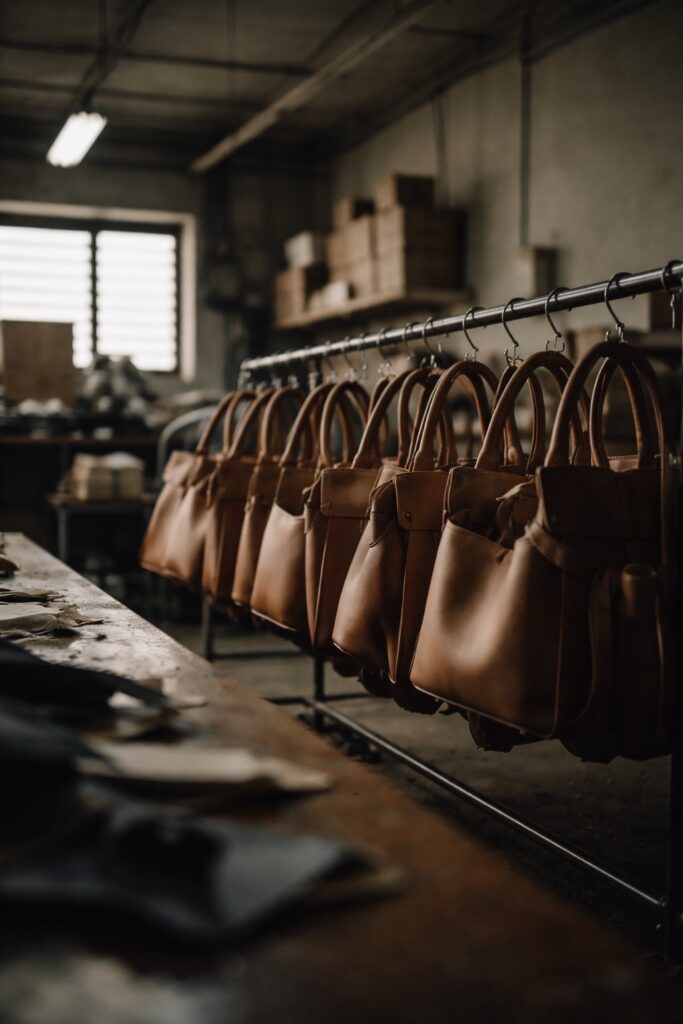
Unfinished leather handbags in a sparse workshop, representing the hidden production behind luxury brands seeking a legal shield.

Della Valle: “The Chinese workshops are not our concern”


In October, the Milan Prosecutor’s Office requested preventive judicial administration for Tod’s SpA. The investigation uncovered serious violations of workers’ rights across the subcontracting chain responsible for producing the brand’s goods. Prosecutors stated that the company was aware of these practices, leading to an investigation for caporalato (the gangmaster system).

Following similar measures against multiple fashion brands, Milan prosecutor Paolo Storari also requested a six‑month advertising ban for Tod’s. Through an exclusive interview with Diego Della Valle, Report reconstructed the luxury supply chain: production is outsourced to Italian firms with no manufacturing facilities, which then subcontract to Chinese workshops.

Della Valle argued that responsibility should not extend beyond the first level of the supply chain. This position is deeply problematic. If a brand entrusts production to intermediaries that do not manufacture anything themselves, what does it expect to happen? And why do brands choose this model in the first place?

In the Tod’s case, one of the most serious issues to emerge was the failure to act on clear audit findings. Problems were identified, yet deliberately overlooked.

The attempted legal shield for luxury brands


Against this backdrop, Article 30 of the Small and Medium Enterprises Bill—approved by the Senate and debated in the Chamber of Deputies—attempted to exempt major fashion brands from liability for crimes committed along their production chains.

Widely described as a legal shield for luxury brands, the amendment was eventually withdrawn following protests by trade unions, workers and the Clean Clothes Campaign. It will now return to the Senate.

During his interview with Report, Minister Adolfo Urso stated that caporalato in Italy had been “brought by the Chinese”. A staggering statement that shifts blame away from the structural drivers.

Shifting blame to the lowest—and weakest—links in the chain conveniently ignores who sets prices, who designs supply chains and who ultimately benefits from lower production costs.

Made in Chitaly: the testimony that explains everything


One of the most powerful moments in Report was the testimony of Andrea Parisi, owner of Spectre Srl, a company specialising in the finishing of heels for luxury footwear.

Until recently, Spectre employed 34–35 people and worked for all the major luxury brands. Today, only three workers remain.

Parisi explained how brands outsource work to companies that possess no machinery, which then subcontract—unofficially—to Chinese workshops capable of producing tens of thousands of units at prices that are economically impossible under legal conditions.

A heel paid €0.80 per piece (€1.60 per pair), he explained, should cost at least twice that amount. This pricing mechanism drives law-abiding Italian manufacturers out of the market, depriving them of contracts, revenue, and skilled labour.

“The most serious loss,” Parisi said, “is our workforce.” Competing, he explained, is impossible unless one is willing to break the law.

Andrea Parisi’s most touching words:

“The fashion sector in Italy no longer exists. But at this moment we don’t even have the tools to fight anymore, how are we supposed to go forward? Must our workers be reduced to ‘Vietnam conditions’? What have we come to? Behind subcontracting, lies undeclared labour, lies precarious employment, exploitation. It must be abolished, full stop, and it must be done tomorrow morning. It’s Made in Italy if the workers’ ethics are respected. Otherwise, write on the products ‘Made in Italy 50%’, at least tell the truth.”

A structural system, not an anomaly


The idea of serving luxury products to everyone has generated this system. The so-called democratic luxury.

As Della Valle said: “We survive because people recognise in us an absolute quality. How many people buy a bag or a pair of shoes from me? Many have the money to do so, then there are those who love them, who perhaps don’t have the money, they make a sacrifice, and to those people you can’t say: ‘You’re working your arse off to buy this little thing, and these people are a bunch of wankers.’”

So brands serve entry price products while, at the same time, cut their costs as much as they can to maximise profits. Let’s clearly state this: the idea of democratic luxury is as contradictory as illiberal democracy: it does not exist. It is either one thing or the other.

As Luca Bertazzoni (Report) said: “The point is that those Chinese companies which President Meloni claims to be fighting are now an integral part of the system and continue to be sought by the major fashion brands to maximise profits. Take the case of Mr Yang, whom we had met a year ago after the Carabinieri found Dior bags inside his workshop in Opera, where workers were being exploited.”

Gian Gaetano Bellavia – expert in corporate criminal law, explained further: “The Italian who wins the contract always keeps his own margin, and it’s the Chinese contractor who has to cut his margin. So then the Chinese contractor perhaps goes to a Pakistani, right? Who is even more desperate than the Chinese.”

This system is not limited to handbags or footwear, nor is it an exception. Furthermore, it is not solely an Italian issue—is Dior an Italian brand? And doesn’t LVMH owns Loro Piana? The problem is structural and global. To be clear, it also exists beyond fashion. Yet, this breadth is not a mitigating factor but an aggravating one.

As Bellavia noted, it is a “war among the poor to serve the rich”. Those at the top remain silent, protected by distance, complexity and legal ambiguity.

Final thoughts


In conclusion, this operating system is not new. As young women working in fashion in the late 1990s, we witnessed its gradual consolidation. For over twenty years, opacity has prevailed. If we saw that, how did nobody question what was happening?

Today, instead of dismantling the system, the Italian government proposes a legal shield for luxury.

But when luxury products are made through exploitation, who is responsible? The last link in the chain? Really? Or those who decide to maximise profits by compressing production costs from the top down?

If Italian manufacturing has been decimated, responsibility lies with both political choices and brand strategies. Blaming labour exploitation solely on the weakest links in the chain is not only dishonest—it is shameful.

A legal shield is not the solution. These companies have money, power and structure. They must be responsible for workers’ conditions and for the reality behind their products. Choosing ignorance forfeits accountability.

Luca Bertazzoni offered a definitive direction:

“If high fashion were to abandon the subcontracting chain that allows it to make profits by producing at rock-bottom prices, Italian artisans could go back to work, with full respect for workers’ rights.”

So, forget a legal shield for luxury. The real solution is clear: dismantle the subcontracting chains that allow luxury brands to profit from cut‑price labour. Only then can Italian artisans return to work under conditions that respect dignity and rights.

Ethics. Fairness. A level playing field.

And hold the brands responsible.

Legal shield for luxury: is this the solution to ending luxury brands’ exploitation of workers? Read More »