Moda

Tabi (足袋) Shoes, Cool Japan?

Reading Time: 2 minutes

Japanese culture, traditions and fashion


These days some high brands produce split-toe Japanese shoes called Tabi. Originally, Tabi are Japanese traditional socks with a separate section for the big toe and the rest. In Japanese, Tabi is written in “足袋” – literally meaning foot-pouch.

During the fashion week in Milano, I saw many Tabi boots and shoes from different brands. As a Japanese person, it was very interesting to see how Tabi shoes are becoming more and more fashion-iconic items nowadays.

Its simple, yet unique shape, is truly cool. I agree!

As you might picture, Tabi socks are usually worn with Zouri, footwear for Kimono. That is probably the most common image that people have of this item.

Yet, Tabi is not only for Zouri. It was used traditionally for various Japanese traditional footwear, such as Waraji (草鞋). Waraji is the rice straw rope sandals commonly worn during the Edo period.

In my 5th grade, I spent all my summer knitting 3 pairs of Waraji. My elementary school had a tradition that all the 5th graders hiked for 9 hours on “Kyu-kaido Ishidatami” – the old highway in Hakone, with their knitted Waraji. Of course, Tabi was a must with Waraji.
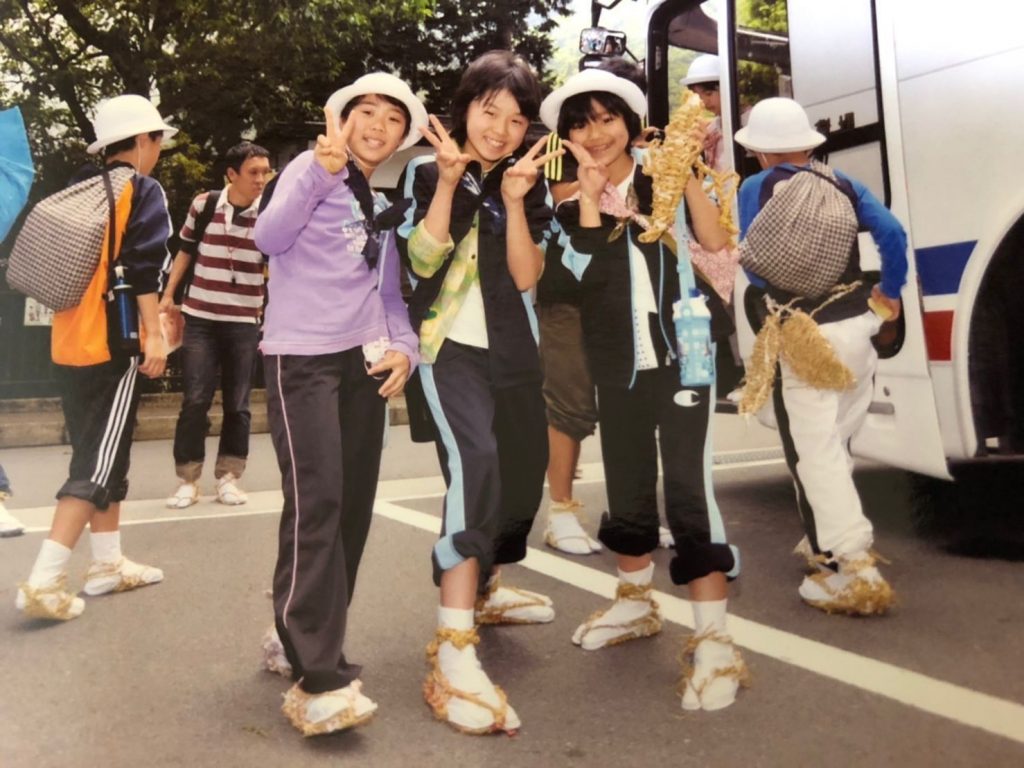
Tabi
Tabi and waraji hand-knitted sandals
Photo courtesy: Kotono Sakai

Tabi: just a mere fashion icon, or something more?


It is intriguing that some high brands, such as Margiela, are inspired by the Tabi shape. Yet, Tabi has its own value and history behind it. It is culture, and it is tradition. Tabi is not just a trendy item.

So it would be disappointing if the people would consume Tabi as a mere fashion icon with simple “Japaneseness”.
Imagine if the fast fashion brands would mass-produce Tabi shaped shoes, making them even more accessible to general consumers. The value would no longer matter.

I am very pleased to see that Japanese traditional culture is being internationally appreciated and more recognized throughout different mediums. But if I saw an overuse or overconsumption of Tabi shaped shoes, I would perhaps get mixed feelings.

I encourage you to tell what is mass and what is special!


✍️ A piece written by Kotono Sakai, a Japanese girl studying history and fashion at Cattolica university in Milan and interning for suite123

Tabi (足袋) Shoes, Cool Japan? Read More »

The Military Bag Small by ZUCCa

Reading Time: 2 minutes

Compact yet practical: the perfect everyday companion


Today we introduce The Military Bag in small size by ZUCCa.
It is the little sister of the bigger version we showed you previously in black nylon.

About the design
The design point of this cool military bag is a large three-dimensional pocket with a vertical zip fastening. Also, cotton fabric is sandwiched by nylon fabric and double stitched. And the puckering stitching highlights the military image.
The typical ZUCCa item specification tag is stitched on the outer maxi pocket.

This shoulder bag has a top zip fastening and two top handles in addition to the strap, meaning you can carry it by hand or crossbody. The shoulder strap is adjustable and removable. In addition to the outside pocket, there is one more pocket on the inside.

image of The Military Bag Small in khaki colour
The Military Bag – small size – by ZUCCa

About the colour
Khaki – a nuance that provides a military image softened by its reduced size. This accessory is easy to match, indeed doesn’t require any particular style advice.

Bag size: W17 cm X H16 cm X D5 cm
Material: 100% nylon

The small military bag


Although it is part of the Spring / Summer 22 ZUCCa collection, this is undoubtedly a seasonless item. Indeed you can use it to complete your style throughout the year.

We suggest using it as an additional day bag where you can put your essentials, wallet, mobile, keys and kleenex. And maybe something else too, because even if it’s small, this crossbody is quite capacious.
The problem with big bags is that you never find what you need, in this way your essentials are easy to find and reach. Indeed, this accessory can be useful even when you travel, so you’ll have your flight documents at your fingertips.

The Military Bag – small size – is practical and stylish. You will never get tired of carrying it with you!

The Military Bag Small by ZUCCa Read More »

The Upscale Drive

Reading Time: 2 minutes

Revising the (over)production model


Ending the diffusion lines is one of the strategies recently adopted by fashion maisons. Why this change of direction? And is it the start of a new business model?

What is a diffusion line?

The diffusion lines, also named second lines, are ready-to-wear collections whose name is similar or somehow recalls the designer’s name. The inspiration and design of these clothing and accessory lines come from the maison archive. But they get simplified in terms of patterns, working, and materials to offer the spirit of the brand at a lower price. More affordable, or relatively so. However, much lower compared to the main lines.

Main lines dominate the high-end market segment, which means they are expensive. However, if brands remained solely in this high-end segment, they would miss out on the majority of the market.

So, driven by greed and speed, brands launched diffusion lines as an opportunity to expand the business and maximise profits. Specifically, diffusion lines were conceived and produced for the mass market.

Apart from some trailblazers like Armani, whose Emporio line was born in 1980, many diffusion lines started spreading in the 90s and mushroomed during 2000. For decades brands focused on evergrowing, ever-expanding, overproducing, and heavy discounting policies. So they triggered a vicious cycle that led to an oversaturated market deprived of value.
Now, things are changing. Some fashion maisons are stepping back, embarking on a new—or not so new—path.

The new strategy: quitting diffusion lines


Recently, Valentino announced the discontinuation of its Red Valentino line starting in 2024—a diffusion line launched in 2003—to shift its focus more toward couture. Likewise, Chloè is to phase out its See by Chloé line over the next three years, addressed as a – “natural and necessary evolution for the long term.”

So, in the short term, brands have maximised profit through secondary lines. But, in the long run, this strategy has compromised the market and their own image.

Now the market is almost dead, and this forced them to change their path.
If fashion maisons want to stay relevant in an oversaturated market, they need to do some cleaning. Ending the diffusion lines will allow brands a more focused business model.

Though we do not expect they will stop overproducing, we are curious to see what they will do next!

The Upscale Drive Read More »

The Melange Wave Pull by Planatation 1982

Reading Time: 2 minutes


Today we introduce The Melange Wave Pull – by Plantation.
Among the Spring/Summer new arrivals, this sweater is indeed a seasonless item.

Since we are not a fashion supermarket, but, on the contrary, we offer a precise selection of meaningful pieces – unique garments that make a difference, we enjoy showing you all the details. Some features that through a digital screen wouldn’t be easy to notice. We pay close attention and care when we pick out the garments, and with the same care, we want to tell you the stories behind the pieces. The beauty of the design and the quality of the materials.

Discover The Melange Wave Pull


About the design
This volcano-neck sweater has a clean neck, three-quarter sleeves, and a relaxed fit. The silhouette is minimal and easy to use daily. Also, the material design shows a refined wavy stripes effect.
Thanks to the unique texture of the material, the surface that touches the skin is very soft and comfortable, so you can use it as innerwear too.

The Melange Wave Pull - by Plantation
The Melange Wave Pull – by Plantation1982


About the material
100% cotton. Fine cotton combed yarn with a good texture is first made into a skein and then dyed unevenly with a pigment dye.
The technique uses a particular kind of dyeing that produces colour differences in shades. This material has a bumpy texture. Specifically, the structure is wavy, so it does not stick to your body and gives a pleasant touch.

About the colour
A delicate warm yellow. It is a colour that gives you a sense of depth with shades due to the melange dyeing.

Laundry
Hand washable, easy-care.
You can wash this item by hand at home.

Comfortable to wear, pleasant on the skin, and easy to match.
The Melange Wave Pull is a beautiful piece, perfect for the change of season and for your layering style.

DM for any further info. We’d love to help!

The Melange Wave Pull by Planatation 1982 Read More »

The New Categorising

Reading Time: 2 minutes

A human need, or an empty extremisation?


The new trend of categorising—or the need to assign labels that define where specific groups should fit—is growing rapidly. Terms like genderless, sustainable, recycled, upcycled, and inclusive are some of the most popular labels in fashion today. Yet, while we see these pretty, or not really so, boxes clearly labelled, they often feel too artificial, fake.

Categorising: a marketing byproduct


Why are brands so obsessed with labelling their work? And, in parallel, why do people need these labels? To identify themselves? or to be represented?

Jean-Paul Gaultier created the majority of the fashion topics that are trending now. Yet, during the ’80s and ’90s, there were no labels to claim in the fashion world. It was, instead, a celebration of freedom—both from the designer’s perspective and for those who wore his creations.
Fast forward to 2022, and the obsession with labelling has exploded. Genderless and sustainable are among the most popular, with nearly every brand now claiming to be genderless. Similarly, terms like recycled and upcycled have surged to the forefront. Clearly, it’s a trend.

Coming from a family of seamstresses, disassembling a pair of trousers to make a skirt or transforming a shirt into a blouse was part of our daily routine—essentially, the essence of upcycling and recycling. Moreover, in our boutique, we always offered men’s items to women and women’s items to men, but we never felt the need to categorise them. This, in many ways, embodies the true spirit of genderless fashion, inclusion, and diversity.

Even though about five years ago, we started focusing more on genderless or recycled as valuable concepts, now brands overuse them. Indeed these leabel became so mainstream that they are abused or intentionally misleading, as in the case of sustainability.

We are not happy to be classified. So we wonder, what happened recently? What does the new categorising mean?

We believe that the less meaning we find in brands and their products, the more they rely on labels to make their offerings easier to market.

The supply far exceeds the number of people in the world who can actually purchase these products—the demand. To reach the masses, brands have lowered the bar. And the more they lower the bar, the less value they offer. This is where the need for aggressive marketing and labelling comes into play.

In conclusion, labelling is an attempt to legitimise and promote an otherwise hollow system. Rather than focusing on what truly matters—the substance—they rely on labels to create a facade of value.

The New Categorising Read More »