Explorations

Quiet Luxury: Brands With No Logo

Reading Time: 2 minutes

Tired of logomania?


Fashion style shifts towards quiet luxury, or brands showing no logo. Indeed, the world is flooded with exposed brand names, overwhelming communication, and excessive oversupply of clothing. It’s simply too much. And people end up seeing logos everywhere, to the point of making them feel sick. Perhaps this saturation is finally prompting some to change their perspective.

Logomania vs quiet luxury


The logomania represents the triumph of capitalism in the fashion system, which fostered a consumerist and shallow taste. Logos are easy to market because they are recognised easily, and people identify with them. Although these items still have a big market in the fashion industry, some people are getting tired. Indeed, logo-emblazoned pieces provide (fake) status symbols rather than true style. This has sparked a growing desire for understated luxury—one that moves away from the need to show off.

Quality over quantity


Since the pandemic shifted our perspective of the world, climate change has become a priority. Consequently, our approach to fashion evolved too. We are not involved in trends anymore, but this understated style resonates with us. In fact, it’s nothing new! It’s the vision of fashion we have promoted for years.
This conscious approach implies a dramatic reduction of consumption, refusing standardised clothing and mass production. However, to us, it’s not a way to sell more. On the contrary, it’s a radical choice that goes to the essential. It’s about quality over quantity, choosing good design, timeless pieces you’ll wear for a lifetime. In a few words it means: buy less, buy better.

Quiet luxury: style, not logos


Quiet luxury is a minimal chic style, but it doesn’t refer to basic garments only. Developed around the concept of less is more, this evolved luxury is about wardrobe staples with a strong sense of design. In other words, accurate silhouettes, quality fabrics, and exquisite tailoring, assembled to depict a sense of elegant ease.

Ultimately, quiet luxury is minimalistic, modern and timeless. Though one must have a trained eye to recognise these garments, logoless items are for people who have nothing to prove. However, the sense of effortless elegance reveals an incomparable style.

Quiet Luxury: Brands With No Logo Read More »
Fashion Far From Consumerism

Reading Time: 2 minutes

Spring-summer 23: bringing back meaning


Can we think about fashion far from consumerism? Indeed, there’s a way of conceiving the fashion industry cleared of its toxic downsides.

Spring-summer 23, a sense of re-birth comes with the new season. And so, we want to take you with us on our journey out of the blob of mass-produced clothes. Come with us to discover rarities and excellence to bring back meaning in an industry that, as it is now, has lost it.

Fashion & consumerism


If fashion mirrors our society, what we see is growth mania. The industry brainwashed people into overconsumption and disposable culture. In fact, there is a constant need for novelties which has much in common with addictive behaviours. But this massified fashion comes with a cost. It has a polluting and destructive impact.

So, we want to take you with us on a different path, which we’ll hone season after season. There’s no perfection but the commitment to doing better, stepping away from pointless labels or empty claims.
Good design, well-made clothes are for those who can see them. However, attention to design, details, and materials are fundamentals to bringing meaning back into fashion.

Spring-Summer 23: niche fashion #formodernhumans


So come with us to explore the Spring-Summer 23: garments made with care and passion. Indeed, the sense of tailoring prevails. Silhouettes are slightly more defined but always comfortable. Specifically, materials have a pleasant hand feel, and lines don’t make your body feel compressed.

There are drapings, a design detail that adds a special touch to t-shirts and dresses, making them suitable for different body shapes. But also, cool military pants and exclusive knitwear. And shirts, timeless garments par excellence, improved with a modern twist, in multiple lengths. Plus comfortable flat leather shoes for your summer walks.

The selection is accurate, essential and in limited quantities. A design-focused slow fashion, far from consumerism. Indeed, garments feature a carry-over design, becoming made-to-last stylish classics.

What if the perspective of what you considered new so far is wrong?

Fashion Far From Consumerism Read More »

AI Is The Trend: Does It Feel Real?

Reading Time: 3 minutes

When human creativity meets artificial intelligence


Humans, AI is the trend! Indeed, artificial intelligence is taking over the fashion industry, as any other area. But the conversation is all about highlighting how advanced and marvellous it is. Very few consider the possible risks.

And while we are here, waiting to receive the spring-summer orders and be inspired by tangible, real fashion stuff, which we will show you soon, we cannot avoid this trending topic. Indeed, some “artificial creativity” surprised us.

AI: what is it?


Artificial intelligence is a machine’s ability to display human capabilities such as reasoning, learning, planning and creativity. Specifically, the computer receives the data, processes it and responds–as in the case of ChatGPT. AI is crucial for digital transformation and certainly will bring great changes.

Though the perspective of losing the human touch is quite scary, everyone seems to prioritise the positive aspects. Of course, the fields of application are countless, and many of them are not even understandable now. Perhaps in the next future, we’ll reach a point where humans aren’t needed anymore. In fact, you can write blog posts, books, songs or even pass an exam with AI. As a result, many jobs currently performed by humans may disappear.

AI generated content in the fashion industry


Practical applications in the fashion field could be for customer service, stock management or market research. But we have seen beautiful fashion editorials made with ChatGPT. For instance, take a look at the fashion concepts created by Gianluca Traina, an Italian talented artist and fashion designer, with the help of ChatGPT: a collection and a complete fashion editorial inspired to the architecture of Samarkand.

SAMARKAND – Women’s clothing collection by Gianluca Traina

And here’s the men’s clothing collection:


Look at the colours! And the silhouettes! Gianluca Traina’s work is impressive, thought-provoking. In fact, it makes you question everything. Now seriously, do we still need fashion magazines made by professionals? Say hello to fashion editors, photographers, stylists, make-up artists, models, and so on… Well, shut down everything and say hello to humans!

But wait, will AI purchase products, too? Since that is the fashion industry’s biggest issue. And who will have the money to buy fashion items if people will not work anymore?  

Among all the conversation around AI, Nick Cave came up with great insight, a human perspective indeed! A fan asked ChatGPT to write a song in the style of Nick Cave and then requested Cave’s feedback.
His reply, from “The Red Hand Files”, is this:

“Mark, thanks for the song, but with all the love and respect in the world, this song is bullshit, a grotesque mockery of what it is to be human, and, well, I don’t much like it — although, hang on! rereading it, there is a line in there that speaks to me —

‘I’ve got the fire of hell in my eyes’ 

— says the song ‘in the style of Nick Cave’, and that’s kind of true. I have got the fire of hell in my eyes – and it’s ChatGPT.

Love, Nick”

The Red Hand Files – Nick Cave

Will AI replace humans?


In conclusion, AI is undoubtedly the trend, and progress is unstoppable. However, despite our limits and flaws, we remain creative humans. And our creativity is essential for progress. But most importantly, creativity without the heartbeat is nothing.

And you, have you got the fire of hell in your eyes? Love it or hate it?

AI Is The Trend: Does It Feel Real? Read More »

Vogue Philippines: The Beauty Of Humanity

Reading Time: 3 minutes

A brave cover story of representation fighting the myth of youth


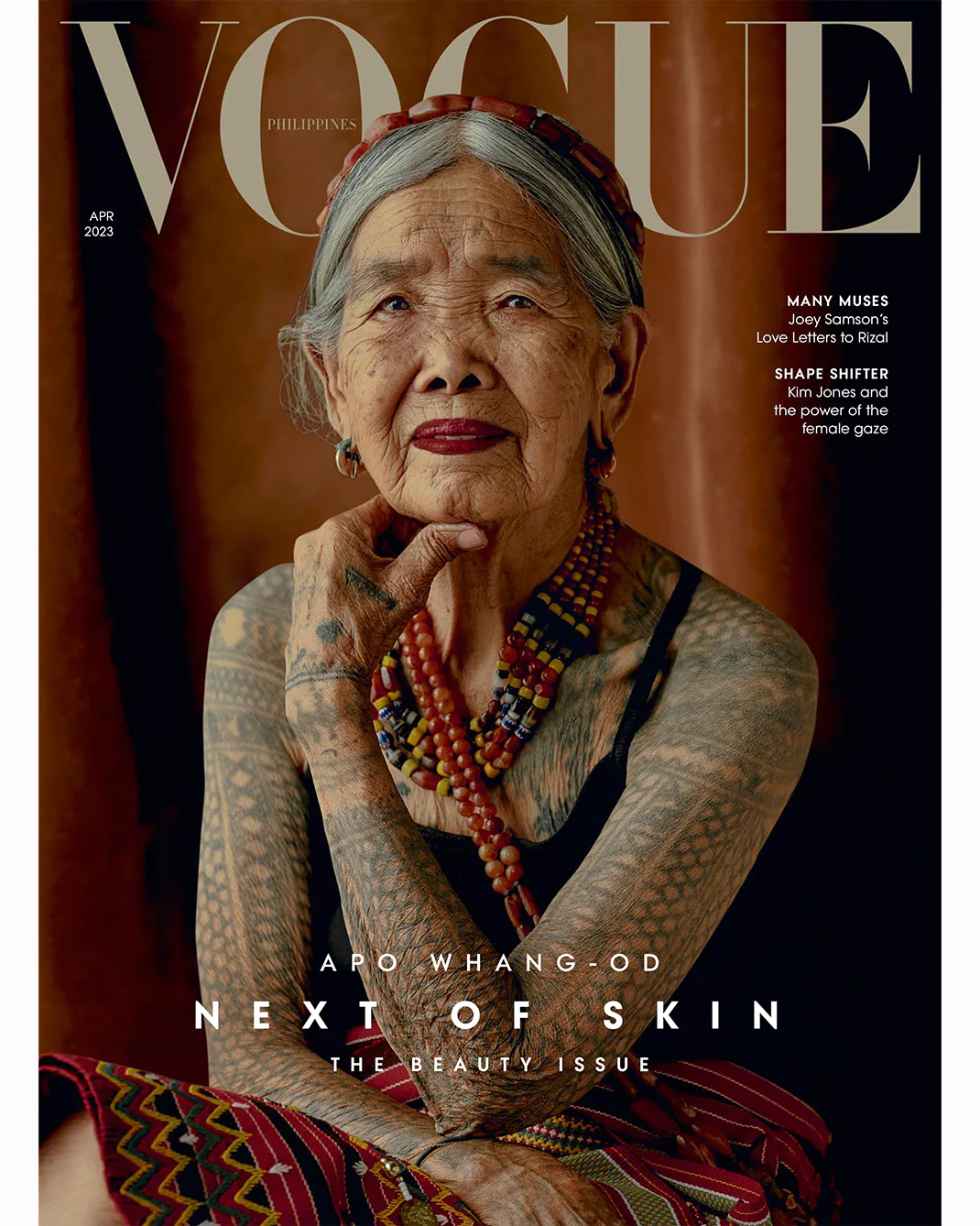
With its April 2023 issue, Vogue Philippines celebrates the beauty of humanity. Lately, fashion doesn’t provide such a momentum of passionate engagement and genuine enthusiasm. Yet finally, we can say: this is a cover story!

Indeed, this cover goes beyond fashion. Not only is it a story of representation, but also it is a powerful challenge to modern beauty standards and the cult of youth.

A centenarian is the cover story of Vogue Philippines


Vogue Philippines’ April issue made history by featuring the oldest person ever on a cover. The woman, Apo Whang-Od–also known as Maria Oggay, is a 106-year-old tattoo artist from the Philippines. Specifically, she comes from the village of Buscalan – from the Kalinga tribe. And she is considered the oldest mambabatok. Batok is the traditional indigenous tattooing whose symbols signify strength, bravery and beauty. (Read her story here)

Vogue Philippines: the beauty of humanity
Credit: Vogue Philippines

“We believe that the concept of beauty needs to evolve, and include diverse and inclusive faces and forms. What we hope to speak about is the beauty of humanity” said Bea Valdes – Vogue Philippines editor-in-chief.

In our modern society, people are subjugated by the myth of youth, so ageing is considered a curse, something to fight as much as possible. In fact, most people invest in plastic surgery or less invasive techniques to keep their “forever young” illusion alive. But the results are quite sad.

However, this issue doesn’t relate to the fashion and beauty industries only. It’s a matter of culture. Because of patriarchy, men are allowed to age while women are not. Though men, too, enjoy plastic surgery a lot, there is a different attititude towards men’s and women’s ageing. With age, men become interesting while women just get old.
Moreover, women struggle to fit into beauty standards because that’s what men expect from them: plastic dolls in tight-fitting clothes. In fact, women accept the idea of how a woman should look based on a male perspective. And they do not even question it! Which means they are easy to manipulate.

The beauty of humanity: more than a cover of a fashion magazine


We wholeheartedly embrace Vogue Philippines’ choice. This is more than just a cover for a fashion magazine; it’s a game-changer. It tells a story of representation, as Whang-Od is one of the last practitioners of Batok tattooing. But it’s also an ode to defying ageism. This woman embodies powerful elegance. She is strong yet soulful, proud yet delicate. She is a piercing beauty!

And that is what we need to challenge modern beauty standards and embrace our life in all its stages.

Vogue Philippines: The Beauty Of Humanity Read More »

The Retail Impasse

Reading Time: 2 minutes

Fashion business: therapeutic obstinacy for an almost-dead patient


The retail impasse and the problems emerging in fashion these days revolve around two main topics: late deliveries and markdown strategies. 

However, both issues are indicators of a fashion system that is basically dead, yet everyone pretends not to see it. Or they refuse to accept it. So every operator in the field is on a kind of therapeutic obstinacy for a patient that is almost gone. And which, by the way, has a huge impact on the planet.

Two main points of the retail impasse


One: many stores have received a small percentage of the Spring-Summer pieces, which makes it complicated to assemble outfits. Why does this happen? Top brands monopolise good manufacturers. So smaller brands get materials late (for the same reason) and consequently are left as the last link of the chain. Therefore, they cannot deliver on time.

Two: markdown strategies and how to get rid of the stock in excess that stores keep purchasing. Even though retailers are perfectly aware that the number of people entering a store isn’t the same as in the pre-pandemic time, they don’t stop overstocking. As a result, selling discounted items becomes more complicated. In fact, these discounts are available online and offline throughout the year, making markdowns less attractive. Furthermore, a discount is no longer the sole reason people purchase a product

In short, this excessive stock policy is harmful to the planet and business. So, we must change it.

Can we find solutions to revive the fashion business?


Solutions must experiment with new ways of operating within the fashion business.

First: a dramatic reduction in consumption. Let’s face reality: if we do not consume less, much less, we can forget to have a future. So, there’s no point in procrastinating the change.

Second: a shift to artisanal garments and made-to-order clothes and accessories, having the chance to reorder during the season. It’s about choosing tailoring over mass-produced garments, quality over quantity.

In conclusion, if we want to overcome the retail impasse, overtreating fashion with more overproduction will take us nowhere. We need a completely different strategy: it’s a matter of reducing the number of pieces while providing a higher value.

Less but better.

The Retail Impasse Read More »