Explorations

Bluewashing: the UN says Global Agreements are saving the seas. Are they?

Reading Time: 6 minutes

When decades-old success stories are used to reassure us about an ocean crisis that’s only getting worse


Bluewashing — the institutional cousin of greenwashing — isn’t confined to corporations. Public bodies can shape narratives by highlighting genuine successes while downplaying the severity of remaining challenges. This kind of storytelling may not involve falsehoods, but it can still leave the public with a misleading impression.

We came across a United Nations article the other day. The headline struck an optimistic tone: “How global agreements are saving the world’s seas.” It opened with a success story from the beaches of Naples, Italy. Once heavily polluted by sewage and industrial waste, they are now clean enough to earn international recognition — including Blue Flag status — for their sustainability.

The article went on to celebrate the 1976 Barcelona Convention, the United Nations Environment Programme’s (UNEP) Regional Seas Programme, and the power of international diplomacy. It painted an optimistic picture. 

But we couldn’t help thinking back to two documentaries.

Seaspiracy (2021) challenged the effectiveness of the institutions supposedly protecting our oceans, arguing that many have become better at projecting reassurance than delivering meaningful change. Four years later, David Attenborough’s Ocean painted a more nuanced picture. While exposing the devastating impacts of industrial fishing, habitat destruction and climate change, it also showed something equally important: marine ecosystems can recover remarkably quickly when meaningful protection is actually enforced.

Reading the UN’s article, we couldn’t shake the feeling that it focused almost exclusively on those past successes while glossing over the scale of today’s crisis. It read less like an objective assessment than an exercise in self-congratulation.

This felt uncomfortably close to institutional greenwashing. Or bluewashing, since it specifically regards the sea.

Bluewashing: an ocean that appears clean and serene, while the crisis remains hidden beneath the surface.

Bluewashing: the misdirection


We’re not denying that the beaches of Naples are cleaner than they were in the 1970s. That’s a genuine public health victory, and credit where it’s due — sewage treatment and industrial waste regulation have come a long way.

But the UN article wraps itself in that decades-old achievement and presents it as evidence that today’s international framework is effectively saving the seas.

That’s where the spin begins.

The article celebrates 145 countries participating in regional seas agreements, legally binding pollution controls and science-backed policymaking. Those are real achievements. Yet what stands out just as much is what receives comparatively little attention.

Overfishing


In the Mediterranean — the article’s own success story — more than 70% of assessed fish stocks remain overfished, among the highest rates in the world. Coastal waters may be cleaner, but marine ecosystems continue to deteriorate under the pressure of industrial fishing.

The Regional Seas Programme can encourage cooperation and scientific monitoring, but it has little authority to enforce fisheries management or prevent destructive fishing practices. Bottom trawling continues, biodiversity declines, and the gap between environmental ambition and political reality remains enormous.

Plastic and microplastics


The article acknowledges that “every day, the equivalent of 2,000 garbage trucks full of plastic are dumped into the world’s oceans, rivers and lakes,” yet treats this staggering figure almost as a passing remark. Then it moves on, returning to its success story.

But plastic pollution is hardly a footnote. The Mediterranean is among the world’s most plastic-polluted seas, while microplastics have now been detected in human blood, lungs, placentas and other organs.

Despite years of negotiations, the world still lacks a binding global treaty capable of significantly reducing plastic production. Action plans exist. Nice words. Production continues to rise.

PFAS and forever chemicals


PFAS — also called “forever chemicals” because they barely degrade in the environment — are not mentioned at all.

These synthetic compounds enter rivers and seas through industrial discharge, agricultural runoff and wastewater. They accumulate throughout marine food chains and increasingly appear in wildlife and humans alike.

While environmental agreements continue to monitor many traditional pollutants, chemical innovation moves faster than international regulation.

The fundraising pitch disguised as journalism


One detail appears repeatedly throughout the article: the Environment Fund.

Again and again, readers are reminded that UNEP’s work depends on flexible financing and donor contributions. The implication is clear: support the fund because international cooperation works.

To some extent, that’s true. The Barcelona Convention demonstrates that coordinated environmental action can produce measurable results.

But the article also risks conflating two very different questions.

Cleaning up sewage pollution around Naples is not the same as saving today’s oceans from industrial overfishing, plastic production, climate change or chemical contamination. Those are global, systemic challenges operating on an entirely different scale.

You can’t solve a 21st-century extinction crisis with a 1970s toolkit.

Using yesterday’s success to reassure readers about today’s crisis feels less like balanced reporting and more like institutional storytelling.

Bluewashing: saving the seas — or saving the narrative?


So, are global agreements saving the seas? Not really.

They have undoubtedly helped reduce pollution, improve scientific cooperation and encourage governments to work together.

But managing some symptoms is not the same as solving the crisis.

Saving the seas would require measures such as:

  • banning destructive bottom trawling;
  • dramatically reducing plastic production;
  • regulating agricultural and industrial runoff carrying PFAS, pesticides and excess nutrients;
  • establishing large, genuinely protected marine reserves;
  • enforcing meaningful consequences for governments and industries that fail to comply.

The UN’s Regional Seas Programme does none of these things. It’s a talking shop — important for science, maybe, but powerless against the corporate and political interests that are systematically emptying our oceans of life.

Many of these ideas have already been discussed within international forums. The problem is that discussion is not implementation.

International agreements often depend on voluntary commitments, political consensus and national enforcement. Against industries worth hundreds of billions of dollars, those mechanisms frequently prove too weak.

The documentaries vs the bluewashing narrative


Seaspiracy was criticised for its sensationalism. But its core thesis holds up: the organisations we trust to protect the oceans are often toothless, conflicted, or complicit. They celebrate small wins to obscure massive failures. They shift the burden onto consumers (stop using straws!) while letting industrial fishing and petrochemical giants off the hook.

Ocean offers a more hopeful perspective. It shows that marine ecosystems can recover with astonishing speed when governments establish and enforce genuine protections. If only it would ever happen…

Taken together, the two documentaries point to the same conclusion.

Recovery is possible.

Political will remains the missing ingredient.

Final thoughts


The UN’s article is not a lie. It is, however, a half-truth — which is often more dangerous.

Yes, international cooperation has delivered genuine environmental successes. The recovery of parts of the Mediterranean proves that coordinated action can work.

But those successes should not be mistaken for evidence that the world’s oceans are on a sustainable path. Overfishing, plastic pollution, microplastics, climate change and forever chemicals continue to intensify. A cleaner beach does not mean a healthier sea. And by conflating the two, the UN is engaging in precisely the kind of bluewashing that erodes public trust and delays real action.

We came across the UN article and immediately thought of both Seaspiracy and Ocean. Not because they reject international cooperation, but because they remind us that celebrating progress should never become an excuse for understating failure.

Hope matters. So does honesty.

And we should never mistake a cleaned-up beach for a saved sea.

Bluewashing: the UN says Global Agreements are saving the seas. Are they? Read More »
French fast fashion law: does it actually address the problem?

Reading Time: 6 minutes

What are the real reasons behind the law: environmental protection or protectionism?


On June 29, the French Parliament passed the fast fashion law. It is a landmark bill designed to curb the rise of ultra-fast fashion, targeting major Asian e-commerce platforms such as Shein, Temu, and AliExpress. The legislation uses two criteria to classify ultra-fast fashion: the volume of clothing placed on the market and the relative cost of repairing garments. Each company’s score determines the penalties it faces.

Tabled two and a half years ago, the law introduces per-item fees that could reach up to €20 by 2030. However, the levy remains capped at 50% of a product’s pre-tax price. It also bans advertising for ultra-fast fashion brands, including promotions by social media influencers. Companies must display messages encouraging more moderate consumption. Part of the revenue will be directed towards textile collection and recycling infrastructure.

At first glance, this appears to be a significant step forward in Europe’s fight against the environmental impact of disposable clothing. The textile industry is responsible for nearly 10% of global greenhouse gas emissions. The rapid growth of platforms offering ultra-cheap garments has only intensified concerns over overproduction and waste.

But before celebrating, we should ask some uncomfortable questions. Especially when viewed alongside the EU-wide Extra-EU parcel tax approved just six months ago.


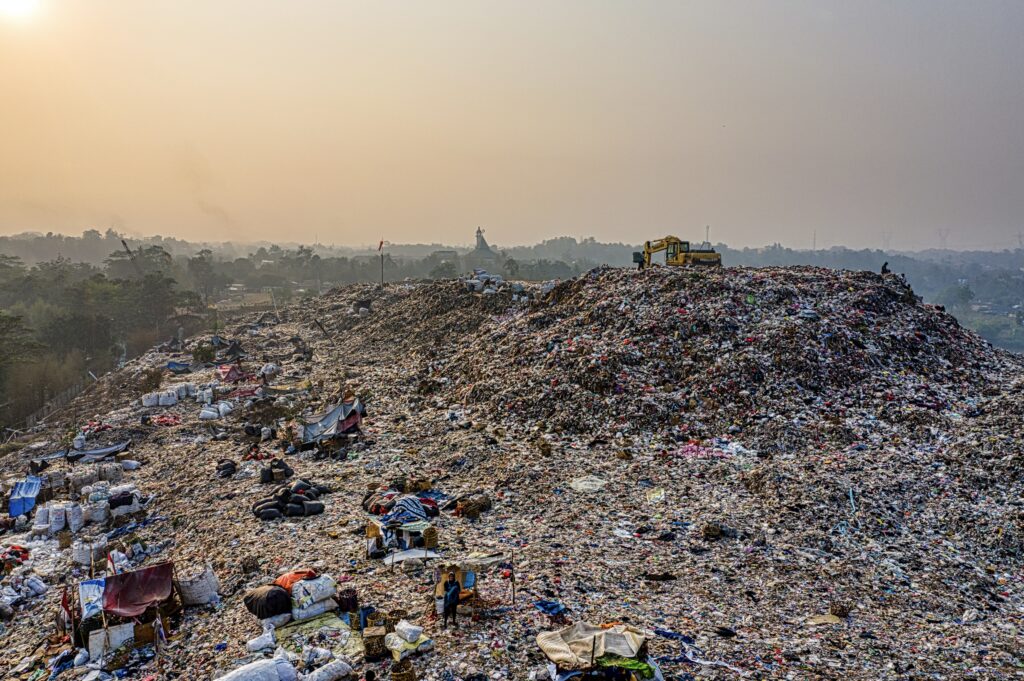
Huge landfill of textile waste questioning whether the French fast fashion law actually addresses the problem

The French fast fashion law: why are European brands exempt?


The most controversial aspect of the legislation is not what it includes, but what it leaves out.

As Green Party lawmaker Charles Fournier pointed out during the parliamentary debate, the original proposal was “considerably scaled back”. European fast fashion companies such as Zara, Kiabi and H&M are largely excluded from measures targeting ultra-fast-fashion platforms.

But is Zara’s business model fundamentally different from Shein’s? Both produce massive volumes of clothing, much of it low-quality and designed for short-term use. Both contribute to the same environmental crisis. Yet under this legislation, French and European fast-fashion giants face no penalties, no advertising bans, and no regulatory pressure.

If the environmental objective is to reduce the impact of disposable fashion, why should similar business models be treated so differently?

This is the same question we raised in December when the EU approved the Extra-EU parcel tax. If fast fashion is destructive and unsustainable, on what basis should its European version be exempt from comparable measures?

This isn’t environmental policy. It’s industrial protectionism dressed in green clothing.

A fragmented European approach


The French law also highlights a broader problem: Europe still lacks a coherent strategy.

In December 2025, the EU introduced a €3 charge on parcels valued below €150 entering the bloc from outside the EU.  Italy followed with its own €2 per-parcel levy, explicitly projecting €245 million in annual revenue. 
At the time, we noted a critical flaw: the tax applies per parcel, not per item. Three items shipped together incur the same €3 charge as a single item – which incentivises consolidation, not reduced consumption.

Now France has introduced a different system altogether: a per-item fee that specifically targets Asian platforms while leaving European competitors untouched.

The result is a patchwork of national and European measures rather than a coordinated policy addressing the environmental impact of fast fashion across the Single Market.

If Europe is serious about tackling overproduction and textile waste, shouldn’t the response be equally consistent?

The uncertainty surrounding the advertising ban


Among the law’s most significant provisions is the ban on advertising by ultra-fast fashion companies, including influencer promotions.

As explained above, the advertising ban only applies to companies classified as ultra-fast fashion under the law’s scoring system.

However, its future remains uncertain. The European Commission has questioned whether this measure is compatible with EU law. France argues that it is relying on principles similar to those used to regulate advertising for products such as alcohol and cigarettes, but if the Commission ultimately disagrees, the ban could become unenforceable.

And if the ban falls, what’s left? A per-item fee that – even at its maximum €20 by 2030 – remains capped at 50% of the product’s pre-tax price. For a €10 item, that means a maximum fee of €5. Hardly prohibitive.

This raises a troubling possibility: was the law designed to look tough while containing a built-in escape clause? 

The French government can claim victory on environmental grounds, but if the key measures are struck down or prove unenforceable, the actual impact will be minimal.

The revenue question remains unanswered


When we analysed the EU parcel tax in December, we asked whether measures presented as environmental policy might also serve another purpose: generating public revenue. 12 million parcels per day at €3 each would generate over €13 billion annually – a staggering sum that would flow into government coffers.

The French law attempts a more virtuous framing – fees will go “towards collection and recycling infrastructure.” But without transparency on how much will actually be collected, whether it will genuinely fund recycling capacity, or if the infrastructure can even handle the volume, scepticism remains warranted.

Will the fees collected from Shein purchases be used to build actual recycling facilities? Or will they disappear into general budgets while the mountains of textile waste continue to grow?

What genuine reform would look like

If Europe were truly serious about addressing fast fashion’s environmental impact, we would see measures that apply equally to all players – regardless of their country of origin. 

Genuine reform might include:

  • Minimum sustainability standards for all clothing sold in the EU
  • True cost pricing that accounts for environmental externalities
  • Product durability requirements and mandatory repair rights
  • An outright ban on destroying unsold inventory
  • Supply chain transparency to address environmental and forced labour concerns


Instead, we’re getting a fragmented, inconsistent approach that protects domestic incumbents while appearing to take action.

Final thoughts


The French fast fashion law is not without merit. It signals that European policymakers increasingly recognise the environmental challenges posed by disposable fashion and represents one of the most ambitious attempts so far to regulate the sector.

But let’s not mistake it for what it isn’t. 

This is political theatre – a gesture that appears tough on Asian platforms while carefully exempting European brands whose business models are not fundamentally different.

The question we posed in December remains unanswered: if fast fashion is destructive — as we all agree it is — why are we protecting our own version of it?

Until European policymakers confront this contradiction honestly – and apply the same environmental standards to Zara, Kiabi, and H&M that they apply to Shein and Temu – the French fast fashion law will remain what it appears to be: tariffs dressed as sustainability, with the environment serving as a convenient pretext for industrial protection rather than a genuine environmental objective.

The environmental challenges created by fast fashion are global. Any lasting solution will ultimately need to be equally consistent.

French fast fashion law: does it actually address the problem? Read More »

Summer heatwave in Europe: an open letter to those who knew

Reading Time: 2 minutes

Climate change: the warning was clear; the will was not


Summer heatwave used to mean lightweight clothes, long evenings, open windows. Summer was our favourite season — until it turned into something unrecognisable. We cling to the memory of what it was, even as we dread what it is becoming. The heat isn’t just weather anymore. It’s evidence. 
Cities are hells of fire, the air is unbreathable.

According to the WHO, the heatwave in Europe caused 1,300 deaths, with Germany hitting a record 41.7 °C.

A scorching heatwave in Europe is not a surprise. It is a confirmation — of every report that was read, every projection that was modelled, and every choice to put money first while the thermometer ran higher. A failure of political will — by leaders who repeatedly chose short-term economic interests over long-term climate action.

To the leaders who signed the Paris Agreement, who stood before cameras and promised to keep 1.5°C alive:

Recently, the Copernicus Climate Change Service released its European State of the Climate 2025 report. You should read it not as a scientific update, but as an indictment.

Europe is the fastest-warming continent on Earth. 2025 saw its second-most severe heatwave, record-high sea surface temperatures, and unprecedented wildfires. The Arctic is warming more than twice as fast as the global average. Greenland is losing ice at rates you were warned about forty years ago.

And where are we on the metrics that matter? Not moving in the right direction.

You celebrate renewables reaching 46.4% of electricity generation. It is genuine progress, but not enough. Markets, technological advances, and public demand have accelerated the transition, often despite hesitant political leadership. At the same time, governments continue to subsidise fossil fuels, approve new extraction projects, and postpone difficult decisions.

The scientists told you. The activists begged you. The youth marched. And you nodded, smiled, and did next to nothing.

The 2025 data is not an anomaly. It is the predictable outcome of your intentional inaction.

Do not ask us to celebrate half-measures. Do not ask us to call stagnation “progress.” The only honest conclusion is this: you knew, you had the power to act, and you chose not to. 
You leave the burden entirely on the people.

This summer, the headlines are telling us about another heatwave, another broken record, other tragedies.
Europe is under the blaze. Widening inequalities. Workers who collapsed. Lives lost. 

And as this summer heatwave burns, the silence of inaction is louder than the fire.

History will not be kind.

Summer heatwave in Europe: an open letter to those who knew Read More »

Feminism today: Michele Mari, Premio Strega finalist, and his insult toward Michela Murgia

Reading Time: 4 minutes

On writers, contemporary culture and the eye that judges — still patriarchy


A recent controversy involving Michele Mari, writer and Premio Strega finalist, made us reflect on a broader question: what does feminism today actually mean? Is it true liberation, or oftentimes patriarchy repackaged by women — or even fully digested — by women theselves?

The debate began after remarks attributed to Mari about Michela Murgia — the acclaimed Italian writer, Campiello Prize winner, unapologetic feminist, queer icon, and fierce critic of patriarchy.

He reportedly said:

“She was intransigent and violent because she was ugly — that was her way of letting out her rage.”
“Through her aggressive behaviour, she made everyone else pay for her ugliness.”
“Every woman who is unhappy and unloved turns spiteful.”

Mari has since disputed parts of the reporting, but the controversy itself reveals something worth examining. How quickly we still use a woman’s appearance to explain her ideas, her anger, or her public presence.

Black-and-white photograph of Michela Murgia's book Stai zitta on a writing desk with glasses, notebooks and a pencil. The image offers a reflection about feminism today.

Of course, it’s a comment you wouldn’t expect from a writer of his calibre. Let alone a candidate for the prestigious Premio Strega. 
If culture and literary prestige cannot dismantle patriarchal thinking, then what can?

Our instinctive reaction is this: if the dominant aesthetic appeals to the male eye almost more than to the female one, we wouldn’t call that feminism.

That may sound provocative, but it touches on a central question in contemporary feminist thought. Feminism is not about conforming to patriarchal standards in order to gain visibility, approval, or power. It is about questioning those standards in the first place.

What does feminism today mean?


One of the defining questions of feminism today is whether women are becoming genuinely freer, or simply learning to navigate old power structures more successfully.

When we still discuss a woman’s value through the lens of attractiveness, desirability, or likability, the underlying hierarchy has not disappeared. It has merely changed its language.

Exposing false emancipation

An idea, or aesthetic, or even a form of empowerment, does not become subversive simply because women embrace it. Especially when, oddly enough, it remains more pleasing to the male gaze. That is not liberation; it is repackaging.

There is only a renegotiation of patriarchy.

Some scholars describe this phenomenon as “pop feminism” or commercial “post-feminism”: a version of empowerment that appears liberating while leaving existing power structures largely intact.

It sells — and its commercial success is often mistaken for social progress. We should also question who pulls the threads of that commercial success and market demands.

The theory of the male gaze

The controversy also recalls the work of feminist film theorist Laura Mulvey.

If the ultimate criterion of approval remains the male gaze, then men remain the subjects of the story while women remain its objects. Even when women believe they are acting freely and autonomously.

The question is not whether women make choices. The question is: who taught us what is desirable, acceptable, and worthy of admiration?

Distinguish feminism from performed femininity

Authentic feminism does not ask women to be pleasing to anyone but themselves.

Nor does it require them to conform to a prescribed ideal of beauty in order to be accepted into positions of influence, authority, or cultural legitimacy.

A woman should not need to be attractive in order to be heard, any more than she should need to be agreeable in order to be respected.

Final thoughts


Perhaps the most important distinction is this: feminism is not about giving women the same tools to compete in men’s games. It is about changing the rules of the game altogether.

That is why controversies such as this one matter. They remind us that, despite decades of progress, we still invoke a woman’s appearance to explain her character, her success, her failures, or even her convictions.

When that happens, we are forced to ask what feminism today really means.

If women are still judged through the lens of attractiveness, desirability, or conformity to a dominant aesthetic, then the rules of the game have not changed nearly as much as we like to believe.

The dominant gaze has simply become harder to recognise.

And if the final judgement still rests there, then it is not liberation.

It is merely a gilded cage.

Feminism today: Michele Mari, Premio Strega finalist, and his insult toward Michela Murgia Read More »

Net Zero is a scam: Kevin Anderson’s case against climate politics

Reading Time: 8 minutes

Why one of the world’s most uncompromising climate scientists says our leaders have chosen to fail, and what we can actually do about it


Net zero is a scam. Kevin Anderson goes straight for the truth about climate change.
There are plenty of climate scientists who soften the message. They talk about “pathways,” “transitions,” and “cautious optimism.” Kevin Anderson is not one of them. 

Professor of Energy and Climate Change, working across the universities of Manchester, Uppsala in Sweden, and Bergen in Norway, he is one of the world’s leading climate scientists.

We refer to him and mention him from time to time. But here’s why we trust him more than almost anyone else: he is brutally direct and honest.

On the Rob Cooper podcast, shared also on Climate Uncensored (source of this post), Anderson laid out the situation in plain language. Here’s what he said.


The 3 numbers you need to understand climate change (straight from Anderson)


1. Temperatures are not small changes.
We signed up to stop warming at 1.5°C or 2°C above pre-industrial levels. Those numbers sound tiny. We need to understand they are massive changes to our climate, they happen on a global scale.

2. Carbon budgets are just fossil fuel budgets.
If we are not to exceed those temperatures, we know how much carbon dioxide we can put into the atmosphere. Those come from fossil fuels. We know exactly how many billion tons of CO₂ we can still emit. That tells us exactly how many fossil fuels we can burn – and therefore, how much time we have left.

3. The time frame is already broken.
For 1.5°C: zero emissions by the early 2030s. That’s five years from now.
For 2°C: zero emissions by 2045–2050. We have more leeway.
This will happen only if we bring emissions down. But we’re not following the pathway to 1.5°C. We never were. Emissions are still rising. 

We’re not going to achieve the 1.5°C target.

“Our leaders have chosen to fail on climate change; this is nothing new. Every single metric on climate change is pointing in the wrong direction.”

What “progress” actually looks like (spoiler: this isn’t it)


Every year, we add more renewables. Every year, we also add more fossil fuels.
The climate does not care about renewables. It cares about the fossil fuel phase-out.

Anderson argues that, to stay within 1.5°C, we need 7–8% emissions cuts every single year, starting yesterday. Even then, he notes, avoiding major tipping points would require an element of luck.

We will move in the right direction when more renewables mean, at the same time, less fossil fuels.  2°C is not safe. We are not in a good place. 

Lots of academics point to China as if it is progress. But it is not. Carbon dioxide builds up every year. So every year we fail to reduce emissions, the following year gets harder. The reductions we see in China are far from sufficient to deliver. Next year, the problem will be more challenging than this year.

“If the problem gets harder every single year, I don’t call that progress. Progress is only when you deliver what you need to. Let’s not put that as it is in line with our progress. It is not at all. Until we eliminate fossil fuels and the emissions from them, until we reduce the emissions from agriculture, temperatures will just keep going up. Reducing emissions doesn’t mean temperatures stay stable or go down; it means temperatures rise less quickly.”

Temperatures vs impacts

“We shouldn’t only talk about temperatures, we should talk about impacts because impacts are what impact people.”

1.5°, 2°, what are those? If the impacts come in five years, we’ll not have time to defend ourselves. If it happens in ten, we’ll have more time. But some of the impacts occur faster than we thought. That’s a real issue.
Infrastructures were created for a specific climate; changing them is highly costly and time-consuming. But we have to do it.

People think we’re in a new normal. But we’re not, because one day will be new and the next one new again. Temperatures will only start to normalise when we stop emitting fossil fuels. Until that point, the climate will just keep changing.

The lie at the heart: net zero is a scam


The scientists are doing a fantastic job. The oil and gas industries know what is happening. Those at the top of these industries deliberately undermined the climate issue.

There is no climate science as such, he points out. It’s only physics and chemistry that explain the world around us. 

Mitigation is about what we do to reduce emissions. There, says Anderson, we have increasingly been overoptimistic, which has started to lie. We have been telling untruths for at least two decades on climate change. And that’s because the analysis that we do doesn’t fit with a particular political framing of the world.

And every year we fail to deliver on climate change, the level of the lies increases. Some say we can’t take away hope or instil fear.

But our job is to say it how it is. There is a global delusion around this. And it goes much deeper than that. If you want to get funding, economic growth, and net-zero 2050, it has to fit a political agenda.

Organisations are discounting the future to models that are greenwashed to keep business as usual.

Net zero is a scam: how to get to the truth


Policymakers put pressure on the chain, on journalists and so on, so the whole system is delusional. People should use common sense. And just do the maths.

Many academics believe in their own delusion, so it is easier to make other people believe in this. We need to start with a sense of integrity. 

On climate change, we desperately need new ways of thinking; people of my age have totally failed. We need new perspectives.

Climate change is colonial (and no, we’re not all in this together)


For Anderson, climate change is not only a scientific issue. It is also a question of historical responsibility and global justice.
This is one of Anderson’s most uncomfortable – and most important – points.

The UK, US and wealthy nations built their prosperity on slavery, stolen minerals and cheap labour. Now they’re doing the same with the carbon budget.

Today, we are still embedded in the legacy of colonial history. We can’t do anything about the past, but we should at least recognise it. And what we shouldn’t do is perpetuate it. There is a responsibility: our prosperity has been built on the backs of others. 

Now, in the UK, people have more per capita carbon budget we can burn compared to other poor countries. There is a disproportionate share. 

“We took their labour as slaves, we stole their minerals, and now we’re stealing their carbon budget.” 

The UK (all wealthy nations) is perpetuating colonialism. We need to question that. Here’s the connection with climate change.

The second part is that we’re not all in this together. There are people locked in their conditions; there’s nothing they can do.

Poor countries cannot afford to cut further. There are people who need to have higher carbon emissions. The richest 1% of emitters globally produce twice the emissions of the bottom half of humanity combined.

“We need to switch from production to the rich to production for the public infrastructure. We need to move the skills to do good things for society. At the moment, we have private luxury for a minority (a big minority), and public squander for everyone else.”

He is also critical of the “cost-of-living crisis” framing. 

“There’s no cost-of-living crisis, it happens for those who benefit from it.”

For high-emitting, high-income households, responding to climate change would mean paying more. So they pretend we’re all in this together. Because they want to put the cost on the average household. 

“It’s easy to point to the billionaires, as soon as they go to Mars the better, but it’s actually us as well. If this discussion is not heard, it’s because we are in the group of disproportionate use.”

What actually gives Kevin Anderson hope?


Not techno-optimism. Not net-zero pledges.

Hope, for him, lives in action – specifically, in honest, humble dialogue.

People talking at a bar. Schoolkids discussing worthwhile things. Communities deciding what a good life looks like, not just an efficient economy. Humility, if something is wrong, admit it and go on.
He mentions Greta Thunberg explicitly: people of his generation have failed, he says. New perspectives are desperately needed.

“Don’t expect experts to solve this. Change comes bottom-up. Talk with integrity. Leave yourself open to views that feel uncomfortable.”

10 words on a billboard? He said no words.


Impactful images. Local meaning. Tailor the issue to the place and identity.

“Most people are good. Play to shared values, not fear.”

We don’t have to fall into the individualistic model, fighting and competing with each other; we need to value our community. Temperature and metrics are very helpful. To get people on board, we have to go from global to local and see what impacts locally.

What you can actually do (from Anderson’s closing advice)


If net zero is a scam, what can we actually do?

  • Don’t look for heroes in high places. Policymakers, most academics, and the media are trapped in the same delusion.
  • Use common sense. And do the maths yourself. The numbers don’t lie.
  • Have honest conversations. Ask: What is a good world? What is a good life? What is a good community?
  • Realise you might be the agent of change. Not a politician. Not a celebrity. You, talking to people around you.

A final thought


Net zero is a scam, Kevin Anderson argues. 
The system is not broken. It is working exactly as designed – for the minority who emit the most.

Change starts when the rest of us stop asking for permission and start talking honestly about what kind of world we actually want.

—

Want to hear it directly? Here is the interview with Kevin Anderson on Climate Uncensored, or on the Rob Cooper podcast.

Net Zero is a scam: Kevin Anderson’s case against climate politics Read More »