Explorations

Skin-kind: garments gentle on your skin

Reading Time: 2 minutes

Comfortable fashion or just the latest marketing buzzword?


“Skin-kind”—clothing designed to be gentle on the skin—seems the latest buzzword taking over fashion. It promises natural fibres, comfort, and skin health. But in reality, this isn’t new. Worse, it risks reducing decades of thoughtful design to a passing trend.

If “clean beauty” has already commodified wellness, as Business of Fashion notes, then “clean fashion” is next—repackaging age-old principles as revolutionary.

But long before this, some brands were already crafting garments with materials specifically chosen for their skin-friendly qualities—clothes that are a pleasure to wear. Decades before. So why does this suddenly sound groundbreaking? Because fashion thrives on reinvention—even when it’s just reheating old ideas. So, it’s not innovation, just hot water, repackaged.

Comfortable fashion: a thoughtful approach to fashion


Since the pandemic, our priorities have sharpened: fewer brands, more independent designers, and a focus on what truly matters—good design, craftsmanship, ethical labour, and a lighter footprint. And yes, that includes attention to fabrics. Not just any fabric, but the kind that feels right: the kind you forget you’re wearing, that makes you feel at ease in your own skin.

In our selection, you can find the finest cotton, jersey so delicate it lingers like a second skin, and timeless basics whose price reflects their worth—not their hype. 

The descriptions say it plainly:


But words can’t replace experience. You have to feel the difference—because no image captures a fabric’s touch against your skin. And no marketing can mask poor quality.

We get it: cheaper prices can be tempting. But quality isn’t just a cost; it’s a value. Thoughtful design means fabrics chosen with care, quality made to last. Clothes crafted from quality materials aren’t an expense—they’re a choice. Achoice for comfort that endures, for design that respects your body.

And that’s the real issue. Brands—especially Japanese—have spent years perfecting textiles with the wearer’s comfort in mind. Now, “skin-kind” threatens to trivialize that work, turning decades of quiet dedication into just another hashtag.

Final thoughts: Skin-kind—clothes designed for the pleasure of wearing


Skin-kind clothing—garments soft on your skin—clean fashion, or comfortable fashion shouldn’t be a trend. It’s part of the care designers put into their work; part of our research; part of what we need and what we want.

Forget the buzzwords. Thoughtful design has always been about more than labels—it’s about intention, integrity, and what truly lasts.

And that’s nothing new.
The choice, as always, is less—but better.

Skin-kind: garments gentle on your skin Read More »

Giancarlo Giammetti: The ultimate word on creative directors

Reading Time: 3 minutes

Valentino’s co-founder declares: “Style must be defended like freedom”


At Rome’s Forme festival – a celebration of fashion academies – Giancarlo Giammetti delivered what may stand as his ultimate word on creative directors. Between recollections of Valentino’s golden era and warnings about today’s industry, one declaration rang out like a battle cry: 

“Style must be defended like freedom.”


The Valentino co-founder served as guest speaker for the third talk of Forme – Perspectives on Fashion, Art, and Creativity, held March 21-22 at Massimiliano Fuksas’ striking Nuvola complex. In conversation with Tg1’s fashion director Barbara Modesti before an audience of students, Giammetti wove personal history into a masterclass on fashion’s shifting values.

Beauty as a form of radical resistance


“True beauty transcends aesthetics,” Giammetti asserted. “For Valentino and me, it now represents peace and serenity.” This philosophy drives their PM23 Foundation at Rome’s 23 Piazza Mignanelli, where fashion and art converge deliberately. “We’re simply honouring what always was: to create beauty through art and fashion.”

The lost art of creative freedom


His advice to emerging designers cut through the noise: “Create what you love. Believe in what you do, in your style, and try to assert it – even if times have changed.” The comparison to his and Valentino’s early struggles was inevitable. “Valentino and I were two twenty-year-olds coming together, facing a thousand difficulties. Today, the times impose business logic, and designers are no longer free to create. The system demands economic values. But the true values are those tied to solitude, freedom, and beauty.”

He recalled Valentino’s epiphany in Barcelona: “Spanish women in red at the opera, crimson flowers everywhere – that became his red. Not a Pantone, but blood and passion made visible.”

Creativity, not algorithms


Giammetti’s voice turned wry discussing fashion’s digital decay: “We dined with Warhol; Valentino dedicated collections to Basquiat. Art has always been fundamental to him.”  

Now? Designers create for Instagram’s hunger, not women’s lives. “We didn’t need to make a fuss on the runway or send messages. Today, with social media, it seems that designers make clothes more for photos on social media than for women.”

He praised the talent in the room but issued a warning: “Defend your style. Creative directors now bend to corporate wills—Valentino’s era of four-person ateliers is gone.”

Heritage vs. hype: Giancarlo Giammetti on creative directors – The ultimate word


Here came his most pointed critique as he pronounced the ultimate word on creative directors:

 “The relationship between a brand’s heritage and business strategy must be respected by creative directors. It’s not about copying the archive, but neither should it be turned into a mockery.”

The unspoken reference to Alessandro Michele’s Valentino tenure hovered like Roman humidity.

Giancarlo Giammetti: Support to young creatives


When prompted for a favourite anecdote, Giammetti shared: “We were visiting Queen Elizabeth, and Valentino said, ‘Your Majesty, may I introduce my assistant?’ I wanted to die.”
The crowd erupted in laughter—and later, a standing ovation—as he confirmed the Garavani Foundation’s mission: “To support young creatives.”

Final thoughts


At Forme – Perspectives on Fashion, Art, and Creativity, Giancarlo Giammetti offered clear, wholehearted guidance. His reflections encapsulated an unrepeatable chapter in fashion history—a true lesson for the younger generation. Yet, it also served as a powerful reminder for those beyond their youth.

His support for emerging creatives was evident. Yet, what resonated most was his ultimate word on creative directors: respect heritage, don’t merely copy the archive, and never turn it into a circus—wisdom much needed in today’s collapsing fashion industry.

In short, Giammetti distilled sixty years of fashion work into pure doctrine:

  • Style is sovereignty – defend it or lose it.
  • Beauty is responsibility – not Instagram currency.
  • Legacy isn’t Lego – don’t dismantle what you should elevate.

In an industry suffocating under frequent changes and instability, his words charted a course.

Giancarlo Giammetti: The ultimate word on creative directors Read More »

Marc Le Bihan FW25/26: Consistency and repetition in a chaotic world

Reading Time: 4 minutes

Why a steady vision defies the ever-changing fashion industry


In a fashion industry grappling with a crisis of identity, Marc Le Bihan FW25/26 collection—spanning both prêt-à-porter and couture—offers a steady foothold. One of exceptional beauty. His unwavering commitment to consistency and repetition stands as a testament to values that are increasingly rare in today’s frenetic landscape. In a world of flux, Marc Le Bihan’s work is a quiet rebellion, a reminder that timelessness can still exist.

The fashion world is no stranger to upheaval. Creative directors hop from one maison to another, prioritising their own ego over the heritage and DNA of the brands they helm. The result? A homogenised sea of sameness, stripped of individuality and meaning. This relentless churn of leadership only amplifies the instability of an already fragile industry. It begs the question: in an era defined by permacrisis, is this cycle of paranoid instability truly what we need? Or does it merely perpetuate chaos?

We believe the answer comes from Marc Le Bihan.

Marc Le Bihan FW25/26 artisanal fashion: Rarities for the rare


When we received Marc Le Bihan’s lookbooks and line sheets, we were struck—once again—by the beauty and distinctiveness of his vision. Each piece, meticulously crafted, tells a story of continuity. The collection features impalpable fabrics such as pongé silk and tulle—staples that elevate the ethereal quality of his designs. The dolcezza fabric, a luxuriously soft cotton blend, adds a tactile dimension, while jacquard and more structured textures provide contrast and depth.

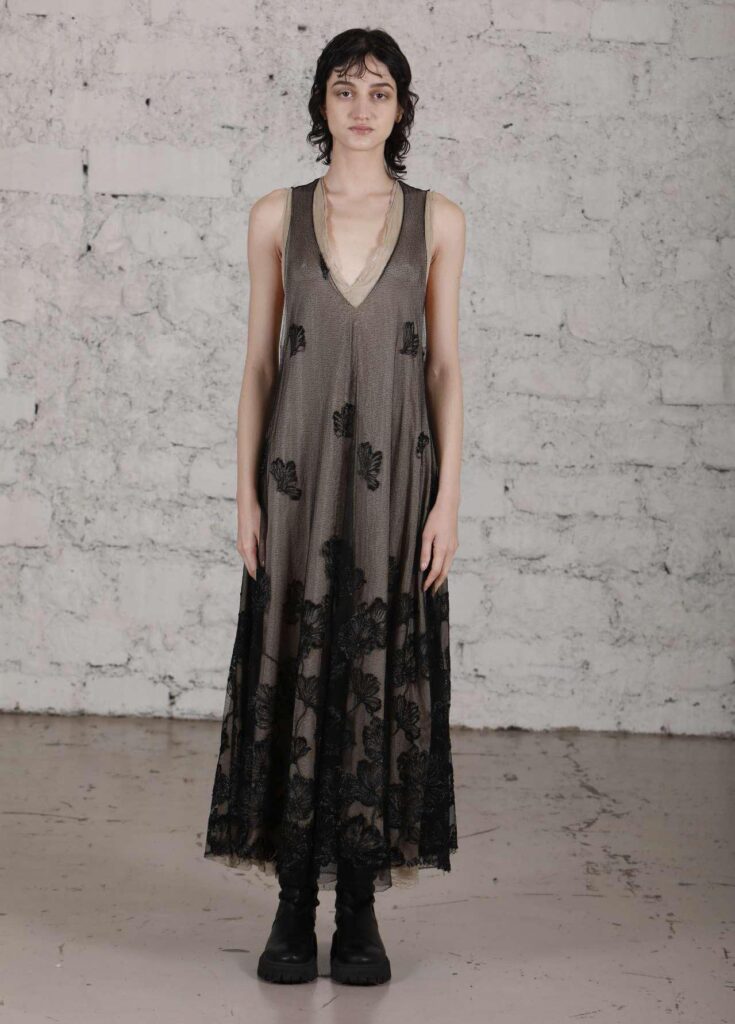
Image of Marc Le Bihan FW25 couture line: profile pose of a short-haired brunette model wearing a black dress with white lace flowers and a black vest covered with silk; hands with natural mani on the hips.
Marc Le Bihan couture


The colour palette is equally considered, moving from pearl and taupe to steel, black, and vibrant shades of red. As the colour card notes, all products are hand-dyed, meaning slight irregularities and subtle tonal variations may occur. This artisanal touch not only underscores the uniqueness of each garment but also reinforces the philosophy of timelessness and individuality that defines Le Bihan’s exacting tailoring.

Season after season, he builds his collections like a wardrobe—one timeless garment at a time. This approach is not just gratifying; it’s revolutionary. In a world obsessed with the next big trend, Marc Le Bihan’s radical design is a pledge: when you invest in his creations, they will never fall out of fashion.

Marc Le Bihan ready-to-wear


We encourage you to revisit our interview with Marc Le Bihan, as his words remain as relevant today as they were when first spoken:

“My idea is to keep a garment for ten years in the wardrobe, then take it out and still want to wear it because it’s timeless. Mine is a work in progress. If a shirt is good, it’s good forever.”

Final thoughts


While many brands chase the ephemeral allure of trends, Marc Le Bihan offers something far more profound: comfort in consistency. His designs are not just garments of exceptional beauty; they are anchors in a turbulent sea. He is a beacon of stability, a rare figure in an industry that has, for the most part, lost its way.

Yet, Le Bihan’s consistency is an exception, not the rule. In a world of excess and instability, his work stands as a rarity—a testament to the enduring power of a steady vision. As Nietzsche once said, “Everything rare for the rare.” To wear Marc Le Bihan is to embody this ethos. It is to declare that you are not common, that you value the enduring over the fleeting.

In a chaotic world, Marc Le Bihan FW25/26 is more than fashion—it’s a philosophy for modern humans. And in an industry crying out for direction, it’s a philosophy worth celebrating.


📲 Claim your piece of Marc Le Bihan’s rare elegance—contact us via WhatsApp or email.

Marc Le Bihan FW25/26: Consistency and repetition in a chaotic world Read More »

Meagratia FW25/26: A Piece of nostalgia at Rakuten Fashion Week

Reading Time: 2 minutes

From Tokyo: Unisex fashion for modern humans


Meagratia has unveiled its FW25/26 collection film, A piece of nostalgia, during Rakuten Fashion Week Tokyo. As one of the standout brands in the Tokyo fashion scene, Meagratia continues to captivate with its unisex designs—timeless, innovative, and crafted for modern humans.

About Meagratia: Fashion from Japan


Founded in 2012 by Takafumi Sekine, Meagratia is a unisex brand built on the concept of “the fusion of history and present sense.” The brand’s designs reflect a worldview where the ephemeral beauty of a flower’s life is layered onto the evolving culture, environment, and human form shaped by time. Romantic, poetic, and subtly punk rock-inspired, Meagratia’s aesthetic is never loud but always delicate. A harmonious blend of past and present.

For the Autumn/Winter 2025 season, Meagratia unveiled its latest collection at Rakuten Fashion Week TOKYO on 17 March 2025. The event, accessible online, invited a global audience to experience the brand’s unique vision—where historical depth meets contemporary design.

A Piece of Nostalgia – Meagratia FW25/26: Watch the show

This season, designer Takafumi Sekine draws from the contacts and intersections that shaped his youth. Those moments when he first discovered fashion and found his inspiration. So, the collection reflects his current perspective, blending punk aesthetics and school-inspired influences that evoke memories of his student days.

Rooted in the vibrant energy of 1990s Harajuku, a place Sekine frequented in search of new experiences and creative inspiration, this collection is less about revisiting the past and more about expressing Sekine’s present identity as the designer behind Meagratia. It’s a bold statement of the “now,” where nostalgia meets modernity.

Meagratia FW25/26 – Final thoughts


In conclusion, Meagratia’s FW25/26 collection, A piece of Nostalgin, unveiled at Rakuten Fashion Week, reaffirms the brand’s unique approach to fashion. It masterfully blends a strong sense of the “now” with the warmth of nostalgia, creating a collection that feels both timely and timeless.

Indeed, we are captivated by its modern sensibility, where punk influences are expressed with delicate subtlety. And its commitment to unisex fashion, speaking to an audience that values design, craftsmanship, and vintage inspiration beyond gender boundaries. This is fashion rooted in a pure love for style.

Stay tuned—Meagratia’s FW25/26 collection will be available at suite123 Milano.

Meagratia FW25/26: A Piece of nostalgia at Rakuten Fashion Week Read More »

Demna at Gucci: How identity crumbles in fashion’s musical chairs game

Reading Time: 2 minutes

Innovation or overload: Is fashion’s new path inspiring or alienating?


The latest shuffle of creative directors—most notably, the appointment of Demna at Gucci—lays bare the fragility of identity in fashion’s relentless game of musical chairs. Just as we begin to acclimatise to one creative vision at the helm of a heritage brand, the winds change once again. But let’s be honest: is this truly innovation, or is it simply overload?

Put another way, is fashion’s frenetic, feverish delirium with designer reshuffles inspiring—or is it alienating its audience?

Recall what we wrote about Milan Fashion Week and, later, Paris Fashion Week. We celebrated the return to brand identity, the renewed focus on timelessness and heritage. We dared to hope for stability. And yet, less than a week later, identity seems to have been tossed out the window.

The Identity Collapse: Demna at Gucci


Just as we were beginning to appreciate a more identitarian Gucci—hoping for a true luxury revival—Kering announced the appointment of Demna Gvasalia as the brand’s new creative director. It’s as if Kering learned nothing from the chaos left in Alessandro Michele’s take—or the polarising fallout of Demna’s own tenure at Balenciaga. Was that really the vision Balenciaga needed? Transforming a maison synonymous with elegance and refinement into a dystopian, post-apocalyptic, East-European flea market aesthetic? To sell what—logoed baseball caps? Now, will the same happen to Gucci? A brand on the verge of death seems to receive its final blow.

The market’s reaction was swift: following the announcement, Kering’s shares plummeted by over 12%. Meanwhile, an Instagram poll by The Business of Fashion revealed that 64% of respondents believe Demna is the wrong choice for Gucci.

Final thoughts


In the end, just as we began to appreciate fashion’s renewed focus on identity, it took mere days for the industry to unravel it all. Identity crumbles under the weight of sensational headlines and the incessant reshuffling of creative directors—a cycle that, in the long run, is exhausting. Demna’s appointment at Gucci is just one example. In the coming days, we’re likely to see more luxury brands playing this same game of musical chairs. Jonathan Anderson, for instance, has just left Loewe—but headed where? For conglomerates, consistency seems to be the least of their concerns. This cycle of constant change has become the new normal in the fashion industry—a chronic disease affecting all luxury brands in pursuit of profit and overgrowth.

This is a game that leads to a devastating collapse of identity. What feels like innovation is, in reality, overload. What should inspire instead alienates. And as the industry spins faster and faster, one can’t help but wonder: who, exactly, is this for?

Demna at Gucci: How identity crumbles in fashion’s musical chairs game Read More »