this is greenwashing

Editorial reflection on what still matters: against the rush of new content

Reading Time: 3 minutes

Looking back, reading forward: why some stories are still worth our attention


Since we’re approaching the end of the year, today’s post is an editorial reflection on what we’ve written so far and why it still feels relevant.

In an era dominated by mass content creation—often fast, repetitive, and empty—we have tried to remain attentive to what happens around us, making sense of events, news, and shifts rather than simply reacting to them. Over time, our work has focused on observation, context, and responsibility, choosing depth over immediacy.

Alongside this, we have consistently worked to clarify what greenwashing is, how to recognise it, and how it differs from genuine sustainability. This effort took a more structured form in our eBook, This Is Greenwashing. In reality, our critical approach to sustainability has always been part of our wider editorial lens, shaping how we read fashion, culture, and systems of production.

Because of this, many of our previous posts remain relevant. They were not written for the moment, but for understanding. Today, we circle back to some of them—pieces that still speak clearly, ask necessary questions, and deserve to be read again.

Editorial reflection: looking back, reading forward


Below is a curated selection of posts that continue to resonate. Each one offers insight into the mechanisms, contradictions, and possibilities of the contemporary fashion landscape.

• We are proud to give voice to designer Consti Gao, co-founder of JAMPROOF. This post is crucial to understanding what it means to build a brand in the contemporary landscape.

Sisyphus’ seventh season — emerging fashion brands in today’s landscape

• This post explores the logic behind labour exploitation and why it signals something deeper—a pattern that connects the fashion industry to any other field.

13 more brands under investigation in Milan for labour exploitation

• A story of slow fashion from Japan, where mud-dyeing becomes a language of time, care, and human connection to the earth.

Clay dye processing: the colour of the earth

• Greenwashing is what, most of the time, hides behind the language of sustainability. This piece helps build the tools to see more clearly.

Greenwashing: The system is designed to fail. It’s time to see clearly

 Is secondhand truly an effective solution, or is it being absorbed by the same logic of overconsumption it was meant to counter?

Secondhand fashion and overconsumption: Is thrifting the new fast fashion?

 Here, we analyse why—despite extremely expensive fashion schools—what the industry increasingly rewards is not skill, but visibility and hype.

Fashion is no longer a job for fashion designers

We invite you to read—or reread—these pieces slowly, without urgency, allowing space for reflection rather than consumption. And perhaps even discover other posts you might have missed.

Final thoughts


This editorial reflection is not about looking back with nostalgia, but about recognising continuity. It’s about understanding what endures and what can guide us forward. Some questions don’t expire, and some texts don’t either. In a digital space driven by constant output, choosing to reread is also a form of responsibility.

Take your time to explore our archive — there’s more to discover — and subscribe to our newsletter to receive reflections, stories, and insights throughout the year.

Editorial reflection on what still matters: against the rush of new content Read More »

Greenwashing: The system is designed to fail. It’s time to see clearly

Reading Time: 3 minutes

Our guide to spotting greenwashing — born from witnessing the system’s hijacking — now available in Italian


How can people tell what is truly sustainable — or confidently say: this is greenwashing?

Let’s take one example we’ve just shared: African organisations are accusing a major UN circularity project of unreliable data and a tainted process.
This isn’t just a failure; it’s a hijacking.

But how can we distinguish between genuine initiatives and those that are not?
The core conflict is no longer just about data — it’s about who gets to define circularity and sustainability.

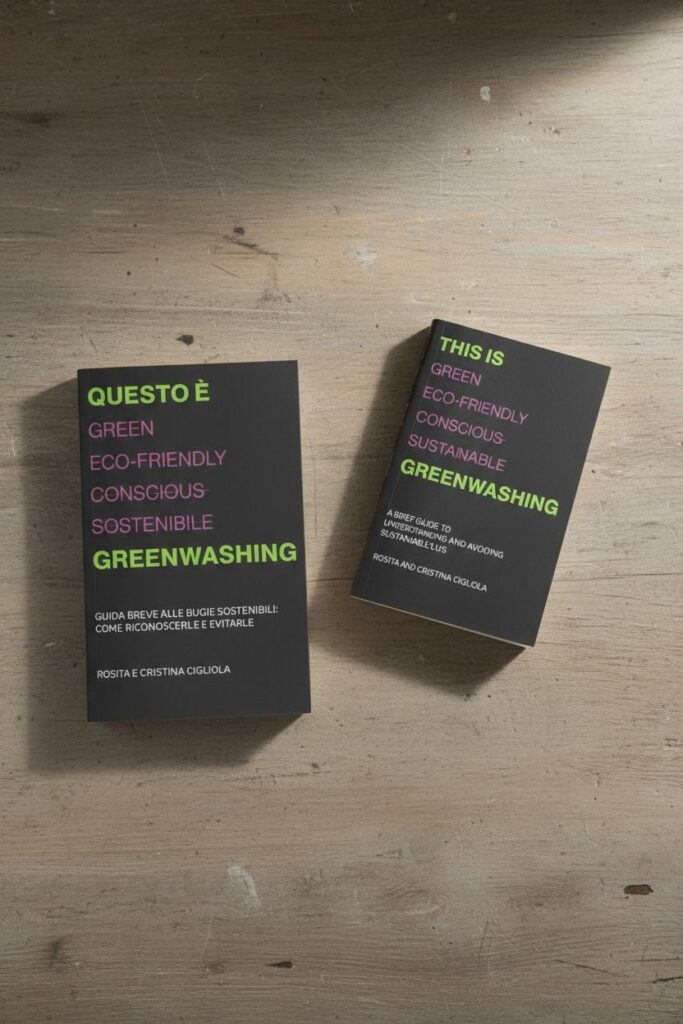
Buy This is Greenwashing and Questo è Greenwashing - photo of both book covers.
Questo è greenwashing – This is Greenwashing

Greenwashing: A system designed to fail


When fast-fashion entities help set the rules for a UN process meant to regulate them, the outcome is predictable: a system designed to fail.
In other words, a system that protects overproduction and waste under the guise of sustainability.

This is greenwashing at the highest level — the green fog at its thickest — designed to confuse us into compliance while the real work of change is undermined.

And this is precisely why we wrote This is Greenwashing.

This eBook goes beyond spotting a fake “eco-friendly” label.
It’s a guide to understanding the systemic lies that corrupts projects like the UNEP’s. It equips you with tools to see through the green fog created by the very systems meant to protect us.

We wrote it because when regulation fails — or is hijacked — awareness becomes our strongest line of defence.

In a world where the credibility of global environmental governance hangs in the balance, we must equip ourselves with the power to see clearly, demand better, and stop being manipulated.

This is Greenwashing – Now available in Italian


🌍 Now available in Italian: Your guide to seeing through the green fog
We are proud to launch This Is Greenwashing in Italian.

This guide will help you:
✔ Decode the jargon and spot lies at a glance
✔ Understand the tactics used not just by brands, but by entire systems to appear “green”
✔ Arm yourself with practical knowledge to make informed choices

In a system designed to fail, knowledge isn’t just power — it’s resistance.

📘 🇮🇹 Get your Italian eBook here: books2read.com/u/mYJ8lP
📘 🇬🇧 Get your English eBook here: https://books2read.com/u/bpgxOX

📣 Please help spread the word by leaving a review — it makes all the difference.

“This is greenwashing’s greatest crime: distracting us with false solutions as the planet burns.”

Spot the lies. Demand better.

P.S. Share this with anyone who questions the ‘sustainable’ façade. It’s time we clear the green fog, together.

 🌿 Now available as an eBook — the print version will follow.

Greenwashing: The system is designed to fail. It’s time to see clearly Read More »

B Corp and ultra-fast fashion: A contradiction of our time?

Reading Time: 2 minutes

What does it really mean when a disposable fashion brand earns a sustainability seal?


What happens when B Corp meets ultra-fast fashion?
When BusinessWire announces“Princess Polly Becomes a Certified B Corporation™”, and BOF frames it as “the US-Australian Shein competitor earning socially responsible recognition,” we’re forced to ask: Is this progress — or just polished greenwashing?

BOF’s headline says it all: “Can an Ultra-Fast Fashion Brand Be ‘Sustainable’?”
Spoiler: it’s a rhetorical question. At least, we hope so.

What is a B Corp?
“A B Corp certification signifies that a company meets certain standards of social and environmental responsibility, but it doesn’t address all aspects of operations and practices.” —This is Greenwashing

B Corp certification and ultra-fast fashion: A Stamp of approval or a smokescreen?


Princess Polly’s Co-CEO, Eirin Bryett, celebrates the certification as proof of their “commitment to purpose-driven practices.”
But let’s be real: can a brand built on overproduction, hyper-consumption, and disposable trends genuinely “embed sustainability into every part of its business”?

After finishing This Is Greenwashing, we almost shelved it, thinking the market was saturated with truth-tellers. Turns out, the greenwashing playbook is still going strong.

The B Corp blind spot: Overproduction


In our book, This is Greenwashing, we called out B Corp’s limitations:

“B Corp certification evaluates various aspects of a company’s operations, including its environmental impact. However, overproduction may not be explicitly addressed, emphasising instead the use of sustainable materials, ethical labour practices, and other criteria.”

Fast fashion’s entire model relies on planned obsolescence — yet B Corp rewards brands for ticking boxes (recycled packaging! carbon offsets!) while sidestepping the root problem: overproduction. And ultra-fast fashion takes it to an even more extreme level.

B Corp and ultra-fast fashion – Final thoughts


We don’t doubt Princess Polly’s intentions. But good intentions don’t change business models.
When a brand profits from overproduction, it isn’t sustainable.
When a brand profits from convincing shoppers to buy more, faster — then slaps on a sustainability badge — it’s not progress. It’s PR.

So, what happens when B Corp meets ultra-fast fashion?
Simple: it’s greenwashing in a purpose-washed package.
Worse yet, the very notion that ultra-fast fashion could be labelled ‘sustainable’ is absurd.

In short, this is greenwashing.


P.S. Tired of being misled?
Read This is Greenwashing — awareness is power.

📘Get your e-book here, from your favourite digital store:  https://books2read.com/u/bpgxOX

Spot the lies. Demand better.

B Corp and ultra-fast fashion: A contradiction of our time? Read More »

This is Greenwashing: Seeing clearly in a world of green fog

Reading Time: 2 minutes

A guide to protecting yourself from false sustainability claims: Spot the lies, demand better


In a world of green fog, we’re surrounded by claims like “eco-friendly,” “carbon neutral,” and “sustainable.”
Sound familiar?

These buzzwords are everywhere, but how many of them are actually true?

Have you ever felt uneasy after buying a product labelled sustainable or eco? You’re not alone.
If you’ve ever felt misled by so-called green marketing, so have we. 
After years of watching brands twist language to appear greener than they are, we decided to write something clear, honest, and useful.

Seeing clearly in a world of green fog: Book cover of This is Greenwashing by Rosita and Cristina Cigliola. The design features bold, minimalist typography with green, pink, and white tones on a black background, highlighting themes of sustainability and deception. 'This is' appears in green; the words 'green', 'eco-friendly', 'conscious', and 'sustainable' are in pink but crossed out; and 'greenwashing' is in green. The subtitle and authors’ names are in white, standing out against the dark base.
This is Greenwashing: our e-book is out now!

Why this book exists


This Is Greenwashing isn’t a textbook.
It’s a guide born from frustration — and from a deep desire to empower.

“The most environmentally sustainable product is the one that never gets made.”

We’re Rosita and Cristina Cigliola, sisters with nearly 30 years in the fashion industry. We’ve seen greenwashing up close — how it misleads consumers and delays real change.

In recent years, especially after the pandemic, we’ve watched companies slap vague eco-labels on products while businesses carried on as usual. Greenwashing keeps consumers confused, compliant, and complicit in a broken system.

This e-book reveals the tactics behind the buzzwords. It helps you recognise what’s real and what’s not. You’ll learn how to decode vague claims, ask the right questions, and stop being manipulated by marketing.
Because when regulation fails, awareness becomes our strongest line of defence.

The bottom line: In a world of green fog, awareness is power


We wrote This Is Greenwashing to:

✔ Expose the tricks brands use to manipulate you
✔ Decode the jargon so you can spot lies at a glance
✔ Give you practical tools to make informed choices—no PhD required

In a world of green fog, knowledge is crucial. Awareness is power.
The more you know, the harder it is for companies to fool you.
And right now—with regulators stepping back and failing to protect us—we need that power more than ever.

📘 Get your e-book here — at your favourite digital store:  https://books2read.com/u/bpgxOX

📣 And if it helps, please leave a review — it truly means a lot.

“This is greenwashing’s greatest crime: distracting us with false solutions as the planet burns.”

Spot the lies. Demand better.

P.S. Share this with someone who’s ever asked: “But is this actually sustainable?”  🌍

🇮🇹 Versione italiana in arrivo — stay tuned!

This is Greenwashing: Seeing clearly in a world of green fog Read More »

As Europe retreats, we push forward: Our e-book This is Greenwashing is out now

Reading Time: 2 minutes

With the EU abandoning its key anti-greenwashing law, the need for awareness is urgent


Just as the EU quietly pulls the plug on the Green Claims Directive, we release This Is Greenwashing.
Coincidence? Perhaps.
But the timing reveals something deeper: a deliberate effort to keep consumers confused, misled, and compliant with business-as-usual.

What the directive was


The Green Claims Directive was designed to combat vague and misleading environmental claims. It aimed to bring transparency, honesty, and accountability to sustainability marketing across the EU. It would have required companies to back up claims like “eco-friendly” or “carbon neutral” with solid, verifiable evidence.
But the EU has withdrawn the proposal.

Italy, backed by other opposing Member States and mounting pressure from right-wing forces, blocked the directive. The final trilogue negotiations were cancelled. A step forward became a step back.
And so, without legal safeguards, we’re left with a regulatory vacuum—one that favours those who profit from ambiguity. Greenwashing wins a round.
But this is where we come in.

Book cover of This is Greenwashing by Rosita and Cristina Cigliola. The design features bold, minimalist typography with green, pink, and white tones on a black background, highlighting themes of sustainability and deception. 'This is' appears in green; the words 'green', 'eco-friendly', 'conscious', and 'sustainable' are in pink but crossed out; and 'greenwashing' is in green. The subtitle and authors’ names are in white, standing out against the dark base.

Why we wrote This Is Greenwashing


In a world flooded with eco-labels and sustainability buzzwords, it’s harder than ever to know what’s real.
In This Is Greenwashing, we—sisters Rosita and Cristina Cigliola, with nearly three decades of fashion industry experience—expose the tactics brands use to manipulate perception. We offer a clear, honest guide to understanding what greenwashing is, how it works, and how to see through it.

This isn’t an academic manual. It’s a practical tool to help you protect yourself from false claims and make truly informed choices. Because when regulation fails, awareness becomes our first line of defence.

📘 Our e-book is available now in digital stores.


If you’re tired of being misled by vague “eco-friendly” claims, This is Greenwashing is your guide to seeing clearly through the green fog.
Let’s not retreat.
Let’s read, question, and resist.

🌍 Get your copy here and leave a reviewhttps://books2read.com/u/bpgxOX

P.S.: 📖 Versione italiana presto disponibile.

As Europe retreats, we push forward: Our e-book This is Greenwashing is out now Read More »