forced labour

Labour, today: what has (not) changed

Reading Time: 4 minutes

An update on labour exploitation, modern-day slavery and human rights


On May 1st, we celebrate labour. But it may be more honest to look at how that work exists.

Because in 2026, labour exploitation has not disappeared. It has become more complex, more fragmented — and easier to ignore.

The system hasn’t changed. It has scaled.

Investigations into global supply chains continue to confirm what is often treated as an exception: exploitation is not on the margins of production. It sits at its centre.

From garments to electronics, companies still achieve cost efficiency, in part, through pressure that travels down the chain — until it reaches those with the least power to resist it.

Labour — What the system depends on


Recent benchmarks by KnowTheChain, a project of the Business & Human Rights Resource Centre, offer a useful lens.

Across industries, performance remains low. In the food and beverage sector, reports from Brazil’s coffee production describe working weeks stretching beyond legal limits, degrading living conditions, and cases of debt bondage. In technology manufacturing, only a handful of companies score above average — and none adequately respond to specific allegations of forced labour.

Even where policies exist, enforcement is inconsistent.
And the model itself — particularly just-in-time production — continues to create conditions where abuse becomes more likely, not less.

The workers the system relies on most


Migrant labour sits at the core of many of these sectors: construction, agriculture, logistics, care.

And yet, it is also where vulnerability concentrates.

Many workers arrive already in debt, having paid high recruitment fees for jobs that do not match what was promised. Once employed, their position is often tied to temporary visas, employer sponsorship, or informal arrangements that make leaving difficult and speaking out risky.

What follows is not always visible, but it is consistent: wage theft, excessive hours, unsafe conditions, restricted movement.

Between 2022 and 2025, authorities and researchers have recorded thousands of cases globally, with agriculture and construction showing the highest concentration. Most involve violations that are not exceptional, but systemic — embedded in how labour is managed, priced, and controlled.

Workers are essential to the system. But remain structurally exposed within it.

Italy: luxury and labour exploitation, side by side


Closer to home, investigations between 2025 and 2026 have made this contradiction harder to ignore.

In subcontracted workshops supplying major luxury brands, authorities uncovered what they described as “heavy exploitation” of migrant workers — often underpaid, sometimes undocumented, producing goods sold at exponentially higher prices.

At the same time, some brand units have been placed under administration due to labour abuses, while others have cut large numbers of suppliers following violations.

These are not isolated incidents.

Prosecutors have pointed instead to a “generalised manufacturing method”— a system where responsibility fragments across layers of subcontracting, and where visibility fades as production moves further away from the brand.

Luxury, in this context, does not sit apart from exploitation.
It can exist alongside it.

The pressure behind the product


Speed drives part of this dynamic. The rise of ultra-fast fashion has intensified cost pressure across supply chains, forcing suppliers into continuous price reductions and unstable production cycles. Those at the top transfer downward what they cannot absorb — through lower wages, longer hours, and compromised conditions.

This is not an unintended outcome. It is the economic logic of scale and acceleration.

Transparency, but on whose terms?


There are signs of movement.

The European Union is advancing toward stricter supply chain traceability, and some brands have begun mapping their networks more systematically. In Italy, a recent agreement introduced a voluntary system for suppliers to disclose labour conditions and obtain certification.

But the key word remains: voluntary.

Transparency is still, in many cases, a choice — not an obligation. And beyond the first tier of suppliers, visibility remains limited.
At the same time, new regulations are emerging globally. Investigations into forced labour are increasing, and legislative frameworks are slowly taking shape.

But the pace of regulation does not yet match the speed of production.

What remains unchanged


This creates a familiar contradiction.
Even as sustainability becomes a dominant narrative, labour conditions often remain secondary:

  • supply chains extend beyond clear accountability
  • companies regularly outsource responsibility
  • “green” transitions risk, excluding the very workers they depend on

In fact, what is presented as progress does not always translate into protection.

What May 1st should remind us


In conclusion, labour exploitation today is not hidden because it is rare. It is hidden because it is structural.

It exists in subcontracting.
In pricing models.
In the distance—geographical and economic—between brands and workers.

And often, in the gap between what is communicated and what is practised.

On a day that celebrates workers, the question is not only how far we have come.

It is also: who remains invisible in the system we continue to participate in?

Labour, today: what has (not) changed Read More »
Luxury is Dead

Reading Time: 3 minutes

Do you still trust the luxe bubble?


There’s a statement we often repeat: luxury is dead. Though some view this claim incredulously, our perspective isn’t mere hyperbole. In fact, the recent Giorgio Armani controversy underscores this assertion. 

What is luxury?


Luxury is about exclusive designs crafted in limited numbers–not mass-produced items. Since all top brands produce their garments in huge quantities, they stopped making luxury long ago. Also, all high-end brands are so overexposed you can see them everywhere, which collides with the idea of luxury itself. Thus, luxury is dead.

Fashion industry, luxury and forced labour


Our exploration of the fashion industry’s connection with forced labour revealed that luxury brands lag significantly behind in efforts to reduce forced labour. (Read our post: “Behind the seams: fashion industry and forced labour”).

It is appalling to even consider the idea of ‘reducing forced labour’, as it implies a tacit acceptance of the exploitation of workers.

The news of Giorgio Armani Operations being put into receivership due to labour exploitation allegations further deepens this narrative. Shockingly, the accusations reveal the indirect subcontracting of production to Chinese companies that exploit workers with deplorable working conditions and starving wages. Workers in Chinese-run workshops paid 2-3 euros/day, judges say. Probe finds migrant workers eating, and sleeping in factories.

This revelation challenges the conventional perception of luxury, especially when juxtaposed with the exorbitant retail prices of their products. But as we said so many times, luxury and fast fashion are two faces of the same coin, just for different budgets. 

Luxury is about skilled craftsmanship and quality materials, excellence made in limited quantities. But mass-produced garments and accessories with marketing manipulation, have created a fake luxury. Therefore, a bubble for people who need to feel safe behind a brand but have no understanding of quality. Both luxury and fast fashion follow the same pattern.

How luxury lost its way


When fashion businesses went from family-owned companies to big luxury conglomerates, the only luxury available was the one in the segment’s definition. Involved in overproduction to maximise profit, the figure of craftsmen tended to disappear. But how do brands grow profit? Exploiting workers and the planet, selecting poor quality materials to make products that get a touch of class thanks to packaging and opulent locations. So, by selling a dream–illusionary luxe–they generate high margins. 

In short, the transformation of fashion maisons from family-owned businesses to profit-oriented conglomerates has eroded the essence of luxury, reducing it to a mere label devoid of substance. 

Overproduction, exploitation, and unskilled craftsmanship taint today’s luxury fashion. The disappearance of the artisan in favour of cost-cutting measures and mass production has altered the fashion industry’s foundations. What was once synonymous with exclusivity and elegance has been diluted into a hollow semblance of its former self.

Redefining luxury


As designers, retailers and consumers, we must redefine our notion of luxury. Is it about status symbols and price tags? Or should it embody integrity, authenticity, and ethical practices? Let’s challenge the status quo and demand accountability from brands. True luxury isn’t about the price tag or the logo. It’s a commitment to craftsmanship, adequately paid, skilled hands, high-quality materials and exclusivity. 

No luxury can exist at the cost of human dignity. Let’s vote with our wallets and support brands that uphold these values. Together, we can reshape the narrative of luxury for a more ethical future.

While the fashion industry grapples with its own contradictions in a state of therapeutic obstinacy, we assert that traditional luxury is dead. Ultimately, it becomes clear that principles rather than mere price points and status symbols define true luxury #formodernhumans.

Luxury is Dead Read More »

Behind the Seams: Fashion Industry & Forced Labour

Reading Time: 3 minutes

Understanding the joint roles of brands and consumers


Let’s delve “behind the seams” to unveil the link between the fashion industry and forced labour. The connection is robust, a topic often discussed yet incredibly overlooked by consumers despite the information.

In a recent post, we exposed the symbiotic relationship between luxury brands and fast fashion, both operating within the capitalistic framework. Today, we peel back another layer, examining recent cases.

Behind the seams of luxury brands


First, we happened to read a BOF post: “Luxury brands lag on efforts to reduce forced labour.” Reduce? But isn’t it appalling that brands discuss reducing forced labour instead of eliminating forced labour? By the way, the graphic in the attachment gathered luxury brands and fast fashion brands. All the most popular ones! (see it here).
Second, these days, the news reported the case of Alviero Martini. The company is under investigation for starving wages.

These two elements confirm our thesis: luxury brands and fast fashion share the same pattern, just for different pockets. But, above all, they highlight how deeply this issue is rooted in the fashion system, revealing it as a consolidated practice to maximise profit.

Also, it is interesting to notice that luxury brands often blame fast fashion while hiding their practices that are no different! Luxury brands exploit people’s work precisely as fast fashion does. Whatever the “made in” label says.

According to “Knowthechain” – a non-profit organisation:
“Today, an estimated 24.9 million people around the world are victims of forced labour, generating $150 billion in illegal profits in the private economy.”

Forced labour & modern-day slavery


Forced labour refers to individuals compelled to work against their will, under threat of punishment or coercion. In other words, individuals suffer exploitation as they are deprived of their freedom, coerced into labour without fair remuneration, and subjected to conditions over which they have no control. Forced labour can take various forms, including human trafficking, debt bondage, and other forms of modern slavery, and it is a violation of fundamental human rights as well as international labour standards.

Although condemned and prohibited by national and international laws, the practice is widespread. What’s worse? People, through their purchases, endorse this despicable system.

The fashion industry has no moral fabric, just as individuals who ignore the issue despite the available information.

Are you willing to shut your eyes when buying a logoed bag?
Did you know there’s an alternative? Small, independent brands offer luxury handbags with the finest materials, quality and skilled craftsmanship, all at just 1/3 the price of a branded bag. But while the logoed ones may be easy to sell, only a niche audience can appreciate true quality.

Your decisions as a consumer can shape an industry that values humanity over profit. Don’t compromise ethics over status.

What happens “behind the seams,” the dark connection between the fashion industry and forced labour, is extensively covered in the media. Read, share, and take action. But do not close your eyes. Ignorance is not an option; it’s time to confront the truth.

Behind the Seams: Fashion Industry & Forced Labour Read More »

Child Labour: Modern-Day Slavery

Reading Time: 2 minutes

The obscenity of a society that closes its eyes in the face of the major issues


Child labour is one of the most obscene issues in our society, one of those problems people don’t want to see. Even though prohibited by legislation worldwide, the number of children exploited is growing. According to Unicef, 2021 registered the first increase in two decades, with cases rising to 160 million worldwide because of covid-19.

There is a consistent number of countries where child labour is not forbidden. Poverty and discrimination are the main causes, but conflicts and the pandemic gave a big hand in spreading the situations that degenerate into this modern-day slavery.

Child labour: modern-day slavery for the western world


Exploited children produce goods that fill the stores of the western world. Or call it that side of the world where either people ignore or pretend to ignore these issues. Whether it’s having the latest mobile device or a fancy car, it’s considered better than facing the truth about the small hands that extract the materials used to make our toys.

And so, we dedicate each day to specific matters giving them the priority for that day. Specifically, the world day against child labour was on 12 June. On an annual basis, we see impactful graphics and beautiful words that end up in nothing. They just become content for social media, but nothing ever changes.

These kinds of stories are as old as the earth. So, if we aren’t able to eradicate them, but we still abuse children’s rights, we have serious problems.

There can be no true sustainability without ethical labor. And if sustainable products are a priority, addressing child labor must come first. How can we talk about sustainability when the number of children involved in production chains has increased over time?

There is an organization committed to creating lasting change, called Still I Rise. Their projects are not endless; they focus on solving specific problems in a given area before moving on to the next. Education is at the heart of their mission, and they open schools to empower those in need.
Please, check them out here and donate if you can!

Child Labour: Modern-Day Slavery Read More »

Modern Slavery: The Hypocrites

Reading Time: 2 minutes

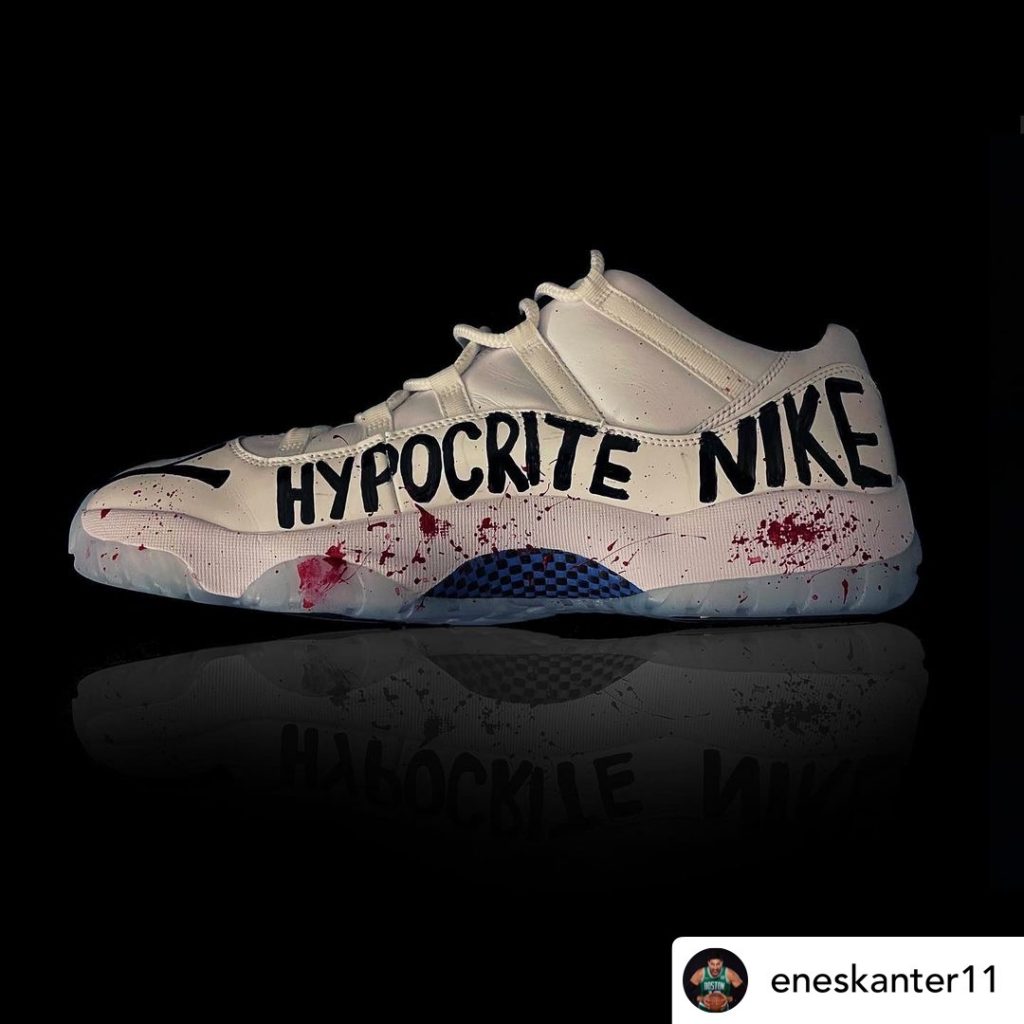
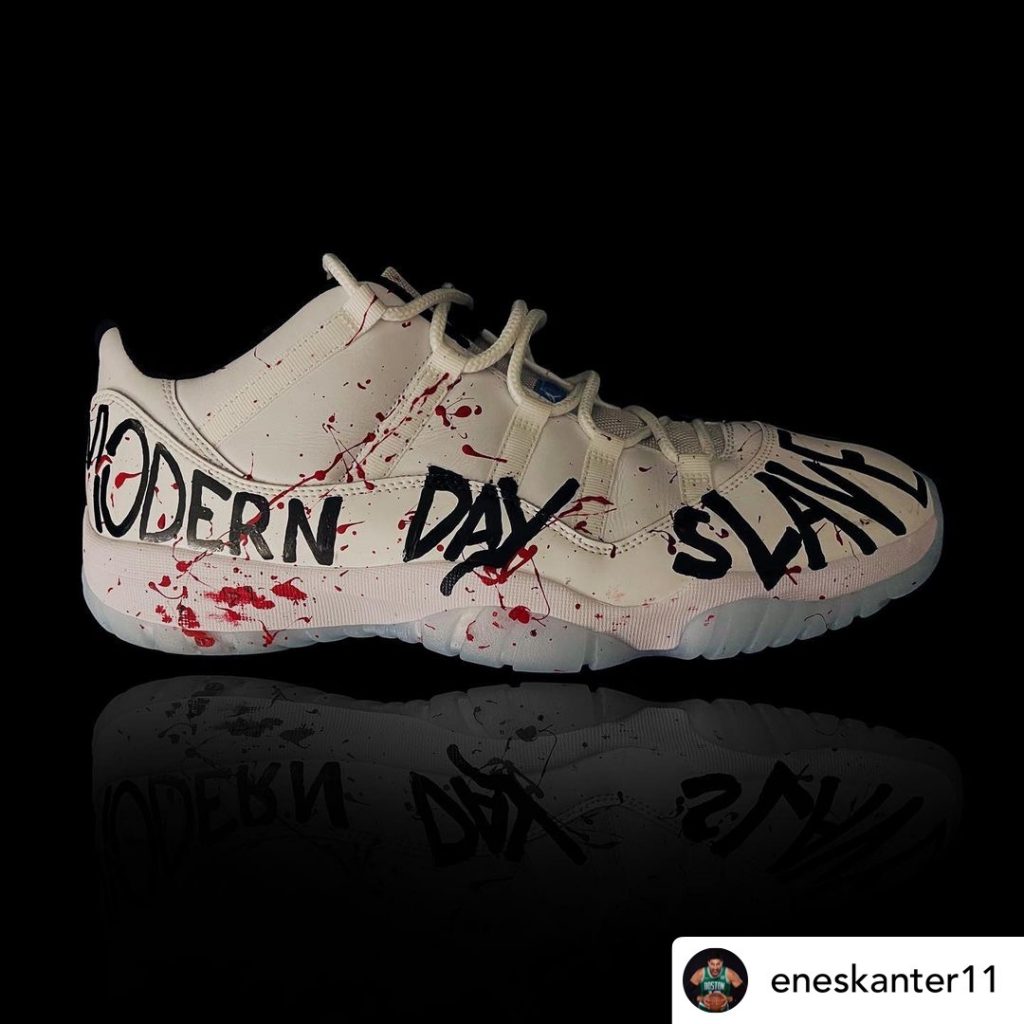
Enes Kanter exposes Nike’s hypocrisy on forced labour and Uyghur Minority


Modern slavery is a topic we frequently discuss because it is horrific and unacceptable. What concerns us even more is the hypocrisy surrounding it.

Brands are the new gods. Sell people a famous name, and in return, you’ll get silence and blindness.

However, as members of an evolved society, we cannot turn our heads to the other side pretending nothing happens.

The system of exploitation, built on forced labor and minority oppression, is directly linked to superbrands. Not only fashion brands, to make it clear. Indeed, every field finds benefit and – profit – in this rotten practice. In fact, there’s no better way to maximise profit.

Though we are just a drop in the ocean, we believe it’s crucial to voice our thoughts and help raise awareness about this issue.
While popular magazines have highlighted it, many people simply don’t engage with written content. People don’t like reading. Or they don’t care enough about things that do not affect them personally. Which, by the way, is a scary attitude.

So, how can we make the message resonate with a large audience?

modern slavery - via Enes Kanter
Modern Slavery – via Enes Kanter


Here comes Enes Kanter, an NBA player. We admit we know nothing about the sport he plays. Zero. But that’s not the point. In fact, we admire him for his bravery in showing up consistently in support of human rights. For many that tend to hide, there are a few who talk out loud.

And so, it was with immense pleasure that we saw his recent posts about the Uyghur minority, forced labour camps and brands hypocrisy, asking Nike’s accountability.

We need more brave humans like Enes Kanter to speak the truth to reach the masses. Just like we need more people that open their eyes and feel touched. Fundamentally, we must find a way to put an end to labour exploitation.

Hypocrite Nike - via Enes Kanter
via Enes Kanter


In conclusion, if as humans, all we have done is invent new forms of slavery to satisfy our fake needs, then we have failed.

Modern Slavery: The Hypocrites Read More »