diversity

Black Carpet Awards: Side events or true inclusion?

Reading Time: 2 minutes

Does celebrating diversity in collateral events really promote inclusion?


The third edition of the Black Carpet Awards recently lit up the Teatro Manzoni during Milano Fashion Week. The event is promoted by the Afro Fashion Association. It celebrates Leaders of Change—individuals of all origins and backgrounds who have distinguished themselves by promoting diversity, inclusion, and equity within the creative industry. 

While such initiatives are undoubtedly meaningful, they also ignite a critical question: should diversity be honored in separate, side events, or should all origins, voices, and experiences be seamlessly integrated into the main stage?

Black Carpet Awards: The dual edge of the side event


Creating a side event like the Black Carpet Awards has both strengths and limitations:

Strengths:

• It shines a spotlight specifically on Diversity, Inclusion, and Equity (DIE). And it ensures that those values and the people embodying them aren’t overlooked.
• It builds vital visibility and fosters a powerful sense of community, making representation the central theme rather than a footnote.

Limits:

• By existing “outside” the official calendar, it can unintentionally reinforce the idea that diversity is a niche topic, not an integral part of the industry’s fabric.
• It risks creating a separation: the official stage for the mainstream, the side stage for diversity.

However, in one of our previous posts, we explored whether fashion is a matter of representation or moneyDisability, of course, adds another layer to the question.

Final thoughts: Diversity fully integrated


So, where does this leave us? Side events like the Black Carpet Awards are vital because they provide visibility, role models, and communities that might otherwise remain unseen. Yet keeping these celebrations separate risks reinforcing the idea that diversity is an exception rather than the norm.

True inclusion means weaving diverse voices into the industry’s very core. Camera Moda should fully integrate diversity into the main and official events, making it a core value rather than an add-on.

Progress will not be achieved by parallel stages, but when the main stage itself reflects the richness of all identities. Diversity should no longer need its own platform; it should be the platform.


🖤 What are your thoughts? We want to hear from you:

💬 Comment below (registration is quick and easy)
📧 Send us an email
📲 Message us on WhatsApp

Your perspective is a vital part of this discussion.

Black Carpet Awards: Side events or true inclusion? Read More »
Vogue Philippines: The Beauty Of Humanity

Reading Time: 3 minutes

A brave cover story of representation fighting the myth of youth


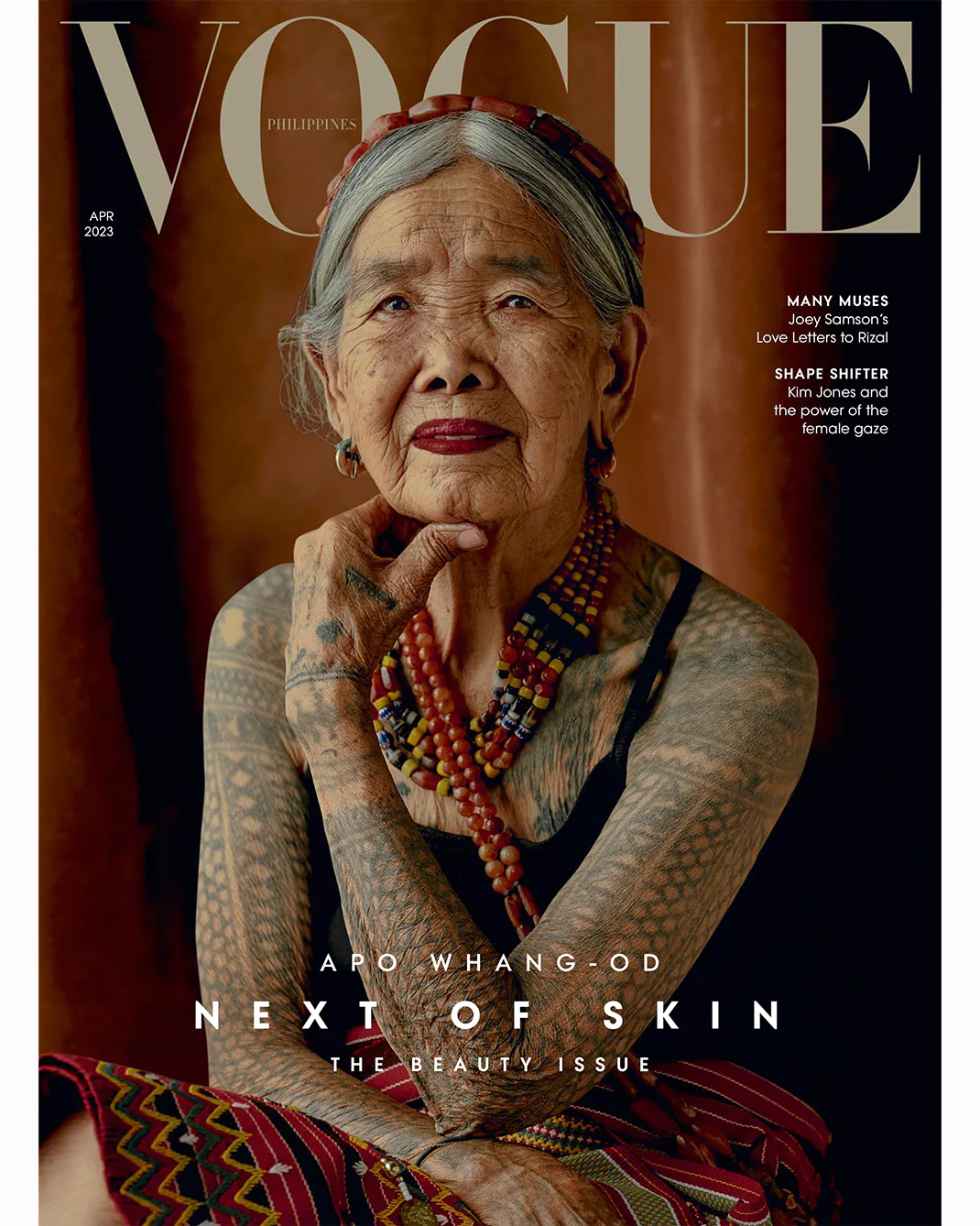
With its April 2023 issue, Vogue Philippines celebrates the beauty of humanity. Lately, fashion doesn’t provide such a momentum of passionate engagement and genuine enthusiasm. Yet finally, we can say: this is a cover story!

Indeed, this cover goes beyond fashion. Not only is it a story of representation, but also it is a powerful challenge to modern beauty standards and the cult of youth.

A centenarian is the cover story of Vogue Philippines


Vogue Philippines’ April issue made history by featuring the oldest person ever on a cover. The woman, Apo Whang-Od–also known as Maria Oggay, is a 106-year-old tattoo artist from the Philippines. Specifically, she comes from the village of Buscalan – from the Kalinga tribe. And she is considered the oldest mambabatok. Batok is the traditional indigenous tattooing whose symbols signify strength, bravery and beauty. (Read her story here)

Vogue Philippines: the beauty of humanity
Credit: Vogue Philippines

“We believe that the concept of beauty needs to evolve, and include diverse and inclusive faces and forms. What we hope to speak about is the beauty of humanity” said Bea Valdes – Vogue Philippines editor-in-chief.

In our modern society, people are subjugated by the myth of youth, so ageing is considered a curse, something to fight as much as possible. In fact, most people invest in plastic surgery or less invasive techniques to keep their “forever young” illusion alive. But the results are quite sad.

However, this issue doesn’t relate to the fashion and beauty industries only. It’s a matter of culture. Because of patriarchy, men are allowed to age while women are not. Though men, too, enjoy plastic surgery a lot, there is a different attititude towards men’s and women’s ageing. With age, men become interesting while women just get old.
Moreover, women struggle to fit into beauty standards because that’s what men expect from them: plastic dolls in tight-fitting clothes. In fact, women accept the idea of how a woman should look based on a male perspective. And they do not even question it! Which means they are easy to manipulate.

The beauty of humanity: more than a cover of a fashion magazine


We wholeheartedly embrace Vogue Philippines’ choice. This is more than just a cover for a fashion magazine; it’s a game-changer. It tells a story of representation, as Whang-Od is one of the last practitioners of Batok tattooing. But it’s also an ode to defying ageism. This woman embodies powerful elegance. She is strong yet soulful, proud yet delicate. She is a piercing beauty!

And that is what we need to challenge modern beauty standards and embrace our life in all its stages.

Vogue Philippines: The Beauty Of Humanity Read More »

Fashion and Politics

Reading Time: 2 minutes

How fashion outlines a political view


Fashion and politics are connected, and in fact, some people in the field release some straightforward statements.

The Italian elections, held yesterday, caused concern about the risk of undermining what our parents and grandparents have tried to achieve so far. Something that still was a work in progress but now looks more like a “work in regress.” A political and cultural setback considering it is the first far-right government since Mussolini. Yes, it sounds scary.

Politicians shouting out loud worked to exacerbate a climate of hate. And since people don’t learn from history, repeating mistakes looks like the outcome. So, in this panorama, we found it interesting reading the thought of Pierpaolo Piccioli. One of the most prominent figures in the fashion industry took a clear stance on politics and Italian elections.

Can fashion be political?


Let’s start with a premise. When fashion underscores words such as inclusion, diversity or genderless, it envisions a specific worldview. And that vision of the world has a lot to do with politics, indeed.

So, in a time when some acquired rights are at risk, and that worldview based on ideas that bring people together, accepting all the differences may be swept away. And individual freedom and choices can vanish, it’s good to see people in the fashion industry who aren’t afraid to speak up.

Fashion politics


Pierpaolo Piccioli (Valentino’s designer), from his Instagram account, released a very on-point and heartfelt statement. He spoke in support of freedom, women’s choices on independent decisions about themselves and their bodies, and gender that doesn’t have to be only male or female. Indeed, he released a political statement calling himself “a man of the left.”

Perhaps using words lightly when the world is falling apart isn’t enough. We must speak up to support the world we want to see and take a stand for it.

Whatever happens, we share what Piccioli wrote. We promote a world that values different cultures. And inclusion, diversity, human rights, women’s rights, and LGBTQ rights. Indeed we must respect everyone’s rights. It’s the worldview for modern humans.

But, in the end, we wake up today with a lesson to learn: never take our rights for granted!

Fashion and Politics Read More »

Wheelchair? Please, Don’t Come!

Reading Time: 4 minutes

Camera Nazionale della Moda Italiana: fashion, disability and non-inclusion in the industry


Inclusion and diversity are topics to which we are particularly sensitive. However, we had to overcome a certain discomfort to share this story with you. But if we want to make a change, we have to open up on this matter.

We acknowledged that Camera Nazionale Della Moda Italiana holds an event, at its second edition, named: “Including Diversity”.

Specifically, on Sept 20th – today – Camera Moda will address diversity and inclusion to promote both matters within the Italian fashion system. If you happen to read about it, you might think the intent is noble and the words powerful. Everything seems on point.

Yes, agreed. If only words truly aligned with actions.

As we wrote in one of our recent posts, inclusion and diversity are much-discussed topics in the fashion field. We call them “the fashion bullshit” – because the smell of marketing is so strong. 

Inclusion and diversity: facts vs words 


After being diagnosed with a degenerative disease, I can report a much different reality about fashion and inclusion based on my personal experience. Indeed, as a wheelchair user, I can attest that not only showrooms lack accessibility but fashion events too. So, this means you have to rely on the empathy of the staff working there – and that empathy can’t always be taken for granted!

In September 2019 – Covid hit the previous season – I was consulting for a brand participating in one of the exhibitions connected to Camera Moda. The designer had received an invitation to an event dedicated to fashion buyers and emerging designers, and so, the designer extended the invitation to me. I couldn’t attend alone; I needed assistance with my wheelchair. Therefore, the designer informed the Camera Moda press office about the need for a plus-one, which, frankly, shouldn’t require much explanation. Should it?

Their response was that because of the pandemic, they had limited access, so I wasn’t allowed to bring another person with me. Naturally, this meant I couldn’t participate in the event.

My friends were shocked by the idea that I put myself in the position of asking permission. In the case of walking disability, plus-one is a fact, period. But I was afraid any reaction would cause problems for the brand I worked for.

Disappointed by that reply, I posted something on my Instagram. I was fuming, frustrated. Unable to respond as they deserved in that precise moment. Shortly after, a beautiful human DM’d me, asking if she had understood my message correctly.

Laura Mohapi, a talented artist based in London, offered her support. Also, she believed I had to address what happened and offered to write a letter to Camera Moda on my behalf. The thought of having to explain myself made me feel awful, even though I knew it was the right thing to do, so her offer was a much-needed gesture of kindness.

I read the letter she wrote, and it was like receiving a punch in my stomach. I pondered a lot. But eventually, I decided to forward it by email.

No response came to my inbox. Probably it went ignored. And so I sent a registered letter as well.

Disability in fashion: Wheelchair? Please, don’t come!


This time, the message got a little attention – though not much. Indeed, I received in my inbox a forwarded email – in English. They didn’t even bother to make an effort to copy and paste the English version they received into a new email. They paid zero attention to the form, which gave the impression that what happened had no relevance for them. Or perhaps, they weren’t familiar with how to handle official correspondence coming from the president of Camera Moda.

In the end, it took me nearly two years to find the courage to write about it. But the sadness, frustration, and disappointment I feel when I see those ‘Include Diversity’ events still make me sick to my stomach.

And so, Cri and I wonder: when they launch those events for the fashion industry, what do they truly mean?

Wheelchair? Please, Don’t Come! Read More »

The Fashion Bullshit

Reading Time: 2 minutes

Exposing notorious fashion marketing empty claims


The fashion industry loves to discuss important matters that we would better describe as fashion bullshit.

How does the system work?
As soon as a new concept becomes popular in the fashion world, the proclamation is made. So the word spreads rapidly. As a result, marketing takes over the subject right away. And, once marketing steps in, you can feel the smell of it. What follows is an unmistakable sense of artificiality that permeates the entire communication strategy.

As voices outside the chorus, we’ve put together a list of some of the fashion bullshit: terms that, the more people in the field put at the centre of the discussion, the more they sound weird.

The fashion bullshit list

New:
usually said about things done and redone. Again and again. Eye roll when you hear this word.

Change:
a kind of mystical belief we like to talk about, but never happens.

Luxury:
or the fake representation of it. What remains after the voluntary shift towards overproduction and mass distribution.

Affordable luxury:
a total absurdity launched to compensate for the collapse of real luxury.

Sustainability:
the biggest bullshit of our times. Most designers who wave this flag lack a distinctive design imprint, and as a result, have no real reason to exist.

Diversity:
possible or allowed only in fashion shows or advertising.

Inclusion:
possible or allowed only in fashion shows or advertising.

Disability:
possible or allowed only in fashion advertising. But please, don’t show up during fashion event!

Fluidity:
gender-fluidity is popular in fashion shootings. But when you go shopping, items are divided by categories. And so, the shop assistant kindly invites you to shop in the section assigned to your gender.

Collaboration:
possible only as co-branding (sharing a profit). However, genuine exchanges are very rare among fashion professionals.

Humbleness:
unreported, or simly missing.

Does anyone have anything to add to this list? We’d love to hear from you.

The Fashion Bullshit Read More »