fashion

One piece, one story: The Curve Hem Tee by Ujoh

Reading Time: 4 minutes

Soft structure meets silent poise — a shape for personal style, for life, for modern humans


This is The Curve Hem Tee by Ujoh.
In a system that produces tonnes of disposable clothing, we curate: one piece, one story. A radical view for ethical and aesthetic resistance — meaningful garments, an expression of good design. Slow fashion—made to last, made by hand.

The Curve Hem Tee arrives without noise. It settles. The unexpected foundation of a modern uniform — a clean silhouette that offers both ease and quiet precision. In its mocrody fabric, it promises breathability; in its curved hem, it grants a sense of motion. A silent, grounding gesture of elevated simplicity.

It honours the discipline of essential form: structure that follows the body, yet leaves room for air. The difference in length between front and back becomes a study in balance. The crew neck — not tight, but exact. The half-sleeve — not short, but considered. A beauty that champions softness without sagging.

Mulberry. Not a primary, but a presence. The same deep richness as fruit in late summer light — a colour that holds warmth and mystery in equal measure. A hue with nothing to prove and everything to offer.
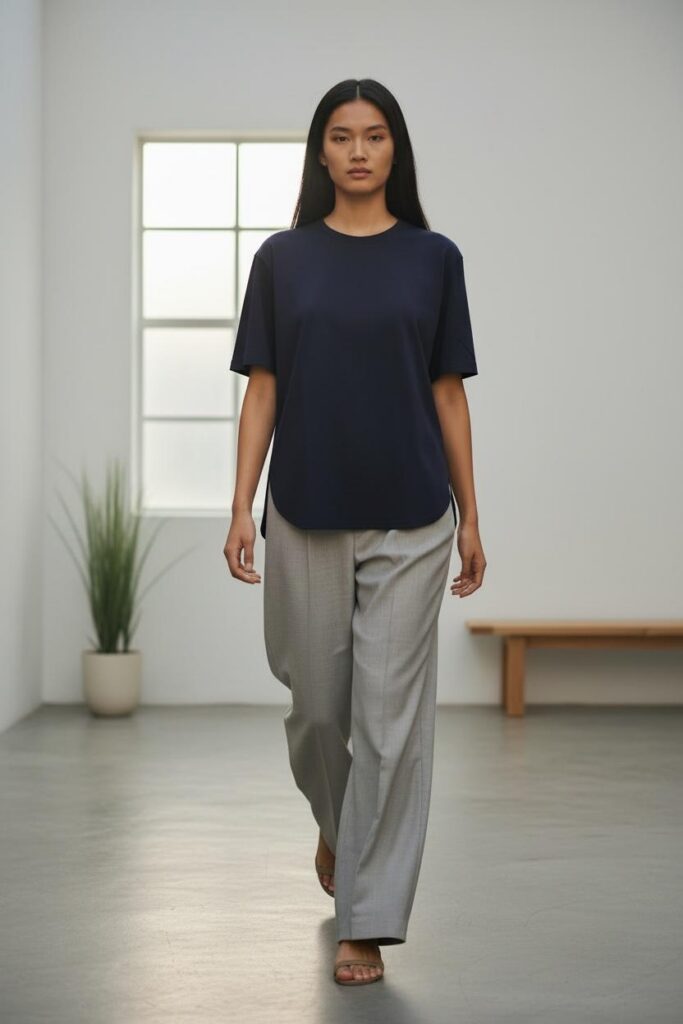
A long-haired model wears The Curve Hem Tee by Ujoh in mulberry colour, paired with grey tropical wool trousers and minimal sandals. The studio background shows a window with a plant in the corner, a wooden bench, and a greyish floor.

Slow fashion, no gender, no noise: the anatomy of timeless fashion

The detail:
A curved hem that rounds the silhouette — front slightly cropped, back sweeping lower. Not accidental, but architectural. Half-sleeves for freedom without exposure. Crew neck that sits clean, never clutches. Made from mocrody: a high-gauge knit fabric from fine-count Supima cotton, with distinct front-and-back construction for natural firmness. A special softening finish adds an ultra-soft touch. Lightweight. Breathable. Moisture-wicking.

The design:
Minimal crew neck tee with a generous, comfortable fit. Half-sleeves. Signature curved hem — longer at the back, shorter at the front — creating a fluid line that moves with you. Clean, unbroken surfaces. Nothing added that does not need to be there.

The make:
Made in Japan — from 100% Supima cotton (mocrody). Breathable, soft, impeccably finished. Fully considered inside and out: clean seams, hand-wash care, private refinement. Tangible quality designed to travel, to settle, to last.

The Curve Hem Tee: the complement of a thoughtful wardrobe


The Curve Hem Tee offers something rare: presence without weight. You move from morning studio to evening walk without adjusting, without thinking — because living is the point.

• For the studio: tucked loosely into high-waisted trousers. Mulberry against tropical wool or linen. A uniform for making. For thinking.

• For a weekend afternoon: worn out, over wide-legged jeans or cotton shorts. The curved hem catching the light. A study in proportion, colour, and breath.

• For an evening gallery visit: half sleeves pushed up. The difference in length between front and back pooling gently over relaxed pants and minimal heels. The apex of considered softness.

For the modern humans who curate, not consume — whose wardrobe is a library of dog-eared favourites, each piece a chapter in their story.

🌟 The Curve Hem Tee – Ujoh
Limited edition. Like a second skin — one for personal style. For life.

🖤 To enquire: DM @suite123 | WhatsApp | Email

Available by appointment for shopping in Milano or worldwide—from screen to doorstep. From our hands to your daily ritual.

P.S. Ask us about the philosophy of its design in fashion — and how a single tee can move from studio to afternoon to dinner without changing its soul. Or how to build a full uniform — tee and trousers — that moves with you from dawn to dark. We are here for the conversations, not just the transactions.

Footnotes: The intelligence of this piece lies in its restraint. It offers the ease of a t-shirt alongside the structural intrigue of a curved hem — resolving a contemporary sartorial need. It proves that avant-garde design does not need to shout. And it simply needs to fit. Design refined to its most personal expression.

One piece, one story: The Curve Hem Tee by Ujoh Read More »

One piece, one story: The Scarf Hoodie by Meagratia

Reading Time: 4 minutes

Sporty ease meets soft elegance — where the hoodie learns manners


This is The Scarf Hoodie by Meagratia.
In a system that produces tonnes of disposable clothing, we curate: one piece, one story. A radical view for ethical and aesthetic resistance — meaningful garments, an expression of good design. Slow fashion—made to last, made by hand.

The Scarf Hoodie is not simply worn; it is inhabited. The unexpected foundation of a modern uniform — a sporty silhouette that offers both relaxed ease and refined detail. In its soft, cotton form, it promises comfort; in its fringed satin scarf, it grants a touch of ceremony. A silent, grounding gesture of elevated casualness.

It honours the discipline of essential form: function that follows form, yet leaves room for play. The elasticated hem and cuffs become a study in balance. The wide front pocket — not decorative, but practical. The subtle side logo — a quiet signature, not a shout. A beauty that champions softness without sloppiness.

Blue. Not a primary, but an atmosphere. The same tranquil foundation as a clear sky — a colour that holds depth and air in equal measure. A hue with nothing to prove and everything to offer.

Long-haired model wearing The Scarf Hoodie, grey Tropical Wool trousers, and black shoes. She twists dynamically with one leg bent and arms open, making her hair flow and highlighting the sweatshirt's shape.

Slow fashion, no gender, no noise: the anatomy of quiet comfort

The detail:
A refined fringed satin scarf integrated into the hoodie — an elevated touch, not an add-on. Elasticated hem and cuffs for a fit that moves with you, never against you. A wide front pocket running across the lower front: not decorative, but directional. It is the hoodie’s quiet signature, a horizontal anchor that grounds the silhouette. The subtle side logo — present, but never loud.

The design:
Sporty-chic hoodie with a generous, comfortable cut. Fringed satin scarf detail at the neck, elasticated hem and cuffs for a clean, held shape, one wide front pocket for practicality and proportion. The hood sits clean; the body breathes. 

The make:
Made in Japan — from 100% premium cotton. Breathable, soft, impeccably finished. Fully considered inside and out: clean seams, hand-wash care, private refinement. Tangible quality designed to travel, to settle, to last.

The Scarf Hoodie: the complement of a modern wardrobe


The Scarf Hoodie offers something rare: presence without effort. You move from morning coffee to evening wine without adjusting, without thinking — because living is the point.

For the studio: elasticated hem and cuffs cinched, worn with the Tropical Wool Trousers and minimalist sneakers. A uniform for creating. For thinking.

For a weekend gallery opening: scarf draped long. Worn with a silk midi skirt and leather slides. The cotton catches the light. A study in proportion, style, and breath.

For an evening dinner at home: scarf tied softly. The wide front pocket holding nothing but intention. Hoodie pooling gently over relaxed trousers. The apex of considered softness.

For the modern humans who curate, not consume — whose wardrobe is a library of dog-eared favourites, each piece a chapter in their story.

🌟 The Scarf Hoodie – Meagratia
Limited edition. Like a second skin — but one that knows when to add a touch of ceremony.

🖤 To enquire: DM @suite123 WhatsApp | Email

Available by appointment for shopping in Milano or worldwide—from screen to doorstep. From our hands to your daily ritual.

P.S. Ask us about the philosophy of its design in fashion — and how a single hoodie can move from studio to gallery to dinner without changing its soul. Or how to build a full uniform — hoodie and trousers — that moves with you from dawn to dark. We are here for the conversations, not just the transactions.

Footnotes: The intelligence of this piece lies in its restraint. It offers the ease of a hoodie alongside the elegance of a satin scarf — resolving a contemporary sartorial need. It proves that avant-garde design does not need to shout. And it simply needs to fit. Design refined to its most personal expression.

One piece, one story: The Scarf Hoodie by Meagratia Read More »

Horror and beauty

Reading Time: 3 minutes

On dignity, clothing, and what we owe each other


Horror and beauty. 

Every time we sit down to talk about clothes, we look at the news — people being bombed, displaced, losing their lives—and think: does any of this really matter?

This is where we’re coming from. That feeling of futility, of powerlessness — wondering how fashion can matter when set against a backdrop of human suffering. 

We mistrust easy answers. The world feels too fractured, too painful, to allow for certainty.

Is it irresponsible to talk about fashion right now?

Clothes document the human condition.


What people wear when everything falls apart is a story — one that speaks of dignity, resistance, and survival. Still, we recognise that we speak from a place of privilege. We can choose what to wear. For many, that choice no longer exists.

Throughout history, clothing has never been only about choice. It has been a form of resistance, a way to preserve identity, a silent protest. In moments of displacement, a garment can become the last piece of home a person carries.

Think of the garments of the displaced. What does a refugee wear? Clothes become tools: extra layers against the cold, hidden pockets for money, protection from the elements. What remains on the body is reduced, essential. And still, within that, there are gestures of agency.

A woman in Gaza evacuates wearing her neighbour’s borrowed sandals—her own destroyed in the chaos. She didn’t choose them; they were simply what was available. Weeks later, in a tent, she washes her only remaining dress by hand and hangs it to dry on a wire. This act is not about fashion. It is about dignity. In caring for that dress, she affirms, I am still here.

We still dress. In cities under siege or after natural disasters, people wash a shirt, mend a seam, fix a shoe. Not out of vanity, but to hold on to something human.

If clothing can be a tool of dignity, it can also be part of systems that strip it away. Not only in war zones, but in the everyday violence of how fashion is made. The way we produce and consume fashion is not neutral. It is tied to labour, to resources, to lives. Choosing differently, when we can, is one small way of refusing that indifference.

So is it irresponsible to discuss fashion right now?


It could be. We’re not sure. And maybe that uncertainty is the only honest place to start.
What we do know now is that it becomes meaningful if we use it as a door to talk about crimes against humanity and the planet—including who is bombing and what we can do. That includes naming power directly. 

We’ve opened that door. 

Writing, or doing our job in fashion, does not mean turning away from suffering. It means staying with the discomfort. And recognising that even in the darkest moments, people hold on to small, fragile expressions of self.

Without excess, we hold space for horror and for beauty. Not because we have an answer, but because letting go of either would mean losing what makes us who we are. Perfectly aware that for many, that horror doesn’t stop. So we use our platform to amplify these voices, to speak against Netanyahu’s government and the Trump regime devastating humanity.

As historian Timothy Snyder wrote on his Substack, Thinking About:

“If we do not say something ourselves about this horror, we allow ourselves to be changed.”

We don’t speak for the woman in Gaza. We cannot know what her dress means to her. What we can do is listen — and, where we can, act. And say clearly whose side we are on, because we do not want to normalise this.

Horror and beauty. We hold both.

What will you do with what you’ve just read?

Horror and beauty Read More »

One piece, one story: The Tropical Wool Trousers by Meagratia

Reading Time: 4 minutes

Tailored minimalism, slow fashion: the discipline of clean lines, where structure meets breath 


These are The Tropical Wool Trousers by Meagratia.
In a system that produces tonnes of disposable clothing, we curate: one piece, one story. A radical view for ethical and aesthetic resistance — meaningful garments, an expression of good design. Slow fashion—made to last, made by hand.

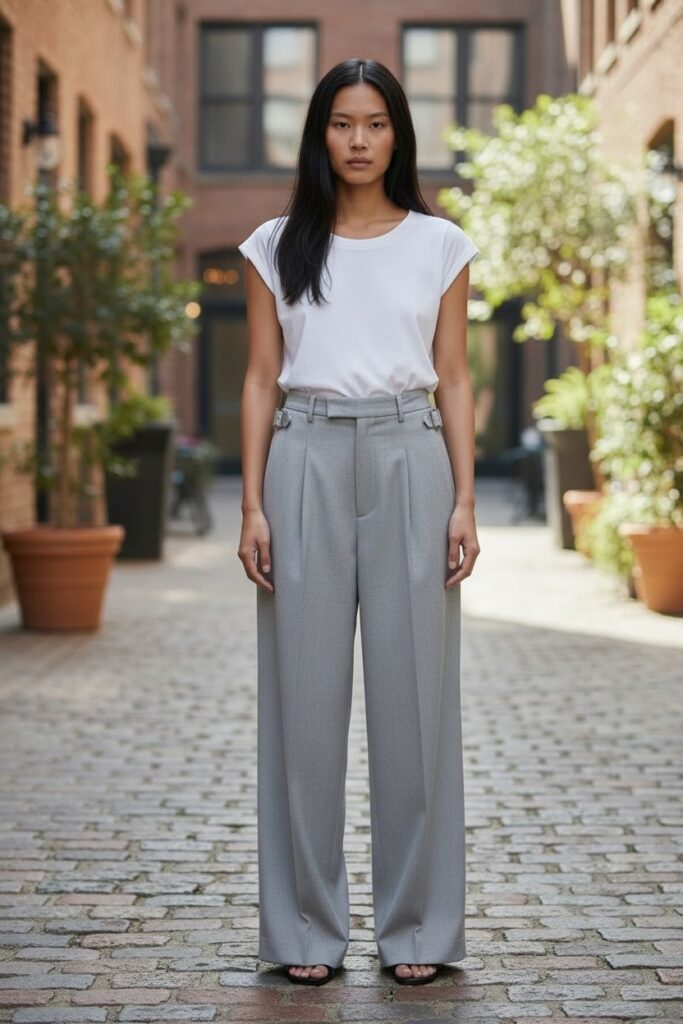
The Tropical Wool Trousers are not simply worn; they are inhabited. The versatile foundation of a modern uniform — an understated silhouette that offers both architectural clarity and effortless flow. In their clean, wide-leg form, they promise presence; in their side adjusters, they grant intimacy of fit. A silent, grounding gesture of refined ease.

They recall the logic of mid-century modernism: form that follows function, yet leaves room for poetry. The tailored waist and generous leg become a study in balance. The tone-on-tone side band — a subtle signature, not a shout. A beauty that champions restraint without severity.

Grey. Not an absence, but an atmosphere. The same sophisticated foundation as the jacket — a colour that holds shadow and light in equal measure. A shade that asks nothing yet gives everything.

A pair of The Tropical Wool Trousers by Meagratia, worn by a model standing in an inner courtyard with potted plants on either side. The trousers are tailored with clean, straight lines and a relaxed fit, paired simply with a plain white t-shirt and flat sandals to let the cut and fabric of the trousers stand out. The minimalist styling emphasizes the trousers' structure and finish.
The Tropical Wool Trousers by Meagratia, Japan

Avant-garde tailoring: the anatomy of quiet movement


The detail:
Side adjusters at the waist — a personalised fit, no belt required. A tone-on-tone side band running the length of the outer leg: not decorative, but directional. It is the trousers’ quiet signature, a visual spine that lengthens the line. The front half-leg lining ensures the wool falls without cling, without interruption.

The design:
Wide-leg trousers with a refined tailored cut. Front button and zip closure, belt loops for those who prefer a belt, two side slip pockets, two back welt pockets. The waist sits clean; the leg breathes. This is not volume for volume’s sake — it is volume with intention. Comfort that reminds you it is still clothing, not a costume.

The make:
Made in Japan — from 100% premium cool wool. Breathable, wrinkle-resistant, impeccably smooth. The same fabric as the jacket, now in dialogue with the ground. Fully finished inside: front half-lining, clean seams, private refinement. Tangible quality designed to travel, to settle, to last.

The Tropical Wool Trousers: the quiet foundation of a modern uniform


These are trousers that offer freedom through precision — allowing you to move from morning to evening without changing your centre of gravity. They understand that the highest form of luxury is the freedom to forget what you’re wearing, because it fits so well.

For the office: Side adjusters cinched, worn with the Tropical Wool Jacket (clips fastened) and a fine-knit sweater. A uniform for presence. For decisions.

For a vernissage opening: Adjusters relaxed. Worn with a silk blouse and leather slides. The wide leg catches the air. A study in proportion, style, and breath.

For an evening dinner: Belt loops empty. The jacket’s clips open. Trousers pooling gently over minimalist sandals. The apex of considered softness.

For the modern humans who curate, not consume — whose wardrobe is a library of dog-eared favourites, each piece a chapter in their story.

🌟 The Tropical Wool Trousers – Meagratia
Limited edition. Like a second skin — but one that knows when to give you room.

🖤 To enquire: DM  @suite123 | WhatsApp | Email

Available by appointment for shopping in Milano or worldwide—from screen to doorstep. From our hands to your daily ritual.

P.S. Ask us about the philosophy of transformative design in fashion — and how a single garment can move from office to vernissage to dinner without changing its soul. Or how to build a full uniform — jacket and trousers — that moves with you from dawn to dark. We are here for the conversations, not just the transactions.

Footnotes: The intelligence of this piece lies in its restraint. It offers the precision of tailored trousers alongside the ease of a relaxed wide-leg — resolving a contemporary sartorial need. It proves that avant-garde design does not need to shout. And it simply needs to fit. Design refined to its most personal expression.

One piece, one story: The Tropical Wool Trousers by Meagratia Read More »

The normalisation of greenwashing

Reading Time: 3 minutes

As sustainability fades from fashion’s agenda, misleading claims fill the void


The normalisation of greenwashing is becoming increasingly visible across fashion — not as a failure of the system, but as a feature of it.

While sustainability appears to be fading from fashion agendas, greenwashing is becoming acceptable.

We came across a Business of Fashion Instagram post that stopped us in our tracks:

“H&M says sustainability is good for business. Can it get shoppers to care?”

The accompanying feature—a sit-down with H&M Group Chief Executive Daniel Ervér and Chief Sustainability Officer Leyla Ertur—explores why the fast fashion giant is “sticking to its long-set sustainability plans” and working on “connecting with customers.”

This piece of news is depressing. Not surprising, perhaps. But depressing.

H&M’s business model is built on overproduction, rapid deliveries, and overconsumption. These are not conditions that can be retrofitted with sustainability plans. Yet there — in the pages of one of fashion’s most respected industry publications — the premise is presented as earnest: Can a fast fashion giant make sustainability matter to shoppers?

Then comes this quote:

“The reality is, it’s hard. To help customers change their behaviour, we have to create real value for them. Otherwise, why should they change?”

Let’s sit with that for a moment.

Shifting the responsibility: the normalisation of greenwashing


In a single statement, H&M absolves itself of responsibility and shifts the burden onto consumers. Not a word about the structural realities of overproduction. Not a question about whether a business model built on volume can ever align with sustainability. Instead: If customers don’t change, that’s on them.

This is the manoeuvre we’ve seen before. Exploit people and the planet through a system engineered to encourage overconsumption, then frame the lack of consumer “will” as the obstacle to progress.

Which raises a more uncomfortable question: Why is The Business of Fashion—a publication that positions itself as the authoritative voice of the industry—willing to take part in this game?

We have our suspicions. Whether or not this was sponsored content, the real question is: what does it say about the state of fashion media when a fast fashion giant’s sustainability messaging is platformed without scrutiny?

Ultimately, the question remains: can a fast fashion brand ever be truly sustainable?

As we explored in our previous post, the answer here is the same. This is greenwashing. 
Not because H&M lacks sustainability initiatives, but because sustainability cannot be grafted onto a business model fundamentally at odds with it. 

Promoting oneself as sustainable while maintaining that model is not progress—it’s a manipulation of eco-discourse. With the approval of the press.

A final reflection


So here we are, facing the normalisation of greenwashing. Sustainability quietly fades from the scene. Greenwashing becomes acceptable. Safe. Sound. Normal. And perhaps not just acceptable, but the dominant language through which fashion now speaks about responsibility.

P.S.: We wrote an eBook to help you cut through the noise. If you want to understand whether a brand is genuinely sustainable or simply dressing itself in green, it’s here:

The normalisation of greenwashing Read More »