fashion

Valentino, the emperor of fashion

Reading Time: 4 minutes

More than a designer, a keeper of beauty — an empire built on devotion, not disruption


Valentino Garavani, the emperor of fashion, passed away on January 19, at the age of 93, in Rome — the city he loved and never truly left. In an era defined by constant noise, speed, and relentless reinvention, his legacy stands apart. Not because it chased trends, but because it cultivated a world of timeless elegance, patience, and enduring beauty.

This is not an attempt to retrace a career — there is already more than enough of that. Instead, this is an effort to understand what Valentino can still teach us. What remains relevant. What the fashion industry — and perhaps creative work as a whole — risks forgetting.

Born in Voghera in 1932, Valentino’s aesthetic awakening came early. He often recalled a formative moment at the opera in Barcelona, where he saw women wrapped in red. That vision — colour, drama, ceremony — sparked a lifelong devotion to clothing as celebration. From that moment on, fashion was never merely functional for him; it was cultural, emotional, and deeply respectful of beauty.

He studied in Milan and then moved to Paris, where he worked for Jean Dessès and Guy Laroche, absorbing the discipline of haute couture and the rigour of craft. In 1960, he returned to Rome, where he met Giancarlo Giammetti — his business partner and lifelong companion. Together, they built something rare: a maison founded on mutual trust, clarity of roles, and a shared vision. Valentino created; Giammetti protected the conditions that allowed creation to flourish.
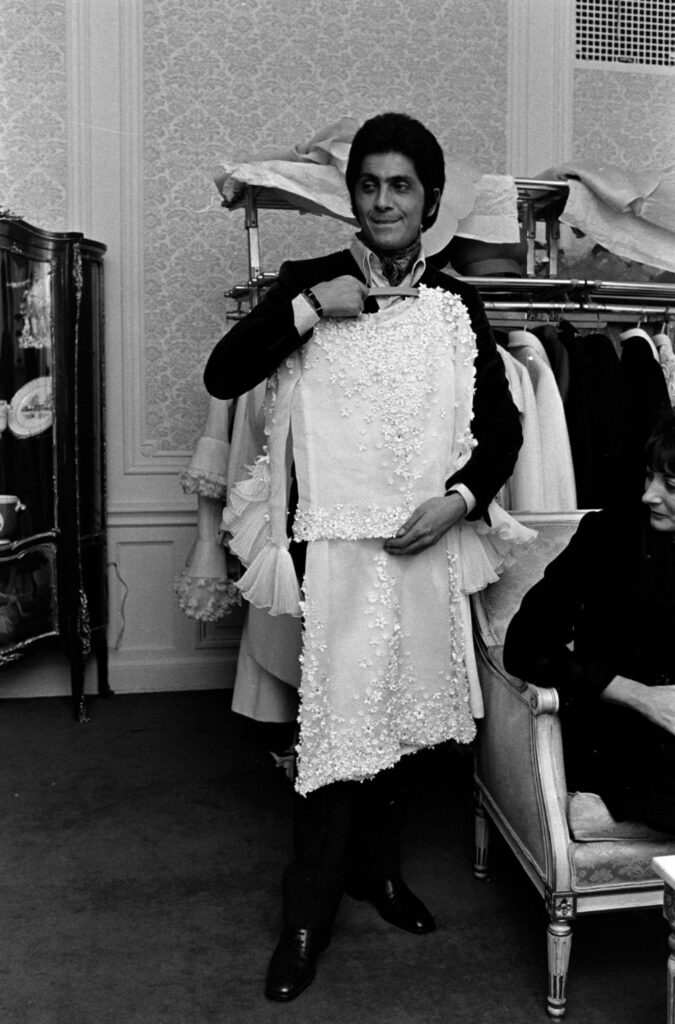
Black-and-white archival photo of Valentino Garavani in his atelier. The emperor of fashion holds a white embroidered dress with care, in the act of presenting his creation.

From a small atelier, international recognition followed. Heads of state, actresses, and cultural icons wore his designs not to be noticed, but to feel complete. His work became a pillar of Italian fashion history, yet its appeal was always global — rooted in classical ideals, but never provincial.

In a fashion system that now rewards disruption above all else — even within his own brand — Valentino’s journey reminds us of what is being lost: the power of a singular vision patiently built over a lifetime. He shaped his path through self-improvement, perseverance, discipline, and devotion. There was no rush, no need to shout. Only the quiet confidence of couture mastery.

This was fashion as artisanal excellence — an expression of creativity anchored in craftsmanship and cultural intelligence. Valentino began in a four-person atelier, where every stitch served a vision, not a market forecast or a shareholder meeting. Today, creative directors often bend to corporate strategies; his generation built houses where creativity led, and business followed.

He announced his retirement in 2007, at the age of 75, with a final, all-red, iconic show in Paris in 2008 that felt less like a farewell and more like a celebration of coherence. Filmmaker Matt Tyrnauer later captured his legacy in the 2008 documentary Valentino: The Last Emperor — a revealing portrait of discipline, obsession, and unwavering standards.

The emperor of fashion — in his own words


Valentino was never vague about what he believed in.

“Elegance is made of intelligence, and above all of not flaunting the label.”

This sentence alone explains much of what feels absent today. His couture belonged to a world where creativity and quality spoke louder than branding. Where clothing revealed taste rather than wealth. Today, the balance has reversed: logos have replaced language, stepping in where quality no longer speaks for itself.

“Today, those who have money do not always have class or memory.”

Memory here is key — cultural memory, aesthetic memory, historical awareness. Without it, fashion becomes noise.

He spoke openly about contemporary taste:

“Today, with the influencers, bad taste is everywhere.”

And in his farewell to Pierpaolo Piccioli, he offered what may be his most revealing statement on modern fashion:

“Thank you… for your friendship, respect, and support. You’re the only designer I know who hasn’t tried to distort the codes of a major brand by imposing new ones and the megalomania of a ridiculous ego.”

In those words lies his entire credo: respect for heritage, humility before beauty, and a firm rejection of ego-driven disruption. 

Final thoughts


So what can we learn from Valentino — the emperor of fashion? From someone who made creativity, couture, and beauty the work of a lifetime?

That legacy is not built by chasing what is new, but by deepening what is beautiful. That true luxury is not only what you create, but what you refuse to compromise. And that elegance — real elegance — requires time, memory, intelligence, and restraint.

In today’s fashion machine, where speed is rewarded and noise is constant, Valentino’s life asks a quieter, more demanding question:

What are we in such a hurry to create, if not something meant to last?

He was not just a designer. He was an emperor — of a slower, more deliberate kingdom. One that, in its silence, still speaks louder than ever.

Valentino, the emperor of fashion Read More »

Saks’ bankruptcy: what game is fashion playing?

Reading Time: 4 minutes

The news, coming one year after the acquisition of Neiman Marcus, highlights the broken state of fashion retail


The news of Saks’ bankruptcy forces a simple question: what game is fashion playing?

Roughly a year ago, Saks acquired Neiman Marcus, along with its sister company, Bergdorf Goodman. On the surface, it appeared to be consolidation, strength, and scale. Cool, right?

Now, almost exactly one year later, Saks has filed for bankruptcy.

This isn’t bad luck, nor an unexpected turn of events. It’s the consequence of a business model that no longer works—yet one the industry keeps pretending is still viable. Fashion is carrying on with business as usual, as if nothing were fundamentally wrong. Let’s try to make sense of it.

Saks is not an anomaly. It is a textbook case of the perfect storm hitting traditional luxury retail—a masterclass in what not to do. Its apparent survival has relied more on inertia and prestige than on any real vitality.

Saks’ bankruptcy: the symptom of a broken system


A close examination of the post-acquisition collapse reveals several structural problems.

First: the customer has changed.
Luxury consumption no longer revolves around temples of consumption. Millennials and Gen Z buy differently: they seek meaning, experience, authenticity, storytelling. The dusty, formal department store —rigid, hierarchical, and disconnected — struggles to resonate with generations who expect fluidity, values, and emotional engagement.

Second: the “emptiness retail” model.
Luxury department stores suffer from a profound identity crisis. They are neither exclusive enough to rival monobrand boutiques nor convenient or experiential enough to compete with direct e-commerce. The result is a space full of products but empty of meaning. Constant overproduction and a culture of perpetual discounting replace identity-building, trapping retailers in a vicious cycle where volume compensates for relevance—until it doesn’t.

Third: the brand wars.
Major luxury groups — Chanel, LVMH, Kering — have tightened control over distribution, investing heavily in their own direct-to-consumer channels. Owned stores and proprietary e-commerce platforms steadily erode the relevance and bargaining power of multi-brand megaretailers such as Saks. Brands are now openly competing with their own stockists. They want it all, yet fail to acknowledge a basic truth: the addressable market for luxury is not infinite.

Finally: monstrous debt.
The acquisition of Neiman Marcus was financed with over $4 billion in debt, backed by private equity. This left Saks servicing an unsustainable financial burden precisely as interest rates rose and the market demanded reinvention. Debt didn’t cause the crisis—but it removed any remaining room to adapt.

However, this pattern isn’t unique to Saks. From Farfetch to LuisaViaRoma to SSENSE, whether e-commerce or brick-and-mortar, fashion retailers have recently faced similar outcomes, even without headline-grabbing acquisitions. The conclusion is hard to ignore: the era of mega-retailers reliant on endless discounts and scale alone is over.

And yet, the response remains stubbornly familiar.

Following last Tuesday’s voluntary bankruptcy filing, Saks Global swiftly secured $400 million in new financing (around €345 million). As reported by Reuters, a US bankruptcy judge granted initial approval despite opposition from Amazon, its now-separated commercial partner.

We suggest reading a post we wrote a while back → Fashion industry: a dying patient

Final thoughts


This is business as usual in its most dangerous form: strategic sleepwalking. Consolidating a dying market through acquisitions, rather than radically rethinking the purpose of the physical store and questioning the overproduction model, is not a solution—it’s a fatal error.

Ultimately, Saks acquired two legacy giants — Neiman Marcus and Bergdorf Goodman — at a premium price, loading its balance sheet with crippling debt at the exact moment the sector was pivoting toward streamlined, direct-to-consumer models.

Cool still?

More than anything, Saks’ bankruptcy has become a case study in what not to do when attempting to transform luxury retail for the 21st century. A very expensive lesson.

So, now that the bailout has arrived, the real question remains: is it plausible to emerge from collapse with a massive cash injection alone? Can survival occur without changing the business model itself?

The question seems rhetorical.

And the answer is no.

Saks’ bankruptcy: what game is fashion playing? Read More »

One piece, one story: The Swallow Tail Sweatshirt  by Ujoh

Reading Time: 4 minutes

Where architectural silhouette meets sanctuary comfort — for those who wear a point of view, not just a garment


This is The Swallow Tail Sweatshirt by Ujoh.
In a system that produces tonnes of disposable clothing, we curate: one piece, one story. A radical view for ethical and aesthetic resistance — meaningful garments, an expression of good design. Slow fashion—made to last, made by hand.

The Swallow Tail Sweatshirt is not merely worn; it is inhabited. It is the foundational layer of an intelligent wardrobe — an apparent ease that offers both profound comfort and sculptural presence. In its generous yet precise volume, it promises sanctuary; in its swallow-tail back, it delivers a coup de théâtre. A silent, powerful gesture of modern nonchalance.

It evokes the serene tension of contemporary architecture: a structure where volume appears to float, anchored by precise, clean lines. The oversized silhouette becomes a generous atrium; the swallow tail, the calculated flourish that guides the eye and defines space. It is a beauty that champions dynamic form and intelligent repose.

Black. Not a mere absence of colour, but a vast, absorbent canvas. A void that holds light and shadow, lending weight to form and depth to drape. A shade that is both absolute and infinite.

A conceptual photograph of the black Swallow Tail Sweatshirt by Ujoh. It hangs on a minimal hanger against a neutral backdrop, with a series of empty golden picture frames arranged below it.
The Black Swallow Tail Sweatshirt by Ujoh

Avant-garde clothing: the anatomy of sculptural ease

• The detail:
An asymmetric swallow tail back, cut from a single, fluid pattern. This is its signature, its soul. More than a detail, it is a kinetic event: a silhouette that transforms with every step, creating a dialogue between movement and stillness. It challenges the static nature of traditional knitwear, introducing a dialogue between body and space.

• The design:
A deceptive oversized cut with dropped shoulders and front slits. This is the core of its philosophy. The volume suggests effortlessness, yet resolves into a clean, controlled fit on the body. The slits grant freedom; the dropped shoulders create a relaxed, refined line. Comfort, meticulously calculated.

• The make:
Made in Japan—from 100% premium mercerised cotton fleece. Not merely a fabric, but a sensorial experience. The mercerisation process enhances the cotton with subtle lustre, exceptional strength, and a plush, enduring hand-feel. The knit lining is a private luxury. This is tangible quality — designed to deepen with time.

The Swallow Tail Sweatshirt: the intelligent core of a modern uniform


This is a piece that offers armour through softness, allowing you to move through your day with ease and quiet authority. It understands that the highest form of luxury is the sovereignty over one’s own comfort.

• For a morning coffee: paired with tailored wide-leg trousers and minimalist leather shoes. A uniform for focused thought and fluid movement.
• For the urban landscape: layered over a cotton shirt and beneath a structured wool overcoat. A study in texture, contrast, and controlled volume.
• For the understated evening: worn with black couture leggings and ankle boots. The apex of considered elegance.

For the modern humans who curate, not consume — whose wardrobe is a library of dog-eared favourites, each piece a chapter in their story.

🌟 The Swallow Tail Sweatshirt – Ujoh
Limited edition.  Like a diary page—meant to be lived in.

🖤 To enquire: DM  @suite123 | WhatsApp | Email

Available by appointment for shopping in Milano or worldwide—from screen to doorstep. From our hands to your daily ritual.

P.S. Ask us about the Japanese philosophy of Ma (negative space) in design, and how this sweatshirt embodies it. Or how to style the swallow tail for maximum dramatic effect in motion. We are here for the conversations, not just the transactions.

Footnotes: The intelligence of this piece lies in its deceptive volume. It offers the psychological comfort of an oversized garment alongside the polish of a tailored layer, resolving a contemporary sartorial tension. It proves that avant-garde design does not sacrifice comfort—it redefines it. Design refined to its most powerful expression.

One piece, one story: The Swallow Tail Sweatshirt  by Ujoh Read More »

Enlightenment by Lidewij Edelkoort: fashion as a mirror of culture

Reading Time: 5 minutes

Trend forecasting beyond style: exploring society, spirit, and the quest for solace in a fractured world


Enlightenment is the recent free webinar by Lidewij Edelkoort, the renowned trend forecaster — a spiritual gift, as she described it. And, judging by the large global audience it drew, a much-needed one. Many participants thanked her at the end; Edelkoort herself appeared deeply moved.

We often say that fashion is culture — more precisely, that fashion is a lens through which we can analyse society. This webinar was a clear demonstration of that idea in action.

Edelkoort’s approach to trend forecasting goes far beyond clothing. It explores habits, customs, values, and lifestyles in depth. It is no longer about which colour or silhouette will be fashionable, but about why a colour, a shape, or a fabric resonates at a particular moment in history. At its core, her method is sociological — yet also deeply psychological and philosophical.

The presentation opened with a forecast written almost a decade ago, one that still rings disturbingly  true today:

Never before have people felt so pummelled and abandoned. Society is at a loss, with ever-increasing tensions between rich and poor, man and woman, young and old, intellectual and worker, white and black. We feel pain for our planet and anger for future generations. We feel helpless when faced with multiple dictators governing their countries like banana republics. We feel outrage at the sacrificing of Black lives, the shooting of our children, or the killing of innocent people. Our neighbour is our enemy, our teacher is our nemesis, our country is our curse — and how will we avoid civil war?

In a world where people feel hurt, insecure, and abandoned, the search for solace, relief, and inner balance has become urgent. The aim, Edelkoort suggests, is to heal society — and, in doing so, to foster another kind of fashion.

Current societal tensions — loneliness, frustration, political unrest — are prompting a return to spirituality. One statement struck us in particular: “Empathy is a political issue.” It feels like the defining slogan of our time.

Enlightenment by Lidewij Edelkoort: inspiration for solace


It is crucial to note that these themes were first released more than ten years ago and originally forecast for Autumn/Winter 2019–2020. This reveals how long macro-trends take to materialise — like seeds that need years to grow. Today, they feel uncannily precise.

Edelkoort framed sixteen interrelated themes as lenses through which to interpret contemporary society: asceticism, monasticism, shakerism, meditativism, taoism, shintoism, krishnaism, druidism, animism, voodoo, mysticism, occultism, romanticism, kama sutra, universalism, and papism.

Each represents a different way humans seek meaning, connection, and comfort in an unstable world. Each also carries its own visual and tactile language — crafts, shapes, colours, materials — which gradually filters into how we dress and live.

At first glance, these themes may appear distant from fashion. Yet they profoundly influence how people consume, behave, and express themselves.

Enlightenment trend report by Lidewij Edelkoort inspired this contemplative image. A woman sits in quiet introspection, her form softly obscured by layered veils and wrapped in textured, natural fabrics like linen and raw wool. The image evokes themes of solace, inner search, and monastic simplicity in a fractured world.

Below are notes on how they translate into dress and culture:

  • Asceticism: deconsumption; layering; simple clothes; warm, sophisticated colours. Inlays, superpositions of wool and linen, or wool and cotton. Minimal detailing.
  • Monasticism: the search for inner peace and concentration. Spirituality. Minimal clothing, soft wool and linen. Hoods, irregular hems, socks, extra-long sleeves. Dirty yellow.
  • Shakerism: community-building, shared tasks, simplicity. Beautiful skirts, bonnets. Black and white. Lace and tiny details.
  • Meditativism: inward focus; rebalancing the aggression of daily life. Elevated well-being. Dark red, clothes that hug the body.
  • Taoism: understanding life and discerning the future. Yin and yang. Repetition. Simplicity. 
  • Shintoism: Japanese influence. Black-and-white contrast. Ritual garments. Graphic and sober fashion. Contemporary kimonos.
  • Krishnaism: orange, layering and draping. Tunics, fluid pants, embroidery.
  • Druidism: Celtic rituals. Ireland and Scotland. Eco warriors protecting the natural world. Country punk. Alone with nature. Checks, blankets, patchwork, faux fur.
  • Animism: the planet as a holistic entity. Ancestral references. Skins, feathers, felt. 
  • Voodoo: ritual-inspired silhouettes and symbolism. Elaborate design. Bold mixes of colours and patterns. 
  • Mysticism: a path to enlightenment. Rich textures, flowing layers, deep colours. Transcending shapes, allegorical textiles.
  • Occultism: mystery, alchemy. Motifs such as eyes and stars. Garments imbued with hidden meanings.
  • Romanticism: softness, fluidity, flowing fabrics. Lace, ruffles, bows. Feminine silhouettes.
  • Kama Sutra: sensuality; celebration of pleasure and beauty. Barely-there garments. Body beige.
  • Universalism: unity across cultures, genders, and religions. Diversity celebrated. A rainbow of influences, textures, colours, and prints.
    From this section comes the slide: “Empathy is a political issue.”
  • Papism: the spiritual father figure. The human search for meaning, guidance, and community. Papal dresses, cardinal red. Flowing robes, cloaks, capelets, embroidery.


Through this lens, fashion becomes a mirror of deeper societal currents. People are drawn to clothing that offers comfort, authenticity, and emotional resonance. Trend forecasting, therefore, becomes less about a superficial style and more about understanding human needs, fears, and aspirations.

Final thoughts


Against this backdrop of fracture and unease, Enlightenment emerges not as a traditional trend report, but as a response — a search for answers about who we are and where we are heading. In an era marked by the loss of religion, tradition, and communal spaces, people are left without places to gather, celebrate, or find solace. These themes respond directly to that absence.

They represent a collective turning both inward and outward: towards spirituality, ritual, community, and meaning.

Enlightenment by Lidewij Edelkoort shows that fashion is more than a reflection of taste. It is a mirror of society, psyche, and spirit. In a fragmented world — where neighbours feel like enemies and the future feels under threat — these trends signal a profound human search: for solace, for connection, for meaning beyond the material.

The webinar was, in essence, a call for a better fashion — and therefore, a better world. A fashion rich in meaning. Fashion as a form of cultural therapy: a way to dress not only the body, but the soul of an age.

Understanding these currents may be the only way to bring about meaningful change in fashion, culture, and human behaviour.

And perhaps, to begin healing it.

Enlightenment by Lidewij Edelkoort: fashion as a mirror of culture Read More »

One piece, one story: The Handpainted Tartan Scarf by Exquisite J

Reading Time: 3 minutes

Where the soul of the artisan meets the canvas of the body—for those who wear art, not just fabric


This is The Tartan Handpainted Scarf  by Exquisite J. In a system that produces tonnes of disposable clothing, we curate: one piece, one story. A radical view for ethical and aesthetic resistance—meaningful garments, an expression of good design. Slow fashion—made to last, made by hand.

The Handpainted Blue Tartan Scarf is not merely worn; it is displayed. It is the culminating layer of a considered wardrobe—the dramatic, intelligent accent that offers both narrative and nuance. In its generous, fluid drape, it provides a sanctuary of self-expression, while the brushed tartan motifs and fringed hems form a deliberate, painterly flourish. A slow, considered gesture of daily elegance.

It evokes the serene impermanence of a watercolour painting—a composition where colour breathes and transitions with poetic licence. The blue-multicoloured canvas is the prepared paper, vast and receptive. The dégradé effect is the artist’s brushstroke—soft, bleeding edges that guide the eye, creating harmony through fluid, organic transitions. It is a beauty that champions uniqueness and emotion.

Blue—multicolour. Not a flat pattern, but a contemplative, shifting seascape of colour that holds the light like dusk over the ocean. A palette that is both tranquil and profound.

A woman models the hand-painted tartan scarf by Exquisite J as a shawl over black trousers, showcasing its large scale and watercolor-like dégradé print against a soft, shadowed background.
The Handpainted Tartan Scarf by Exquisite J

Winter scarves: the anatomy of artisanal uniqueness

• The craft: 
A hand-painted dégradé on a blend of virgin wool and modal, each piece unique. This is the secret to its soul. The artisan’s touch offers inherent warmth and human character, while the watercolour-like technique lends it a soft, ethereal quality that defies mass production. It is artistry you can feel.

• The detail: 
Brushed tartan motifs and fringed hems. This is not machine-made repetition, but the core of its philosophy. These intentional, softened patterns challenge the static nature of a conventional tartan, creating a dynamic, flowing drape that moves with the body—elevating the accessory from simple to singular.

• The make: 
Made in Italy—by a small artisanal brand that oversees the entire process. Not a label of convenience, but a genuine commitment to craftsmanship. Every detail, from the hand-painted brushstroke to the final finish, is curated with integrity and care, ensuring that each piece remains one of a kind.

The Tartan Handpainted Scarf: the final touch of a considered wardrobe


This is a piece that provides effortless drama, allowing you to navigate your day with artistry and intention. It understands that the most profound luxury is the freedom to express your uniqueness.

• For the creative day: draped loosely over a crisp white shirt and relaxed denim. The uniform for thoughtful work and open spaces.
• For the urban landscape: knotted elegantly over a tailored coat and leather boots. A dialogue between soft artistry and structured refinement.
• For the weekend’s quiet repose: wrapped generously as a shawl with a minimalist knit and slippers. Effortlessly sophisticated warmth.

For the modern humans who curate, not consume—whose wardrobe is a library of dog-eared favourites, each piece a chapter in their story.

🌟 The Tartan Handpainted Scarf – Exquisite J
Limited edition. Like an original canvas—meant to be cherished.

🖤 To enquire: DM  @suite123 WhatsApp | Email

Available by appointment for shopping in Milano or worldwide—from screen to doorstep. From our hands to your story.

P.S. Ask us how to tie this piece for maximum dramatic effect, or about the artisanal printing philosophy that makes each scarf a one-of-a-kind masterpiece. We are here for the conversations, not just the transactions.

Footnotes: The hand-painted technique is a lesson in modern alchemy. It transforms a classic, substantial fabric into a wearable canvas—proving that true luxury is not about adding more, but about masterfully imbuing soul, story, and a singular touch. It is elegance, refined to its most artistic expression.

One piece, one story: The Handpainted Tartan Scarf by Exquisite J Read More »