Explorations

The Mannish Shirt: A Wardrobe Essential

Reading Time: 2 minutes

In the mood for a relaxed elegance


The mannish shirt is a wardrobe essential. When it comes to timeless fashion, you cannot miss some good shirts to complete your capsule wardrobe. Classic or casual, shirts are garments designed for life. Above all, they add a stylish edge to your outfits.

The Mannish shirt & contemporary fashion


Slim volumes – too close to the body, aren’t a style we like, so we tend to choose slightly oversized to oversized fit. Indeed, grabbing the shirts directly from a man’s closet is one of the best options. The mannish fit is more comfortable, and the silhouette looks modern and fresh.

So, in the mood for shirts, we selected GoodNeighbors Shirts from Japan. We love its unisex designs, a style everyone can wear and make personal by revealing their personality.

However, we suggest starting with the check flannel shirts.
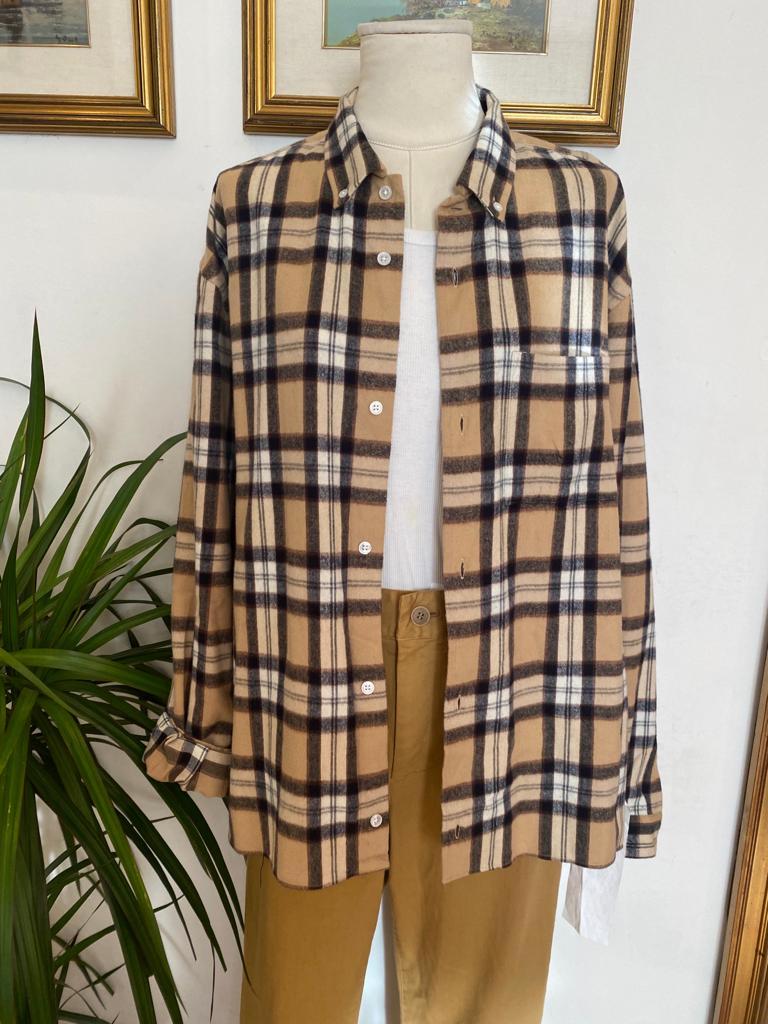
The Mannish Shirt
The Flannel Check Button Down Shirt – by Good Neighbors Shirts

1- The Flannel Button Down Shirt
2- The Flannel Mao Collar Shirt
3- The Flannel Maxi Shirt

These pieces come in check print (beige, black and white). While The Maxi Shirt is available in camouflage, too (100% cotton).

Good Neighbors Shirts: the design point


These well-tailored shirts come with a rubber band along the back, it is detachable, and you can wear them as a belt or as you like. Also, all the shirts have a pocket, on the right side, for your phone or wallet.

Styling tips
For preppy style lovers, layer your shirt underneath a sweater. You can wear The Maxi Shirt as a shirtdress or lightweight coat for the change of the season. Also, you can try these casual items to tone down some statement pieces of clothing in a modern mix-and-match. But we love these pieces as an overshirt with a basic t-shirt underneath and straight-leg trousers.

The Mannish shirt, a relaxed elegance #formodernhumans

Check out Good Neighbors Shirts.
Drop us an email, WhatsApp or comment here below to know more!

The Mannish Shirt: A Wardrobe Essential Read More »

Gendered Fashion Weeks, Genderless Fashion & Sustainability

Reading Time: 2 minutes

Do we still need separate men’s and women’s fashion weeks?


In order to make sense, genderless fashion and gendered fashion weeks should find a thoughtful convergence. And not only from a style perspective but for the compelling necessity of a more sustainable industry.

During fashion weeks, which last about one week for each category, womenswear and menswear, designers present their new collections. Now there are two elements:
First, the fashion industry needs a more sustainable approach.
Second, many designers lately proposed clothes less defined by gender.
The intersection of these two points can help the fashion industry change for the better.

Genderless fashion: what does it mean?


Contemporary fashion is more gender-fluid, and the separation between men’s and women’s clothing seems less felt. Apparently, people are free to select clothes from the category they prefer. Indeed, genderless fashion doesn’t mean renouncing femininity or masculinity but having the freedom to pick the garments suitable for yourself.

Genderless has become one of the most represented concepts in fashion designs. So why does the fashion industry keep dividing the schedule into women’s and men’s fashion shows? It seems contradictory in terms of style proposal and sustainability, too.

Fundamentally, we are free to choose. Designers can create the image they like following their creativity and vision of style. At the same time, everyone can refer to femininity and masculinity to express their personal tastes.

Gendered fashion weeks & sustainability


But it is not just a matter of style and freedom of expression. In the face of the environmental crisis, sustainability must be a priority in the fashion industry. In fact, weaving together men’s and women’s on the same runway would not only optimise costs for the brands but would reduce the impact of fashion shows on the environment.

And so, do we still need gendered fashion weeks? Presenting one calendar only seems to be a more sustainable solution for the future of fashion.

Gendered Fashion Weeks, Genderless Fashion & Sustainability Read More »

What Is Sustainability? A Comprehensive Definition by Vito Mancuso

Reading Time: 2 minutes

Exploring ethics, nature and accountability


What is sustainability? Think about an all-embracing definition, a few words we can extend to any field. To our whole life, indeed. In our search for a more sustainable lifestyle, Prof. Vito Mancuso offered some food for thought.

In a tv show called “Quante storie”, a must-see programme which is all about books, Prof. Vito Mancuso, a theologist and philosopher, introduced his latest essay titled “Etica per i giorni difficili” (Ethics for difficult days).

Addressing the need for shared ethics, he gave some guidance on the importance of preserving nature. Precisely, he said: “Custodire la natura è un’ assunzione di responsabilità.”

Literally:

“Preserving nature is an assumption of responsibility.”

Vito Mancuso

We believe we can extend this definition into the discussion on sustainable matters. Likewise, we can assert: “Sustainability is an assumption of responsibility.” Put more simply, “Sustainability is about taking responsibility.”

And taking responsibility means, in other words, holding ourselves accountable.

However, holding ourselves accountable goes beyond economics, marketing, or personal power. In fact, it’s about ethics.
And so, from a marketing perspective, can we agree to associate the word sustainable with big corporations? From the perspective of profit, can we allow well-known brands to sponsor sustainable events? Or set up sustainable fashion shows with the same rule as non-sustainable ones?

On an ethical level, we cannot agree.

From an ethical perspective, taking money from big corporations won’t lead to real change. But holding ourselves accountable doesn’t mean being perfect in our effort to make a change. It means taking seriously the choice we made and being consistent with it. Fundamentally, it means changing the way we operate, and being very careful who we partner with.

Mainstream sustainability vs ethics


So, what is the mainstream sustainability movement proposing? Green capitalism as the enlightened path. Specifically, it encourages us to shift towards an eco-green-sustainable model while continuing to consume as much as we did so far.

Of course, it won’t work. Either they are missing the point, or ethics isn’t their concern–nor is sustainability.

What Is Sustainability? A Comprehensive Definition by Vito Mancuso Read More »

The Land Of Waste

Reading Time: 2 minutes

How the fashion industry dumps the problem into Africa


A land of waste describes the unbelievable amount of discarded clothing that is regularly dumped in Africa.. About three million pieces of clothing every year. Endless layers of textiles form mountains high of fashion waste polluting the land and waters. A terrifying sight that illustrates the destruction the Western world inflicts on nature, known as waste colonialism.

Fast-fashion waste recycling?


People often believe that clothes discarded into the recycling container (the yellow ones here in Italy) are reused. Usually, charities are in charge of these garments. But fast fashion items are of poor quality. So, large quantities can’t be resold and eventually end up in a massive toxic blob in Africa.

Y2K: the overproduction era


Since 2000, global clothing production has doubled, but the quality has steadily decreased. As we’ve already discussed, brands accelerated the overproduction model. At the same time, they promoted overconsumption, kickstarting the toxic cycle.
Brands overproduce up to 40% every season.

Waste shipped to Africa: waste colonialism, the western solution


In West Africa, everyday cargos arrive full of dirty clothes, and most get there in unwearable condition. In Ghana, a dumping ground for textiles, they call them the “dead white man’s clothes.” Moreover, Western garments are so cheap that local manufacturers can’t compete (source ABC.net.au) with their original textiles.

The city of Accra has to find a place to dispose of 160 tons of textile waste every day! Liz Ricketts, a circular economy advocate, has spent about ten years documenting what happens in Ghana.During the monsoon season, the heavy rains drag the textiles into the sea. Then they return to the shore buried in the sand.

In Accra, there’s no room left to throw away clothing.

ABC News: the land of waste


We recommend to watch this video by ABC News:

Video by ABC News


Waste colonialism & the land of waste


If waste is the byproduct of a fashion industry based on an overproduction pattern, consumers play an active part, too. Indeed, they contribute to this environmental disaster with their consumption habits. Perhaps years ago, information was lacking, but now it’s everywhere! Everyone can understand the downside of cheap clothing.

There are people who are underpaid to make cheap clothes and, at the end of the cycle, other people who earn 4 dollars a day collecting fashion waste. Slaves, indeed!

The western world’s solution was to ship the problem to Africa–waste colinialism. But that has resulted in a land of waste, which we are leaving to the coming generations.

Fashion brands are responsible, but so we are if we don’t change our consumption habits.

The Land Of Waste Read More »

The Fashion Regeneration

Reading Time: 2 minutes

A circular vision from the Paris Haute Couture Week


Although the status quo is hard to fight, some designers made a strong visual impact showing some fashion regeneration at the Paris Haute Couture. Their creations went beyond mere opulence, embracing bold innovation and craftsmanship to redefine traditional codes. These designers demonstrated that couture is not just about preserving heritage but also about pushing boundaries and imagining the future of fashion.

Regeneration: a new narrative in the fashion industry


While showcasing beautiful clothes, some brave young designers proposed bold setups to provoke thought. Specifically, they introduced a new narrative that raised awareness about fashion overproduction and waste, promoting a more sustainable lifestyle based on circularity.

Since finance controls top brands, the fashion business has become an uneven playing field. In fact, independent designers put immense effort into competing with large luxury conglomerates that have no interest in change. However, some spectacular shows made a difference during Paris Haute Couture Week.

One-of-a-kind: a positive change


Yuima Nakazato is a talented designer who presented impressive work. The collection named “INHERIT” wants to inspire a positive change. Born from upcycling, it is a mix of captivating design, enveloping lines and evocative colours. So, he showed the beauty of fashion innovation and the downside of fashion pollution. Chills and creativity.
Inspired by a trip to Kenya, the introduction video showed an Africa devastated by fashion waste.

“There are many places in Nairobi that have been contaminated with textiles. We need to change that.”

Yuima Nakazato SS23 Couture

Circular couture and fashion regeneration


Marine Serre: proposed a fashion regenerated through a circular design. To better explain, we quote her concept for her Couture show:

“The RISING SHELTER show featured a fully circular set design. The tower weighs 1.3 tons of vintage clothes inside three 8m high towers full of used denim, silk scarves and t-shirts that will be regenerated for the collection’s production.”

Marine Serre SS23 Couture


Perhaps highlighting the reality with the terrifying imposing towers full of fashion waste will help understand the urgency no one wants to see.

In conclusion, these young designers deserve credit for addressing fashion waste and climate change, leading fashion regeneration with creativity and skilful design—paving the way for positive change in the future.

The Fashion Regeneration Read More »