Explorations

Galliano for Zara: this isn’t a victory — it’s a verdict

Reading Time: 5 minutes

A couturier, a fast-fashion giant, and an archive that doesn’t exist


Galliano for Zara. The news landed like a thunderclap in the fashion world: John Galliano, one of the last true couturiers on the scene, has signed a two-year contract with Zara. He will not simply design a collection; he will, in their words, “re-author” the brand’s archive.

On the surface, industry press has framed this as a moment of “fashion democracy”— a thrilling opportunity for the masses to own a fragment of a genius’s vision. But peel back the layers of the press release and something far more unsettling emerges. This is not a celebration of accessibility; it is one of the clearest absurdities of the modern fashion system. A signal of its complete destabilisation.

As we explored in a previous post, the idea of democratic luxury is as contradictory as illiberal democracy: it does not exist. It is either one thing or the other.

What makes this partnership truly fascinating is its jarring incongruity. We are watching John Galliano — a master of bias-cutting and elaborate construction — arrive at Zara’s doorstep. Meanwhile, across the industry, designers who built their reputations on more commercial ready-to-wear lines are now producing couture for heritage houses.

Today, the fashion industry doesn’t care about craft; it only cares about marketing.

Galliano for Zara: the “re-authoring” of nothing


Zara and Galliano describe this project as “re-authoring.” The word is carefully chosen. It sounds intimate, artistic, even sustainable. Galliano has spoken of working physically with garments from past seasons — deconstructing, reconfiguring, transforming. It evokes the atelier: scissors gliding through fabric, a master giving new life to forgotten pieces.

But does Zara really have an archive?

In fashion, the term archive is sacred. It implies a body of original work — pieces that defined eras, garments with a soul and a story, grounded in authorship, memory, and meaning. It suggests a point of view.

So we must ask: what, precisely, is the Zara archive?

Is it a catalogue of items subtly (and not so subtly) lifted from luxury runways as soon as they appear? A repository of trend-driven ephemera designed for a three-week lifecycle at best? Or is it the afterlife of these garments — the toxic mountains of textile waste piling up in Accra, the bleached remnants in the Atacama Desert?

Is the archive, in fact, the sum of garments made in the lowest quality polyester, worn twice, and discarded without ceremony?

To call this churn an archive is not just a marketing stretch. It is an erosion of meaning. An insult to the very concept of design history.

The pile-up we aren’t meant to see


When the strategists behind this campaign at Inditex approved it, did they assume we would ignore the elephant in the room — or rather, the mountains of textile waste?

The dissonance is staggering. Inditex remains one of the highest-emitting fashion companies in the world. Its business model is built on overproduction and planned obsolescence. And now, it seeks to cloak itself in the language of sustainability and high art, inviting a legend to “re-author” the very waste stream it has created.

From a sustainability perspective, “re-authoring” fashion waste only makes sense if the production of new items is significantly reduced. Otherwise, it is simply greenwashing.

This raises an uncomfortable question — not just about them, but about us, consumers.

When we applaud moves like this, when we rush to buy a “re-authored” piece of fast fashion, what exactly are we celebrating? Craft — or the permission to forget?

Brands are betting on our willingness to look away. They are betting that the word archive will blur the reality of the supply chain, and that Galliano’s name will function as a cultural absolution. 

But isn’t this simply a case of: This is greenwashing?

From our eBook, This is Greenwashing:

According to the British NGO Earthsight (2024), the fabric used by international giants H&M and Zara to produce their clothes is dirty cotton. The NGO alleges that the two European brands are complicit in large-scale illegal deforestation activities in Brazil, including land grabbing, human rights abuses, corruption, and violent land conflicts. “Earthsight’s year-long investigation reveals that corporations and consumers in Europe and North America are driving this destruction in a new way. Not by what they eat – but what they wear.” 

Or consider this excerpt:

Fashion Group Inditex (Zara) has partnered with the World Wide Fund for Nature (WWF). Why is a multinational fast fashion corporation partnering with a foundation focused on protecting the animals whose habitats their manufacturing destroys?

On closer inspection, the answer seems less about transformation and more about optics.

And if we widen the lens further, another troubling dimension appears. In October 2022, ahead of the Israeli Knesset elections, Joey Schwebel — who holds the Zara franchise in Israel — hosted a campaign event for Itamar Ben-Gvir. The move sparked calls for a boycott, raising further questions about the political entanglements surrounding the brand.

Final reflections


Ultimately, the news about Galliano for Zara is not really about John Galliano or Zara. It is about an industry that has run out of ideas — and perhaps, out of direction. 

The fact that a designer like Galliano, a true couturier, has landed within a fast-fashion system is not a sign of creative evolution. It is a sign that the structures once capable of supporting such talent have eroded. The houses that should be courting his genius are too risk-averse, too driven by quarterly performance, to embrace a complex, demanding artist. 

So let’s call this what it is.

Not a meeting of minds.
A merger of convenience.

One side acquires cultural legitimacy—a halo of artistry.
The other secures a paycheck.

And still we are left with a question that no press release can convincingly answer: what does “fast fashion archive” really mean?

Galliano for Zara: this isn’t a victory — it’s a verdict Read More »

Antithesis, Ujoh at FW26 Paris Fashion Week

Reading Time: 4 minutes

The Japanese designer duo created a play on contrasts through unexpected combinations


Antithesis is Ujoh’s starting point for Fall/Winter 26 at Paris Fashion Week. In both Japanese and French, the word does not imply a rupture but rather a questioning. With this idea in mind, Ujoh re-examines its own foundations — its shapes, codes, and certainties — in order to rethink them from within.

Founded by the Japanese designer duo Mitsuru Nishizaki and Aco, the brand has long explored the tension between precision and experimentation. The house’s DNA remains intact, yet it asserts itself with renewed clarity. Silhouettes sharpen while volumes loosen, as if the collection were the result of a deliberate stripping bare. Minimalism acquires an insolent edge, infused with grunge energy and a rock spirit drawn from the 1990s. Between élégance and disorder, a new silhouette begins to emerge.

Antithesis by Ujoh at Paris Fashion Week FW26. A model walks the runway wearing a square pinstriped vest over a black lace blouse and trousers.
Ujoh – Paris Fashion Week FW26.27

Ujoh’s FW26 collection: antithesis


This season, the concept of antithesis takes shape through a deliberate tension between opposing forces— both structural and spiritual. Ujoh’s signature elements, such as precise layering and functional tab-tie details, remain present. But subtly reconfigured, as though charged with a new energy. The collection continues the brand’s long-standing dialogue with tailoring, a discipline rooted in Nishizaki’s early experience as a pattern maker. Structure remains central, yet here it is deliberately destabilised through unexpected layering and fluid volumes.

Volumes become looser, while A-line silhouettes are sharpened by asymmetric, cape-like panels. One particularly inventive gesture appears in the tailoring: Bermuda shorts in striped or solid menswear cloth are pleated along the side seams and layered directly over matching full-length trousers. The result is a hybrid garment — simultaneously tailored and relaxed — that perfectly embodies the collection’s dialogue between structure and ease.

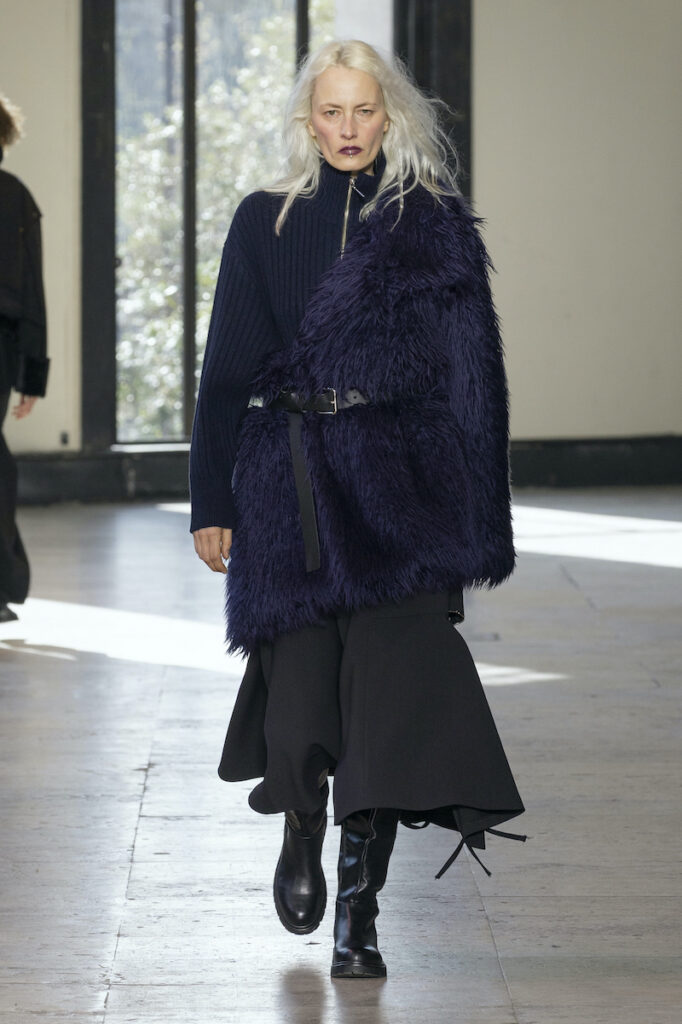
This conceptual rigour drives from in an almost artisanal approach to material. True to its philosophy, the house continues its deep textile research, this season highlighting fabrics produced on a 1960s Schöherr loom in Japan. Operating five times slower than modern machinery, the loom produces textiles with a distinctive tactile surface. A deliberate slowing down that stands in quiet opposition to the logic of speed and overproduction that defines much of the industry today. In one striking example, a diaphanous silver nylon ribbon is woven into black wool, creating a semi-transparent check. Elsewhere, coats and skirts in deep black and aubergine are finished with hand-snipped fringing, introducing a deliberately undone quality.

Rugged elegance & unexpected combinations


The garments that result are studies in rugged elegance. Unexpected fabric combinations abound. Delicate lace juxtaposed with the utilitarian character of an aviator jacket in faux suede and fur. Heavy metal zippers carve graphic lines across coats and tops, functioning not merely as closures but as sculptural elements that shape the silhouette.

Antithesis by Ujoh at Paris Fashion Week FW26.
Ujoh – Paris Fashion Week FW26.27

The palette remains restrained: chocolate, rosewood, fern green, and fig. Punctuated by flashes of optic white and beige borrowed from sharkskin suiting. Recurring check patterns evoke a subtle grunge sensibility. Yet the reference to the 1990s is less about nostalgia than attitude, expressed through layering, texture, and a studied nonchalance rendered with unmistakable Japanese precision.

At the core of the season, a collaboration with the Japanese duo DREAMS COME TRUE extends the collection beyond the runway. Designing stage costumes for their tour, Ujoh translates its tailoring language into performance, with select pieces in the collection emerging as direct continuations of this exchange between clothing and movement.

Final thoughts


The theme of antithesis in FW26 Ujoh’s collection extended even to the show’s format. Rejecting a fixed sequence, the looks appeared in a seemingly personal order, as if drawn from a lived-in wardrobe to be explored rather than a story to be followed. This liberated presentation encouraged the audience to consider each piece individually. An object of desire in its own right. While still belonging to a cohesive, beautifully unresolved whole.

In this sense, antithesis becomes less a stylistic device than a way of thinking. An ongoing negotiation between discipline and disruption, precision and instinct.

Antithesis, Ujoh at FW26 Paris Fashion Week Read More »

Changing shape, keeping the soul: twenty years of suite123

Reading Time: 3 minutes

On fashion, ideas, and the friendships that became bonds


Twenty years of suite123.
There’s a moment when you realise a space has become more than just walls. More than just a store, a studio, or an office. For us, that realisation took 20 years.

On March 15, suite123 turned two decades old. Anniversaries are strange things: they invite you to look back, but they also reveal how much has changed along the way.

suite123 began with fashion. Not simply selling clothes, but curating a point of view — pieces chosen because they carried something lasting. Clothes you wouldn’t tire of. Clothes that felt right.

suite123 was a place you went to.
A destination with its own atmosphere and energy.

Of course, the clothes mattered. But what mattered even more was how you felt when you walked out the door wearing them. That feeling was always the real point.

Somewhere along the road, fashion became something deeper for us: a language. We found ourselves not only interested in hemlines but even more interested in humans. And our relationship with the planet — our impact on it.

We realised we could use fashion as a lens to analyse society, understanding why we wear what we wear. How people live. What they believe. The choices they make. What gives meaning to everyday life.

During the pandemic, that is when suite123 moved.

Not down the street—but from a place to a perspective.

Ideas slowly joined fashion.
Research replaced routine.
Curiosity replaced seasons — and prepackaged concepts.

And with that, a philosophy took shape: ethics alongside aesthetics. Attention to the environment. A commitment to uniqueness. Garments well-made, chosen with care. Less, but better—not as restriction, but as intentional choice.

suite123 stopped being just somewhere you visited and became something you could carry with you — a way of looking at things, a small lens through which to observe the world.

Of course, you don’t shape-shift without friction. There were difficulties — many. Money tight. Health uncertain. Moments when the old path or the mainstream seemed the only possibility. When the new direction felt like a gamble rather than a necessity. Moments when change felt uncertain—
and still now, feels so.

But there were also discoveries. Research that opened unexpected doors.
Style that revealed deeper substance.
And conversations that turned into something more — even a book.

Because through all these years, the most important element has always been people.

Clients who became friends.
Encounters that became relationships.
Friendships that slowly turned into bonds. Unexpected, beautiful. 

Celebrating twenty years of suite123. Three arms intertwined, wearing the same chartreuse knit, seated on a green velvet sofa. A portrait of connection between the two of us from suite123 and a close friend.


Some of you have been with us since the beginning — since the racks, the fittings, the laughter in the boutique. Others arrived during the years of transition, when suite123 began to change shape. And some of you may have discovered us only recently, through a blog post or an Instagram story.

To those who stayed: thank you.
To those who understand the journey: you are the reason this evolution continues.

Twenty years later, suite123 is still evolving.
Still exploring fashion —  with garments worth keeping.
Still searching for ideas.
And still asking questions about what it means to be a modern human—with all the complexity, contradiction, and beauty that comes with it.

Changing shape.
Keeping the soul.

An independent voice in an increasingly corporate fashion system.

Still suite123.
The next chapter is still being written.

Changing shape, keeping the soul: twenty years of suite123 Read More »

Jean Paul Gaultier by Duran Lantink: when experiment fails to deliver the magic

Reading Time: 3 minutes

Deconstructing the hype: how Gaultier codes got lost in translation at FW26 Paris Fashion Week


At Fall/Winter 2026 Paris Fashion Week, Jean Paul Gaultier by Duran Lantink provoked mixed reactions. Some welcomed its playful spirit, while others raised harsher criticisms about its wearability.

The collection felt more like a pure exploration of creativity and technical possibilities. It reiterated several of Gaultier’s iconic concepts — masculine and feminine codes (what we now call genderless fashion), underwear as outerwear, sporty chic, and tattoo imagery. Yet, despite these nods, Lantink’s interpretation marked a clear departure from the brand’s traditional aesthetic.

To be fair, this FW26 collection appeared more resolved than Lantink’s first attempt. Still, the clothes didn’t feel like Gaultier. Instead of channelling the brand’s distinctive magic, the designer seemed to prioritise his own chaotic vision.

But what happens when the experiment fails to deliver the magic?

An experiment without the magic: Jean Paul Gaultier by Duran Lantink


Lantink proposed heavily exaggerated and distorted silhouettes: raised shoulders floating far away from the body, abstract S-shaped figures with jutting breasts and derrières. The result was sculptural, almost architectural — but also highly restrictive. (Watch the show here).

While some praised the collection as art or celebrated its playfulness, most pieces felt futuristic to the point of impracticality. They were statements, rather than garments meant to be worn.

And this is where the comparison with Gaultier becomes unavoidable.

Jean Paul Gaultier is the designer who taught us so much about fashion. Many of the concepts that are now widely celebrated — gender fluidity, the transformation of underwear into outerwear, the playful mixing of cultural references — were introduced by him forty years ago.

We remember it well. When we were young, we bought his clothes. Men’s or women’s, it didn’t matter to us. And we still have them in our wardrobe; they are perfect and even fashion-forward now. (Which raises another point: the most sustainable clothing is that which you never throw away — yet designers who focus solely on sustainability rarely achieve this kind of durability or appeal.) Later, we also curated Gaultier pieces for our boutique. His designs carried a particular energy — beauty, humour, and a certain magic. Yes, Gaultier could be strange. But even in its strangeness, his fashion remained wearable.

It’s impossible to say the same about Lantink’s pieces.

Which raises a broader question: this constant urge to reinvent, to shock, to create something radically new— where does it lead?

Final reflections


Ultimately, Jean Paul Gaultier by Duran Lantink felt more like an exploration of boundaries than a fashion collection. But when experimentation fails to deliver the magic, what remains? A display of creativity from which nothing survives beyond the runway. 

So we are left wondering: is Paris Fashion Week becoming a stage for unwearable clothes?

Of course, some brands have built their identity on that very idea — fashion as pure spectacle. But Gaultier was never one of them. His magic lived in the tension between fantasy and wearability.

Which leads to a more uncomfortable question: what’s the point of it in a world where nobody wants to buy well-made garments anymore?
A theatre piece with no purpose?

Jean Paul Gaultier by Duran Lantink: when experiment fails to deliver the magic Read More »

A point on sexiness: Haider Ackermann for Tom Ford, FW26 Paris Fashion Week 

Reading Time: 3 minutes

Gucci vs Tom Ford:  from mere provocation to seduction – what marks the difference


We recently explored the theme of identity at Milano Fashion Week, where Demna made a point about sexiness at Gucci.

It was the worst version of it.

As the fashion caravan moved to the Fall/Winter 26.27 Paris Fashion Week, we witnessed another interpretation—one that stunned for its precision and beauty. A perfect execution.

Demna’s debut was, undeniably, an ugly spectacle. He replicated the Balenciaga formula of distortion and cynicism, repurposing even the Tom Ford–era archives in a way that felt superficial and cheap. If his intention was to hold a mirror up to a grotesque contemporary aesthetic, he succeeded. But the question lingers: beyond provocation, what was the point?

For a brand in a serious downturn, the shortcut to quick sales has always been the most literal and commercial version of sex. But is provocation all that remains?

At Fall/Winter 26 Paris Fashion Week, Haider Ackermann for Tom Ford delivered a definitive answer.

He offered a completely different point on sexiness — a masterclass in elegance. Every detail felt precise: the cast, the music, the design, the tailoring.

Inside an all-white box, models of all ages wandered through a minimalist setting where tailoring and glamour came alive through a refined sense of style and colour. The show opened with a persistent sound that gradually intensified with the notes of Chopin’s Nocturne No. 20 — poignant piano and violin — ushering in an atmosphere of effortless seduction.

Sensuality emerged through androgyny and a play of opposites: razor-sharp masculine suits contrasted with the barest styling — a tiny belt on naked skin — and tapered, feminine evening gowns.

“My language here is that of seduction,” Ackermann stated. “Hard and soft. Sharp and enveloping.”

In fact, all contrasts emerged beautifully. With class. (Watch the show here).

Midway through the show, the words and music of The Beloved took over, underscoring the show’s ethos until the end:

Let’s come together / Right now / Oh yeah / In sweet harmony.

Final thoughts


At FW26 Paris Fashion Week, Haider Ackermann didn’t simply design clothes for Tom Ford; he created a sensual universe.

He proved his ability to evolve the brand while remaining faithful to its core DNA of desire and glamour. It was, without question, one of the most beautiful shows of the season. In doing so, he made a point on sexiness — quietly demonstrating to Mr Gvasalia the difference between sensuality and vulgarity. And he reminded us that sexiness is an art, not a provocation.

In a world increasingly defined by absurdity — where even governments announce war to the soundtrack of the Macarena — Ackermann offered a rare moment of beauty, elegance, and poise.

Let’s come together / Right now / Oh yeah / In sweet harmony.

A point on sexiness: Haider Ackermann for Tom Ford, FW26 Paris Fashion Week  Read More »