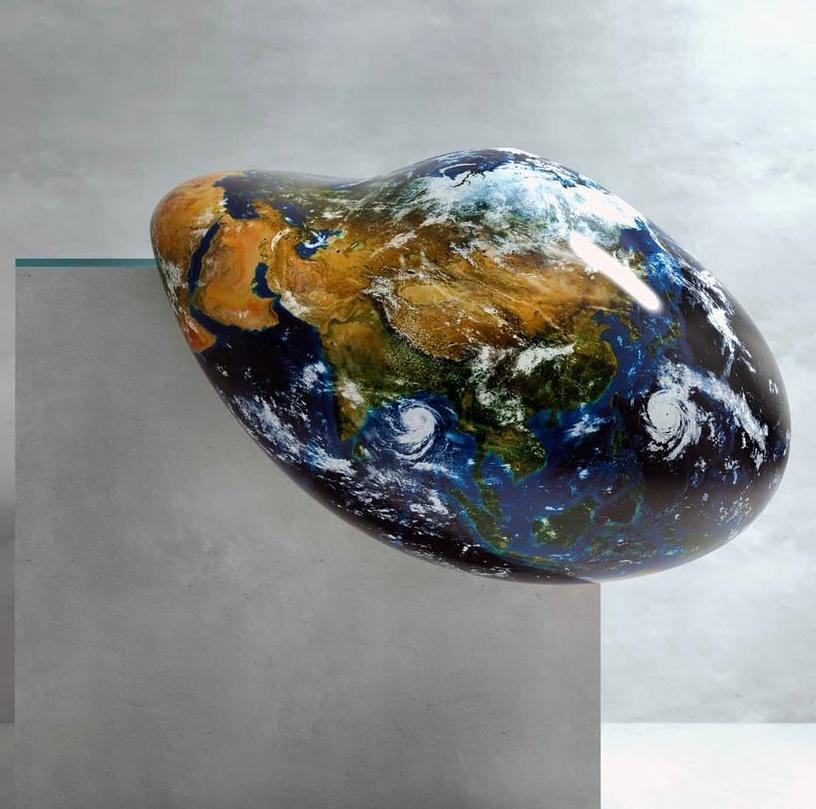
We got to a point where rethinking Earth Day becomes crucial. Indeed, if we continue at this pace, in a future devoid of resources, Earth Day will be remembered for the countless celebrations. But should we even celebrate?
Earth Day significance
April 22nd marks the annual recurrence of World Earth Day 2024, a global event dedicated to raising awareness and promoting environmental protection. This day is a powerful reminder of the critical need for conservation and sustainability efforts. The purpose is to inspire collective action towards a healthier planet and a more sustainable future.
Earth Day marketing
However, we received emails inviting us to purchase products to save the planet! Is this truly the extent of our commemoration? Another opportunity for product promotion? Is increasing sales an effective strategy against global warming? Is it the means to safeguard our planet? Earth Day promotions sound really weird!
For those striving for a sustainable lifestyle, which transcends the hollow slogans bombarding us incessantly, Earth Day holds no celebrations. In truth, there is little cause for celebration. What’s to commemorate? The devastation wrought by humanity? Or perhaps a brief respite? Certainly not!
The aim is to raise public consciousness, to instil the understanding that we have but one planet, and we must preserve and protect it. Mother Earth requires time to heal from the havoc we wreak daily, from the mountains of waste generated by our economic system, by our way of life! The devastation is the byproduct of progress, something we seem unwilling to relinquish.
Let’s face it. Unfortunately, Earth Day has become the ultimate marketing strategy to drive sales. But sustainable growth is a myth. Similarly, there can be no sustainable fashion or sustainable tourism without a significant reduction in consumption.
“What is needed in the first instance are reduced levels of consumption, not just changed patterns.” – Herman E. Daly.
In conclusion, brands may push marketing gimmicks to celebrate Earth Day 2024. Tourism, fashion, or any other industry may create its own sustainable bubble. But we will neither address nor solve any issue unless we are wholeheartedly committed–every day–to saving the planet by curbing our consumption.
So, let’s be serious: rethinking Earth Day means nothing to celebrate. We must raise awareness and take action!
Exploring tangible contrasts and ethical dilemmas in contemporary events
As the Milano Design Week concluded, we reflected on tangible distinctions with Fashion Week and delved into the pros and cons of the greenwashing effect evident in contemporary events.
The Milano Design Week is an annual event which serves as a platform for showcasing furniture, objects, creativity and ideas. This season’s theme, “Materia Natura” (matter nature), set the stage for contemplating the importance of environmental sustainability in the creative and design process. Also, running in parallel with the official “Salone del Mobile,” the Fuorisalone has experienced significant growth. As a result, every corner of the city boasted its own installations and events.
Blessed with beautiful sunny days, we immersed ourselves in numerous installations, many intertwined with fashion brands, just without the please-look-at-me foolishness. But a couple of reflections began to crystallise in our minds.
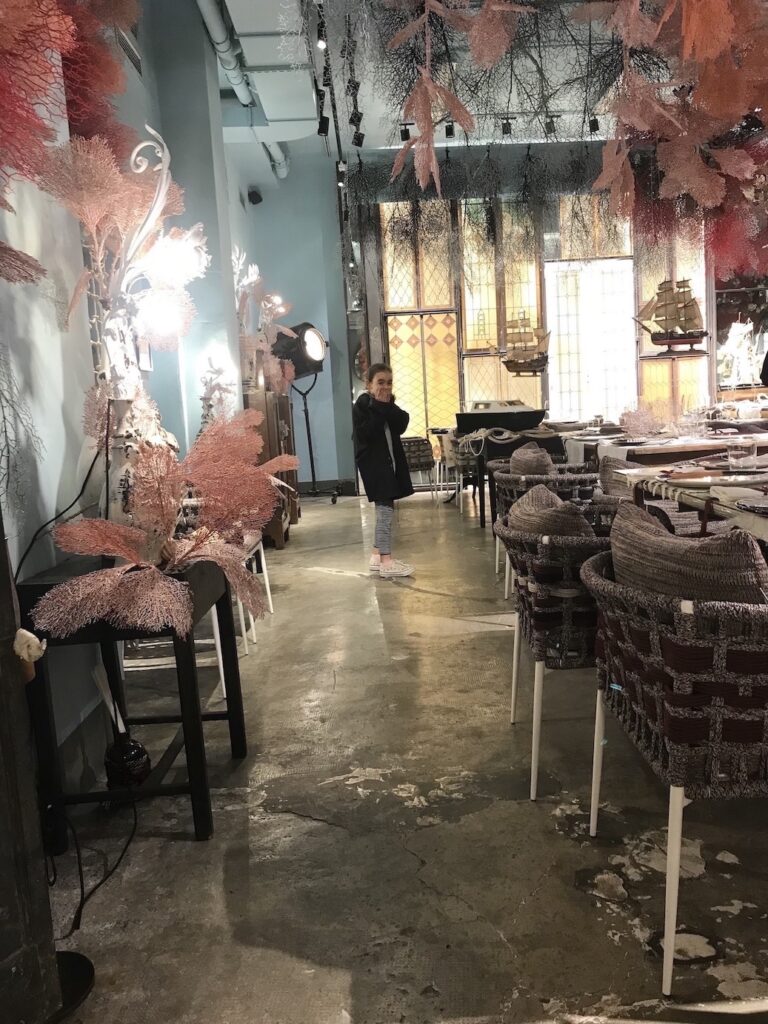
Milano Design Week – “Il mare dove non si tocca” by Antonio Marras
Milano Design Week & Greenwashing
The cons: 1 – The emphasis on sustainability often appeared to be mere greenwashing, given the excessive expenditure of money and resources without tangible environmental benefits. On the contrary, waste seemed clear. 2 – Some (fashion) brands participated simply to secure a spot on the list rather than with genuine needs. Indeed, this sentiment was palpable when the quality of the installation was just a way to invite people to stop by. Even among those who collaborated on a co-marketing initiative, the focus seemed to be just the marketing strategy.
Milano Design Week vs Fashion Week
The pros: 1 – In contrast to Milano Fashion Week, Design Week is more inclusive and open to anyone. And the atmosphere is way more enjoyable. 2 – The staff responsible for welcoming attendees and ensuring security exhibit a notably kinder attitude. Since Ro is a wheelchair user, we received acts of kindness during Design Week that we were not accustomed to compared to our experiences during Fashion Week. 3 – No fashion carnival, meaning no subjects begging for attention.
suite123 staff- Milano Design Week – “Il mare dove non si tocca” by Antonio Marras
However, we loved “Il mare dove non si tocca” (In the deep sea) by Antonio Marras. Upon entering the enchanting NonostanteMarras space, we encountered a temporary bar in the inner courtyard. Unfortunately, the arrangement of plants and tables left little room for a wheelchair to pass through. Witnessing our attempt, Antonio Marras jumped up and asked people to clear a path for us. Moreover, he kindly offered assistance if we wished to explore the basement area, where he showed his ceramics and a marvellous marine set-up for the restaurant area in collaboration with the Rana family. Also, we met the beautiful Antonella Rana, Global Image and Communication Director of Pastificio Rana. Antonio Marras’ caring attitude surprised us. Such unconventional behaviour for the fashion industry standards!
The Milano Design Week concluded amidst fusions with fashion and a deluge of greenwashing. Specifically, design wins over fashion for accessibility and courtesy, but sustainability sounds too much like greenwashing. In contrast, let’s shape events where creativity harmonizes with sustainability, inspiring and innovating without compromising our planet.
Embracing the up-and-coming wave of fashion designers
As we embrace the up-and-coming wave of fashion designers, we are thrilled to share our conversation with Aurora. Her first name doubles as her brand name (Aurora De Matteis); a young woman walking the fashion industry with a polite demeanor and a clear sense of an ethically run business.
We first met Aurora a couple of years ago at a fashion exhibition in the heart of Milano. Her universe, small, focused, and well-crafted, conveyed emotion to us. So we kept in touch until, finally, we placed an order. Indeed, we are leaders in uncovering talented designers committed to exceptional design, premium materials, and ethical practices.
Read our conversation with Aurora to find out more about the brand!
Aurora – the conversation
• How did your passion for fashion begin? What is your background? I always thought I wanted to do this in life because I always loved creating something with my hands. Actually, my mother passed down to me a certain passion; she taught me how to crochet when I was little. In fact, I used to make handmade crochet earrings. I’m passionate about handicrafts and artisanal work. I love the world of graphics, but after high school, I enrolled in Secoli Institute to get a technical background in fashion. I did well in pattern making, learning to make a whole garment. My passion for manual work led me to take a knitting course recently. Learning new skills stimulates me; in this sense, I never stop.
• What inspired you to start your slow fashion brand, and what values do you aim to promote through your designs? After graduating from fashion school, I could work for big companies where I would have focused on just one specific thing, like being a pattern designer. But I like to explore, research materials, so, despite all the difficulties, I chose to launch my own brand. Mine is a brand that believes in slow fashion, which means attention to fabrics and well-made garments, things big brands often overlook. But, above all, it’s a brand that aims to convey the value of the time needed to create a handmade garment in a small workshop. Time, quality, and ethics are values I believe in.
Aurora Spring-Summer 24 collection
• What is your vision of style? Can you share insights about your design philosophy and how it aligns with the concept of slow fashion? “Less is more” is a concept resonating deep within me. A quote from Mies van Der Rohe explains it all: “Please, do not confuse simple with easy, there is a big difference. I love simplicity because of its clarity, not because of its ease or for other reasons. To achieve clarity we must simplify practically everything. It’s hard work. You have to fight, and fight, and fight.” Indeed, this process of distilling from complexity to essentiality is what I find interesting.
Minimalism reconnects to my pattern-making studies, garment construction. Specifically, making it distinctive in terms of construction. Instead of prints or decorations, I prefer to create colour blocks because I focus on lines and shapes. However, this design concept perfectly aligns with my vision of slow fashion because it allows me to emphasize the quality and longevity of the garment through a timeless style. ‘What’s in fashion this year?’ has always puzzled me. Who decides that? Today, talking about fashion can be chilling, with unwearable clothes and exorbitant prices.
• How do you ensure sustainability and ethical practices in your production process? Many stop at the labels, but natural doesn’t mean sustainable. For instance, see natural viscose. It may be natural, but it has a significant environmental impact. I focus more on quality materials. And I only work with suppliers who don’t impose high minimums. Moreover, I produce without waste in a small artisanal workshop, ensuring ethical and sustainable manufacturing because I make limited quantities. I myself sew in my workshop in Turin. Everything is made in Italy, in small batches. I am against overproduction. Indeed, the concept of limited quantities is crucial to limit our impact on the environment.
• How do you evaluate conversations about sustainability? Superficial. In fact, I don’t say that my brand is sustainable, I demonstrate it through actions. Often I’m asked: ‘Is this all you have?’ Yes, exactly: a capsule collection, thoughtful and well-made.
• What challenges have you faced in establishing your brand within the competitive fashion industry? The showrooms have asked me to do things from their point of view without considering my project. They are seeking the product, not the idea. Just to sell more. My way of working was almost belittled. It shows a certain lack of attention from industry operators because if you want a massive production, you don’t go to an emerging brand.
• Do you think enough space is given to young people in Italy? Unfortunately, Italy is an old country, doesn’t give space to young people.
After reviewing her Spring-Summer 24 collection, we were impressed by the precise cuts and fresh take on fashion. Also, we discovered each other within a philosophy that felt familiar: a shared vision of design and meaning. So, we hope you enjoyed our conversation with Aurora. In the end, isn’t it time to give space to the new generation of creatives?
So stay tuned to discover more about Aurora designs #formodernhumans
Earthsight Ong linking european giants to illegal activities in Brazil
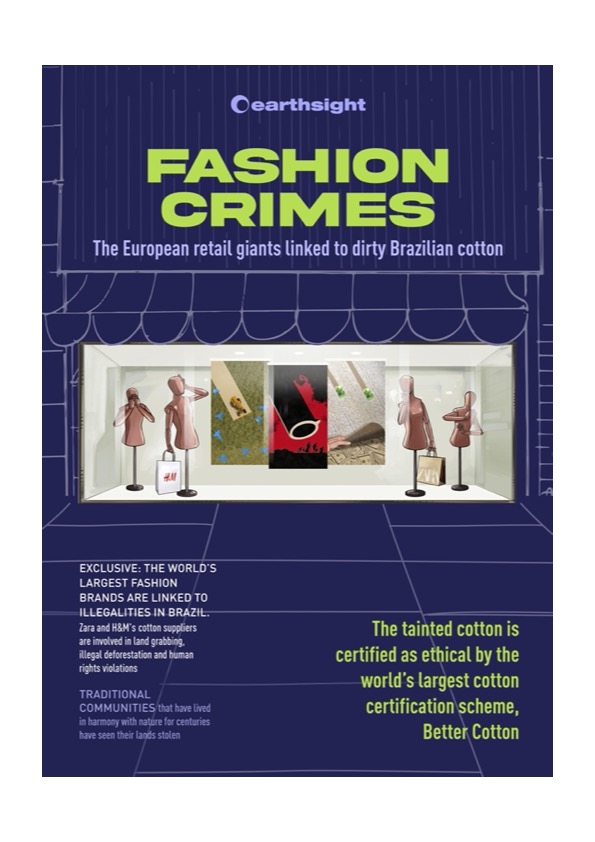
According to the British NGO Earthsight, the cotton used by textile giants H&M and Zara to produce their clothes is dirty cotton.
Specifically, the NGO alleges that the two European brands are complicit in large-scale illegal deforestation activities in Brazil, including land grabbing, human rights abuses, corruption, and violent land conflicts. But this revelation is particularly alarming as it implicates Better Cotton, a certified sustainable cotton label. If you heard us say certifications worth zero, here’s the proof.
Using satellite imagery, court decisions, product shipping records, and undercover investigations, Earthsight has compiled a report titled ‘Fashion Crimes.’ The result is a damning portrait! Cotton certified as ethical by the world’s largest certification system, Better Cotton, is found to be contaminated by numerous environmental offences. Also, this cotton is exported to various Asian manufacturers, producing approximately 250 million clothing items and household articles annually for H&M, Zara, and their sister brands’ global stores.
The NGO has tracked the journey of 816,000 tons of cotton from two of Brazil’s largest agroindustrial companies, Horita Group and Slc Agrícola, in Western Bahia. Traditional communities lived in harmony with nature. But greedy agricultural companies serving global cotton markets attacked them and robbed their lands. The Brazilian families who own these lands have a lengthy history of legal proceedings, convictions for corruption, and multimillion-dollar fines for illegal deforestation.
Some of these illicit activities take place in the Cerrado region, a savanna renowned for its rich fauna and flora, constituting the second most important biome in Brazil. The Cerrado, which hosts 5% of the world’s species, saw a 43% increase in vegetation destruction in 2023. The clearing of Cerrado trees for agriculture generates carbon equivalent to the emissions of 50 million cars each year.
Environmental protection is a key issue for the European Union, which has included the new European Deforestation Regulation (Eudr) in the Green Deal. A program against climate change that encourages the consumption of certified raw materials and imposes restrictions on the importation of those produced in deforested regions.
“Earthsight’s year-long investigation reveals that corporations and consumers in Europe and North America are driving this destruction in a new way. Not by what they eat – but what they wear.”
Better Cotton: certifications & greenwashing
In conclusion, the NGO points the finger at Better Cotton, the world’s largest ‘ethical’ cotton certification system, with the raw material exposed as dirty cotton. Therefore, contaminated by various environmental offences. “BC has been repeatedly accused of greenwashing and criticised for failing to allow for full traceability of supply chains.”
Therefore, can we trust sustainable labels? No, of course not! Left alone, labels and certifications mean nothing. In fact, they are frequently used to mislead people. So, they are just greenwashing. Moreover, selling more green products is a strategy to support the overproduction model. So, it won’t solve any issue. (Download “The sustainability basics” checklist here).
Even though brands like Zara and H&M might use sustainable materials, the massive quantities they produce would nullify the sustainable effort. Why isn’t this clear? The solution is plain: we must produce and consume less. It’s the only viable strategy in the face of such devastation. Consumers play a crucial role in perpetuating these harmful practices, often unknowingly. By reducing our consumption and demanding accountability from brands, we can make a real difference in protecting the environment and promoting sustainability.
While uncovering dirty cotton practices is crucial, it’s imperative to recognize that consuming less is fundamental for sustainability. Consume less: this is the action we must take now!
There’s a statement we often repeat: luxury is dead. Though some view this claim incredulously, our perspective isn’t mere hyperbole. In fact, the recent Giorgio Armani controversy underscores this assertion.
What is luxury?
Luxury is about exclusive designs crafted in limited numbers–not mass-produced items. Since all top brands produce their garments in huge quantities,they stopped making luxury long ago. Also, all high-end brands are so overexposed you can see them everywhere, which collides with the idea of luxury itself. Thus, luxury is dead.
Fashion industry, luxury and forced labour
Our exploration of the fashion industry’s connection with forced labour revealed that luxury brands lag significantly behind in efforts to reduce forced labour. (Read our post: “Behind the seams: fashion industry and forced labour”).
It is appalling to even consider the idea of ‘reducing forced labour’, as it implies a tacit acceptance of the exploitation of workers.
This revelation challenges the conventional perception of luxury, especially when juxtaposed with the exorbitant retail prices of their products. But as we said so many times, luxury and fast fashion are two faces of the same coin, just for different budgets.
Luxury is about skilled craftsmanship and quality materials, excellence made in limited quantities. But mass-produced garments and accessories with marketing manipulation, have created a fake luxury. Therefore, a bubble for people who need to feel safe behind a brand but have no understanding of quality. Both luxury and fast fashion follow the same pattern.
How luxury lost its way
When fashion businesses went from family-owned companies to big luxury conglomerates, the only luxury available was the one in the segment’s definition. Involved in overproduction to maximise profit, the figure of craftsmen tended to disappear. But how do brands grow profit? Exploiting workers and the planet, selecting poor quality materials to make products that get a touch of class thanks to packaging and opulent locations. So, by selling a dream–illusionary luxe–they generate high margins.
In short, the transformation of fashion maisons from family-owned businesses to profit-oriented conglomerates has eroded the essence of luxury, reducing it to a mere label devoid of substance.
Overproduction, exploitation, and unskilled craftsmanship taint today’s luxury fashion. The disappearance of the artisan in favour of cost-cutting measures and mass production has altered the fashion industry’s foundations. What was once synonymous with exclusivity and elegance has been diluted into a hollow semblance of its former self.
Redefining luxury
As designers, retailers and consumers, we must redefine our notion of luxury. Is it about status symbols and price tags? Or should it embody integrity, authenticity, and ethical practices? Let’s challenge the status quo and demand accountability from brands. True luxury isn’t about the price tag or the logo. It’s a commitment to craftsmanship, adequately paid, skilled hands, high-quality materials and exclusivity.
No luxury can exist at the cost of human dignity. Let’s vote with our wallets and support brands that uphold these values. Together, we can reshape the narrative of luxury for a more ethical future.
While the fashion industry grapples with its own contradictions in a state of therapeutic obstinacy, we assert that traditional luxury is dead. Ultimately, it becomes clear that principles rather than mere price points and status symbols define true luxury #formodernhumans.