Explorations

Kimia Yousofi: Platform, Leadership and Values

Reading Time: 4 minutes

Championing the right to empowerment


The journey of Kimia Yousofi at the Paris Olympics provided much food for thought on the concepts of platform, leadership, and values. In today’s world, having a platform seems to be everything. Whether the content is authentic or not, few seem to care. You can be uninformed – often the case – but if you have a platform, doors open. You’re in!

Unfortunately, the contemporary idea of a platform often equates to a superficial social media presence. However, we believe that a true platform and leadership are about much more than showcasing a new handbag, your body, or spewing hate towards anyone who doesn’t fit the mainstream mould.

This is why Kimia Yousofi has become one of our favourite athletes: she used the Olympic platform to express her sense of leadership and values.

Kimia Yousofi’s Paris 2024 Olympics inspiring experience


At the Paris 2024 Olympics, Kimia Yousofi ran the slowest time in her preliminary round of the women’s 100m competition. Having already competed in Rio de Janeiro and Tokyo, this was her third Olympics. Yousofi finished with a time of 13.42 seconds, slower than the 13.29 she ran in Tokyo.

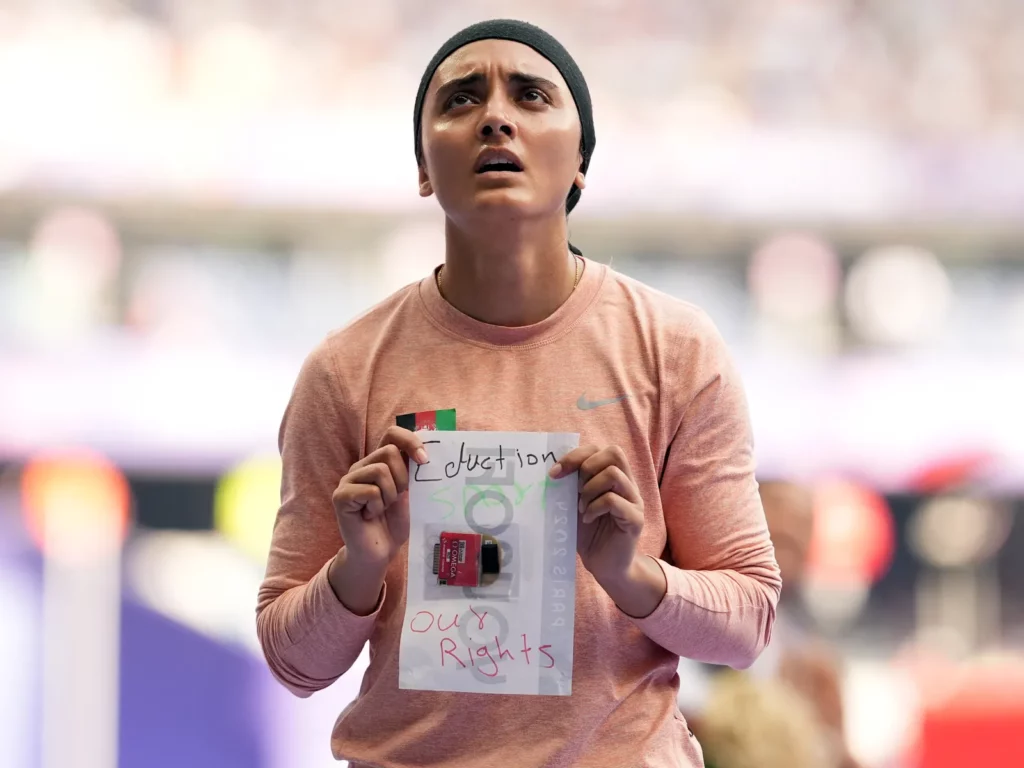
Most athletes might feel disappointed at this point, but for Yousofi, this race was just the beginning. As the competition concludes, she removes the bib pinned to the back of her jersey, proudly displaying the red, green, and black emblem of Afghanistan. Then, she turns the bib around, eager to show the camera what is written on the other side. It’s crucial that people see it.

“Education, Sport, Our Right,” it reads.

image of Kim Yousofi holding a card which reads: "Education, Sport, Our Rights."


“Of course, the Olympic Games are a big dream for every athlete, not just for me. I’ve competed in the Tokyo Olympics and the Rio Olympics. But back then, I was running just for myself, because I loved to run. Now, I’m here for Afghanistan’s girls. I almost forgot my dream. I almost forgot everything. And I worked hard for three years, but all of this is for Afghanistan’s girls,” she says.

“I was in Kabul when the Taliban came. And I wanted to stay because I felt I belonged to this country. My people needed me. But many told me they couldn’t guarantee my safety. I was a woman with a public face because I had carried the flag of Afghanistan just a few days before. So I had to flee. I went first to Iran, and then Australia helped me get a visa to go there,” she added.

Ever since the Taliban took over the country, girls have been banned from even studying. “Our girls in Afghanistan, our women, want their basic rights—education, the ability to play sports. They want to be treated as human beings. They want to be able to decide what to do with their lives. These rights have been taken away from them for the last three years. I’m fighting for that.”

Kimia Yousofi and women’s rights


Despite not being in peak physical condition, Yousofi ran. Although she had prepared well for the Olympics, she developed an allergy in the weeks leading up to the event and then injured her right knee just before the race. “My knee was really sore, but I told myself I’m just going to run. I kept icing it and took pain tablets to manage the pain. But I had to run.”

She will do all of this to remind Afghan girls that there is another world out there. “I have a message for Afghan girls. Look for opportunities, and then use them. Even if you get a small one, use it. Don’t give up. Don’t let others make your decisions for you,” she says.

So, if having a platform is the most important thing today, she secured a powerful one! Platform, leadership, and values – all at once. Kimia Yousofi won!

Kimia Yousofi: Platform, Leadership and Values Read More »

Earth Overshoot Day 2024 & Fashion

Reading Time: 2 minutes

Considerations for shopping, overconsumption and the imminent buying season


August 1st marked Earth Overshoot Day 2024, meaning that in just seven months, we have consumed all the resources the planet can regenerate in a year. What does this mean for the fashion industry and our lifestyle?

The fashion industry is characterised by overproduction and excessive shopping. While brands aggressively promote overconsumption, consumers are often caught up in the desire to buy more, driven by frivolous thoughts. Only a few people consider deeper, more sustainable practices. As we enter the eighth month of the year, we have already used up the natural resources the Earth can regenerate annually. This means that from now until December 31st, we will be depleting resources that the Earth cannot naturally replenish.

Overshoot Day: Understanding calculation and global impact


Overshoot Day is calculated by determining the number of days Earth’s resources can sustain humanity’s ecological footprint. In simpler terms, we take the planet’s biocapacity – the amount of ecological resources the Earth can generate in a year – and divide it by our annual ecological footprint – the amount of natural resources humans consume in a year. This result is then multiplied by the 365 days of the year.

The ecological footprint varies by country because each nation has different amounts of resources and uses them in various ways, such as land for agriculture, water reserves, electricity, and marine areas. Therefore, each country has its own Overshoot Day.

This year, the first country to exceed its ecological capacity was Qatar (February 11), followed by Luxembourg, the United Arab Emirates, and the United States. Italy wasn’t far behind, reaching its Overshoot Day on May 19. The last countries to exceed their ecological capacity this year will be Indonesia and Ecuador on November 24, 2024.

Conclusion: Earth Overshoot Day & Fashion


Given that in just seven months we have already consumed the natural resources the Earth can generate in a year, it begs the question: are sustainable brands planning to stop their production? On what basis can we begin the buying season for fashion stores? And how can people continue to consume, travel, and live excessively while ignoring this fundamental fact?

What the heck are we doing? Perhaps, a true understanding of it should make us stop everything and pause. It should compel us to reconsider not only the fashion industry but our lifestyle as a whole.

But you can sleep well; no one will move a finger.

Earth Overshoot Day 2024 & Fashion Read More »

Fashion Reshuffling: The Game of Musical Chairs and its Impact on Consumers

Reading Time: 2 minutes

An industry lost in translation, struggling to grasp the change


These days, we are witnessing a fashion reshuffling, a game of musical chairs that mirrors the unserious behaviour of politics. Indeed, by hopping from chair to chair, trying not to lose visibility or power, fashion imitates politics.


The turbulence of fashion creative directors’ reshuffling


Recent news reports that Peter Hawkings is stepping down from his role at Tom Ford, Galliano will exit Margiela next autumn, and Virginie Viard has just left Chanel. Where are they headed next? Here and there, come and go. The industry is abuzz with speculation. In fashion, as in politics, enjoy the game!

This excessive mixing has significant effects: brands lose consistency, and consumer trust erodes. In fact, the original design codes and unique DNA that identified each Maison become blurred, making the brands look all the same. But egos are bigger than ever in the fashion industry. And so, keeping the chair – whatever it is – is the ultimate goal for designers.

Entering the era of creative directors frequent changes


It seems we are entering an era of frequent changes in fashion Maisons. This constant reshuffling and the game of musical chairs is becoming the norm. While a designer moving to a new brand might result in a short-term revenue boost, in the long run, brands lose consistency and integrity, risking their image. But for many designers, this game is the lifeblood of their egos.

However, the market for luxury goods is slowing down. Even strong brands and corporations struggle mainly because of the declining demand from Chinese and US clients. Additionally, a probe has linked brands such as Armani and Dior to sweatshops. Of course, they are not the only ones exploiting labour. Sadly, the practice is familiar to modern corporations. So talking about who goes where is the easiest way to avoid discussing these fundamental issues.

In light of this, we wonder: can the CEOs feel the deep change occurring in the fashion industry? Can they sense the earthquake shaking the foundation of a fashion system that has lost its way? Is it possible that consumers are realising luxury is no longer what it once was?

Conclusion


In conclusion, to combat the industry’s slowdown, fashion houses are increasingly relying on the vision of creative directors, leading to frequent rotations at the helm of major Maisons. However, this fashion reshuffling addresses only a symptom of a much deeper issue: the loss of luxury’s true essence and the collapse of an outdated and inflexible system. Ultimately, can the industry believe that this game of musical chairs will resurrect the fortunes of its once-glorious past?

Fashion Reshuffling: The Game of Musical Chairs and its Impact on Consumers Read More »

Fashion Devastation and Mindless Shopping

Reading Time: 2 minutes

Another example of people’s inaction in hunting for cheap clothing


Last week, we witnessed yet another TV program highlighting the immense devastation caused by the fashion industry and mindless shopping. This time, the focus was specifically on the fast fashion and ultra-fast fashion segments, although the issue pertains to the fashion system as a whole.

The program “Newsroom,” titled “Buy, Wear, and Toss,” covered aspects we’ve discussed repeatedly. Indeed, there was nothing new.

“Every year, 150 billion new pieces of clothing are produced worldwide, sold at rock-bottom prices, and of increasingly poor quality. They are worn only a few times, then end up at the back of the closet and are never used again. But what happens when we get rid of them? Where do all these clothes end up? The episode follows their long journeys to Ghana – where they pollute the beaches and the ocean – and the Atacama Desert in Chile, magnificent places that have become immense open-air dumps. Behind every t-shirt sold for a few euros, there is not only pollution but also the exploitation of low-cost labour and a huge business on which organised crime has also set its sights.”

Fashion devastation means overproduction, overconsumption, waste, pollution, exploited workers and modern-day slavery. We have explored these topics in detail in previous posts:


Conclusion


These are just a few examples, as we frequently share news, information, and thoughts on these crucial matters. Indeed, discussing style without setting priorities would be naive and utterly pointless.

In the end, no piece of clothing that costs just a few euros comes without the exploitation of a worker. However, one image powerfully captured the fashion devastation and mindless shopping: a man standing on heaps of garbage, mountains of clothing piling up, holding a tag from a certified green company. Sad irony! The consequences of mindless shopping in the Global North significantly impact the Global South. That conveys a clear idea of how fake the façade of sustainability in the fashion industry is.

While we are glad to see these issues gaining attention, as we have explored over the past five years of blogging, we feel a sense of bitterness in realising that nothing ever changes.

Fashion Devastation and Mindless Shopping Read More »

Exclusive Slow Fashion in Small Batches

Reading Time: 2 minutes

Good design & thoughtful lifestyle #ForModernHumans


What do we do?


We offer exclusive slow fashion in small batches, carefully selected from independent international designers, with a particular passion for Japanese brands. Our selection intentionally offers limited pieces to ensure uniqueness and a sustainable approach. Indeed, to minimise waste, we limit the quantities of pieces we order. Also, we reduce packaging to the essentials. Our aim is not to accumulate more but rather to prioritise quality over quantity. So, it is not whether an item is from the current season or not, but rather it is about whether it is truly worth having. It’s about enduring value.

Why do we do it?


The traditional fashion industry model, focused on endless growth, overproduction, and rampant consumption, is no longer viable. Game over. With 2024 potentially surpassing 2023 as the hottest year on record due to human-caused climate change, the need for a different approach is urgent. We must make a change.

Who is it for?


Our approach isn’t for everyone. If you don’t see a problem with overconsumption, disposable garments, frequent flights, constantly upgrading tech devices, and so on, our offerings may not resonate with you. However, if you recognize the urgency of climate breakdown and believe in the necessity of change, you’ll find kindred spirits here.

Our selections are for those who reject business as usual and understand the importance of respecting planetary boundaries. We cater to individuals who are passionate about discussing climate change, ethical business practices, and a thoughtful lifestyle. If we fail to understand and operate within these limits, we risk heading towards extinction.
Change must happen now, not later.

Evolved fashion design must start from this awareness. A meaningful lifestyle begins here. Our exclusive slow fashion in limited pieces reflects this ethos: encouraging questions, finding solutions, and sharing meaningful ideas.

Exclusive Slow Fashion in Small Batches Read More »