Explorations

Unsold stock destruction: EU ban now in force. Why are legislators tackling the outcome instead of the cause?

Reading Time: 4 minutes

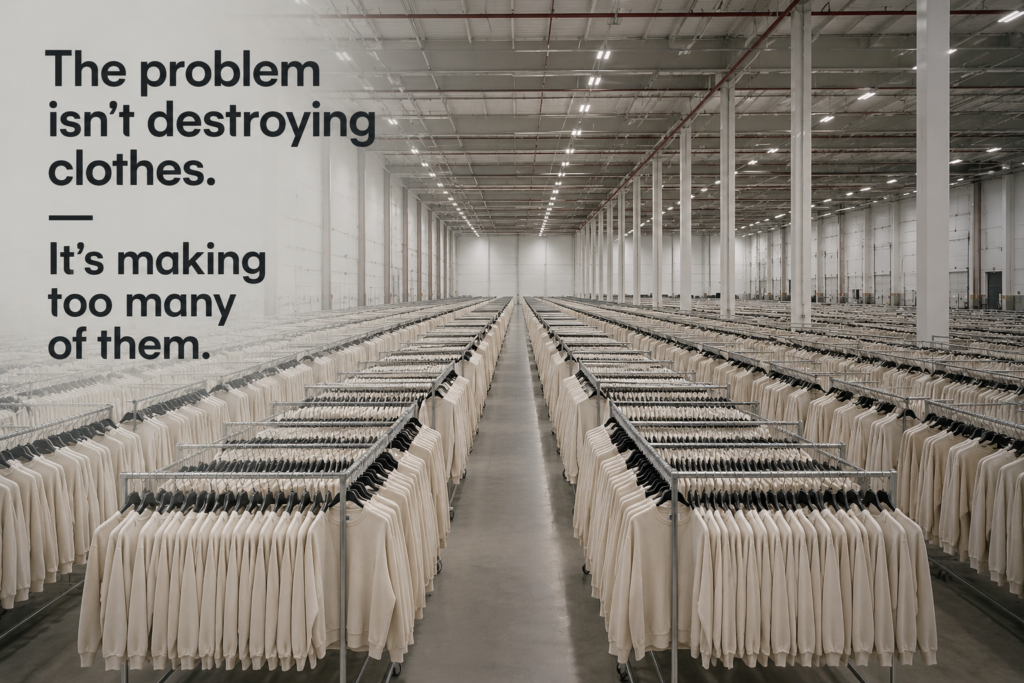
Fashion still has one problem legislators chose not to solve: overproduction


The EU ban on unsold stock destruction has now come into force.

Under the Ecodesign for Sustainable Products Regulation (ESPR), large companies are no longer allowed to destroy unsold clothing, clothing accessories and footwear. The measure aims to reduce textile waste and encourage more circular ways of managing excess inventory.

Instead of destroying unsold products, companies are encouraged to improve stock management and explore alternatives such as resale, donations, remanufacturing and reuse.

The ban applies to large companies from 19 July 2026, while medium-sized companies will have to comply from 2030. Destruction remains possible only in specific, justified circumstances, including safety risks, irreparable product damage and counterfeit goods.

Related post: Destruction of unsold textiles: a historic ban… with many loopholes

There is no doubt that preventing perfectly usable garments from being destroyed is a positive step. Every year, between 4% and 9% of unsold textiles in Europe are destroyed before ever being worn, generating millions of tonnes of unnecessary CO₂ emissions.

Warehouse filled with identical garments illustrating the problem of unsold stock destruction.


Unsold stock destruction: treating the symptom


The regulation addresses what happens after clothes remain unsold.

It does not address the question that comes before everything else:

Why are so many garments being produced that they become waste in the first place?

Overproduction remains fashion’s structural problem.

Brands continue to manufacture collections at a pace that exceeds real demand. The result is predictable: discounting, returns, excess inventory and, ultimately, disposal.

Better inventory management can reduce some waste, but it does not challenge the production model itself. As long as brands continue to rely on high volumes and constant product turnover, unsold stock will remain an inevitable consequence.

The problem is amplified by online retail, where high return rates create another layer of excess stock. Returned garments may be difficult or too costly to inspect, repair and resell, pushing companies towards disposal or lower-value solutions.

This is why the issue is not only what happens to unwanted garments at the end of their journey. It is also how many garments enter the market in the first place — and whether the fashion system is designed around genuine demand or around continuous growth.

If too many garments continue to be produced, banning their destruction changes what happens at the end of the process, but not the business model that creates the surplus.

The risk of shifting the problem


The regulation also includes exemptions, allowing destruction in justified cases such as safety concerns, damaged products or counterfeit goods.

It also requires companies to disclose the volumes of unsold goods they discard, improving transparency.

These are important safeguards, but they do not eliminate every risk.

Unsold products can still be exported, downcycled into low-value materials or redirected into opaque secondary markets. Preventing destruction is easier than preventing waste from simply changing form.

Final thoughts


The ban on unsold stock destruction is an important environmental measure. Destroying perfectly usable clothing has long been one of the fashion industry’s most indefensible practices, and banning it is long overdue.

Yet the regulation addresses what happens after overproduction has already occurred. It manages the surplus, but not the system that creates it.

The fashion industry’s environmental crisis does not begin with burning garments or disposing of unsold stock. It begins much earlier, with a business model that rewards ever-increasing production volumes, encourages rapid product turnover, and ultimately generates more clothing than the market can absorb.

In this context, the ban treats one of the industry’s most visible symptoms rather than its underlying cause. It may achieve exactly what it was designed to do, but what it was designed to do is too limited to tackle fashion’s structural environmental problem.

A truly sustainable fashion policy would also ask a more fundamental question: how much clothing do we actually need? That is where concepts such as sufficiency and degrowth become relevant — not because they advocate stopping the production of clothing, but because they challenge the assumption that producing more is always compatible with sustainability.

Until overproduction becomes part of the political conversation, Europe will continue making fashion less wasteful without necessarily making it sustainable. 

Unsold stock destruction: EU ban now in force. Why are legislators tackling the outcome instead of the cause? Read More »

Italian luxury fashion investigation: Milan court expands probe

Reading Time: 4 minutes

Labour exploitation in the high-end segment of the fashion system


Reuters reports that Italian police have visited the headquarters of nine high-end fashion firms as part of the Italian luxury fashion investigation into the alleged exploitation of workers employed by subcontractors. Officers requested documents relating to corporate governance and supply chain controls.

In December 2025, the investigation had already involved thirteen other brands, including Dolce & Gabbana, Gucci, and Prada.

This time, the companies that received the orders are Brunello Cucinelli, Moncler, Chanel, Bulgari, Jacob Cohen Company SPA, Etro, Stefano Ricci, Goyard Italie and Owenscorp Italia.

These brands became linked to the probe after authorities found subcontracting records and goods traceable to them during previous searches of two Chinese-run workshops accused of exploiting undocumented workers.

None of the companies is currently under criminal investigation, nor have prosecutors sought court-ordered administration for any of them. Most of the firms did not immediately reply to requests for comment. Chanel said it is cooperating with the Italian labour investigation and has terminated its relationship with the subcontractor.

The two Chinese-run workshops made garment bags, shopping totes, and pouches for Brandart and F. VL., both of which were raided by the Carabinieri. Those suppliers passed the goods directly to the nine fashion brands, which sold them under their own names.

Carlo Capasa, president of the Camera Nazionale della Moda Italiana, described these as isolated cases. The growing number of brands linked to the investigation suggests otherwise.

More importantly, these investigations reveal the production model behind luxury fashion.


Italian luxury fashion investigation illustrated by an empty textile factory with rows of industrial sewing machines.

The subcontracting labyrinth


Although these investigations are unfolding in Milan, the dynamics at play are anything but local. What we are witnessing is a global production model built on opacity. The exploitation uncovered among subcontractors serving luxury brands is not an exception — it is the predictable outcome of layered supply chains designed to reduce costs while distancing brands from legal and reputational responsibility.

Every additional layer of subcontracting increases the distance between the brand and the factory floor, making accountability progressively harder to establish while labour costs continue to fall. Brands can legitimately claim they had no direct relationship with the workshop where abuses occurred, even though those workshops ultimately exist to produce their goods.

This mechanism is hardly unique to fashion. Similar structures operate in electronics, agriculture, logistics and automotive manufacturing. Wherever relentless cost reduction becomes the overriding objective, labour is usually the first variable to be squeezed.

The financialisation of luxury


Luxury fashion has changed profoundly over the past few decades. Once dominated by family-owned ateliers centred on craftsmanship, the industry is now largely controlled by listed groups and investment-driven owners. Growth targets, quarterly earnings and shareholder expectations increasingly shape business decisions. Fashion houses have become financial assets as much as cultural ones.

Sweatshops and luxury fashion are therefore not disconnected realities. They are products of the same economic logic: maximise margins, outsource costs and push production through increasingly fragmented supply chains. These investigations do not expose an isolated failure — they reveal a system operating as intended.

Within such a model, ethical production becomes difficult to sustain because commercial pressure continually rewards lower costs over greater transparency. There are only varying degrees of responsibility.

Final thoughts


The Italian luxury fashion investigation highlights that these cases are not isolated incidents but symptoms of a production model built on fragmented supply chains. Whether it will lead to lasting structural change remains uncertain.

Previous investigations have also shown that closing individual workshops does not necessarily dismantle the system. Suppliers can disappear, reopen under different names, or continue operating for different clients, while the economic incentives that created the problem remain unchanged.

This is neither an Italian problem nor one unique to fashion. It reflects an economic model that systematically pushes production towards the lowest possible cost while distancing brands from responsibility. Until that underlying structure changes, similar investigations will continue to emerge — not only in fashion, but across industries built on the same logic. And each time, the response will sound familiar:

We didn’t know.

Italian luxury fashion investigation: Milan court expands probe Read More »

Hype — can it really sustain fashion brands?

Reading Time: 5 minutes

How independent labels struggle when hype isn’t enough to sustain a business in a weak market


When hype fails to pay the bills, the party is over for fashion brands.

For decades, the fashion industry has been obsessed with one currency: noise. We have watched brands skyrocket to fame based on a viral logo, a celebrity sighting, or a sell-out drop that crashes websites. But recently, the music has stopped for some of the industry’s most beloved “cool” kids.

The recent news of Sunnei’s bankruptcy and Marine Serre entering judicial receivership seeking court protection has reverberated through the independent fashion scene. These weren’t obscure brands struggling for relevance. They were influential labels that appeared to be doing everything right from the outside.

Their situations are different, but both illustrate how creative success and commercial resilience are not necessarily the same thing. A brand can remain culturally relevant and still face a business crisis.

Both Sunnei and Marine Serre have been darlings of the fashion week circuit. They have built their reputations on the pillars of modern success: scarcity (or the illusion of it), buzzy collaborations, and an impressive list of celebrity supporters. They understood the algorithm. Yet, understanding the algorithm didn’t stop them from hitting a wall.

This led us to ask a critical question: what is hype, really? And more importantly, can hype alone sustain a fashion business?

Graphic reading "Visibility isn't viability," capturing the article's key takeaway that hype in fashion doesn't equal business sustainability

The hype curve


To understand the crisis, we have to understand the mechanics of hype. Hype is a rocket, not a foundation. It propels a brand from obscurity to prominence at a speed that traditional luxury houses could only dream of.

But here is the harsh reality many independent labels eventually face.

As attention grows, brands often interpret rising visibility as permanent demand. They hire staff, expand production, increase investments, expand into new markets, or launch new projects, expecting growth to continue.

What many don’t anticipate is that hype follows a predictable curve. Once a brand reaches its peak, a natural correction is almost inevitable. But if a business has been built on the assumption that demand will continue indefinitely, even a normal decline can quickly become a serious problem. The mistake is assuming that attention automatically translates into long-term business growth.

This observation isn’t just theoretical. It comes from our experience working with emerging brands over the past two decades, combined with continuous analysis of the fashion system.

Hype may create extraordinary visibility, but visibility alone cannot sustain a business over time. The paradox is that when everyone is talking about a brand, exclusivity can start to disappear. Early adopters move on to the next underground name, while consumers who bought into the brand for its status begin looking elsewhere. The peak is followed by a hangover, and that hangover can be brutal.

Most importantly, visibility doesn’t automatically translate into sales. Media attention, celebrity endorsements and viral moments may generate awareness, but they don’t necessarily create loyal customers or sustainable revenue. Likes don’t pay suppliers, and headlines don’t guarantee repeat customers.

The conglomerate safety net vs the independent tightrope


The most dangerous aspect of this cycle is the lack of a safety net.

Unlike brands owned by major luxury conglomerates such as LVMH or Kering, independent labels are walking a tightrope without one. When a conglomerate-owned brand experiences a slowdown, the parent company can absorb losses, reinvest in marketing and wait for consumer demand to recover.

Independent labels don’t have that luxury. They operate with thinner margins and fewer financial resources, without the economies of scale or purchasing power enjoyed by the large groups. Many also depend on external investors who expect returns within a relatively short timeframe.

They are also particularly vulnerable to cash-flow pressures. Wholesale partners may reduce or delay orders, payments often arrive months after production costs have been incurred, and even a temporary drop in sales can quickly become a liquidity crisis.

In a volatile market — where geopolitical tensions, economic uncertainty or changing consumer sentiment can affect demand almost overnight — that combination can become a dangerous trap for a business built around popularity.

The danger of overexposure


There is a cruel irony in fashion: the very strategy that makes a brand successful can eventually weaken its position.

When every celebrity is wearing your crescent moon print (Marine Serre) or your playful deconstructed tailoring (Sunnei), the magic begins to fade. Consumers become desensitised. Hype is fragile because it depends on constant novelty and the energy of the crowd.

Stability, on the other hand, takes years to build. It requires consistent quality, genuine customer relationships, financial discipline and a business model that doesn’t depend on the next viral moment.

Brands can’t build trust by chasing social media trends.

Final thoughts


So, is hype enough to sustain fashion brands?

The Sunnei and Marine Serre cases suggest a clear answer: no.

Hype is a powerful accelerant, but it is a poor fuel source. It can propel a brand to the top far faster than anyone imagined, but if the underlying business hasn’t been built to withstand the inevitable slowdown, the descent can be just as rapid.

For the independent labels watching this unfold, the lesson is clear: don’t confuse virality with viability. Build a business that can survive when the attention moves elsewhere.

Because fashion increasingly mistakes visibility for value. Algorithms reward constant novelty, but businesses survive on repeat customers, healthy margins and financial resilience.

Hype creates attention. Trust builds stability.

Hype comes and goes. Stability takes years to build.

Hype — can it really sustain fashion brands? Read More »

Bluewashing: the UN says Global Agreements are saving the seas. Are they?

Reading Time: 6 minutes

When decades-old success stories are used to reassure us about an ocean crisis that’s only getting worse


Bluewashing — the institutional cousin of greenwashing — isn’t confined to corporations. Public bodies can shape narratives by highlighting genuine successes while downplaying the severity of remaining challenges. This kind of storytelling may not involve falsehoods, but it can still leave the public with a misleading impression.

We came across a United Nations article the other day. The headline struck an optimistic tone: “How global agreements are saving the world’s seas.” It opened with a success story from the beaches of Naples, Italy. Once heavily polluted by sewage and industrial waste, they are now clean enough to earn international recognition — including Blue Flag status — for their sustainability.

The article went on to celebrate the 1976 Barcelona Convention, the United Nations Environment Programme’s (UNEP) Regional Seas Programme, and the power of international diplomacy. It painted an optimistic picture. 

But we couldn’t help thinking back to two documentaries.

Seaspiracy (2021) challenged the effectiveness of the institutions supposedly protecting our oceans, arguing that many have become better at projecting reassurance than delivering meaningful change. Four years later, David Attenborough’s Ocean painted a more nuanced picture. While exposing the devastating impacts of industrial fishing, habitat destruction and climate change, it also showed something equally important: marine ecosystems can recover remarkably quickly when meaningful protection is actually enforced.

Reading the UN’s article, we couldn’t shake the feeling that it focused almost exclusively on those past successes while glossing over the scale of today’s crisis. It read less like an objective assessment than an exercise in self-congratulation.

This felt uncomfortably close to institutional greenwashing. Or bluewashing, since it specifically regards the sea.

Bluewashing: an ocean that appears clean and serene, while the crisis remains hidden beneath the surface.

Bluewashing: the misdirection


We’re not denying that the beaches of Naples are cleaner than they were in the 1970s. That’s a genuine public health victory, and credit where it’s due — sewage treatment and industrial waste regulation have come a long way.

But the UN article wraps itself in that decades-old achievement and presents it as evidence that today’s international framework is effectively saving the seas.

That’s where the spin begins.

The article celebrates 145 countries participating in regional seas agreements, legally binding pollution controls and science-backed policymaking. Those are real achievements. Yet what stands out just as much is what receives comparatively little attention.

Overfishing


In the Mediterranean — the article’s own success story — more than 70% of assessed fish stocks remain overfished, among the highest rates in the world. Coastal waters may be cleaner, but marine ecosystems continue to deteriorate under the pressure of industrial fishing.

The Regional Seas Programme can encourage cooperation and scientific monitoring, but it has little authority to enforce fisheries management or prevent destructive fishing practices. Bottom trawling continues, biodiversity declines, and the gap between environmental ambition and political reality remains enormous.

Plastic and microplastics


The article acknowledges that “every day, the equivalent of 2,000 garbage trucks full of plastic are dumped into the world’s oceans, rivers and lakes,” yet treats this staggering figure almost as a passing remark. Then it moves on, returning to its success story.

But plastic pollution is hardly a footnote. The Mediterranean is among the world’s most plastic-polluted seas, while microplastics have now been detected in human blood, lungs, placentas and other organs.

Despite years of negotiations, the world still lacks a binding global treaty capable of significantly reducing plastic production. Action plans exist. Nice words. Production continues to rise.

PFAS and forever chemicals


PFAS — also called “forever chemicals” because they barely degrade in the environment — are not mentioned at all.

These synthetic compounds enter rivers and seas through industrial discharge, agricultural runoff and wastewater. They accumulate throughout marine food chains and increasingly appear in wildlife and humans alike.

While environmental agreements continue to monitor many traditional pollutants, chemical innovation moves faster than international regulation.

The fundraising pitch disguised as journalism


One detail appears repeatedly throughout the article: the Environment Fund.

Again and again, readers are reminded that UNEP’s work depends on flexible financing and donor contributions. The implication is clear: support the fund because international cooperation works.

To some extent, that’s true. The Barcelona Convention demonstrates that coordinated environmental action can produce measurable results.

But the article also risks conflating two very different questions.

Cleaning up sewage pollution around Naples is not the same as saving today’s oceans from industrial overfishing, plastic production, climate change or chemical contamination. Those are global, systemic challenges operating on an entirely different scale.

You can’t solve a 21st-century extinction crisis with a 1970s toolkit.

Using yesterday’s success to reassure readers about today’s crisis feels less like balanced reporting and more like institutional storytelling.

Bluewashing: saving the seas — or saving the narrative?


So, are global agreements saving the seas? Not really.

They have undoubtedly helped reduce pollution, improve scientific cooperation and encourage governments to work together.

But managing some symptoms is not the same as solving the crisis.

Saving the seas would require measures such as:

  • banning destructive bottom trawling;
  • dramatically reducing plastic production;
  • regulating agricultural and industrial runoff carrying PFAS, pesticides and excess nutrients;
  • establishing large, genuinely protected marine reserves;
  • enforcing meaningful consequences for governments and industries that fail to comply.

The UN’s Regional Seas Programme does none of these things. It’s a talking shop — important for science, maybe, but powerless against the corporate and political interests that are systematically emptying our oceans of life.

Many of these ideas have already been discussed within international forums. The problem is that discussion is not implementation.

International agreements often depend on voluntary commitments, political consensus and national enforcement. Against industries worth hundreds of billions of dollars, those mechanisms frequently prove too weak.

The documentaries vs the bluewashing narrative


Seaspiracy was criticised for its sensationalism. But its core thesis holds up: the organisations we trust to protect the oceans are often toothless, conflicted, or complicit. They celebrate small wins to obscure massive failures. They shift the burden onto consumers (stop using straws!) while letting industrial fishing and petrochemical giants off the hook.

Ocean offers a more hopeful perspective. It shows that marine ecosystems can recover with astonishing speed when governments establish and enforce genuine protections. If only it would ever happen…

Taken together, the two documentaries point to the same conclusion.

Recovery is possible.

Political will remains the missing ingredient.

Final thoughts


The UN’s article is not a lie. It is, however, a half-truth — which is often more dangerous.

Yes, international cooperation has delivered genuine environmental successes. The recovery of parts of the Mediterranean proves that coordinated action can work.

But those successes should not be mistaken for evidence that the world’s oceans are on a sustainable path. Overfishing, plastic pollution, microplastics, climate change and forever chemicals continue to intensify. A cleaner beach does not mean a healthier sea. And by conflating the two, the UN is engaging in precisely the kind of bluewashing that erodes public trust and delays real action.

We came across the UN article and immediately thought of both Seaspiracy and Ocean. Not because they reject international cooperation, but because they remind us that celebrating progress should never become an excuse for understating failure.

Hope matters. So does honesty.

And we should never mistake a cleaned-up beach for a saved sea.

Bluewashing: the UN says Global Agreements are saving the seas. Are they? Read More »

French fast fashion law: does it actually address the problem?

Reading Time: 6 minutes

What are the real reasons behind the law: environmental protection or protectionism?


On June 29, the French Parliament passed the fast fashion law. It is a landmark bill designed to curb the rise of ultra-fast fashion, targeting major Asian e-commerce platforms such as Shein, Temu, and AliExpress. The legislation uses two criteria to classify ultra-fast fashion: the volume of clothing placed on the market and the relative cost of repairing garments. Each company’s score determines the penalties it faces.

Tabled two and a half years ago, the law introduces per-item fees that could reach up to €20 by 2030. However, the levy remains capped at 50% of a product’s pre-tax price. It also bans advertising for ultra-fast fashion brands, including promotions by social media influencers. Companies must display messages encouraging more moderate consumption. Part of the revenue will be directed towards textile collection and recycling infrastructure.

At first glance, this appears to be a significant step forward in Europe’s fight against the environmental impact of disposable clothing. The textile industry is responsible for nearly 10% of global greenhouse gas emissions. The rapid growth of platforms offering ultra-cheap garments has only intensified concerns over overproduction and waste.

But before celebrating, we should ask some uncomfortable questions. Especially when viewed alongside the EU-wide Extra-EU parcel tax approved just six months ago.


Huge landfill of textile waste questioning whether the French fast fashion law actually addresses the problem

The French fast fashion law: why are European brands exempt?


The most controversial aspect of the legislation is not what it includes, but what it leaves out.

As Green Party lawmaker Charles Fournier pointed out during the parliamentary debate, the original proposal was “considerably scaled back”. European fast fashion companies such as Zara, Kiabi and H&M are largely excluded from measures targeting ultra-fast-fashion platforms.

But is Zara’s business model fundamentally different from Shein’s? Both produce massive volumes of clothing, much of it low-quality and designed for short-term use. Both contribute to the same environmental crisis. Yet under this legislation, French and European fast-fashion giants face no penalties, no advertising bans, and no regulatory pressure.

If the environmental objective is to reduce the impact of disposable fashion, why should similar business models be treated so differently?

This is the same question we raised in December when the EU approved the Extra-EU parcel tax. If fast fashion is destructive and unsustainable, on what basis should its European version be exempt from comparable measures?

This isn’t environmental policy. It’s industrial protectionism dressed in green clothing.

A fragmented European approach


The French law also highlights a broader problem: Europe still lacks a coherent strategy.

In December 2025, the EU introduced a €3 charge on parcels valued below €150 entering the bloc from outside the EU.  Italy followed with its own €2 per-parcel levy, explicitly projecting €245 million in annual revenue. 
At the time, we noted a critical flaw: the tax applies per parcel, not per item. Three items shipped together incur the same €3 charge as a single item – which incentivises consolidation, not reduced consumption.

Now France has introduced a different system altogether: a per-item fee that specifically targets Asian platforms while leaving European competitors untouched.

The result is a patchwork of national and European measures rather than a coordinated policy addressing the environmental impact of fast fashion across the Single Market.

If Europe is serious about tackling overproduction and textile waste, shouldn’t the response be equally consistent?

The uncertainty surrounding the advertising ban


Among the law’s most significant provisions is the ban on advertising by ultra-fast fashion companies, including influencer promotions.

As explained above, the advertising ban only applies to companies classified as ultra-fast fashion under the law’s scoring system.

However, its future remains uncertain. The European Commission has questioned whether this measure is compatible with EU law. France argues that it is relying on principles similar to those used to regulate advertising for products such as alcohol and cigarettes, but if the Commission ultimately disagrees, the ban could become unenforceable.

And if the ban falls, what’s left? A per-item fee that – even at its maximum €20 by 2030 – remains capped at 50% of the product’s pre-tax price. For a €10 item, that means a maximum fee of €5. Hardly prohibitive.

This raises a troubling possibility: was the law designed to look tough while containing a built-in escape clause? 

The French government can claim victory on environmental grounds, but if the key measures are struck down or prove unenforceable, the actual impact will be minimal.

The revenue question remains unanswered


When we analysed the EU parcel tax in December, we asked whether measures presented as environmental policy might also serve another purpose: generating public revenue. 12 million parcels per day at €3 each would generate over €13 billion annually – a staggering sum that would flow into government coffers.

The French law attempts a more virtuous framing – fees will go “towards collection and recycling infrastructure.” But without transparency on how much will actually be collected, whether it will genuinely fund recycling capacity, or if the infrastructure can even handle the volume, scepticism remains warranted.

Will the fees collected from Shein purchases be used to build actual recycling facilities? Or will they disappear into general budgets while the mountains of textile waste continue to grow?

What genuine reform would look like

If Europe were truly serious about addressing fast fashion’s environmental impact, we would see measures that apply equally to all players – regardless of their country of origin. 

Genuine reform might include:

  • Minimum sustainability standards for all clothing sold in the EU
  • True cost pricing that accounts for environmental externalities
  • Product durability requirements and mandatory repair rights
  • An outright ban on destroying unsold inventory
  • Supply chain transparency to address environmental and forced labour concerns


Instead, we’re getting a fragmented, inconsistent approach that protects domestic incumbents while appearing to take action.

Final thoughts


The French fast fashion law is not without merit. It signals that European policymakers increasingly recognise the environmental challenges posed by disposable fashion and represents one of the most ambitious attempts so far to regulate the sector.

But let’s not mistake it for what it isn’t. 

This is political theatre – a gesture that appears tough on Asian platforms while carefully exempting European brands whose business models are not fundamentally different.

The question we posed in December remains unanswered: if fast fashion is destructive — as we all agree it is — why are we protecting our own version of it?

Until European policymakers confront this contradiction honestly – and apply the same environmental standards to Zara, Kiabi, and H&M that they apply to Shein and Temu – the French fast fashion law will remain what it appears to be: tariffs dressed as sustainability, with the environment serving as a convenient pretext for industrial protection rather than a genuine environmental objective.

The environmental challenges created by fast fashion are global. Any lasting solution will ultimately need to be equally consistent.

French fast fashion law: does it actually address the problem? Read More »