contemporary culture

Never Too Late To Start

Reading Time: 4 minutes

The extraordinary paintings of Sally Gabori at Triennale Milano


It’s never too late to start may seem like a catchphrase. Usually, we tend to believe that there is a specific path we must follow to find what is possible for us. However, we discovered an artist we didn’t know about, Sally Gabori. Her powerful story and artistic career taught us that it is never too late to start doing something and find your way.

Last week we went to Triennale Milano to attend Mirdidingkingathi Juwarnda Sally Gabori’s exhibition. It collects 30 marvellous paintings that show intense brushstrokes of colours beautifully paired.
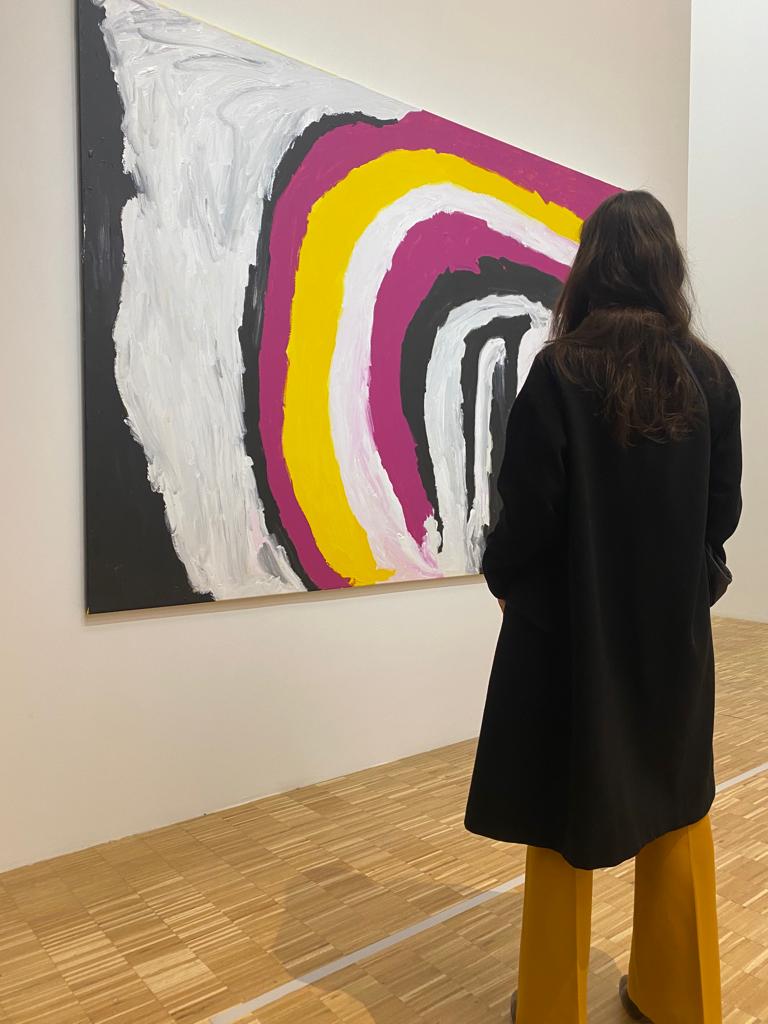
Never too late to start
Sally Gabori exhibition – Triennale Milano – Fondation Cartier pour l’art contemporain

Considered one of the greatest contemporary Australian artists of the past two decades, Sally Gabori started painting in 2005, around the age of eighty and quickly earned national and international acclaim.
Before her death in 2015, she had a few years of rare creative intensity, developing her unique work with no ties to other aesthetic currents, particularly within contemporary Aboriginal painting.
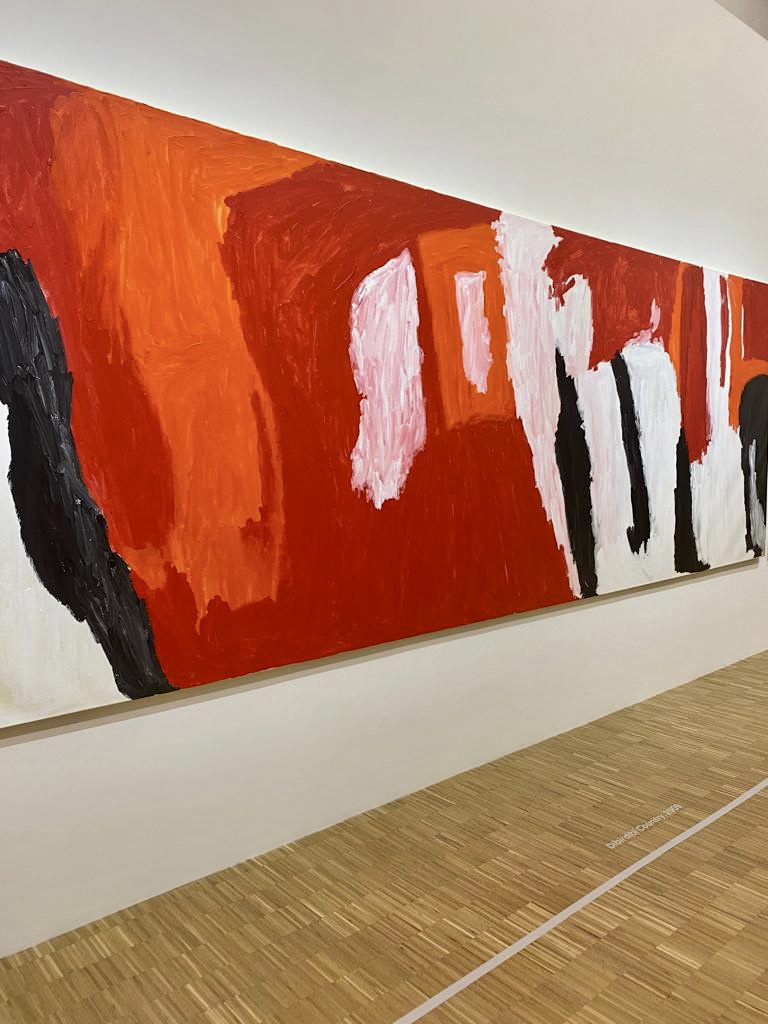
An extensive canvas, Sally Gabori painting, contemporary art
Sally Gabori exhibition – Triennale Milano – Fondation Cartier pour l’art contemporain

Sally Gabori’s story

Gabori was born in 1924 on Bentick Island, in the Gulf of Carpentaria, off the northern coast of Australia. She was a Kaiadilt woman who spoke the Kayardilt language. Her name, Mirdidngkingathi Juwaranda, comes from the Kaiadilt tradition by which people take their name from their birthplace. Therefore, her name indicates she was born at Mirdidingki, a small creek south of Bentinck, and her “totem animal” is “juwarnda”, or dolphin.

The Kaiadilt, a population of 125 in 1944, were the last Aboriginal people of coastal Australia to establish lasting ties with Europeans. They had a traditional lifestyle relying on their island’s natural resources.

In 1940, Presbyterian missionaries settled on Mornington Island and tried unsuccessfully to convince the Kaiadilt to join their mission. But in 1948, a hurricane flooded and contaminated their land. So, the Presbyterian led the 63 survivors, including Gabori and her family, to their mission. Once in Mornington, they housed the Kaiadilt in camps on the beach, and the children, separated from their parents, in dormitories inside the mission. Also, they’ve forbidden kids from speaking their mother tongue, detaching them from their culture.

Sally Gabori paintings, contemporary art
Sally Gabori exhibition – Triennale Milano – Fondation Cartier pour l’art contemporain

The revelation at 80 years old


Around the age of eighty, Gabori visited the Mornington Art Center for the first time, and the contact with painting was a revelation. Indeed, she went there whenever she could, even painting several canvases per day. Six months after her revelation, she had her first solo exhibition.

She left more than 2.000 canvases. Her paintings celebrate different places of her native island, which she had not visited for many years. Indeed, they have deep meaning for herself, her family, and her people.

In 2013, Gabori was invited to present her work at the 55th Venice Art Exhibition. And at the Royal Academy of Arts in London.
In 2022, the “Fondation Cartier pour l’art contemporain” in Paris presented the first extensive exhibition of Sally Gabori’s work in Europe.

Bright and bold colours on large size-canvases, absolute formal freedom and boundless imagination. Impossible not to feel deep emotions. Stunning! A must-see if you are in Milan until May 14th.

An exhibition and a life lesson: whatever you want to do, it’s never too late to start!

Never Too Late To Start Read More »

What Is Sustainability? A Comprehensive Definition by Vito Mancuso

Reading Time: 2 minutes

Exploring ethics, nature and accountability


What is sustainability? Think about an all-embracing definition, a few words we can extend to any field. To our whole life, indeed. In our search for a more sustainable lifestyle, Prof. Vito Mancuso offered some food for thought.

In a tv show called “Quante storie”, a must-see programme which is all about books, Prof. Vito Mancuso, a theologist and philosopher, introduced his latest essay titled “Etica per i giorni difficili” (Ethics for difficult days).

Addressing the need for shared ethics, he gave some guidance on the importance of preserving nature. Precisely, he said: “Custodire la natura è un’ assunzione di responsabilità.”

Literally:

“Preserving nature is an assumption of responsibility.”

Vito Mancuso

We believe we can extend this definition into the discussion on sustainable matters. Likewise, we can assert: “Sustainability is an assumption of responsibility.” Put more simply, “Sustainability is about taking responsibility.”

And taking responsibility means, in other words, holding ourselves accountable.

However, holding ourselves accountable goes beyond economics, marketing, or personal power. In fact, it’s about ethics.
And so, from a marketing perspective, can we agree to associate the word sustainable with big corporations? From the perspective of profit, can we allow well-known brands to sponsor sustainable events? Or set up sustainable fashion shows with the same rule as non-sustainable ones?

On an ethical level, we cannot agree.

From an ethical perspective, taking money from big corporations won’t lead to real change. But holding ourselves accountable doesn’t mean being perfect in our effort to make a change. It means taking seriously the choice we made and being consistent with it. Fundamentally, it means changing the way we operate, and being very careful who we partner with.

Mainstream sustainability vs ethics


So, what is the mainstream sustainability movement proposing? Green capitalism as the enlightened path. Specifically, it encourages us to shift towards an eco-green-sustainable model while continuing to consume as much as we did so far.

Of course, it won’t work. Either they are missing the point, or ethics isn’t their concern–nor is sustainability.

What Is Sustainability? A Comprehensive Definition by Vito Mancuso Read More »

Fashion, Politics, and Dante Alighieri

Reading Time: 2 minutes

Why bother the Tuscan poet?


From fashion to politics, Dante Alighieri has become a recurrent name in the news. Sadly, people like to speak out of turn to make an impression. However, their remarks often have the opposite effect, making them appear absurd.

Dante on the Italian scene: sad but true


Not a piece of fake news, so please take a deep breath if you didn’t already know it. Recently, Gennaro Sangiuliano, Italy’s culture minister, claimed that the poet Dante Alighieri was the founder of right-wing thinking. Of course, this statement caused a great stir leaving many people perplexed. However, understanding why contemporary politicians look like caricatures more than real leaders would be really interesting. But that needs a deep reflection we will not tackle here.

Dante Alighieri & the Paris Haute Couture


Yesterday, Daniel Roseberry for Schiapparelli opened the Haute Couture week in Paris. And for the maison, the creative director sent on the runway a show inspired by the Inferno by Dante Alighieri. Specifically, he focused on the three fairs the poet encounters in the forest dark: the leopard, the lion and the she-wolf.

Cultured reference or not, animal trophies embroidered onto evening gowns were a horrible concept. Even more considering that those animals are in danger of extinction. Furthermore, models no longer in their youth had the face skin smooth as a child’s butt.

Bad taste dominated the show. Most of all, it is unclear what kind of women the fashion industry wants to appeal to.

Ignoring the Italian culture minister’s statement made sense—it’s best to avoid highlighting stupidity. But now Dante is back, making headlines again—this time, from Paris Haute Couture week!

Understandably, we are living in an unprecedented time of disruption and change. But why bother Dante? From fashion to politics, they force out-of-context cultural references. The only plausible explanation is that they want to impress but have nothing meaningful to say.

Fashion, Politics, and Dante Alighieri Read More »

Davos Forum: Permacrisis and Private Jets

Reading Time: 2 minutes

World leaders, the luxury bubble that rules the world


These days, the planetary elite is gathering in Davos. And try to guess how they reach the World Economic Forum? On a private jet, of course! How would one address cliamte change if not from a private jet? It’s almost poetic, isn’t it? The same people who claim to have the solutions to the planet’s problems are the ones most disconnected from the realities of the world they seek to fix.

Davos Forum: what is it?


Davos is a town located in the Switzerland Alps where, in January, the World Economic Forum takes place. Started in 1971, WEF is a Switzerland non-profit that holds a five-day conference annually. The delegates include political leaders and representatives from international companies, pharmaceuticals, tech, banks and academics.

Every year the leaders tackle a different topic. This year’s theme is: “Cooperation in a fragmented world.”
Since Europe is facing a persistent state of hardship, going from crisis to crisis, we entered the era of “permacrisis.” And there seems to be no end to this challenging time. Other than economics, leaders will touch on environmental and social issues too.

Greenpeace & Davos


Greenpeace published an analysis conducted by the Dutch CE Delft checking the CO2 emissions from the private flights to the Davos Forum:

“The analysis shows a substantial increase in private jet flights to and from Davos airports and an even more sizable increase in CO2 emissions during the week of the World Economic Forum 2022, compared to an average week. The number of private jet flights doubles and private jet emissions quadruple during the week of the World Economic Forum compared to an average week.”

About every second flight is attributed to the meeting. But, the distance travelled is striking:
53% of all private jet flights were short-haul flights under 750 km. 38% were ultra short flights (below 500 km) that could have easily been train or car trips. More than 6% of all private jet flights flew less than 100 km. The shortest flight recorded was 21 km.

Read the full report here.

Clearly, these leaders live in a luxury bubble. In order to address issuses like the economy, the climate emergency and social injustice, they fly on private jets and stay in five-star hotels. Yet, they suggest a radical change in technology and sustainability. In short, they suggest solutions while simultaneously exacerbate the problems. Absurd, isn’t it?

Of course, the idea that leaders travel on private jets to address pollution—while contributing more CO2—might make us laugh. Unfortunately, the climate emergency is here to stay, and there’s nothing to laugh about.

Davos Forum: Permacrisis and Private Jets Read More »

Patti Smith & “The infinite”

Reading Time: 3 minutes

How to make sense of our world and recharge our spirit


Art helps us make sense of the world. It is beauty, in essence. So, we seek it in all forms. Patti Smith & “The Infinite” is one of those forms.

You know life is unpredictable. You make your plans, but life has plans of its own. And so, because of covid, on the 1st of August, we had to miss Patti Smith’s concert in Milano. 

Her music and poetry are a powerful blend, and we’re certain her performance would have been a true balm for our souls.

Also, we really appreciate how she redefined the role of female representation in rock music. Her androgynous outfits have been a major source of inspiration in fashion—think mannish white shirts, blazers, loose neckties. Never traditionally ‘pretty,’ but effortlessly cool. Her style is so iconic that she’s crafted an entirely unique aesthetic.

By the way, as a tribute to Italy during her performances in Pompeii, Rome, and Milan, Patti Smith recited Giacomo Leopardi’s poem The Infinite.

Patti Smith reading Giacomo Leopardi


This is the poem in Italian, but you can listen to the English version directly from Patti Smith’s voice – here

L’infinito

«Sempre caro mi fu quest’ermo colle,
e questa siepe, che da tanta parte
dell’ultimo orizzonte il guardo esclude.
Ma sedendo e mirando, interminati
spazi di là da quella, e sovrumani
silenzi, e profondissima quiete
io nel pensier mi fingo, ove per poco
il cor non si spaura. E come il vento
odo stormir tra queste piante, io quello
infinito silenzio a questa voce
vo comparando: e mi sovvien l’eterno,
e le morte stagioni, e la presente
e viva, e il suon di lei. Così tra questa
immensità s’annega il pensier mio:
e il naufragar m’è dolce in questo mare.»


L’infinito by Giacomo Leopardi is a famous Italian poem that explores themes of nature, the infinite, and the human condition. The speaker reflects on the vastness of the universe, feeling both awe and sorrow as they contemplate the boundless horizon and the limits of human experience. Through this reflection, the poem touches on the tension between the beauty of the natural world and the inevitable sense of insignificance that comes with it.

The sense of insignificance in L’infinito is related to the human condition—specifically, the limitations of human life and understanding when compared to the vastness of nature and the universe. Leopardi reflects on how small and fleeting human existence can feel in the face of infinity. While the natural world appears endless and eternal, human life is limited, creating a poignant contrast between the beauty of nature and the finiteness of human experience.

Art, music, and poetry reflect a certain mindset and a unqiue style. Most importantly, they bring the beauty we need to make sense of our world and offer the peace of mind that helps us navigate life.

In the end, art, music, and poetry are embodiments of beauty—beauty that heals our souls.

We’re so sorry we couldn’t attend Patti Smith’s concert, but we hope L’infinito will recharge your spirit!

Patti Smith & “The infinite” Read More »