Why imagining a different society is the first step towards changing it
There are few figures whose presence commands such profound respect and intellectual curiosity as Angela Davis. Last week, we had the immense privilege of attending an event with the legendary philosopher, activist, and scholar at Fondazione Prada in Milan. In conversation with Italian writer Claudia Durastanti (who wrote the preface to Abolizionismo. Femminismo. Adesso. (2023), a collective volume co-authored by Davis), Davis explored the central tenets of her thought, offering a powerful critique of our current global landscape and, crucially, a vision for a better future.
The Cinema Godard was packed. In the front row sat Miuccia Prada, along with philosopher, feminist, and posthuman thinker Rosi Braidotti, and Gina Dent, professor of Humanities and faculty director of the Institute of the Arts and Sciences at UC Santa Cruz. Their presence reflected the intellectual and cultural significance of the encounter.
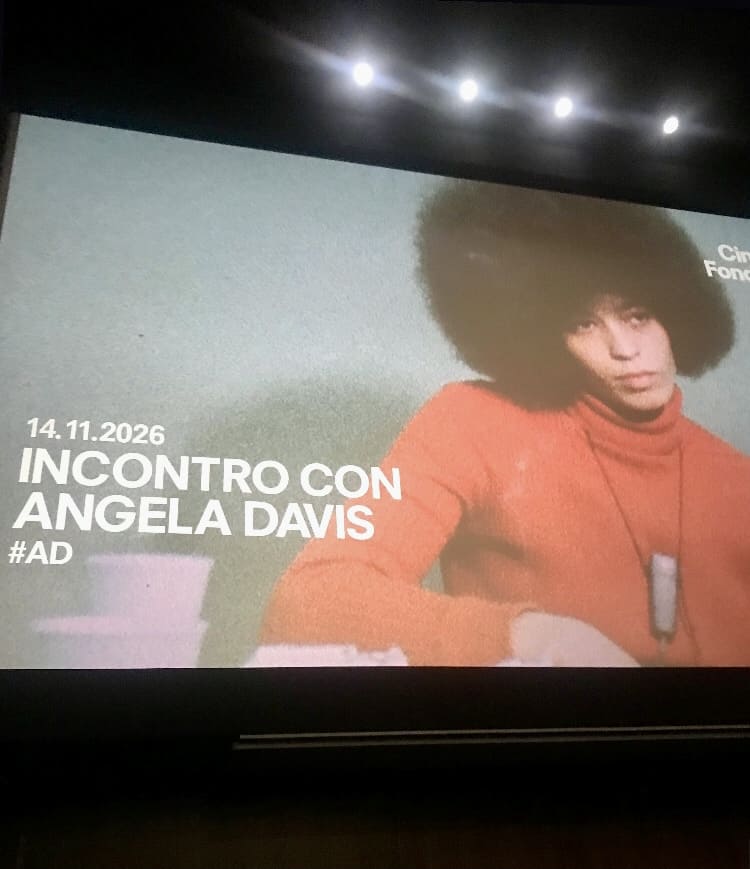
For over sixty years, Davis’s work has been foundational to anti-racist, feminist, and abolitionist movements. Her discussion in Milan, taking the fraught political climate of the US and Europe as its starting point, was a masterclass in connecting the dots between seemingly disparate struggles.
From racial and gender inequality to the carceral state and the climate crisis, Angela Davis articulated a single, unifying thread: capitalism.
Beyond prisons: rethinking security and price justice
Davis’s critique of the prison system is unwavering. She describes the prison, an institution that developed alongside bourgeois democracy, as fundamentally functional to that very system — a shortcut rather than a solution to social problems.
Her words challenge some of our most deeply ingrained assumptions: public order is defined by racism, just as the prison system is.
This leads to a fundamental question: how can we ask for protection and security from armed men who wield such enormous discretionary power? For Davis, the answer lies not in reform, but in abolition. She invites us to imagine a radically different world: to create a world without police, where people do not compete with each other to survive, where there are no hierarchies for having a home, where there is equal access to schools that truly help children discover their desires, what they want to be and how they want to be in the world.
This vision extends to her analysis of sexual violence. Angela Davis argues, contrary to popular belief, that sending rapists to a violent institution like prison — where sexual violence is encouraged — does not solve the problem. It merely perpetuates a cycle of violence, outsourcing society’s responsibility to a system that dehumanises all it touches.
Responding to one form of violence through another institution that perpetuates it does little to address the conditions that allow violence to exist in the first place. Abolition, in this sense, is not simply about dismantling institutions. It is about creating the social conditions in which they are no longer seen as necessary.
An intersectional, anti-capitalist feminism
Davis was equally clear on the necessary scope of feminism. Her stance is a powerful rejection of any watered-down version of the movement: white feminism is not feminism. If feminism is not anti-racist and anti-capitalist, it is not feminism. This is not merely about diversity and inclusion; it is a call for justice. As she so aptly put it, “When it comes to diversity and inclusion, why don’t we talk about justice?” Not inclusion but justice.
The distinction is important. Inclusion, on its own, does not necessarily challenge the structures that produce exclusion in the first place. Justice requires confronting those structures and understanding how different forms of oppression are interconnected.
There is a common thread connecting racism, colonialism, gender inequalities, struggles for social justice and the climate crisis: capitalism. These are not isolated problems, but expressions of a system whose inequalities extend across societies, economies and the environment.
Davis’s perspective invites us to look beyond individual issues and consider the broader structures that sustain them. It is also a reminder that struggles for racial, gender and environmental justice cannot be separated from one another.
The power of writing and memory
The conversation also turned to more personal matters, including the role of autobiography, memory and friendship as instruments of emancipation.
Recalling the writing of her own autobiography at just 28, Davis reflected wryly: “Who writes an autobiography at 28?” The book was edited by Toni Morrison, who trusted her to tell a story with a strong political context. As Davis recalled, Morrison knew she wasn’t going to write about gossip or who she had gone to bed with. It was going to be a different kind of story.
The anecdote reveals something important about the relationship between personal experience and political consciousness. Autobiography can become more than an account of an individual life: it can preserve collective memory, give historical context to personal experience and open up new ways of understanding the present.
An optimist’s vision
The event ran considerably longer than anticipated, and the organisers eventually had to skip the Q&A. Only one student from the Black community had the opportunity to speak, expressing frustration that the conversation was taking place at the same time as another event on racism in Milan. Despite the immense challenges she outlines, Angela Davis remains a steadfast optimist. She acknowledged the unfortunate coincidence but responded with characteristic optimism: rather than seeing the two events as competing, she saw something encouraging in the fact that two conversations about racism were taking place in Milan on the same day.
It was a small but revealing moment. Her optimism does not come from overlooking the difficulties, but from recognising the possibility of collective action even in the most challenging circumstances.
One of her observations stayed with us: we are the ones who set the rhythm of history. They are the counter-revolutionaries.
It is a powerful reminder that history is not simply something that happens to us. We participate in shaping its direction, and the future is not predetermined.
Amid all that is going on, her message is one of relentless hope and radical imagination. Imagining a different world is not an exercise in idealism, but a political act. A more just society will not emerge simply by reforming the structures we have inherited. It also requires the courage to question them, to imagine alternatives and to work towards making them possible.
Perhaps the most important lesson from this conversation is that the world as it is does not represent the limits of what is possible. We can, and must, bring our vision for a better world into being.

P.S.: We left the venue alongside Angela Davis, which allowed us to ask her to sign a vintage copy of one of her books. Ro immediately grabbed a pen and squiggled something on the page to see if it worked. We then handed Davis both the book and the pen. She signed — but the pen kept skipping. “I guess you can see it,” she said. And so, imperfect as it is, this will be our tangible memory of the encounter.