Beyond the spectacle: when clothes speak for themselves
Tailoring meets sportswear — that’s the central tension in Ujoh’s Spring-Summer collection, shown at Paris Fashion Week. It was also a recurring trend across the season, from Milan to Paris. For us, though, it isn’t just a trend. It’s a styling classic.
Ujoh’s design codes are unmistakable: clean lines, precise tailoring. Asymmetrical structure and bold cuts. Distinctive layering; form and function in seamless balance. The result is a modern elegance that never needs to shout.
The same restraint defines the brand’s philosophy: no loud logos, just good design and excellent quality. Most pieces don’t change completely every season. Ujoh builds on an established vocabulary, creating continuity, timelessness — a wardrobe that doesn’t expire. That consistency is what keeps their universe culturally relevant.
In a market saturated with novelty, that consistency feels rare. The industry demands new drops, new stories, new noise. Ujoh quietly rejects that logic.
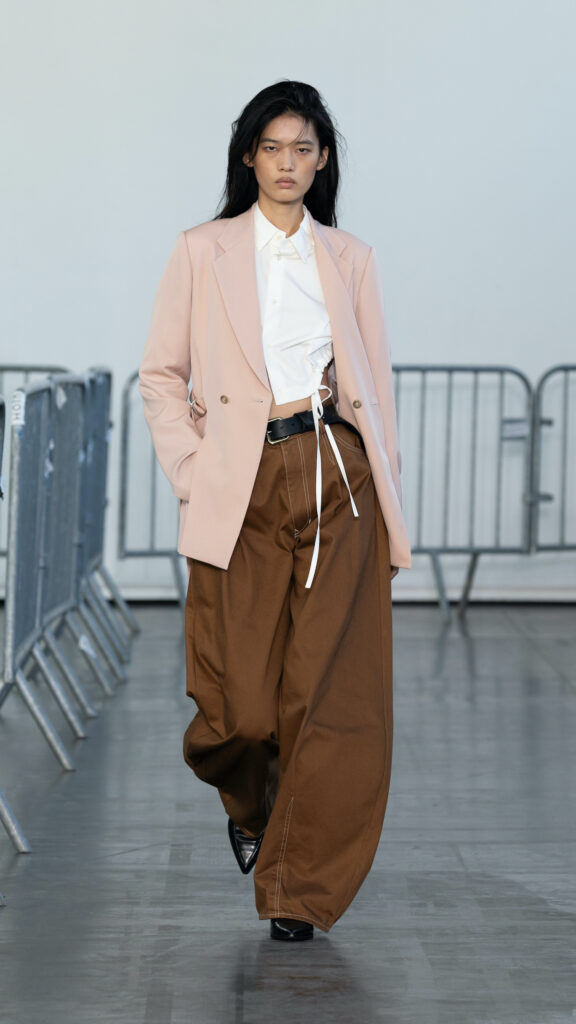
This season, the brand explores what happens when established categories begin to dissolve.
Tailoring meets sportswear, casualwear and workwear. Garments shift purpose and acquire new identities. A single piece can function as a shirt from the back and a jacket from the front. Denim breaks free from familiar constructions through asymmetry and cut-outs, while generous, balloon-like trousers and jackets that balance heritage with freedom of movement challenge conventional silhouettes.
Ujoh SS27: Tailoring meets sportswear on the Paris runway
The collection also looks to traditional Japanese craftsmanship. As the brand’s press release describes, flowers are hand-painted in Kyoto directly onto long rolls of fabric through a painstaking process that takes nearly a week. Techniques traditionally associated with kimono fabrics find a new expression in a contemporary wardrobe. The past isn’t discarded; it becomes part of something new.
And that’s where it all converges: the formal and the everyday, tradition and experimentation, structure and movement. Nothing needs to be confined to a single category or occasion.
Versatility isn’t a compromise between style and practicality; it’s a design value in its own right. A garment that moves between formal and casual, changes character through layering, or adapts to different occasions offers more than functionality: it invites us to experiment, combine and make it our own.
For us, this is what makes Ujoh compelling. We believe in garments that are distinctive without being difficult to wear. And in meaningful pieces that can be combined, reinterpreted and adapted to different moments. Clothes that leave room for the wearer to make them their own.
This is the new luxury: identity and values.
Because the best-designed clothes don’t dictate how we should wear them. They give us more ways to express who we are.