Fashion still has one problem legislators chose not to solve: overproduction
The EU ban on unsold stock destruction has now come into force.
Under the Ecodesign for Sustainable Products Regulation (ESPR), large companies are no longer allowed to destroy unsold clothing, clothing accessories and footwear. The measure aims to reduce textile waste and encourage more circular ways of managing excess inventory.
Instead of destroying unsold products, companies are encouraged to improve stock management and explore alternatives such as resale, donations, remanufacturing and reuse.
The ban applies to large companies from 19 July 2026, while medium-sized companies will have to comply from 2030. Destruction remains possible only in specific, justified circumstances, including safety risks, irreparable product damage and counterfeit goods.
Related post: Destruction of unsold textiles: a historic ban… with many loopholes
There is no doubt that preventing perfectly usable garments from being destroyed is a positive step. Every year, between 4% and 9% of unsold textiles in Europe are destroyed before ever being worn, generating millions of tonnes of unnecessary CO₂ emissions.
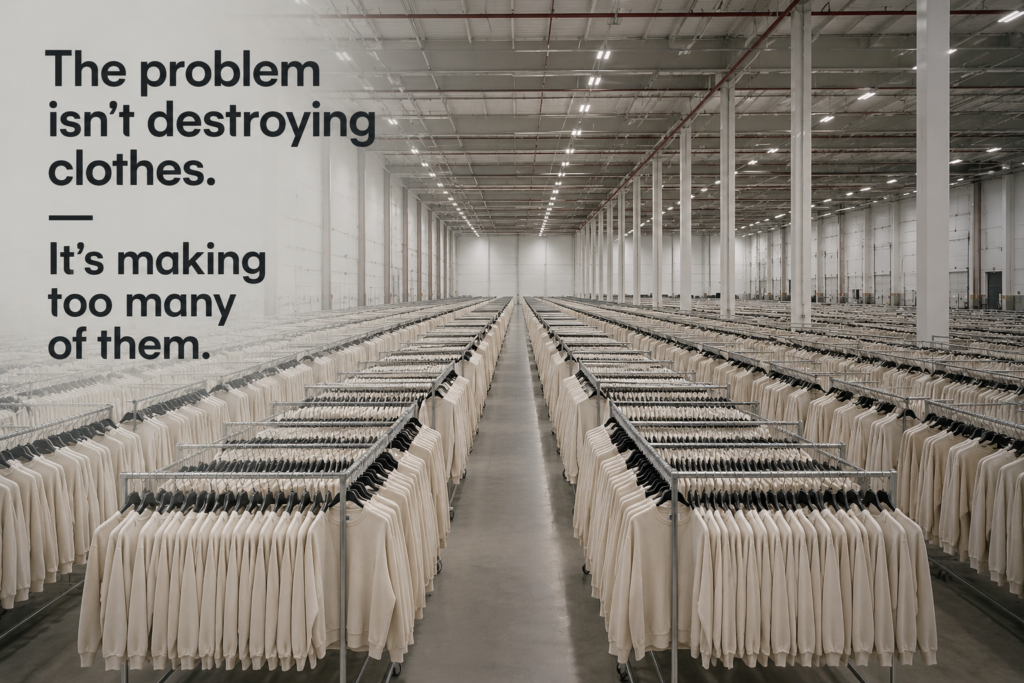
Unsold stock destruction: treating the symptom
The regulation addresses what happens after clothes remain unsold.
It does not address the question that comes before everything else:
Why are so many garments being produced that they become waste in the first place?
Overproduction remains fashion’s structural problem.
Brands continue to manufacture collections at a pace that exceeds real demand. The result is predictable: discounting, returns, excess inventory and, ultimately, disposal.
Better inventory management can reduce some waste, but it does not challenge the production model itself. As long as brands continue to rely on high volumes and constant product turnover, unsold stock will remain an inevitable consequence.
The problem is amplified by online retail, where high return rates create another layer of excess stock. Returned garments may be difficult or too costly to inspect, repair and resell, pushing companies towards disposal or lower-value solutions.
This is why the issue is not only what happens to unwanted garments at the end of their journey. It is also how many garments enter the market in the first place — and whether the fashion system is designed around genuine demand or around continuous growth.
If too many garments continue to be produced, banning their destruction changes what happens at the end of the process, but not the business model that creates the surplus.
The risk of shifting the problem
The regulation also includes exemptions, allowing destruction in justified cases such as safety concerns, damaged products or counterfeit goods.
It also requires companies to disclose the volumes of unsold goods they discard, improving transparency.
These are important safeguards, but they do not eliminate every risk.
Unsold products can still be exported, downcycled into low-value materials or redirected into opaque secondary markets. Preventing destruction is easier than preventing waste from simply changing form.
Final thoughts
The ban on unsold stock destruction is an important environmental measure. Destroying perfectly usable clothing has long been one of the fashion industry’s most indefensible practices, and banning it is long overdue.
Yet the regulation addresses what happens after overproduction has already occurred. It manages the surplus, but not the system that creates it.
The fashion industry’s environmental crisis does not begin with burning garments or disposing of unsold stock. It begins much earlier, with a business model that rewards ever-increasing production volumes, encourages rapid product turnover, and ultimately generates more clothing than the market can absorb.
In this context, the ban treats one of the industry’s most visible symptoms rather than its underlying cause. It may achieve exactly what it was designed to do, but what it was designed to do is too limited to tackle fashion’s structural environmental problem.
A truly sustainable fashion policy would also ask a more fundamental question: how much clothing do we actually need? That is where concepts such as sufficiency and degrowth become relevant — not because they advocate stopping the production of clothing, but because they challenge the assumption that producing more is always compatible with sustainability.
Until overproduction becomes part of the political conversation, Europe will continue making fashion less wasteful without necessarily making it sustainable.